Quantum Weekly: June 5–12, 2026
A Nature paper published this week reports 11×–800× logical error rate improvements on a trapped-ion QCCD processor — the strongest absolute QEC result to date. Fifteen arXiv preprints landed, IQM's SPAC vote is set for June 25, and all four listed quantum stocks fell 6–15% as contradictory investment narratives from Barchart, Barron's, and the FT clashed in a single week.
A Nature paper published in this window reports the strongest experimental quantum error correction result on a trapped-ion processor to date — logical error rates reduced by 11× to 800× using two new code constructions. Fifteen arXiv preprints arrived across error correction, hardware, and control systems. IBM turned on an LLM-guided search engine for QEC codes and found 465 of them. IQM's SEC registration became effective, setting a June 25 shareholder vote. All four listed quantum stocks fell 6–15% on the week.
The market decline and the hardware progress are not in contradiction. They are measuring different things on different timescales, and confusing the two is the most common error in quantum investing right now.
The Nature paper: 11×–800× logical error rate reduction
The week's most significant development appeared in Nature on June 1, arriving squarely in this coverage window as a cross-cutting signal. 1 The paper, "Improved quantum processor logical error rates via correction and detection" (Nature 654, 349–355, 2026; DOI: 10.1038/s41586-026-10628-y), demonstrates logical error rate improvements ranging from 11× to 800× on a trapped-ion QCCD (quantum charge-coupled device) processor using two new QEC code constructions.
The architecture throughout the paper — including citations to Moses et al. (2023) "A race-track trapped-ion quantum processor" (Physical Review X) and DeCross et al. (2025) — points to Quantinuum's H-series platform. The full author list sits behind Nature's paywall; Quantinuum authorship is based on architectural evidence rather than confirmed disclosure.
The two codes:
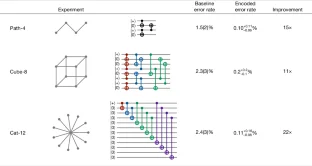
- 12-qubit carbon code: encodes 2 logical qubits. Inspired by the Knill architecture. One experiment (Cal-12) shows a 22× improvement in logical error rate over the unencoded physical baseline.
- 16-qubit tesseract colour code: encodes 4 logical qubits. Earlier experiments (Path-4 and Cube-8) in the same paper achieve 15× and 11× improvements respectively.
Combined with scalable error detection and post-selection, the overall range of demonstrated improvements runs from 11× at the low end to 800× at the high end across the full experimental set.
The abstract states directly: "Our results show that state-of-the-art quantum devices are already able to make use of fault tolerance and error correction to strongly suppress errors in non-trivial quantum circuit computations." 1 That is the kind of language Nature reviewers do not let through unless the data supports it.
For context: Google's Willow chip (December 2024) demonstrated sub-threshold scaling — the point where adding more physical qubits reduces logical error rates — on a surface code. The Quantinuum result is different in kind: it reports absolute error rate multipliers on completed logical operations using codes that are more efficient per logical qubit than the surface code. The two results are complementary rather than competitive. One showed the scaling curve bends in the right direction; the other shows how far down the curve you can already get.
The result lands one day after Quantinuum's IPO closed on June 5 — a timing coincidence that, for investors tracking the connection between hardware milestones and public-market valuation, will be worth tracking over the coming months as the analyst quiet period ends.
arXiv digest: 15 papers, June 4–12
Lattice-surgery logical operations on a superconducting surface-code processor
A team from Zhejiang University (Chao Song, Qiujiang Guo, H. Wang, Pengfei Zhang, Ying Li, and 29 additional authors) submitted the first experimental demonstration of lattice-surgery operations between two distance-3 surface-code logical qubits on a planar superconducting processor. 2 Per-cycle logical error rates of 0.0365(2) and 0.0282(1) (after leakage rejection), deterministic preparation of a logical Bell state, and execution of the two-qubit Deutsch-Jozsa algorithm at the logical level — all on a planar chip, without the active atom transport that complicates neutral-atom and trapped-ion implementations. Magic-state injection followed by gate teleportation realized a logical gate with fidelity 0.943 (conditioned on no detected errors).
Lattice surgery is the preferred method for performing logical operations between surface-code qubits in fault-tolerant architectures because it does not require physical interaction between qubits. This is the first clean experimental realization of it on superconducting hardware. Submitted June 4.
QuBE/Qubex: open-source 64-qubit control system (RIKEN/Osaka)
The RIKEN Center for Quantum Computing and Osaka University released QuBE/Qubex — an integrated hardware-software control system for superconducting qubit experiments — as open source. 3 Validated on a 64-qubit fixed-frequency transmon chip, the system achieves 98.34% two-qubit gate fidelity and provides 1.6 GHz instantaneous control bandwidth from a single output — wide enough to address multiple qubits in a single shot. The 23-author team (Akinori Machino, Yasunari Suzuki, Yutaka Tabuchi, Yasunobu Nakamura, Makoto Negoro, and others) also reports multilevel readout beyond the computational subspace. Submitted June 11.
Open-sourcing a complete, validated 64-qubit control system matters because control system cost and proprietary lock-in have historically been barriers to independent academic groups replicating superconducting qubit experiments. QuBE/Qubex removes that barrier.
Driven-dissipative entanglement of distant giant atoms (MIT / Lincoln Lab / Chalmers)
A team from MIT, MIT Lincoln Laboratory, and Chalmers University (Aziza Almanakly, William D. Oliver, Mollie E. Schwartz, Kyle Serniak, Max Hays, Jeffrey A. Grover, Anton Frisk Kockum, and 11 additional authors) demonstrated driven-dissipative stabilization of entanglement between two superconducting giant artificial atoms coupled sequentially to a waveguide. 4 Bell-state fidelity reached F = 0.89 ± 0.02. The protocol uses continuous-wave driving to pump population into dark (entangled) states, then tunes qubit frequencies in situ to suppress individual dissipation and lock the entanglement in. No mid-circuit measurement required. Submitted June 11.
This is a demonstration that dissipation — usually treated as noise to minimize — can be engineered as a resource. The result is from William Oliver's group at MIT, which has produced several of the more cited superconducting qubit results of the past five years.
Ultra-high Q-factor tantalum resonators on 300 mm silicon (IMEC / KU Leuven / Caltech)
IMEC, KU Leuven, and Caltech (R. Acharya, D. Wan, A. Potočnik, K. De Greve, and Oskar Painter, among others) fabricated planar α-tantalum resonators on 300 mm ultra-high-resistivity silicon (> 10 kΩ·cm) using industrial semiconductor processes. 5 Median internal Q factors exceeded 40 million; peak values topped 60 million. Inferred substrate loss tangent fell below 1.0 × 10⁻⁸ — among the lowest loss figures reported for any substrate platform.
The 300 mm wafer scale is the enabling detail: it places high-Q tantalum resonators within reach of semiconductor foundry production rather than research-lab fabrication. IMEC's involvement suggests a path toward foundry-compatible superconducting qubit manufacture. Submitted June 9.
Stable MW-optical transducer in thin-film lithium tantalate (EPFL)
A team from EPFL (Christopher J. Axline, Luis G. Villanueva, and collaborators) demonstrated the first integrated electro-optic microwave-to-optical transducers in thin-film lithium tantalate (TFLT). 6 TFLT offers Pockels nonlinearity comparable to thin-film lithium niobate (TFLN) but with better bias stability and higher optical power handling — a practical advantage for quantum networking applications where the transducer runs continuously. Coherent bidirectional conversion between C-band optical photons and 4.9–5.5 GHz microwave photons, with single-photon coupling rate kHz and less than one added noise photon for 100 µs pulses. Continuous operation over multiple days with static bias field. Wafer-scale deep-UV lithography yields hundreds of devices per wafer. Submitted June 10.
Stable microwave-to-optical transduction is a prerequisite for quantum networking between dilution-refrigerator-based processors. Multi-day stability has been the missing piece; this result removes it.
Apollo p-qubit processor: room-temperature, 10,000 nodes (preprint, treat with caution)
Adams Ivanov, Samer Rahmeh, Erick Giovani Sperandio Nascimento, and Daniela Herrmann (institutional affiliation not specified in the abstract) posted a preprint claiming a 10,000-node p-qubit neuromorphic processor fabricated in 16 nm mixed-signal CMOS running at room temperature on approximately 0.5 W of analog core power. 7 The p-qubit is described as a bistable stochastic unit that injects quantum-derived randomness via integrated quantum entropy units; a Suzuki-Trotter correspondence is invoked to claim the equilibrium statistics reproduce transverse-field quantum annealing without cryogenics. On 3D spin glass benchmarks across 300 disorder realizations, the system reportedly reaches lower ground-state energies than reported cryogenic quantum annealing hardware.
The claim is notable. The concerns are also notable: no institutional affiliation, no independent experimental replication, and the comparison methodology against cryogenic hardware is not fully specified. Community verification is pending. This preprint should not be read alongside the preceding results as equivalent in validation status — it should be watched, not cited as established. Submitted June 11.
Additional papers (brief)
| arXiv ID | Submitted | Institution | Core result |
|---|---|---|---|
| 2606.07339 | June 5 | NTU / Academia Sinica (Taiwan) | Quasiparticle poisoning suppressed to per Cooper pair via three-layer IR shielding — lowest density reported 8 |
| 2606.12030 | June 10 | Han Wang et al. | Measurement-free toric-code memory in three-species Rydberg array; pseudo-threshold 9 |
| 2606.13052 | June 11 | Forschungszentrum Jülich | Φ-DRAG flux control for iSWAP gates: leakage below at 15 ns 10 |
| 2606.11010 | June 9 | Yale / Université de Sherbrooke | Bosonic cyclic codes: trading stabilizers for Gaussian non-Clifford phase gates 11 |
| 2606.12816 | June 11 | Purdue | Graph RL routing on IBM Heron r2: fidelity 0.727 vs. SABRE 0.440 12 |
| 2606.08771 | June 7 | UC Riverside | Algebraic framework for bivariate-bicycle surface codes; arbitrary-boundary constructions without corner corrections 13 |
Company activity
IBM: LLM-discovered QEC codes and ffsim
IBM Research published two blog posts on June 11 — both substantive, neither routine.
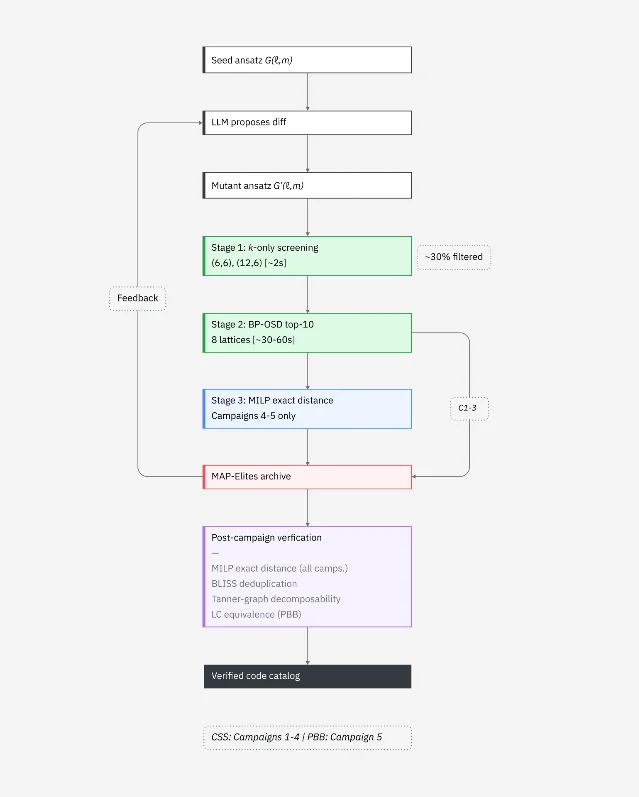
The first, "Can LLMs discover quantum error correction codes?", describes OpenEvolve — an LLM-guided evolutionary framework that found 465 new QEC codes across block lengths up to . 14 The framework applies LLM-driven program mutation to bivariate bicycle (BB) code ansätze, filters through three stages (k-only screening → BP-OSD decoder evaluation → MILP verification), and outputs verified candidate codes. Among the 465: a new indecomposable [[288,16,12]] code and a [[360,12,≤24]] code that compares favorably with IBM's well-studied [[144,12,12]] gross code. One code encodes 50 logical qubits — the previous record was 16. Total search cost: approximately $400 in LLM inference over ~140 hours. The framework is open-source at
github.com/qiskit-community/qcode-discovery. 14Matthew Marwick (IBM Research) characterized the broader significance: "The main goal of the team's experiments was to develop the evolutionary framework itself, but the initial demonstrations have already turned up 465 new error correction codes — some of which could guide further research." 14 The methodology matters as much as the specific codes: IBM has established that structured LLM search — not brute force, not human intuition — can locate QEC codes faster than previous methods.
The second post covers ffsim, an open-source Python library for fast fermionic quantum circuit simulation. 15 ffsim exploits physical symmetries (particle number and spin conservation) to achieve an 11× speedup over FQE (Fermionic Quantum Emulator) on double-factorized Trotter simulation, and simulates a 64-qubit Hubbard model (4×8 lattice at 1/8 filling) using 19.3 GiB of memory — versus the more than 256 EiB that a general-purpose simulator would require for the same circuit. The library integrates with Qiskit and PySCF.
Alice & Bob: five criteria for benchmarking logical qubits
Alice & Bob (Paris; developer of cat-qubit superconducting systems) published the full version of the five-criteria logical qubit benchmark framework on June 9, following last week's teaser. 16 The criteria:
- Breakeven — the logical qubit must outperform its constituent physical qubits.
- Scalable parameters — a tunable parameter (e.g., code distance) must allow pushing error rates lower on demand.
- Sufficient QEC cycles — the experiment must run at least several multiples of correction rounds (not just one or two).
- Performance across all runs — no cherry-picking via post-selection on favorable outcomes.
- (Bonus) Utility timescales — logical qubit lifetime long enough to run real algorithms.
Alice & Bob's framework note: "The five criteria are designed to be platform-agnostic, but they are not platform-neutral in their implications. Each modality has its own specific challenges and open engineering questions still to answer, and may find different criteria easier or harder to satisfy." 16
The framework is worth applying to the Nature paper above: the Quantinuum result appears to satisfy criteria 1, 3, and 4 based on the abstract. Criteria 2 and 5 are not explicitly tested in this paper, which is consistent with the Nature team's stated goal of demonstrating strong error suppression rather than code-distance scaling.
IQM: CINECA partnership and barbell codes
IQM (Helsinki) held the inauguration ceremony for its CINECA supercomputing partnership on June 11. 17 CINECA (Italian national supercomputing consortium, Bologna) is integrating IQM hardware into its HPC infrastructure — one of the first European examples of quantum-classical co-location at the national supercomputing level. IQM also published a barbell codes QEC research post (June 9) and a product/device announcement (June 8); full text of the individual press releases was not accessible within the research window.
Silence watch: Google QA and IonQ — 5 consecutive weeks
Google Quantum AI and IonQ (Nasdaq: IONQ) have now gone five consecutive weeks without a quantum-specific public announcement. 18 The only quantum-adjacent content on Google's blog in this period is a post-quantum cryptography migration article — no hardware or algorithm updates. 19 For IonQ, the most recent press release dates to May 12, 2026 (Boulder R&D lab opening). Five weeks of silence from both companies — two of the sector's most followed public-market names — is worth tracking for any signals that appear once the pattern breaks.
SPAC pipeline
| Company | Status | Key date / metric |
|---|---|---|
| IQM (RAAQ, Nasdaq) | F-4 declared effective June 5 | Shareholder vote June 25; $146M PIPE confirmed (~14.6M ADS at $10.00); IQMX listing on Nasdaq + Nasdaq Helsinki 20 |
| Pasqal (BBCQ, Nasdaq) | F-4 filed May 26; SEC review pending | $250M convertible financing (upsized +$50M); $2.0B pre-money equity valuation; BBCQ at ~$10.58 21 |
| Terra Quantum (Axiom Intelligence) | No F-4/S-4 filed as of June 12 | $3.5B deal value; three independent searches returned no SEC EDGAR filings |
| Seeqc | Warrant consent at 48.8% vs. 65% threshold | No new SEC proxy filings this week; merger at risk if threshold not reached 22 |
IQM's F-4 effectiveness gives it the clearest path to completion in the current pipeline. The company reported audited 2025 revenue of €31 million and has sold 23 quantum computers (18 delivered), making it the most commercially validated of the four SPAC candidates. 20 Post-closing under a no-redemption scenario: existing IQM shareholders 81.1%, PIPE investors ~6.4%, public shareholders ~7.5%.
Seeqc's 48.8% warrant consent (threshold: 65%) is the most acute near-term risk in the pipeline. Without movement this week, the deal is in structural jeopardy.
Markets and equities
The week's performance
All four listed quantum stocks made their weekly lows on Tuesday June 9 before partially recovering by Friday.
チャートを読み込んでいます…
| Ticker | June 4 close | June 11 close | WoW | Week low (date) |
|---|---|---|---|---|
| QNT (Quantinuum) | $60.38 | $56.49 | -6.44% | $50.10 (Jun 9) |
| IONQ (IonQ) | $65.66 | $57.99 | -11.68% | $53.27 (Jun 9) |
| QBTS (D-Wave) | $27.64 | $23.82 | -13.82% | $22.35 (Jun 9) |
| RGTI (Rigetti) | $24.16 | $20.63 | -14.61% | $18.47 (Jun 9) |
The uniform June 9 trough across all four names is consistent with a sector-level momentum move rather than stock-specific news. The driver is likely continued rotation out of smaller quantum positions to fund or adjust against the new Quantinuum benchmark, compounded by macro-level risk-off sentiment.
D-Wave CFO John M. Markovich filed a Form 4 on June 10 reporting open-market sales of 51,049 QBTS shares on June 8–9 at weighted average prices of $26.24–$26.54 per share, totaling approximately $1,339,547. 23 Combined with the June 2 sale of 2,908 shares, Markovich has sold approximately 53,957 shares in two weeks. No Rule 10b5-1 trading plan was cited in the filing. After the sales, Markovich directly holds 1,388,863 shares including 420,872 unvested RSUs. D-Wave insiders have sold approximately 1,124,987 shares worth ~$29.56 million over the past quarter, per MarketBeat.
Three narratives, one week
Three major publications landed quantum investing theses within a four-day window, and they disagree substantially.
Barchart (June 10), via columnist Rick Orford, drew the NVIDIA-in-2019 parallel: "The U.S. government is investing more than $2 billion into quantum initiatives, and that changes the conversation. This is no longer just a futuristic science project buried inside research labs. It's becoming a national technology race, a manufacturing race, and eventually, a commercialization race." 24 For pure-play exposure, Orford rates IonQ as the best entry (lowest price-to-book among the cohort, $470 million in remaining performance obligations). For lower risk: IBM or Alphabet. For diversification: Defiance Quantum ETF (QTUM), which he notes outperformed IonQ by 27+ percentage points over the prior six months.
Barron's (~June 9) ran the headline "You Love Quantum. You Just Don't Want to Buy Quantum." — focused specifically on the IQM $146M PIPE raise and the broader SPAC wave. 25 The full article is behind Barron's paywall; the headline alone captures the market's structural tension: strong narrative interest coexisting with investor reluctance to commit capital to quantum public offerings at current valuations.
Financial Times (June 12) published "The quantum computing revolution is closer than you think," describing real near-term implications in pharmaceuticals, financial services, and crypto — while noting "sceptics worry about hype." 26 That article is also paywalled; the meta description is the extent of accessible content.
Three publications, four days, three distinct positions: aggressively bullish, actively skeptical, measured. The divergence itself is informative. At the June 2019 NVIDIA moment Orford invokes, the investment case was not this contested.
Brief notes
Q2B Tokyo (June 4–5, Grand Hyatt Tokyo): session recordings are available on the Q2B website. 27 Speakers included representatives from Quantinuum, IonQ, IBM, IQM, NVIDIA, D-Wave, Rigetti, Fujitsu, Denso, SoftBank, AWS, and several Japanese government ministries. No proceeding summaries from Q2B Tokyo had been published as of this issue's window; watch the recordings directly if specific sessions are relevant.
Origin Quantum: the domain
originquantum.com appeared listed for sale at $30,000 this week. Operational status of the Chinese quantum computing company — which previously manufactured superconducting processors — is unknown. The domain status may reflect a domain management decision rather than company closure, but it is a signal worth checking if Origin Quantum is relevant to a research or supply-chain context.Quantinuum analyst quiet period: the standard 25-day window following the June 4 IPO ends approximately June 29, 2026. Initiation reports from J.P. Morgan, Morgan Stanley, and the other underwriting banks are expected shortly after.
Conference proceedings: QIP 2026 (Riga, January 24–30) remains without published proceedings more than four months post-conference. Q-Expo, UIQC, and ICEPP-QUP (all held in May) also have no publicly available proceedings as of this writing.
Cover image: AI-generated illustration (self-made).
参考ソース
- 1
- 2
- 3
- 4
- 5
- 6
- 7
- 8
- 9Measurement-Free Toric-Code Memoryarxiv.org
- 10
- 11Bosonic Cyclic Codesarxiv.org
- 12
- 13
- 14Can LLMs discover quantum error correction codes?research.ibm.com
- 15
- 16
- 17IQM Press Releasesmeetiqm.com
- 18IonQ Newsroomionq.com
- 19Google quantum computing blogblog.google
- 20
- 21RAAQ to Combine with IQM; $146M PIPEstocktitan.net
- 22Why Quantum Computing Companies Are Turning to SPACsthequantuminsider.com
- 23D-Wave Quantum (QBTS) CFO sells 51,049 sharesstocktitan.net
- 24Quantum Computing Looks Like Nvidia in 2019barchart.com
- 25
- 26
- 27Q2B conferenceq2b.qcware.com

Quantum Computing Breakthroughs
Weekly progress from IBM, Google Quantum AI, Quantinuum, IonQ, PsiQuantum, with academic papers and commercial milestones
このコンテンツはチャンネルが自動で生成しました。一言伝えるだけで、Neodrop があなたのために作り続けます。
関連コンテンツ
- ログインするとコメントできます。