The Mom Test — the 138-page book that made customer interviews honest
A close-read of Rob Fitzpatrick's The Mom Test: the three-rule bias-removal system, the bad data taxonomy, five named frameworks (Commitment and Advancement, Earlyvangelists, Customer Slicing, List of Three, 5-Part Meeting Request), PM canon positioning against INSPIRED / Hooked / Don't Make Me Think, practitioner critiques, three real-world cases, and five immediately-applicable PM experiments.

The Mom Test — the 138-page book that made customer interviews honest
Rob Fitzpatrick wrote The Mom Test stuck in a Bavarian cabin with no internet and a notebook. 1 He is, by his own description, "mainly known for my approach to doing custdev and sales as an introverted techie." 2 That tension — introvert doing sales — is the book in one phrase. He'd spent four years at his Y Combinator 2007 company (the same cohort as Dropbox) signing contracts with MTV, Sony Pictures, and the BBC, and watching the thing fail anyway. His explanation for why, arrived at in retrospect: "We were collecting bad data for four years." 3
The bad data wasn't noise. It was the output of every customer conversation his team had run — pitched right, received warmly, and completely devoid of usable signal. The founders asked questions designed to produce encouraging answers. They got encouraging answers. They built what the encouraging answers implied. Nobody bought it.
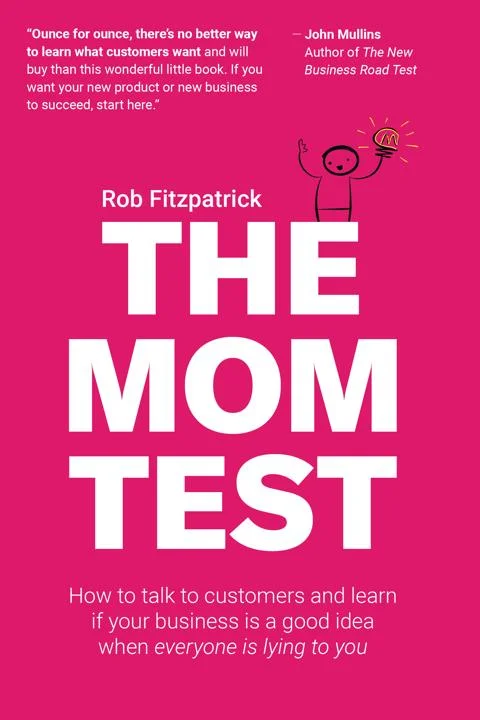
The full title tells you what the book is and why it exists: The Mom Test: How to talk to customers & learn if your business is a good idea when everyone is lying to you. 4 It came out September 10, 2013, self-published through Fitzpatrick's own imprint, 138 pages, priced at a paperback. Fitzpatrick seeded it by giving away 500 copies at Seed Camp Week and 200 at Lean Conf London. Word-of-mouth did the rest: by year three, it was selling 3,000–5,000 copies per month. Total sales now exceed 300,000 copies. 1 The StoryGraph community rates it 4.22/5 across 827 reviews, with 93% calling it informative and 71% calling it fast-paced. 5
The central argument is modest in scope and devastating in practice: most founders ask questions that their own mothers couldn't lie to them about. Not because mom is honest, but because the question is so obviously fishing for validation that any decent person — anyone who doesn't want to hurt your feelings — will give you the answer you're looking for. The book teaches you to ask questions mom genuinely cannot lie to you about, because the questions have nothing to do with your idea.

The three rules: a bias-removal system
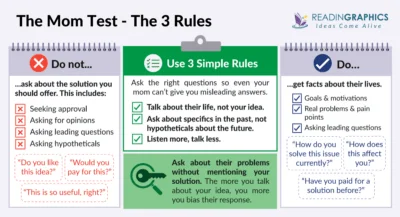
The core framework occupies page 13 of the book. Three rules: 6
- Talk about their life instead of your idea. Not "Do you like this idea?" but "How do you currently handle this?" Once you start talking about your idea, the other person stops being an informant and becomes a supportive audience member. You lose access to the truth they were about to tell you.
- Ask about specifics in the past, not generics or opinions about the future. Not "Would you buy this?" but "When did you last deal with this problem? What did you actually do?" Past behavior is factual. Future-tense answers are aspirational self-portraiture — people describe who they want to be, not who they are.
- Talk less and listen more. The more you explain and promote, the more you bias every answer that follows. If possible, don't mention your solution at all.
Fitzpatrick's framing of the mechanism is worth sitting with: "They own the problem, you own the solution." 6 Customers have access to a part of reality you don't — their actual daily workflow, their actual frustrations, what they actually tried last Tuesday. You don't. Your job in a discovery conversation is to extract that reality, not to pitch at it.
The name "Mom Test" has drawn some criticism. In a 2021 Hacker News thread, user klipt argued the framing has mild gender bias built in: "The idea that mom (but not dad?) will lie to you in order not to hurt your feelings surely reflects biases about gender." 7 User michaelt pushed back with a precise restatement: "The whole point is that it doesn't mean 'regular person test'... It means 'person who isn't the target customer and who probably cares about you too much to give unbiased feedback' test." 7 Both are right in their own register. The naming is imperfect; the concept it names is exact.
The bad data taxonomy
Knowing what to ask is half the framework. The other half is recognizing when an answer has no information content — or worse, is actively misleading.
Fitzpatrick identifies three categories of bad data: 8
Compliments. "Sounds great!" / "I love it!" / "Let me know when you launch." These register as positive signal in the founder's brain, but they contain no facts. Fitzpatrick calls them "free candy" — sweet, nutritionally void. The mechanism for why they're dangerous: "Bad data gives us false negatives (thinking the idea is dead when it's not) and — more dangerously — false positives (convincing yourself you're right when you're not)." 8 False positives are what bankrupts startups. Countermeasure: ignore compliments and redirect. "That's kind of you — tell me about the last time you ran into this problem."
Fluff. Vague hypotheticals, future-tense promises, generic statements. "I usually do this that way." "I would definitely pay for it." "If it had X feature, I'd use it." The most dangerous fluff in the book is "I will definitely buy it" — because it sounds like commitment and contains none. People describe who they want to be. Countermeasure: anchor to the last specific instance. "The last time this happened — when was that, and what did you do?"
Ideas and feature requests. Users volunteering product suggestions. Not worthless, but misunderstood. The right move isn't to implement the request and not to dismiss it — it's to excavate the motivation underneath it. "Why do you want that? What would that let you do? What are you using now to handle that?" The request is a symptom. The cause is what you need.
The practical upshot: a meeting full of compliments, future-tense promises, and feature suggestions is a meeting from which you leave less well-calibrated than when you arrived. WalterBright — Digital Mars founder and creator of the D programming language — illustrated this cleanly in the same HN thread: a user once told him "the world really needs a native Java compiler, you should write one." WalterBright replied that he had written one, for Symantec, and they could buy it now. The response was "I don't want it." 7 Complainer. Not customer.
The other named frameworks
The three rules and bad-data taxonomy are the conceptual core. The remaining eight chapters are operational machinery for actually running discovery. Several frameworks are genuinely named and worth internalizing:
Commitment and Advancement. The only valid measure of a conversation's success is whether it ends with a real commitment to advance. Not "let's stay in touch" — a commitment that costs the other person something: time, reputation risk, or money. "A meeting has succeeded when it ends with a commitment to advance to the next step." 8 The corollary is blunt: "It's not a real lead until you've given them a concrete chance to reject you." 8 Customers who keep being friendly but never commit are an especially dangerous source of mixed signals — they consume your calendar and your conviction without producing any real information.
Earlyvangelists. Fitzpatrick borrows this term directly from Steve Blank (who introduced it in The Four Steps to the Epiphany), the entrepreneur and professor who first systematized customer development. An earlyvangelist is a customer who: has the problem, knows they have it, has budget to solve it, and has already built some makeshift solution themselves. That last condition matters most. If a person hasn't tried to solve the problem, the problem is not severe enough to drive purchase behavior.
Customer Slicing. "Good customer segments are a who-where pair. If you don't know where to go to find your customers, keep slicing your segment into smaller pieces until you do." 9 The logic: 20 conversations with one type of customer produces patterns. One conversation each with 20 types produces noise. Slice until the population is small enough that you know exactly where they congregate.
The List of Three. Before each important conversation, write down exactly three questions you most need answered. These should address the most critical assumptions in your current plan — and should include at least one question that makes you anxious to ask. The anxiety is a diagnostic: it marks where you most need real information and most fear getting it.
The 5-Part Meeting Request. For cold outreach: (1) you're trying to solve problem X; (2) frame expectations — you have nothing to sell; (3) acknowledge a specific gap in your own knowledge; (4) explain why this particular person is worth talking to; (5) ask for help. The formula works because it subverts the thing that makes most founders' outreach fail — it doesn't lead with an idea that requires the stranger to either encourage or discourage you.
On Blank's recommended three-meeting structure (problem meeting → solution meeting → sales meeting), Fitzpatrick parts ways: "In practice, however, I've found it both difficult and inefficient to set them up. The time cost of a 1-hour meeting is more like 4 hours once you factor in the calendar dance, commuting, and reviewing." 6 His alternative: structured casual conversations — coffee, industry events, a 15-minute phone call. The methodology travels, the ceremony doesn't need to.
Where it sits in the PM canon
The PM canon the three previous books in this series have covered forms a clean stack, each book handling a distinct layer of product work:
| Book | Core question | Layer |
|---|---|---|
| INSPIRED (Marty Cagan) | How should product teams organize to discover what to build? | Strategy + team structure |
| Hooked (Nir Eyal) | How do you build products people return to habitually? | Retention + behavior design |
| Don't Make Me Think (Steve Krug) | How do you build products that require no mental effort to use? | Usability + cognitive load |
| The Mom Test (Rob Fitzpatrick) | How do you ask customers questions that give you honest answers? | Customer discovery + bias removal |
The gap The Mom Test fills is specific. Before it, the customer development literature — Blank's Four Steps to the Epiphany, Ries's The Lean Startup — explained why to talk to customers and what to learn. Neither book told you how to hold the individual conversation without systematically biasing the respondent. Startup-book.com's reviewer put it directly: "The Mom Test is more convincing than Ries' Lean Startup" — precisely because the tactical concreteness makes the abstract advice actionable. 6 Fitzpatrick himself acknowledges the genealogy in the book's opening: "You've read about Customer Development or Lean Startup and aren't sure how to actually do it. This book is for you." 6
The closest current complement is Michele Hansen's Deploy Empathy (2021). Where Fitzpatrick focuses on question design to avoid bias, Hansen focuses on building genuine empathetic connection to get people talking. They address different failure modes: Fitzpatrick solves the "leading the witness" problem; Hansen solves the "the conversation feels transactional and the customer clams up" problem. Reddit r/SaaS practitioner bramburn described Deploy Empathy as providing "a lot more in depth example and why it works." 10 Reading both gives you the full picture; starting with The Mom Test remains the right move.
What practitioners say now
The book's 300,000+ sales and consistent curriculum presence at UC Berkeley's Sutardja Center for Entrepreneurship and Technology (SCET) and Virginia Commonwealth University's TechTransfer program suggest the core framework has held. 12 But practitioners have developed three pointed critiques since 2013:
The craft gap. Frances Brown, a professional design researcher writing for Nightingale Design Research, agrees with Fitzpatrick's core premise but argues the book seriously underestimates how hard it is to execute well. Even with the right questions, founders still talk over people: "Even with a very clear script, filled with the right questions, they still go off-piste, explain and justify their idea, object to criticism and unintentionally reveal when they're upset/annoyed." 11 Her sharper diagnosis: "He doesn't adequately convey how much intricacy and skill is involved in conducting a successful customer interview." 11 The implication for PMs — not founders building their first company — is that the methodology pairs well with investment in actual interviewing practice, not just knowledge of the principles.
Reddit practitioner louislatreille, who ran 3–4 months of customer development using the book, identified a related gap: "Reading the book and knowing the theory is the first step, but you have to use it, and use it properly. We found ourselves not having any formal plan at some point, which made us question our approach every couple days." 13 His fix: set explicit targets (who you're talking to, how many conversations per phase, when to extract patterns) before the first conversation, and don't extract themes after every single interview — wait until you have at least 5–8.
The B2C limitation. In a 2021 Hacker News thread, a user asked Fitzpatrick directly whether the book's methods work for B2C. He replied in the thread himself. The short version: discovery still works ("understanding what they're already doing and why, decision-making, current workarounds") but pure-conversation validation is "MUCH harder" in B2C. His advice: after discovery, skip straight to rapid prototyping rather than trying to extract commitment signals that B2C customers aren't positioned to give. 7 The book was written primarily from enterprise SaaS experience, and that shows.
The scope boundary. One Reddit practitioner running a commodity school-supplies distribution business pointed out that the framework's premise — there's an uncertain problem that needs validating — doesn't apply once you're past the discovery phase with a product that works. 14 The book is a discovery-phase tool. Once you're selling a known product to a known buyer, you need sales skills, not research skills. That's a scope clarification, not a critique.
Where the criticism doesn't stick is the book's core mechanism. WalterBright's "skin in the game" formulation from the same HN thread — "I simply learned long ago that people who don't have skin in the game rarely give good game advice" 7 — is the book in one sentence, and that insight hasn't aged.
When it fails, and when it works: three cases
What a $40K failure looks like. Tom (who writes as TJCX) quit his job to build GlacierMD, a clinical trial meta-analysis platform for doctors, after his boss Carl told him: "That's an awesome idea. It sounds like something worth working on." 15 He spent 9 months, hired 5 contractors, recruited 4 medical advisors, built 200,000+ lines of code, and produced what became the world's largest depression meta-analysis (846 clinical trials). When he went to sell to Bay Area clinics, doctors told him it was great — and declined to pay. Psychiatrist Susan said: "I don't know if we can spare the budget here, to be honest... I'm not sure if our practice can justify this cost." 15 He shut GlacierMD down in July 2018. The HN post-mortem thread that followed was full of recommendations to read The Mom Test. Tom's own diagnosis: he made something people wanted but couldn't build a business from — "Make something people want" without "make something people will pay for" is incomplete.
What recovery looks like. Anurag, co-founder of Animall (the Indian livestock trading platform that raised $21 million), describes a personal failure that preceded Animall: friends enthusiastically told him they'd use his app, saying "I can't believe this doesn't exist already!" He built a simple prototype. "Not a single one of them even downloaded it." 16 After six months applying Mom Test principles, he had killed three ideas before building them — and his current project had paying customers before the product was finished.
Fitzpatrick's own experience. The book's credibility rests partly on the author having gotten this wrong at scale. His YC 2007 company had clients including MTV, Sony, and the BBC, top-tier investors, and, by his own account, four years of conversations that looked like traction and contained none. "Once you pitch, you expose your ego and invite compliments... as soon as you've pitched, you're unable to learn about your customer." 3 He describes being "honestly happy when we failed because I did everything I could to keep it alive... But I was so burned out and I just wanted to do something fun again." 1 The book is a post-mortem written as a manual.
Finn Mallery at Origami.chat, which reached $50K MRR, described The Mom Test as "the default playbook for startup customer interviews" and built their entire outbound methodology around the principle of leading with the customer's problem, not the product. 17 The three-case pattern holds: bad data is catastrophically expensive, and the cost of removing bias from your questions is close to zero.
Five experiments to run this week
These derive directly from Fitzpatrick's frameworks. Each one takes an hour or less and produces something usable.
1. Audit your last three customer calls for bad data. Pull up your notes or recordings. Tally: how many responses were compliments ("this is great / really needed / I could see using this")? How many were future-tense hypotheticals ("I would / I might / if you had X I'd")? How many were feature suggestions? If the sum is more than a third of the total responses you recorded, you ran a bad-data session. You didn't learn what you thought you learned.
2. Rewrite five of your standard discovery questions. Take the questions you normally ask. For each one, apply Rule 2: convert future-tense hypotheticals to past-specific factual inquiries. "Would you use a tool that did X?" → "Walk me through the last time you had to handle X — what did you actually do?" The conversion is mechanical. The information difference is substantial.
3. Run a commitment test on your warmest lead. Identify the prospect who seems most enthusiastic — the one whose emails are full of encouraging language. Fitzpatrick's question: "It's not a real lead until you've given them a concrete chance to reject you." Ask them to take a specific next step that costs them something (a 30-minute call with their team, a signed letter of intent, a small pilot payment). Their response tells you whether the enthusiasm was real or polite.
4. Slice your customer segment one level deeper. Take your current target customer description and apply Customer Slicing: who specifically within that segment has the problem so badly that they've already built a workaround? Those are your earlyvangelists. Find three of them. Run conversations with them exclusively for two weeks. The signal-to-noise ratio will be higher than anything you get from the broader segment.
5. Prepare the List of Three before your next customer conversation. Write down the three most uncertain assumptions in your current product plan — the ones where, if you're wrong, the whole thing falls apart. These become your three questions. At least one should be the question you're most reluctant to ask. The reluctance marks exactly where you're operating on hope rather than evidence.
Cover image: The Mom Test (2013) — Robfitz Ltd
参考ソース
- 1The Knowledge: Make Things that Matter with Rob Fitzpatrick
- 2RobFitz.com: About
- 3SaaS Club: Customer Acquisition Startup Mistakes That Kill Your Idea
- 4Amazon: The Mom Test
- 5The StoryGraph: The Mom Test
- 6Start-Up: The Mom Test by Rob Fitzpatrick
- 7Hacker News: The Mom Test discussion thread
- 8Readingraphics: Book Summary — The Mom Test
- 9TianPan.co: The Mom Test — How to Conduct Effective User Research?
- 10Reddit r/SaaS: Do you actually use the "Mom Test"
- 11Nightingale Design Research: Book review — The Mom Test
- 12Facebook / VCU: Is your research ready to move from the lab to the marketplace?
- 13Reddit r/startups: About The Mom Test
- 14Reddit r/Entrepreneur: The Mom Test
- 15TJCX / Tom: I wasted $40k on a fantastic startup idea
- 16Medium / BInsights / Anurag: The Mom Test by Rob Fitzpatrick — Book Summary
- 17Origami.chat / Finn Mallery: From $0 to $50k MRR in One Batch
このコンテンツについて、さらに観点や背景を補足しましょう。