The last-place team that won it all: LA Kings, June 11, 2012
The 8th-seeded Kings beat the Devils 6–1 on June 11, 2012 — the first last-seed champion in major North American sports history.

On the night of June 11, 2012, a hockey team that had barely scraped into the playoffs lifted the Stanley Cup — the first 8th-seeded squad in any of the four major North American sports leagues to win a championship. The Los Angeles Kings beat the New Jersey Devils 6–1 in Game 6, and they did it on the back of one brutal boarding call, a five-minute power play, and three goals in 165 seconds that turned a tense Game 6 into a coronation. 1
The team that wasn't supposed to be there
Start at the beginning, because the beginning is genuinely weird.
The Kings entered the 2011–12 season with big expectations — a deep, talented roster anchored by captain Dustin Brown (who would finish with 22 goals) and Slovenian center Anze Kopitar (76 points in the regular season). By early December, they were going nowhere. After 29 games their record sat at 13–12–4, good enough for tenth place in the Western Conference and well out of a playoff spot. Head coach Terry Murray got fired on December 12. 2
Eight days later, GM Dean Lombardi called a rancher from Viking, Alberta.
Darryl Sutter — gruff, laconic, a five-time 40-win coach — had been out of hockey for four years running a cattle operation. He had won the Stanley Cup with Calgary in 2004 (also beating the top three seeds in the West, as it happens). Lombardi had employed him once before in San Jose. On December 20, 2011, Sutter took the job. His first game was a shootout win over Anaheim two days later, and something clicked.
Under Sutter the Kings went 25–13–11 in their remaining 49 regular-season games. They closed the year at 40–27–15 (95 points), which was just enough to squeeze into the 8th and final playoff spot on the last day of the regular season — but only because they dropped their final two games to San Jose and tumbled from third in the Pacific Division all the way to 8th in the conference. 2 It was a team with a losing record — 40 wins against 42 combined losses and overtime losses — becoming only the third team in NHL history to win the Stanley Cup with that kind of regular-season balance sheet.
Eating the seeds
Here is what the bracket looked like when the Kings entered the playoffs: they faced the Presidents' Trophy winners (Vancouver, 111 points, the best team in the entire NHL), then the second-best team in the West (St. Louis, 109 points), then the third-best (Phoenix, 97 points). In any sport, an 8th seed getting through one of those would be a story. Getting through all three is something else.
チャートを読み込んでいます…
The Kings swept St. Louis in four games and beat Vancouver and Phoenix each in five. Their road record going into the Stanley Cup Final: 10–0 — the first team in NHL history to go undefeated on the road through three playoff rounds en route to the Final. 1 They also became the first team ever to take a 3–0 series lead in all four rounds of the same playoffs.
The goaltender making those road trips possible was Jonathan Quick. The 26-year-old from Milford, Connecticut finished the regular season with a 1.95 goals-against average (GAA) and a .929 save percentage. In the playoffs he was even better: 16–4, 1.41 GAA, .946 save percentage, 3 shutouts across 20 games — a .946 figure that ranks among the highest playoff save percentages ever recorded for a Cup-winning goaltender. 3 He stopped 41 shots in a shutout against Vancouver in Round 1, then turned aside 32 of 33 in a double-overtime Game 2 against New Jersey in the Final.
Five minutes that changed history
After winning the first three games of the Final away from home, the Kings came back to Los Angeles leading the series 3–0 — the Devils only the second team ever to force a Game 6 after trailing 3–0, clawing wins in Games 4 and 5 to stay alive. 1
Game 6, June 11 at Staples Center. 18,858 fans. NBC. The first 10 minutes were tight.
Then, at 10:10 of the first period, Devils forward Steve Bernier caught Kings defenseman Rob Scuderi with a hard hit from behind into the boards. Scuderi went face-first into the glass and lay on the ice, bleeding from his nose. The officials assessed Bernier a five-minute major penalty for boarding plus a game misconduct — ejecting him from the game and handing Los Angeles a full five-minute power play (i.e., five skaters against four) that could not be killed early even if the Kings scored.
What followed was merciless. Three goals in 4 minutes and 58 seconds:
- 11:03 — Dustin Brown, power play
- 12:45 — Jeff Carter, power play (the series-winning goal, assisted by Brown and Mike Richards)
- 15:01 — Trevor Lewis, power play
3–0 after one period. Jeff Carter added a fourth goal 90 seconds into the second. New Jersey's Adam Henrique got one back late in the second, but the outcome was never in doubt. Two empty-netters — Lewis again at 16:15 of the third, Matt Greene 15 seconds later — made it 6–1, the most lopsided Cup-clinching margin since Pittsburgh beat Minnesota 8–0 in Game 6 in 1991. 1
Bernier, to his credit, did not dodge the moment afterward. "I wish I could take that play back," he said. "I didn't want to hurt my team. I wanted to help them. This is extremely hard. It's been a long playoff run for us. To finish on that note, it's not fun for sure. But there's nothing I can do now." 4
Rich Chere of The Star-Ledger called the boarding call "the most devastating call in the Stanley Cup Final since the illegal curve on Marty McSorley's stick in 1993" — a reference to the Kings' last Cup Final, when a stick-curve infraction against Los Angeles defenseman Marty McSorley in Game 2's final minute turned the series and handed the Montreal Canadiens four straight wins. The Kings knew all about momentum-turning penalties in Cup Finals. This time, the call went the other way. 1
The handshake line and what it meant
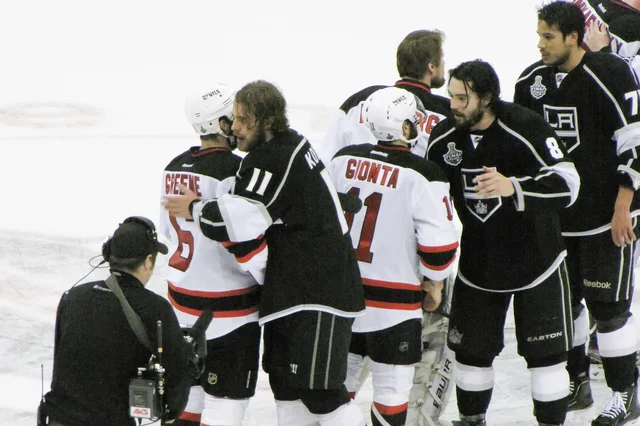
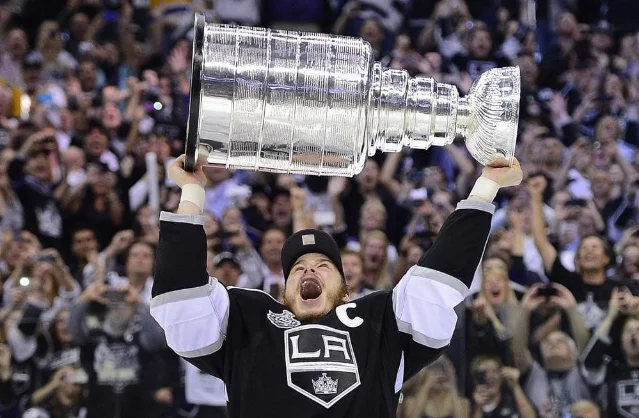
When the horn sounded, Brown became only the second American-born captain in NHL history to lift the Stanley Cup, after Derian Hatcher did it with Dallas in 1999. He handed the Cup first to 35-year-old defenseman Willie Mitchell — who had never won a championship — then to forward Simon Gagne, who had just returned from injury to play in the Final.
Quick was awarded the Conn Smythe Trophy as playoff MVP, becoming only the third American goaltender to win the award (after Brian Leetch in 1994 and Tim Thomas in 2011). 3 Dustin Brown and Anze Kopitar each finished the playoffs with 20 points (8 goals, 12 assists), tied as the team's top scorers. Jeff Carter — acquired in a trade-deadline deal from Columbus just 109 days earlier, in exchange for defenseman Jack Johnson and a first-round pick — put up 8 goals and 5 assists in 20 games and scored both the series-winning goal and two goals in the clincher. 2
The combined playoff seed of the two finalists was 22 (the Kings entered as the 13th-ranked team by regular-season points; New Jersey ranked 9th) — the second highest combined seed number in Stanley Cup Final history, just behind the 23 logged in 1991. No 8th seed had ever won a title in the NHL, NBA, MLB, or NFL before. 5 The 1999 New York Knicks reached the NBA Finals as an 8th seed but lost to San Antonio in five games. The Kings are still the only 8th seed to actually finish on top.
"We never lost our confidence," Quick said afterward. "We had to take it on the chin to keep moving, losing two, and we looked at it as, 'Hey, we still have to win one game to win a championship. And we have two chances.' Finally, we were able to do it at home." 4
Three days later on Figueroa Street
On June 14, roughly 250,000 fans packed downtown Los Angeles along Figueroa Street to watch the Kings roll past on double-decker buses through a blizzard of silver and black confetti. The players brought the Cup to a Hermosa Beach bar the night they won it. Dustin Brown's two sons drank chocolate milk from it in his backyard. It went on The Tonight Show. David Beckham and Chuck Liddell turned up at an after-party at the Hollywood Roosevelt Hotel.
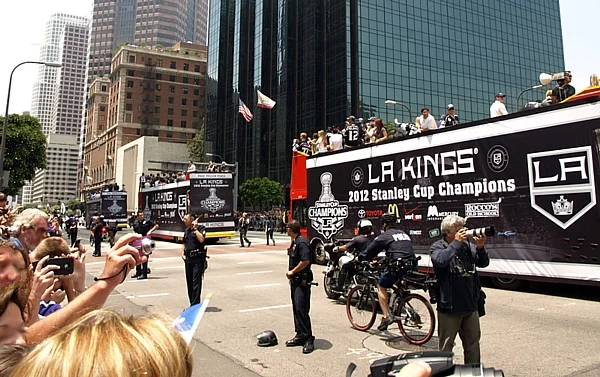
Coach Darryl Sutter — the straight-faced Alberta rancher who had taken over a sinking ship in December — got a rare public moment of joy. "Just to see the looks on their faces after they won it is something I'll remember for the rest of my life," he said at the rally. "It's just awesome, awesome, awesome." 6
The Kings won a second Cup in 2014. No 8th seed has won a major North American title since.
Cover image: AI-generated illustration
参考ソース
- 12012 Stanley Cup Final – Wikipedia
- 22011–12 Los Angeles Kings season – Wikipedia
- 3Jonathan Quick – Wikipedia
- 4LA Kings Beat Devils 6–1, Claim 1st Stanley Cup – WBUR/AP
- 5Los Angeles Kings and the Best No. 8 Seeds in Sports History – Bleacher Report
- 6LA Kings celebrate Stanley Cup with parade, rally – AP/OnlineAthens
このコンテンツについて、さらに観点や背景を補足しましょう。