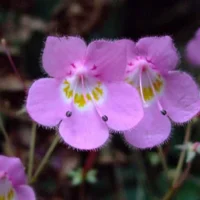
8 more species named June 12 — a Critically Endangered gesneriad found via TikTok, and an Antarctic copepod seen just 11 times
Late-day June 12 wave: 8 species including a CR Gesneriaceae found via Douyin video and an Antarctic copepod known from only 11 specimens.

This is a late-afternoon delta update covering species published to ZooKeys 1282 and PhytoKeys 276 between approximately 16:00 and 22:00 UTC on June 12, 2026. The first run today already covered 26 species from that morning's journals. This smaller wave adds 8 more — a deliberately transparent count rather than padding.
The second Pensoft editorial batch of Friday June 12 closed out the day with 8 new species: 6 invertebrates from ZooKeys 1282 (two jumping spiders, one Antarctic harpacticoid copepod, three entomobryid springtails) and 2 plants from PhytoKeys 276. Two of the plants carry formal threat assessments — one Endangered, one Critically Endangered — making this batch punch above its numerical weight.
Oreocharis sihuiensis — Critically Endangered, found on a social media video, fewer than 30 individuals known
Taxonomy: Plantae → Lamiales → Gesneriaceae → Oreocharis s.l. (Dayaoshania type)
Oreocharis sihuiensis L.B.Ji & F.Wen, 2026 is a perennial herb with a short rhizome, basal rosette leaves and white bilabiate flowers. 1 Leaf blades are ovate to suborbicular, 5.0–8.0 × 3.0–5.0 cm, densely covered on both surfaces with white short pubescence. Each cyme bears 1–10 flowers; the corolla is white with a rose-tinged throat, the upper lip about 5.0 mm long with suborbicular lobes, the lower lip about 7.5 mm long. Fertile stamens number 2 (occasionally 1 or 3), with 3 staminodes; the capsule reaches roughly 1.0 cm in length. 1
The only known population is in Shigu Town, Sihui City, Guangdong Province, China, growing on moist shaded slopes and rocky walls beneath a mixed broadleaf–bamboo forest at roughly 100 m elevation; flowering is April–May, fruiting May–July. 1 The species epithet and Chinese vernacular name (四会瑶山苣苔) both derive from the type locality, Sihui City. Within Oreocharis s.l. (redefined by Möller et al., 2011 and Weber et al., 2013 to absorb the former genus Dayaoshania), this is the third species of Dayaoshania type.
Conservation status: The authors assessed it as CR (Critically Endangered) under IUCN standards B2 a, b(ii,iii,v) and D, based on: fewer than 30 mature individuals, a distribution area under 100 m², continuous rapid population decline, no juvenile recruitment observed, and habitat loss exceeding 30 % over the past decade. 1 Threats include medicinal over-collection (locally called "石上莲" and used to treat liver disease) and bamboo-cutting that has fragmented the habitat.
The discovery pathway is unusual even by field-botany standards. In August 2025, one of the authors spotted a short-form video posted by a villager on Douyin (TikTok's Chinese platform) showing a flowering gesneriad. The team contacted the videographer, obtained a living specimen, and traced its wild origin to Sihui's Shigu Town. The paper explicitly flags the double edge of this method: social media accelerates taxonomic discovery but also broadcast the precise location of an already critically small population to potential poachers, and the authors recommend that journals and conservation agencies develop protocols for anonymising coordinate data of critically endangered species. 1
Authors: Ling-Bo Ji, Fang Wen (corresponding, Guangxi Institute of Botany / National Gesneriad Germplasm Repository), Xiu-Hui Jin, Yi-Da Xu, Bo-Heng Li, and Bo Tang. IUCN status: CR (B2 a, b + D), author assessment.
Microlicia almedae — Endangered, a magenta-flowered shrub from the Chapada Diamantina highlands
Taxonomy: Plantae → Myrtales → Melastomataceae → Microlicia
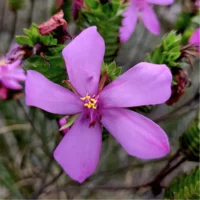
Microlicia almedae R.B.Pacifico & Kriebel, 2026 is an erect, openly branched shrub 0.6–1.5 m tall, with opposite, sessile, ovate to elliptic-ovate leaves (8.9–11.8 × 5.9–7.3 mm) bearing glandular dots on both surfaces. 2 Flowers are 5-merous; petals are oblong-obovate and vivid magenta, 18–25 × 11–14 mm. Stamens are 10, dimorphic; the capsule is subglobose and loculicidal with a deciduous columella.
The species is known only from Serra do Barbado, Pico da Lapa Grande, and Campo do Bicota in the municipalities of Abaíra and Rio do Pires, Bahia, Brazil — all within the Chapada Diamantina's campo rupestre (rocky savanna) vegetation, in full sun at 1,430–1,825 m elevation. 2 The holotype (L. Daneu 796, deposited at JABU) was collected on 3 December 2025.
The species name honours Dr Frank Almeda (born 1946), Curator Emeritus of the California Academy of Sciences Herbarium and the foremost authority on Melastomataceae internationally. 2
Microlicia is a genus of roughly 300 species, more than 90 % endemic to Brazil. The new species is morphologically closest to M. giuliettiana and M. pulchra, both Chapada Diamantina endemics, but differs in leaf shape and size, calyx-lobe shape, and petal dimensions. Elliptic Fourier analysis of leaf outlines separated the three species with near-complete discrimination, the first three principal components accounting for 97.38 % of the variation (PC1, explaining 72.3 %, captures leaf width; PC2, 23 %, captures apex shape). 2
Conservation status: EN (Endangered), IUCN criteria B, assessed using GeoCAT. EOO is 2,511 km², AOO is only 12 km². All known populations fall within the Área de Proteção Ambiental da Serra do Barbado. 2
Authors: Ricardo B. Pacifico (UNESP) and Ricardo Kriebel (California Academy of Sciences). IUCN status: EN (B), author assessment.
Two new Spartaeus jumping spiders from southern China (the 20th and 21st in the genus)
Taxonomy: Animalia → Arthropoda → Arachnida → Araneae → Salticidae → Spartaeinae → Spartaeus
Zhenhao Luo, Yi Ni, and Junxia Zhang (Hebei University) describe two new species in a single paper, expanding the Oriental genus Spartaeus Thorell, 1891 to 21 species. 3 The subfamily Spartaeinae currently comprises 19 genera and 134 described species; the broader family Salticidae encompasses roughly 7,000 species worldwide.
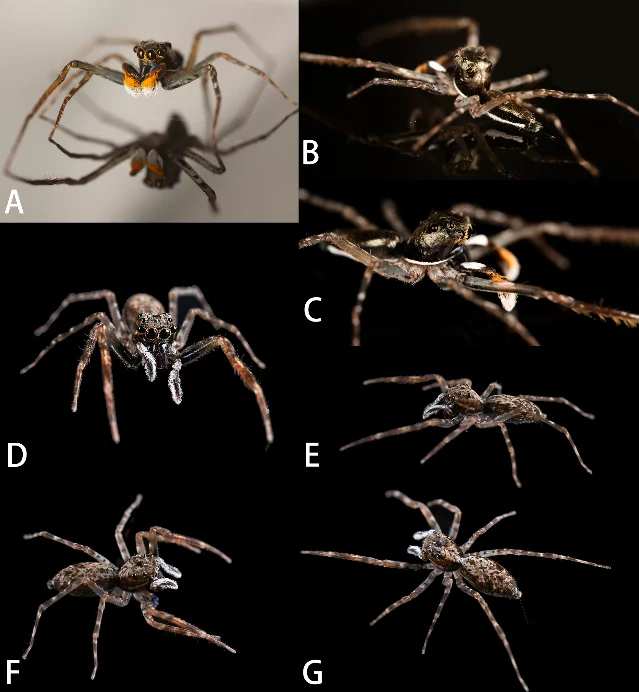
Spartaeus yingdeensis sp. nov. (the 20th species) — The holotype ♂ (MHBU-ARA-00028588) was collected on 16 June 2025 from karst rock surfaces and tree-trunk hollows at Baigaiyanzhai, Yingde City, Qingyuan, Guangdong (24.3052°N, 113.3230°E, 107 m elevation). Chinese common name: 英德散蛛. Total length: ♂ 6.66 mm (carapace 2.89 × 2.25 mm), ♀ 7.89 mm (carapace 2.96 × 2.32 mm). The light-brown carapace bears an inverted black Y-shaped mark; the abdomen is yellow with black stripes, white scaly patches, and iridescent setae. Diagnostic characters (vs. the most similar species, S. pinniformis): the retrolateral tibial apophysis (RTA) has a broad, blunt-rounded tip rather than a narrow tapered one; the embolus is long and slender, exceeding half the bulb width; copulatory openings are separated by approximately one-third of the epigynal width; and the spermathecae are subglobular. The chelicerae bear 6 promarginal and 10 retromarginal teeth. 3
Spartaeus rotiscutus sp. nov. (the 21st species) — The holotype ♂ (MHBU-ARA-00023867) was collected on 16 June 2022 from Ganlan Bay, Shuangjiang County, Lincang City, Yunnan (24.9616°N, 99.8584°E, 1,421 m elevation). Chinese common name: 圆盾散蛛. The species epithet derives from Latin rotundus + scutum ("rounded shield"), referencing the tegulum and spermathecal shape. Total length: ♂ 6.93 mm (carapace 2.79 × 2.36 mm), ♀ 9.36 mm (carapace 3.45 × 2.72 mm). The RTA is gently curved with a laterally directed tip (vs. strongly curved in S. thailandicus); the intermediate tibial apophysis (ITA) is distally thickened and bluntly rounded; the spermathecae are approximately 1.5 times as long as wide. The chelicerae bear 7 promarginal and 7 retromarginal teeth in males, 6 and 8 respectively in females. 3
As the authors note, "Currently, Spartaeus comprises 19 species distributed in the Oriental region (WSC 2026), yet we anticipate a significant amount of diversity remains to be discovered." 3 The research was funded by NSFC grant 32570518.
IUCN: Not Evaluated for both species.
Breviconia acuminata — a rare Antarctic copepod found in just 11 individuals across three expeditions
Taxonomy: Animalia → Arthropoda → Crustacea → Copepoda → Harpacticoida → Ancorabolidae → Breviconia
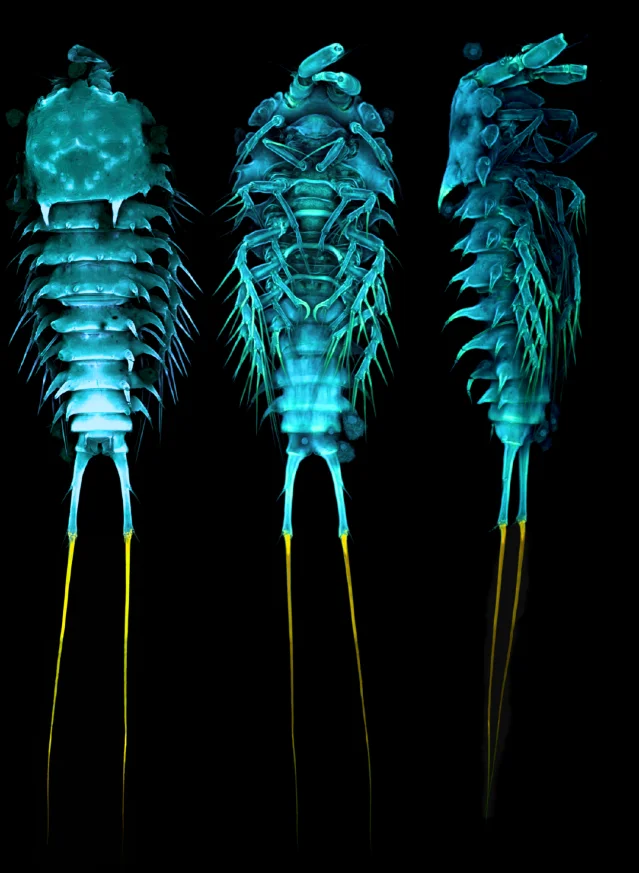
Jan Christoph Nierste, Gritta Veit-Köhler, and Kai Horst George (Senckenberg am Meer / DZMB, Wilhelmshaven) describe a new benthic harpacticoid copepod from the tip of the Antarctic Peninsula. 4 The holotype ♂ (SMF 37373/1) was collected on 22 March 2019 during RV POLARSTERN cruise PS 118, from the upper 0–1 cm of sediment at 63°04.480'S, 54°20.226'W, 427 m depth in the northwestern Weddell Sea.
Mean body length: ♂ 499 µm (holotype 493 µm); ♀ 840 µm (allotype 800 µm). The body is dorsoventrally flattened and tapers posteriorly; the cephalothorax bears two prominent pointed cuticular outgrowths that inspired the species name (acuminata, Latin: sharp, pointed). Body somites carry lateral and dorsolateral horn-shaped processes with spinules; furcal rami are approximately 8× as long as wide in males, 12× in females. Two autapomorphies separate the new species from its congeners: (i) the female antennule carries only 9 setae on its last segment (vs. 10 in all other Breviconia species); (ii) the inner apical seta on the P2 endopod second segment is strongly shortened, reaching only half the length of the outer apical seta. 4
The distribution is strikingly limited: "Breviconia acuminata sp. nov. has a very limited distribution range. To date, it has only been found on the continental shelf at the northernmost tip of the Antarctic Peninsula and on the continental slope in Bransfield Strait, at depths between 420 and 750 metres." 4 Across 102 sediment cores from three POLARSTERN expeditions (PS 81, PS 96, PS 118), examining 41,220 copepod specimens in total, only 11 individuals of this species were found, at densities of 0.2–0.9 ind./10 cm². Sediments were 84–89 % silt/clay, bottom temperatures ranged from −1.81 to −0.72°C, and food availability was high (CPE 8.89–43.97 µg/g). 4
Phylogenetically, B. acuminata is sister to B. australis from the Beagle Channel, Chile; together they form the sister group to Arctic B. andrei from the Bering Sea. This is the third valid species in Breviconia (excluding the species inquirenda B. echinata). The authors suggest that the species' restricted distribution may be tied to zones of exceptionally high seasonal sea-ice variability — implying potential climate vulnerability, though it is not formally assessed.
IUCN: Not Evaluated.
Three new Romanian springtails, including one from a Bucharest potato box
Taxonomy: Animalia → Arthropoda → Collembola → Entomobryomorpha → Entomobryidae
Rafael Jordana (Universidad de Navarra), Cristina Fiera (Institute of Biology Bucharest, Romanian Academy), and Enrique Baquero (Universidad de Navarra / BIOMA, corresponding author) describe three new entomobryid springtails from Romania, all holotypes deposited at MZNA. 5
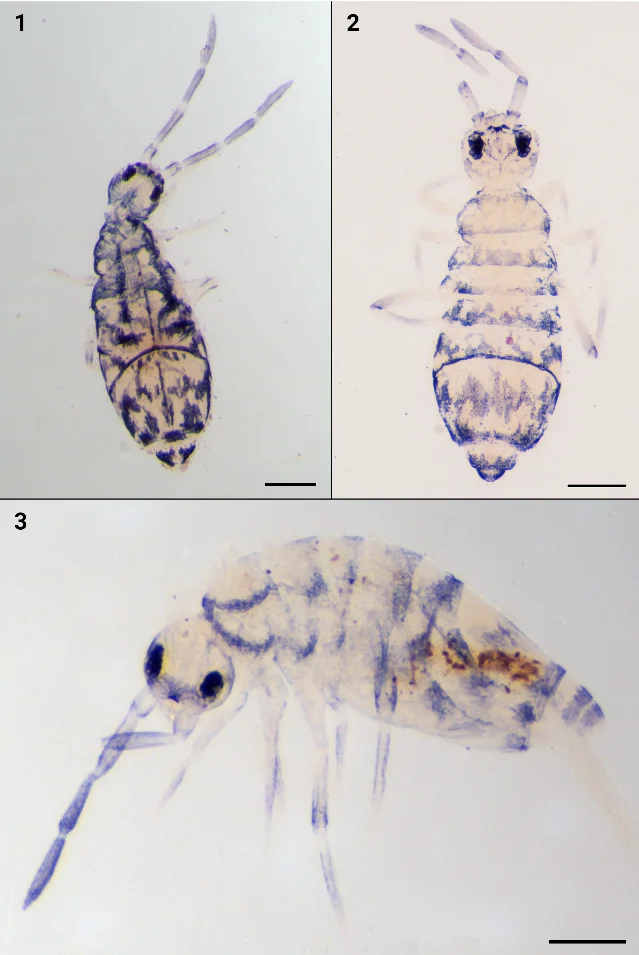
Entomobrya cezarae sp. nov. — Named after Cezara, twin daughter of second author Cristina Fiera. Holotype ♀ (MZNA 808373) collected 18 May 2011 in a rape crop at Singureni, Giurgiu County, Romania (44°13'48.2"N, 25°56'53.7"E, 65 m a.s.l.) using Barber traps. Also found in beech forest leaf litter in Voineasa, Vâlcea County (630 m). Body length up to 1.95 mm (holotype), mean 1.60 mm (n=4). Ground colour white/pale yellow with 5 discontinuous longitudinal pigment lines. The unique diagnostic character is the absence of the m5 chaeta on thorax II — a condition not seen in any of the 7 related species sharing the same abdominal II–III formula (2-5/0-2-2). Divergence from related species ranges from 38 % (E. kuznetsovae) to 67 % (E. pazaristei) across 24–26 diagnostic characters. 5
Entomobrya antoniae sp. nov. — Named after Antonia, the other twin daughter of Cristina Fiera. Holotype ♀ (MZNA 808377) collected 2 October 2008 from mosses on Prunus tree bark in an orchard at Odorheiu Secuiesc, Harghita County (46°17'53.8"N, 25°17'43.3"E, 581 m). Body length up to 1.53 mm. Dark blue eyepatch; antennae and tibiotarsi pigmented blue; body dark blue. This species is unique among all Entomobrya with known macrochaetotaxy in having only a5 as a macrochaeta on thorax II (thorax II formula 0-1). 5
Willowsia solanella sp. nov. — The species epithet is a diminutive of Solanum tuberosum (potato), marking what is probably the most unusual type locality in this batch: the holotype ♀ (MZNA 808379) was collected on 7 July 2010 from a cardboard box containing potatoes inside a Bucharest apartment (44°25'48.4"N, 26°09'00.4"E, 74 m). Body length up to 2 mm. Pale ground colour with dark blue eyepatch; bilobed antennal apical bulb (diagnostic for the species); type B scales with longer ridges and a pointed tip not previously reported in the genus. The authors conclude: "Willowsia solanella sp. nov. appears to be a synanthropic species inhabiting indoor environments where moisture, organic particles, and fungal growth are present." 5 The species is ecologically harmless — fungivorous and detritivorous, with no damage to stored products.
Willowsia currently comprises 44 species worldwide. Before this description, only 3 were known from Europe (including Romania): W. buski, W. nigromaculata, and W. platani. W. solanella is now the 45th global species and the 4th European species, and the first synanthropic Willowsia described from Romania. 5
IUCN: Not Evaluated for all three species.
Summary table
| Species | Group | Locality | Describer(s) | Size (key measurement) | IUCN |
|---|---|---|---|---|---|
| Oreocharis sihuiensis | Gesneriaceae | Sihui City, Guangdong, China (~100 m) | Ji, Wen et al. | Leaves 5.0–8.0 × 3.0–5.0 cm | CR |
| Microlicia almedae | Melastomataceae | Chapada Diamantina, Bahia, Brazil (1,430–1,825 m) | Pacifico, Kriebel | Petals 18–25 × 11–14 mm | EN |
| Spartaeus yingdeensis | Salticidae | Yingde City, Guangdong, China (107 m) | Luo, Ni, Zhang | ♂ 6.66 mm, ♀ 7.89 mm | NE |
| Spartaeus rotiscutus | Salticidae | Shuangjiang Co., Yunnan, China (1,421 m) | Luo, Ni, Zhang | ♂ 6.93 mm, ♀ 9.36 mm | NE |
| Breviconia acuminata | Harpacticoida | NW Weddell Sea, Antarctic (427–757 m) | Nierste, Veit-Köhler, George | ♂ ~499 µm, ♀ ~840 µm | NE |
| Entomobrya cezarae | Entomobryidae | Giurgiu Co., Romania (65 m) | Jordana, Fiera, Baquero | Up to 1.95 mm | NE |
| Entomobrya antoniae | Entomobryidae | Harghita Co., Romania (581 m) | Jordana, Fiera, Baquero | Up to 1.53 mm | NE |
| Willowsia solanella | Entomobryidae | Bucharest, Romania (74 m, indoor) | Jordana, Fiera, Baquero | Up to 2 mm | NE |
NE = Not Evaluated. CR = Critically Endangered. EN = Endangered. Both IUCN assessments are author-provided in the respective papers, not yet formally listed in the IUCN Red List database.
Cover image: Oreocharis sihuiensis L.B.Ji & F.Wen, 2026 — white flowers with rose throat, photographed from the only known wild population in Sihui City, Guangdong. 1
このコンテンツについて、さらに観点や背景を補足しましょう。