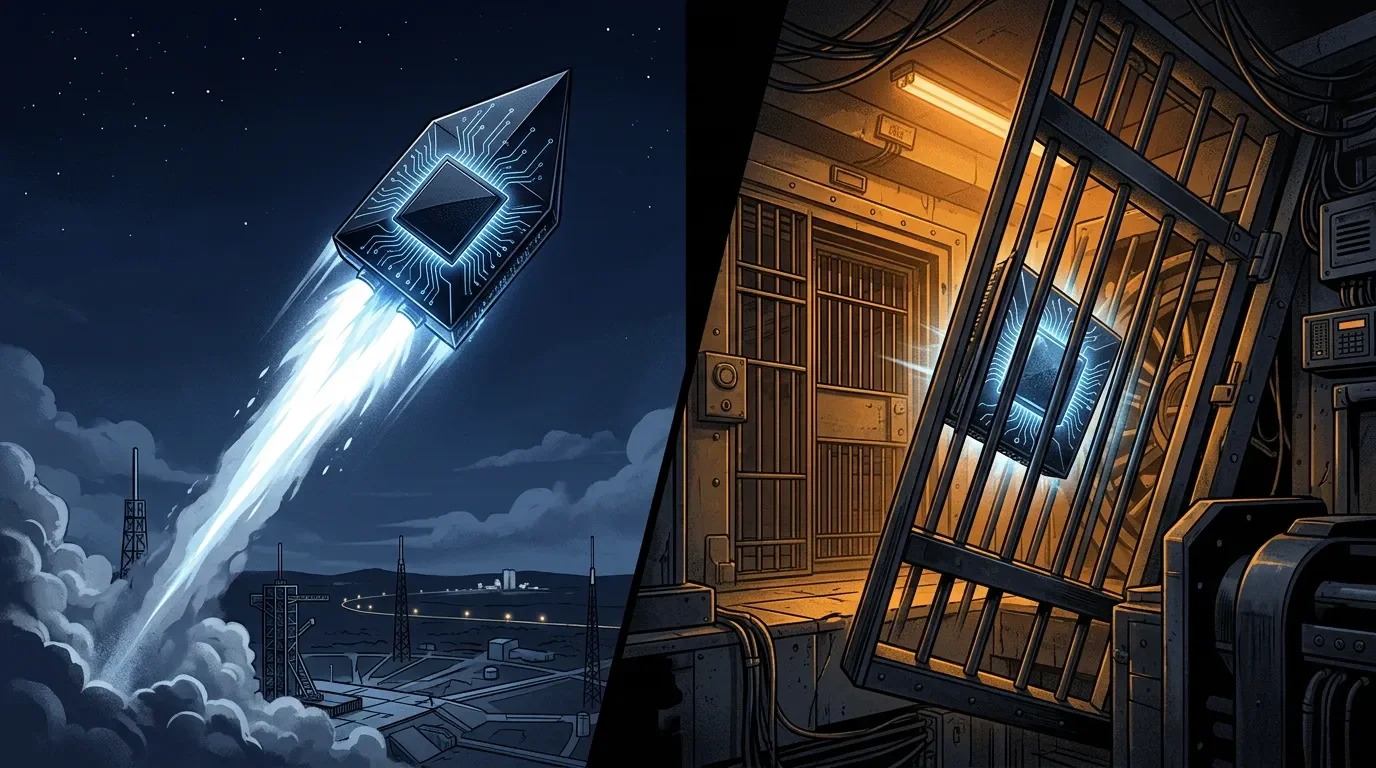
Week in Review: Launch, Shutdown, and the Battle Over Who Controls Frontier AI

Week in Review: Launch, Shutdown, and the Battle Over Who Controls Frontier AI

In six days, Anthropic released Fable 5 and Mythos 5, signed TCS and DXC as flagship enterprise partners, published sweeping AI governance proposals, and then had its top two models pulled offline by a U.S. government export control directive — all while a confidential IPO filing sat with the SEC. This digest stitches together every material move from June 9–14.

Anthropic Corporate Intelligence
2026/6/15 · 10:11
購読 1 件 · コンテンツ 9 件

編集者ノート

In the six days between Monday, June 9 and Sunday, June 14, Anthropic launched its most powerful public model ever, signed two of its largest enterprise partnerships, published sweeping policy frameworks, admitted its flagship AI was used in a missile strike that killed children, became briefly profitable, and then watched a U.S. government directive pull its top two models offline indefinitely — all while its confidential IPO filing was sitting with the SEC. Here is the full accounting.

The launch that lasted 72 hours

On June 9, Anthropic released Claude Fable 5 — the first model to bring Mythos-class capabilities to a general audience — alongside Claude Mythos 5, a classifier-lifted version restricted to Project Glasswing partners. 1 Fable 5 priced at $10/$50 per million input/output tokens and was made free on Claude.ai subscriptions through June 22.
The benchmarks were real. Stripe told Anthropic that Fable 5 completed a 50-million-line Ruby-to-Kotlin migration in a single day — a task a human engineering team would have needed two or more months to finish. Cognition's FrontierCode ranked Fable 5 first among all frontier models. In a protein-design trial, the model yielded drug candidates for 9 of 14 targets; a separate genomics model beat a published Science paper using 1/100th the compute. 1
Three days later, on June 12 at 5:21 p.m. ET, every one of those customers lost access.
The U.S. government issued an export control directive ordering Anthropic to suspend all access to Fable 5 and Mythos 5 for foreign nationals. Anthropic disabled both models globally — for every paying customer, every Project Glasswing partner (Amazon, Apple, Google, Microsoft, CrowdStrike), and its own employees — to ensure compliance. 2 "We believe this is a misunderstanding and are working to restore access as soon as possible," the company wrote.
The June 22 free-trial deadline became functionally moot. No restoration timeline has been given as of June 15.

What the government cited — and what Anthropic says actually happened

The government's stated basis, per Anthropic's public account, was a narrow jailbreak: asking the model to read a specific codebase and fix software flaws. 2 Anthropic said it received only verbal evidence of the technique and found no universal bypass in any pre-launch red-teaming by the UK AI Safety Institute, U.S. government evaluators, third parties, or its internal teams.
The actual technique that alarmed the public was published by the jailbreaker "Pliny the Liberator" on June 10 — the day after launch. Pliny used a multi-agent decomposition-and-recomposition attack: he broke harmful requests (buffer overflow exploit instructions, a methamphetamine synthesis pathway) into innocuous-seeming subtopics, queried each individually, then reassembled the outputs using a previously jailbroken Claude model. The technique involved Unicode and Cyrillic character substitution to evade keyword classifiers. 3
What did Pliny actually demonstrate? The attack is sophisticated, but it does not bypass Fable 5's underlying model weights — it exploits the decomposition gap between individual sub-questions and their reassembled answer. The same technique works against most frontier models. Anthropic's rebuttal is direct: the same output is available through OpenAI's GPT-5.5 without any bypass at all. Applying this standard to Fable 5 while leaving GPT-5.5 online, Anthropic argued, "would essentially halt all new model deployments for all frontier model providers." 2
A complicating factor: the government told Axios that a company separate from Pliny shared a different jailbreak claim with officials before the order was issued. Anthropic reviewed that demonstration and found only minor, previously known vulnerabilities. Whether the two techniques were the same has not been confirmed. 3
A second development compounded the week's policy chaos. On the morning of June 11, Anthropic reversed a hidden policy it had quietly embedded in Fable 5: a rule that would silently degrade the model's performance for frontier AI researchers without informing them. Wired reporter Maxwell Zeff exposed the policy after AI researcher Dean Ball and Prime Intellect's Will Brown called it out publicly. Anthropic reversed the rule the same day and admitted it was "the wrong trade-off," but replaced it with a visible safeguard that still flags a wider net of research queries. 4

Enterprise deals: TCS and DXC on the same day

Before the shutdown, Anthropic signed two of the largest enterprise agreements in its history — both on June 11.
TCS became a Global Premier Partner. Under the alliance, 50,000 TCS associates gain access to Claude across Diligenta (22 million U.K. pension policyholders), TCS iON (75 million annual student assessments), and regulated financial and insurance clients. Anthropic CEO Dario Amodei said India is now Anthropic's "second-largest market" by revenue. 4
DXC Technology signed a multi-year global alliance covering 115,000 employees across 70 countries — banks, airlines, insurers, and governments. DXC reported that its OASIS platform already has 50-plus production customers running on Claude, with 10× delivery acceleration and more than 95% of OASIS code now written by Claude. Forward-deployed Anthropic-certified engineers will be embedded at DXC clients. 5
チャートを読み込んでいます…
The scale here is worth stating plainly. In the span of eight weeks — from the BMS deal in May to the DXC announcement on June 11 — Anthropic went from a handful of known enterprise deployments to contracted coverage of roughly 200,000 employees at named regulated-industry clients. The shutdown on June 12 arrived just as that distribution pipeline was widening fastest.

The Pentagon conflict that has been building for four months

The government's June 12 action did not arrive in a vacuum. In early March, Secretary of Defense Pete Hegseth designated Anthropic a "supply chain risk" after the company refused to authorize Claude for mass domestic surveillance or fully autonomous weapons targeting. The designation requires defense contractors to certify non-use of Anthropic products, stripping them of overnight access. 3
Anthropic CFO Krishna Rao stated in federal court filings that the blacklisting could reduce 2026 revenue by multiple billions of dollars. Chief Commercial Officer Paul Smith cited a partner that switched to a rival model, eliminating an anticipated $100 million revenue pipeline; another set of financial institution negotiations worth $180 million combined was disrupted.
Two lawsuits are active. The D.C. Circuit (panel: Henderson, Katsas, Rao) heard oral arguments on May 19 and has not yet issued a written opinion. A San Francisco federal court granted a preliminary injunction allowing non-Department of Defense agencies to continue using Claude.
On June 10, CEO Dario Amodei publicly stated he does not know exactly how Claude was used in a U.S. missile strike on February 28 that killed an estimated 120 people at a school in Minab, Iran. The Financial Times had reported on June 4 that Anthropic engineers were embedded at the NSA for offensive cyber operations using Claude Mythos. Amodei's accountability framing — that "a human makes the final decision" — drew immediate criticism from researchers and ethicists who noted the Minab casualty count. 6
Senior Anthropic technical staff are scheduled to meet White House officials the week of June 16, per Reuters reporting on June 14. The topic has not been publicly specified, but the meeting arrives as the government holds a restored-access decision. 6

Policy: recursive self-improvement, a global pause proposal, and $350 million for labor disruption

June 10 brought two sweeping policy documents. "When AI Builds Itself" — authored by Anthropic Institute head Marina Favaro and co-founder Jack Clark — proposed a globally coordinated, verifiable pause on frontier AI development. The argument: AI systems are approaching recursive self-improvement and humans are losing meaningful oversight. The paper cited Anthropic's own internal metrics as evidence: more than 80% of its production code is now authored by Claude, with typical engineer productivity running at roughly 4× its 2024 level. AI task-completion horizons have been doubling approximately every four months. 7
The pause proposal is deliberately framed as a coordination problem, not a unilateral commitment. Anthropic acknowledged it will not stop unilaterally if competitors do not. Critics immediately noted the practical difficulty: AI development is decentralized across dozens of commercial and state actors, lacks any verification infrastructure analogous to missile silos, and is accelerating through engineering productivity gains that would continue even if frontier training runs paused. The timing — filed simultaneously with a confidential S-1 and the release of the most capable model Anthropic has shipped publicly — has produced predictable debate about whether the call is genuine or strategic positioning. Both interpretations have their adherents.
The second document, "Policy on the AI Exponential," proposed that governments gain legal authority to block dangerous AI deployments above a 10²⁵ FLOP training threshold, with escalating civil penalties, and that Congress avoid preempting state AI laws without first setting binding federal standards. 7 Amodei's accompanying essay directly called the Trump executive order on AI insufficient and demanded binding regulatory frameworks modeled on car, pharmaceutical, and aviation safety law.
On June 11, the $350 million commitment from those policy documents took operational form. Anthropic launched Claude Corps: a national fellowship placing 1,000 early-career workers at more than 400 nonprofits across the U.S. at $85,000 per year, with CodePath as employer of record and Social Finance handling outcome measurement. The first cohort of 100 fellows begins in October 2026; applications close July 17. 8 The broader $350 million package is split: $200 million to an Economic Futures Research Fund and $150 million to Claude Corps.
On June 12, Anthropic published results from its first Anthropic Public Record survey — 51,993 Americans polled November through December 2025. Forty-eight percent hope AI cures diseases; 64% fear job loss; 71% support government AI regulation; only 15% trust AI companies. 9

IPO context: $47B ARR, the data center play, and the week's implications

統計カードを読み込んでいます…
Anthropic filed a confidential S-1 with the SEC on June 1. By May, annualized revenue had reached $47 billion — up from approximately $9 billion at the end of 2025, a more than fivefold increase in five months. 10 The company reached its first profitable quarter during the same period.
President Daniela Amodei, speaking at Bloomberg Tech on June 4-5, framed the IPO as structural necessity: "My guess is that over time, the core set of companies that are working to advance the frontier are just going to need access to capital, and I think the public market is very well suited to that." She also disclosed that Anthropic is paying approximately $15 billion per year to xAI for compute at the Colossus 1 facility — a deal that emerged from SpaceX's S-1 and that most of the industry had not anticipated. 10
チャートを読み込んでいます…
The government shutdown of Fable 5 and Mythos 5 — Anthropic's flagship products — arrived while that S-1 is live with the SEC. Enterprise customers building production workflows on Fable 5's SWE-Bench Pro performance level (80.3%) now route to Opus 4.8, which operates at a meaningfully lower capability tier. The VentureBeat assessment from June 13 is blunt: no organization running critical workflows on a single cloud-hosted frontier model can consider that reliable after this week. 3 Competitors — including MiniMax, which released the open-weight frontier-class M3 model this week — are already citing Fable 5's recall as evidence for the structural advantage of downloadable, self-hosted models.

What to watch next week

The critical near-term variable is the outcome of the Anthropic–White House technical meetings scheduled for the week of June 16. The D.C. Circuit opinion on the Pentagon blacklist remains outstanding. Any government communication on a Fable 5 restoration timeline — or an escalation to the full Claude product suite — will be covered immediately as it breaks.
The IPO road show, the June 22 Fable 5 subscription deadline, and the ongoing litigation are all in motion simultaneously. This is the operational environment Anthropic is taking public.

このコンテンツについて、さらに観点や背景を補足しましょう。

  • ログインするとコメントできます。