Geopolitics Daily Brief — June 11, 2026 (08:00 UTC)

Geopolitics Daily Brief — June 11, 2026 (08:00 UTC)

Iran formally closes the Strait of Hormuz as the US completes its third night of strikes and Brent holds near $91; US CPI hits 4.2%, the Dow falls below 50,000; Ukraine hit by a Russian drone near Chornobyl's spent-fuel storage while Moscow is targeted for a third consecutive day; Taiwan fires 32 HIMARS rockets into the Taiwan Strait for the first time; and the FBI seizes 13 Chinese-espionage websites.

Geopolitics Daily Brief
2026/6/11 · 16:10
購読 1 件 · コンテンツ 16 件

Hormuz formally closed, US CPI hits 4.2%, Taiwan fires HIMARS into the Strait

08:00 UTC, Thursday 11 June 2026

1 · Middle East: Iran seals the Strait of Hormuz as US launches third night of strikes

Iran's military headquarters formally declared the Strait of Hormuz closed to all vessels on Thursday morning, hours after the US Central Command completed its third consecutive overnight strike package on Iranian air-defense networks, surveillance sites, and communication infrastructure.1 CENTCOM said the strikes — carried out by Marine Corps, Air Force, and Navy assets — were "additional self-defense strikes" in response to Iran's continued aggression and specifically the downing of a US Army Apache helicopter over the Strait on 8 June.2 Iran responded by launching missiles and drones at US bases in Bahrain, Kuwait, and Jordan for the second day running; Kuwait temporarily closed its airspace.
Explosions were reported around Tehran, the port city of Bandar Abbas, and other southern areas along the Strait.2 Speaking at the Oval Office, President Trump said the US would "hit them again hard today," signaling that the February 28 war with Iran is entering a new, more intensive phase.1 The Institute for the Study of War (ISW) assessed that Iran is using calibrated strikes and the threat to suspend nuclear negotiations simultaneously — betting that Washington will avoid full escalation because Trump wants a deal before November's midterms.3 Iran's foreign ministry previously threatened to "review" talks if US strikes continued.
Supply-chain and market impact. Iran's Khatam al-Anbiya Headquarters warned that "any movement" through the strait would be targeted, casting doubt on Trump's claim that the US military is secretly shepherding oil tankers through at night.2 Brent crude traded at $91.46/bbl on Thursday morning, roughly flat on the day but up more than 25% since the war began on 28 February.1 India reported a new tanker incident off Oman — three sailors killed in one separate strike — underlining that maritime insurance and rerouting costs remain acute for Asian buyers.4
Key uncertainties. Whether the formal Hormuz closure is a legal-political signal or an operational blockade; whether US strikes will push Iran to formally walk away from nuclear talks; and whether Israel, which is still pushing north of the Litani in Lebanon, will launch an independent strike on Iranian facilities.

2 · Markets and macro: US CPI at 4.2%, Dow falls below 50,000

Wednesday's US market session was the sharpest daily rout since April 2025. The Dow Jones Industrial Average dropped more than 950 points, closing below 50,000 — its second consecutive session of losses — after Trump publicly threatened new Iran strikes and the May CPI print landed well above 4%.5 The PHLX Semiconductor Index fell 3.6%.
The Bureau of Labor Statistics reported that the Consumer Price Index rose 4.2% year-on-year in May — a three-year high, up from 3.8% in April and the third consecutive monthly acceleration.6 Energy drove the majority of the move, up 23.5% year-on-year, directly attributable to the Hormuz disruption; food inflation was 3.1%; core CPI ticked up to 2.9%.7 The data wiped out any near-term rate-cut expectations and raised bets on whether the Fed could be compelled to hike into a war-driven supply shock.
チャートを読み込んでいます…
Supply-chain and market impact. Energy's 23.5% surge is feeding directly into logistics costs: fuel surcharges on ocean freight are up and air-cargo premiums on routes diverting around the Persian Gulf have widened. With the Hormuz closure announcement arriving after Wednesday's close, Thursday's session opens with fresh uncertainty. The Dow at sub-50,000 and a 4.2% CPI print together force a rapid reassessment across fixed-income, defence, and energy procurement strategies.

3 · Russia-Ukraine: Chernobyl drone strike, Moscow targeted for third consecutive day

A Russian Shahed drone struck the spent nuclear fuel storage facility near the Chornobyl Nuclear Power Plant — the second such nuclear-cluster strike in 16 months, according to Ukrainian officials. The IAEA Board of Governors condemned the attack.8 Russia's deputy foreign minister stated Moscow is "prepared to use all means, including nuclear ones" for its security — a formulation that senior Kyiv officials described as deliberate escalatory signalling.9
Ukraine responded with a third consecutive day of mass drone attacks on Moscow. Russia's Defense Ministry said it intercepted at least 326 Ukrainian drones; four people were killed inside Russia after some broke through.10 The previous night, Ukraine launched long-range missile and drone strikes deep into Russian territory, hitting a drone-components factory, oil refineries, and energy infrastructure.11 President Zelensky declared 11 June the inaugural "Day of the Unmanned Systems Forces," underscoring how drone warfare has become central to Ukraine's operational doctrine.9
The UK-Australia AUKMIN joint statement released Thursday called for allies to accelerate drone deliveries, air-defense systems, and extended-range 155mm ammunition to Ukraine.12
Supply-chain and market impact. The strikes on Russian oil refineries and depots add a secondary supply risk to European energy prices, compounding the Hormuz shock. European gas forward contracts have edged higher. Defence procurement cycles are accelerating across NATO — the AUKMIN statement explicitly referenced stepping up production timelines, which benefits European and Australian defence manufacturers.
Key uncertainties. Whether the Chornobyl strike will prompt UN Security Council action (China and Russia hold vetoes); and whether the Kremlin's nuclear language constitutes a doctrine shift or is purely rhetorical.
統計カードを読み込んでいます…

4 · Taiwan Strait: First HIMARS live fire into the Strait

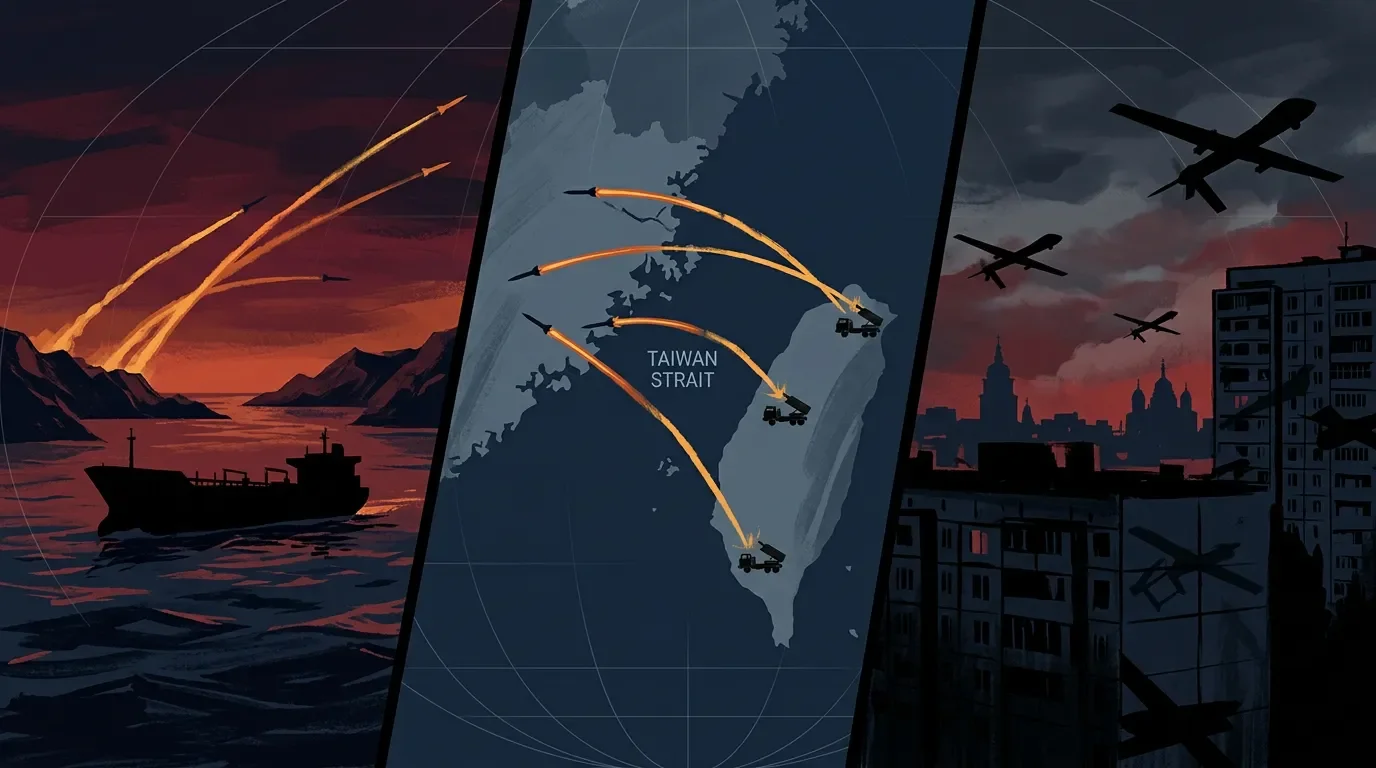
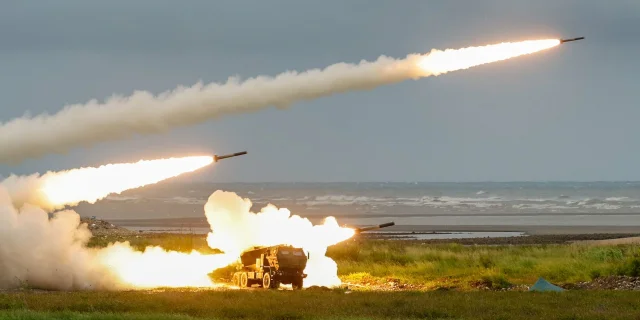
Taiwan fired 32 rockets from truck-mounted HIMARS launchers into the Taiwan Strait on Wednesday — the first time the US-supplied High Mobility Artillery Rocket System has been fired into the strategic waters directly facing mainland China.13 The drill, conducted from a site near a river-mouth on Taiwan's western coast — a potential Chinese landing zone — was part of a two-day invasion-defense exercise.14
The Taiwan Affairs Office of China's State Council responded that after "peaceful reunification, Taiwan will become an island of peace, security and prosperity" — its standard formulation but issued hours after the HIMARS live fire, which Beijing has never before faced from the island.15 There was no immediate announcement of a PLA exercise response, but Wednesday also saw increased China Coast Guard activity in waters east of Taiwan, continuing a pattern tracked since February 2025.
The US-China espionage dimension sharpened separately: the FBI on Thursday seized 13 websites that the Justice Department said were operated by "suspected Chinese agents" to recruit current and former US security-clearance holders via AI-generated profiles offering consulting payments.16
Supply-chain and market impact. The HIMARS test is a calibrated signal to both Beijing and Washington ahead of a decision on the $14 billion US arms package, still under review. A formal PLA exercise in response would raise transit risk premiums in the Taiwan Strait shipping lane — through which roughly 40% of global container traffic passes — but no such exercise has been announced as of 08:00 UTC. TSMC and other Taiwanese semiconductor stocks remain sensitive to any escalatory exchange.
Key uncertainties. Whether Beijing interprets the HIMARS live fire as a red-line crossing that demands a kinetic response; and how the FBI espionage case feeds into pending legislative action on export controls and outbound-investment restrictions targeting China.
Taiwan HIMARS drill near the Taiwan Strait, June 10, 2026
Taiwan's army fired 32 HIMARS rockets into the Strait on June 10 — the system's first live use in waters facing China. 13

5 · US-China: espionage crackdown and energy-security divergence on Iran

China's response to escalating US-Iran fighting on Thursday was diplomatic, not confrontational: Beijing renewed its call on both sides to "halt fighting and return to dialogue," an appeal that has been a consistent refrain since the war began.17 The Hormuz closure, if sustained, hits Chinese energy security acutely: China imports roughly 40% of its crude through the Strait, and Iran's formal shutdown notice arrives at a moment of heightened US-China trade tensions.18
On the technology competition front, BBVA Research's June 2026 China Economic Outlook noted that global geopolitical tensions are driving military spending to a historic high equivalent to 2.4% of global GDP — a level that is accelerating the structural decoupling of US and Chinese defence-industrial supply chains.19 The June 11 FBI domain seizure underlines that the intelligence competition is running in parallel to the trade and military rivalry.
Supply-chain and market impact. Chinese refiners who have been running down Hormuz-sourced crude inventories will face acute pressure if the closure extends beyond days. Rerouting via the Cape of Good Hope adds roughly 15–20 days to Gulf-to-China voyage times, lifting tanker day-rates and tightening near-term VLCC availability. Malaysia, which was noted in a separate NST analysis on Thursday as a beneficiary of US-China tech rivalry, is among the South-East Asian economies where semiconductor supply-chain investment is accelerating as firms seek to reduce China-concentration risk.20
Key uncertainties. Whether China will use its energy vulnerability to push Iran harder on negotiations, or use the Hormuz crisis as leverage in its own bilateral talks with Washington; and how quickly US forced-labour tariffs (July 24 deadline) interact with a Hormuz-driven supply shock.

このコンテンツについて、さらに観点や背景を補足しましょう。

  • ログインするとコメントできます。