The fiber gap: why the nutrient most professionals ignore is quietly wrecking their blood sugar (and their afternoon focus)

The fiber gap: why the nutrient most professionals ignore is quietly wrecking their blood sugar (and their afternoon focus)

Most professionals track protein and fear sugar — but fiber is the third variable quietly determining whether your blood glucose stays stable through your peak cognitive hours. This guide explains the viscous-fiber mechanism that flattens the glucose curve, the gut-brain connection via short-chain fatty acids, where the desk fiber gap is widest (breakfast and midday), and four desk-ready upgrades that add 12–15g of fiber to your workday without a new meal routine.

Daily Fuel for Peak Performance
2026/6/16 · 8:08
購読 1 件 · コンテンツ 13 件
You probably track your protein. You definitely watch your sugar. But there's a third variable quietly running your blood sugar — and your afternoon focus — that most professionals barely think about.
Fiber. The average American gets 10–15 grams per day. The recommended intake is 25–38 grams. 1 That gap isn't a minor shortfall. It's the difference between a glucose curve that supports four focused hours and one that delivers a 2pm wall.

🧠 Why fiber is a brain-performance variable, not just a digestion variable

Here's the mechanism most people miss: when you eat carbohydrates alongside viscous (soluble) fiber, the fiber forms a gel in your small intestine that physically slows glucose absorption into the bloodstream. 2 The result isn't just a slower peak — it's a flatter curve overall, which means a longer window of stable energy before your brain starts looking for its next glucose hit.
Without fiber, a starchy or sugary meal sends a fast glucose spike, triggers a proportional insulin response, and sets you up for a drop 60–90 minutes later. That drop is the crash. The fix isn't avoiding carbs — it's pairing them with fiber.
チャートを読み込んでいます…
The red line is what's happening on a bagel-and-coffee morning. The green line is what happens when that same amount of carbohydrate arrives wrapped in fiber — same calories, same work meeting, very different prefrontal cortex an hour and a half later.

⚡ The gut-brain connection: fiber's second job

Fiber doesn't stop at blood sugar stabilization. When soluble fiber reaches your large intestine, gut bacteria ferment it into short-chain fatty acids (SCFAs) — primarily butyrate, acetate, and propionate. 3 Those SCFAs do several things that matter for cognitive performance:
  • Butyrate is the primary fuel for the cells lining your colon, and it also signals to the vagus nerve — the main communication highway between your gut and brain
  • Propionate plays a role in regulating dopamine synthesis pathways 4
  • Acetate crosses the blood-brain barrier and has direct effects on appetite regulation and focus signaling
A gut consistently fed adequate fiber is producing a steady SCFA output. A gut running on processed, low-fiber office food is producing far less — and that deficit shows up as brain fog, low motivation, and the kind of flat, scattered focus that doesn't respond to another coffee.

🥑 The desk fiber gap: where professionals actually fall short

統計カードを読み込んでいます…
Most of the fiber deficit happens across three predictable points in the workday:
Eating windowTypical fiber intakeTarget
Breakfast (7–9am)2–4g (toast, Greek yogurt, granola bar)8–10g
Bridge snack (10–11am)0–1g (crackers, protein bar)4–6g
Functional lunch (12:30–1:30pm)4–6g (sandwich, salad without legumes)10–12g
The dinner window isn't the problem — most people eat vegetables in the evening. The problem is the morning and midday windows, when your brain is doing its heaviest lifting and your fiber intake is the lowest.
A close-up overhead shot of colorful mixed beans and legumes, representing fiber-rich whole foods
Fiber-rich legumes and beans — among the most effective per-gram blood sugar stabilizers available at the grocery store 5

🔒 The Power Snack fiber upgrade

The Power Snack Formula (Protein + Fiber + Healthy Fats) has already been covered in this channel, but it's worth being explicit about what the fiber component needs to do mechanically: at minimum 3 grams per snack, ideally 5–6g, to meaningfully slow the glucose curve. Here's what 5g+ of fiber looks like in desk-friendly form:
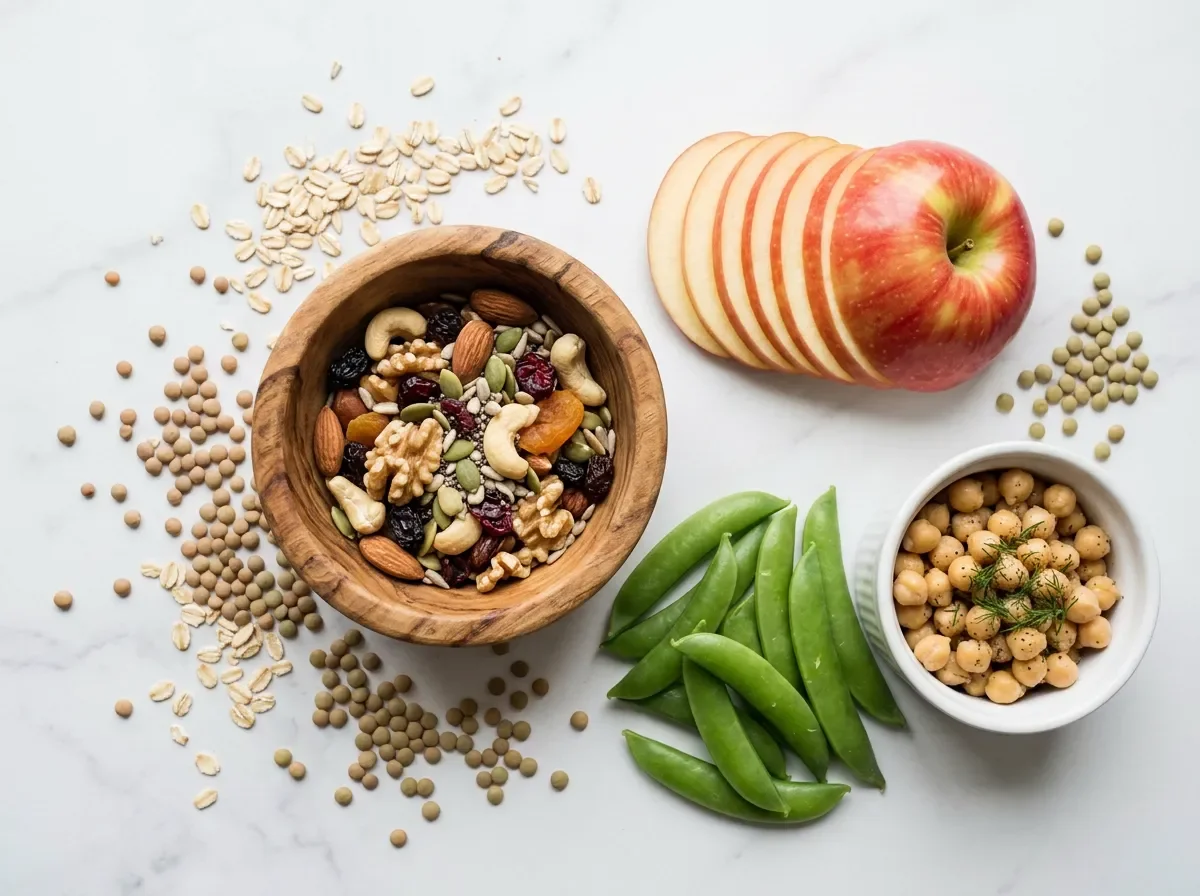
  • Apple (medium) + 2 tbsp almond butter → ~4.5g fiber from the apple skin + pectin; the almond butter adds fat to further blunt the glycemic response
  • ½ cup hummus + carrot sticks or bell pepper strips → ~6–7g fiber; chickpeas and raw vegetables are a high-fiber pairing that also delivers protein
  • Wasa crispbread (2 slices) + string cheese → ~4g fiber from the rye crispbread vs. ~0.5g from regular crackers — the swap alone triples your fiber hit
  • ½ cup roasted chickpeas → ~6g fiber, shelf-stable, no refrigeration needed; the crunchiest option for a desk drawer
Notice the pattern: the fiber source is usually the carbohydrate portion of the snack. Swapping low-fiber carbs (refined crackers, pretzels, granola bars) for high-fiber alternatives is the single highest-leverage move.

💧 Two micro-habits that don't require planning

1. The fiber anchor rule. Every time you eat a carbohydrate-containing food, pair it with a fiber source before you eat the carbohydrate. Sequence matters: eating fiber first delays gastric emptying even more than eating fiber alongside the carb. 6 Vegetables or legumes before the bread, not after.
2. Swap one processed carb per eating window. You don't have to overhaul your diet. Swap the bagel for whole grain toast with skin-on apple on the side. Swap the regular crackers for rye crispbread. Swap the afternoon granola bar for roasted chickpeas. One swap per window — morning, midday, afternoon — adds roughly 12–15g of fiber to your day without a new meal routine.

Your brain isn't running on caffeine and willpower. It's running on a glucose supply that fiber either stabilizes or abandons to chance.
What's your current go-to fiber source during the workday — and do you eat it before, with, or after the carb? Drop it in the comments. 👇

このコンテンツについて、さらに観点や背景を補足しましょう。

  • ログインするとコメントできます。