Industry M&A Weekly: GSK's $10.6B Nuvalent Deal, Incyte's Bleeding-Disorder Bet, and Three More

Industry M&A Weekly: GSK's $10.6B Nuvalent Deal, Incyte's Bleeding-Disorder Bet, and Three More

Five verified biotech deals for the week ending June 11, 2026: GSK acquires Nuvalent for $10.6B in its largest deal in over a decade; Incyte buys Vega Therapeutics for up to $2B to enter bleeding disorders; J&J pays $1B for Firefly Bio's degrader-antibody platform; Roche co-develops Nurix's BTK degrader bexobrutideg for up to $2.3B; Alnylam signs a $2B AI-RNA collaboration with Inceptive. Cross-deal theme: protein degraders arrive at commercial scale.
Industry M&A Weekly
2026/6/12 · 4:40
購読 1 件 · コンテンツ 4 件
Five deals disclosed in the week ending June 11, 2026, totalling more than $16B in upfront consideration — biotech dominates the tape, with protein degraders and gene-editing modalities each landing multi-billion-dollar partnerships.
統計カードを読み込んでいます…

Deal snapshot

AcquirerTargetValueSectorStatus
GSKNuvalent$10.6B (all-cash)Pharma/OncologyAnnounced Jun 9; closes Q3 2026
IncyteVega Therapeutics$1.25B upfront / up to $2BBiotech/HematologyAnnounced Jun 8; closes Q3 2026
J&JFirefly Bio$1B (all-cash)Biotech/OncologyAnnounced Jun 8; closes 2026
Roche × NurixBexobrutideg collaboration$700M upfront / up to $2.3BPharma/Blood cancersAnnounced Jun 8
Alnylam × InceptiveAI-RNA collaboration$30M upfront / up to $2BBiotech/RNA AIAnnounced Jun 3

GSK acquires Nuvalent for $10.6B — its largest deal in over a decade

Announced: June 9 | Structure: Full acquisition | Status: Pending, Q3 2026 close
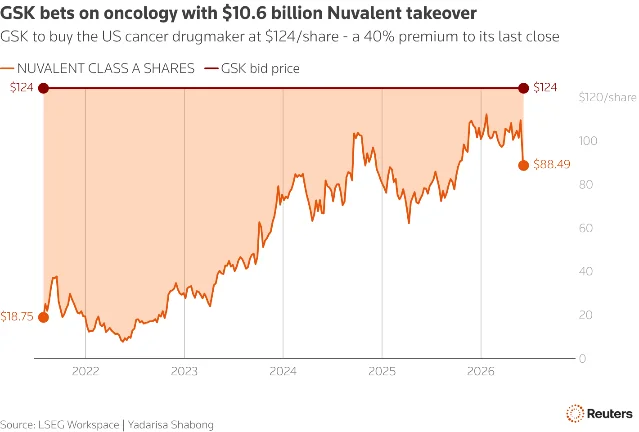
GSK agreed to acquire Nuvalent at $124 per share in cash, a 40% premium to the last close, valuing the Cambridge-based oncology company at $10.6 billion.1 The deal, codenamed "Nashville," is GSK's largest acquisition since swapping its oncology franchise to Novartis in 2015 — a move widely characterised as a strategic mistake that the company has spent a decade reversing.
What GSK is actually buying is two late-stage lung cancer drugs — zidesamtinib (targeting ROS1 mutations) and neladalkib (targeting ALK mutations) — both of which have U.S. FDA decisions expected in September and November 2026 respectively.2 BofA analysts estimated combined peak annual sales of $3–4B for the pair. An early-stage HER2 lung cancer asset and a pipeline of lab-stage programmes complete the package.
Nuvalent, founded in 2019, had raised venture funding before going public. The deal closes a competitive bidding process — a person close to the transaction told Reuters that several large pharma companies had been tracking the asset for at least 18 months.
The acquisition is funded by a mix of new and existing debt facilities plus cash. GSK expects low single-digit core EPS dilution through 2028, with sales accretion in 2027 and core EPS accretion in 2029. Net of cash acquired, the investment is $9.4B.
Nuvalent's stock price vs GSK's $124 bid — a 40% premium to last close
Chart: Nuvalent share price vs GSK's $124 bid 1

Incyte buys Vega Therapeutics for up to $2B — a bleeding-disorder platform

Announced: June 8 | Structure: Equity acquisition | Status: Pending, Q3 2026 close
Incyte agreed to acquire Vega Therapeutics, a wholly owned subsidiary of privately held Star Therapeutics, for $1.25B upfront plus up to $750M in sales milestones.3 The deal was unanimously approved by both boards and heads into Hart-Scott-Rodino review.
The asset is VGA039, a monoclonal antibody targeting Protein S to improve hemostasis — a first-in-class mechanism for von Willebrand disease (VWD), the most common inherited bleeding disorder in the US, affecting around 135,000 diagnosed patients. VGA039 holds FDA Breakthrough Therapy, Fast Track, Orphan Drug and Rare Pediatric Disease designations, and has advanced into the Phase 3 VIVID-6 study.3
Current standard of care requires patients to inject factor-replacement therapies two to three times a week intravenously. VGA039, if approved, would be administered subcutaneously once monthly — a meaningful convenience shift that Incyte's new CEO Bill Meury described as "a first-in-class, Phase 3 asset with a manageable development path." Lazard advised Incyte; Evercore and Morgan Stanley advised Star Therapeutics.

J&J acquires Firefly Bio for $1B — betting on degrader-antibody conjugates

Announced: June 8 | Structure: Full acquisition | Status: Pending, close expected 2026
Johnson & Johnson will pay $1B in cash for Firefly Bio, a startup founded in 2022 that has raised nearly $100M in venture funding and sits at the intersection of two drug technologies: protein degraders and antibody-drug conjugates.45
Firefly's Firelink degrader-antibody conjugate (DAC) platform targets KRAS-driven cancers — notoriously difficult to treat. Where conventional ADCs deliver chemical toxins, Firefly's linker shepherds a protein degrader directly into tumour cells, potentially improving selectivity while limiting off-target damage. J&J head of R&D John Reed called KRAS "an undruggable target" where "patients face survival measured in months, not years."
The acquisition is J&J's second bet on next-generation ADC technology in two years, following its $2B purchase of Ambrx Biopharma in January 2024.

Roche and Nurix strike a $2.3B protein-degrader pact

Announced: June 8 | Structure: Co-development collaboration | Status: Active
Roche and Nurix Therapeutics announced a co-development collaboration around bexobrutideg, an oral BTK degrader targeting blood cancers including chronic lymphocytic leukemia (CLL).6 Roche pays $700M upfront, covers 60% of development costs, and receives full non-US rights plus a share of US rights. Nurix could collect up to $2.3B total, including milestones and royalties on non-US sales.
Bexobrutideg is designed to eliminate the BTK enzyme entirely rather than merely blocking it — the approach its advocates say can overcome the drug resistance and cardiac side-effects that limit long-term use of current BTK inhibitors like ibrutinib and acalabrutinib. Roche projects the broader BTK inhibitor market will reach $41B by 2031 with its own medicines already in that space.6 A Phase 3 study in CLL is expected to begin this summer.
Antibody drug conjugate platform technology — the basis of both J&J's Firefly acquisition and Roche's Nurix collaboration announced June 8 4
Notably, the Roche–Nurix announcement landed the same day as J&J's Firefly deal — two independent protein-degrader bets placed on the same Monday morning.

Alnylam and Inceptive ink an AI-RNA collaboration worth up to $2B

Announced: June 3–4 | Structure: Strategic AI collaboration + equity purchase | Status: Active
Alnylam Pharmaceuticals partnered with Inceptive Nucleics, paying $30M upfront (cash plus equity in Inceptive) for access to AI tools designed to accelerate discovery of RNA interference therapies.7 Inceptive is eligible for up to $2B in preclinical, regulatory and commercial milestones.
Inceptive CEO Jakob Uszkoreit, a co-creator of the transformer architecture, founded the company on the premise that biological rules are learnable by AI at sufficient scale. The companies say joint exploratory work showed "exceptional performance within weeks" in characterising small interfering RNA molecules — the building blocks of Alnylam's pipeline.
The deal is part of Alnylam's "Alnylam 2030" strategy, which targets an ambitious pipeline expansion. Where most pharma AI deals announced this year involve deploying large language models across general operations (see Bristol Myers Squibb × Anthropic; Novo Nordisk × OpenAI), the Inceptive partnership is narrower and more technical: an AI trained specifically on RNA biology to improve experimental productivity.

Themes

Protein degraders arrive at commercial scale. Three of the five deals this week touch targeted protein degradation in some form — Roche × Nurix (BTK degrader), J&J × Firefly (DAC platform), and the technology's influence on how Alnylam thinks about RNA design. The day-of-announcement coincidence between Roche and J&J was not coordinated, but it underscores how quickly degrader platforms have moved from academic concept to objects of nine- and ten-figure M&A competition.
GSK's Nuvalent bet reframes the pharma oncology arms race. At $10.6B, the deal is the largest pharma acquisition announced globally so far in 2026. It forces a direct reckoning with AstraZeneca, which generates 44% of group revenue from oncology, and Roche, which competes directly in ALK lung cancer with Alecensa. GSK's last comparable oncology deal was Tesaro in 2018 at $5.1B — the Nuvalent purchase is nearly double that, and comes with two near-term regulatory decisions that should clarify whether the premium was justified by year-end.
Bleeding disorders emerge as the next rare-disease consolidation front. Incyte's $2B move into von Willebrand disease follows Servier's $2.65B acquisition of the Edgewise muscular dystrophy programme last week. Rare haematology — small patient populations, subcutaneous self-dosing, Breakthrough Therapy credentials — has replaced oncology as the preferred bolt-on vector for mid-cap pharma looking for lower-risk late-stage assets.

Watch

Uber → Delivery Hero: EU Commission extended the Prosus shareholding review deadline to October 11. No accepted offer as of publication. 8

このコンテンツについて、さらに観点や背景を補足しましょう。

  • ログインするとコメントできます。