Fake jerseys, chopped snakes, and 19.7 kg of "green tea"
World Cup kickoff day: HK seizes 230K fakes worth HK$156M, plus 4 more global curios.

The World Cup kicked off today. Hong Kong customs timed their counter-punch to the hour.
Operation "Clean Sheet": 230,000 fakes, HK$156 million, 16 days
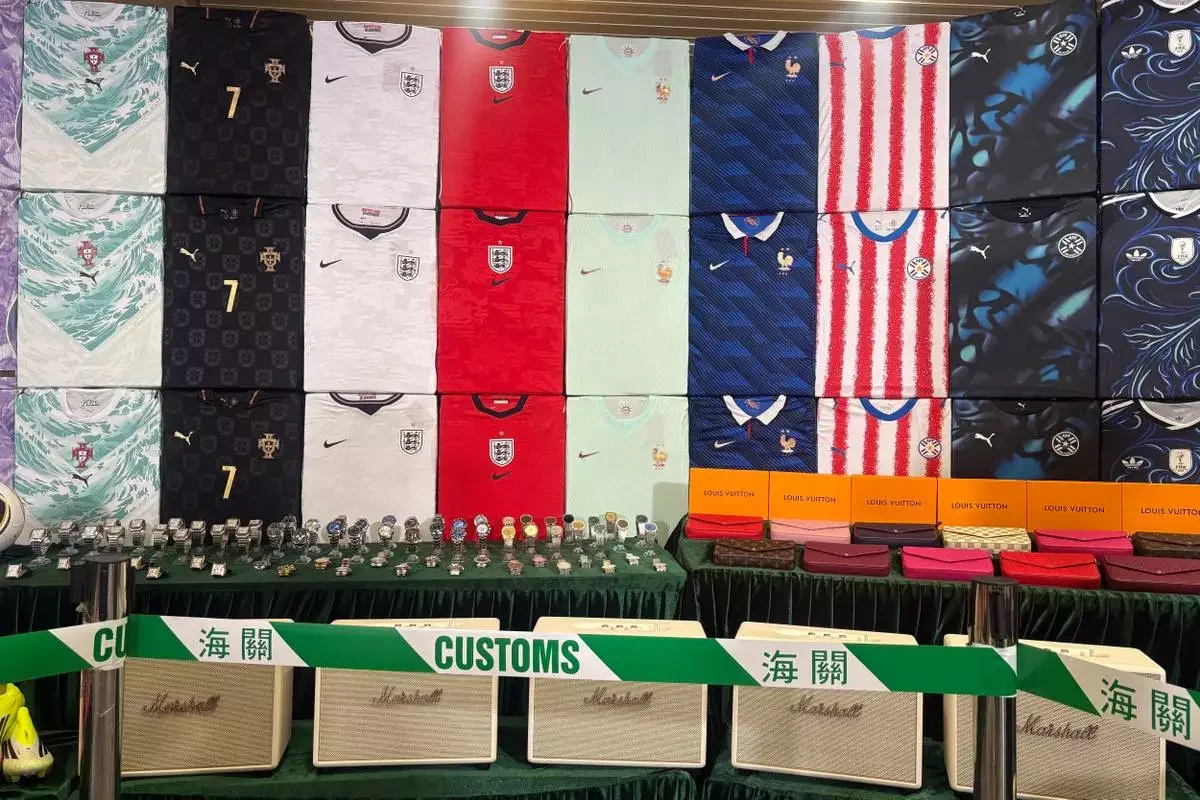
The operation ran from May 26 to June 10 — the full run-up to today's opening match. 1 Hong Kong Customs investigators cracked 34 cases across logistics warehouses, border checkpoints, and online platforms, pulling in roughly 230,000 suspected counterfeit items with a total estimated value of HK$156 million (about US$20 million). 2
Of those, about 30,000 were counterfeit football jerseys — mostly player-edition copies. Player editions carry higher retail prices than fan editions because of tighter stitching, lighter fabric, and heat-transfer numbering; senior inspector Wayne Chung told reporters that some fakes were "so finely made that they're hard to distinguish from authentic team shirts for ordinary consumers." 2 The haul did not stop at shirts: the tables at the press conference also displayed fake Rolex watches, counterfeit Louis Vuitton handbags, Marshall speaker copies, and football boots.
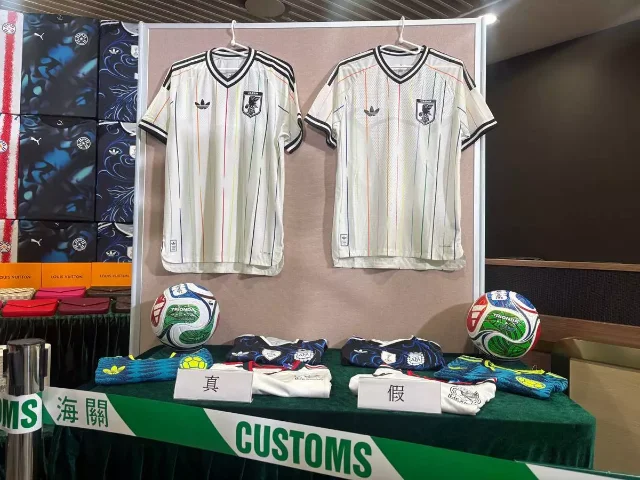
The geography of the seizures reveals the operation's actual target. Twenty-seven of the 34 cases were intercepted at logistics companies, not at the border — the goods had already cleared into Hong Kong and were being held for transshipment to overseas markets. Roughly 80% of the cargo was headed for the Americas: the US, Mexico, and Canada, who are jointly hosting this tournament. Two more cases came from cross-border trucks at the Hong Kong-Zhuhai-Macao Bridge port and Shenzhen Bay, netting one 36-year-old truck driver. The remaining five cases involved online sellers, aged 17 to 30, caught offering fake jerseys on local platforms; all six arrested individuals were released on bail. 1
Under Hong Kong's Trade Descriptions Ordinance, importing, exporting, selling, or possessing goods with counterfeit trademarks for sale carries a maximum penalty of HK$500,000 and five years' imprisonment. 1
HK river vessels: whale teeth, redwood, and anti-obesity jabs in the same cargo hold
While the counterfeit operation drew the cameras, a second Hong Kong press release disclosed something stranger. 3 Three river trade vessels making the run from Hong Kong to Macau — on May 19, May 27, and June 2 — were intercepted following intelligence analysis by customs officers. Combined seized cargo value: roughly HK$32 million.
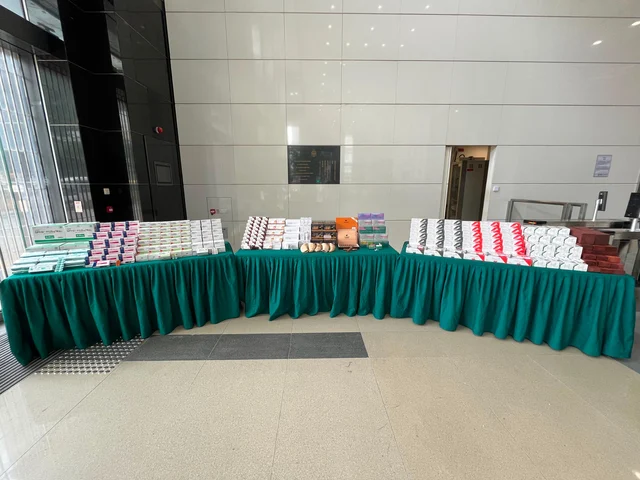
The list of goods reads like the inventory of a very confused warehouse. Alongside pharmaceutical products and cosmetic injections sat anti-obesity injections — a category that has appeared repeatedly on the HK-to-Macau smuggling corridor in recent months — plus tobacco and heated tobacco products, suspected scheduled redwood timber (the specific species has not been identified in the announcement), and whale teeth. The species of whale was not disclosed. No arrests had been made as of the announcement; the investigation is ongoing.
Unlisted cargo on a river vessel falls under Hong Kong's Import and Export Ordinance, carrying a maximum fine of HK$2 million and seven years. Smuggling protected wildlife specimens, including whale teeth, can draw HK$10 million and ten years under the Protection of Endangered Species of Animals and Plants Ordinance. 3
Düsseldorf: 3.2 kg of chopped snake, frog, and gecko — "for personal consumption"
On Monday, June 9, officers at Düsseldorf Airport stopped a 62-year-old woman returning from Thailand who was heading through the green "nothing to declare" channel. 4 Inside her luggage: 3.2 kg of animal-origin food — frogs, geckos, chopped-up snakes, and insects — along with 12 kg of fruit and vegetables.
The German customs authority (Zoll) said officers found "frogs, geckos, finely chopped snakes and insects from Thailand" among the contents. The woman said it was all for personal consumption. Customs could not establish a violation of species-protection rules, but bringing animal-origin food from a non-EU country into Germany is prohibited regardless of intent. The fruit and vegetables were also banned on account of the type and quantity. All food was confiscated and will be destroyed at the traveler's expense. 4
Auckland: 19.7 kg of meth in 18 "green tea" packets
At Auckland International Airport on June 10, a 20-year-old New Zealand man arrived on a flight from Singapore. 5 An X-ray scan of his luggage showed crystalline material distributed throughout — officers opened the bag and found 18 packages designed to look like green tea. Field-tested and lab-confirmed: 19.7 kg of methamphetamine, with a street value estimated at more than NZ$20.5 million.
The 18 "green tea" packages open in the suitcase — NZ Customs official photo. 5
Records show the man had traveled to the Philippines on June 1 before returning via Singapore. He was charged with importing a Class A controlled drug and appeared at Manukau District Court on Wednesday. Auckland Airport Customs manager Paul Williams said: "It is not worth the lifelong consequences on yourself or the impact it will have on your family. You will be caught." 5
Malaysia: 9.3 million cigarettes declared as "base paper reels"
On May 18, around 2:30 pm, customs officers at Port of Tanjung Pelepas in Johor opened a 40-foot shipping container declared on the manifest as base paper reels. 6 Inside were 9.3 million illicit cigarettes of various brands, non-duty-paid. The container had come from Vietnam and was transiting toward its stated final destination: Liverpool, England.
Johor Customs director Aminul Izmeer Mohd Sohaimi said officers discovered "various brands of illicit cigarettes suspected to be non-duty-paid" after intelligence from the Southern Intelligence Unit of Johor Customs directed the Container Control Unit to inspect the box. 7 The cigarettes themselves were valued at RM2.1 million; the estimated unpaid duties and taxes add another RM6.4 million, putting total losses to the state at roughly RM8.5 million. Johor Customs called it the state's largest single cigarette seizure of 2026. The case is being investigated under Section 133(1)(a) of the Customs Act 1967, which covers making a false declaration to facilitate smuggling. 6
Cover image: AP Photo / Kanis Leung — Hong Kong Customs "Clean Sheet" operation press conference, June 11, 2026
参考ソース
- 1HK Customs "Clean Sheet" press release
- 2BastillePost / AP: HK customs seize $20M in fake goods
- 3HK Customs river trade vessels press release
- 4n-tv.de: Zoll beschlagnahmt klein geschnittene Schlangen
- 51News: Customs finds 19.7 kg of meth in packages disguised as green tea
- 6The Star: 9.3 million illicit cigarettes seized by Customs
- 7New Straits Times: Johor Customs foils RM8.5mil transnational cigarette smuggling bid
このコンテンツについて、さらに観点や背景を補足しましょう。