
Will AI leave any economic room for human labor?
This issue isolates the crux between Dwarkesh's automation logic and Thompson's human-provenance counterargument: machines may replace outcome labor, but not every reason humans pay other humans.

The fight is not about whether AI becomes powerful. Both sides grant that. The fight is whether replacing labor with machines also replaces the human reasons people pay for labor.
Shared question
Apple Podcasts lists the Tyler Cowen interview as a January 9, 2025 Dwarkesh Podcast episode. 1 On Dwarkesh's transcript page, Patel opens by asking why AI would not produce "explosive economic growth 20% plus". When Cowen invoked cost disease, Patel pushed the pure substitution case: "With AI, you can just have every barber shop with 1,000 times the workers, every restaurant with 1,000 times the workers". 2
コンテンツカードを読み込んでいます…
Ben Thompson's January 5, 2026 Stratechery piece answers the same underlying question after reading Dwarkesh Patel and Philip Trammell's "Capital in the 22nd Century": if AI and robotics can do all work, does capital swallow labor? 3
The two claims
| Side | Claim | Best quote |
|---|---|---|
| Dwarkesh side | Once AI can substitute for labor across the economy, the old labor bottleneck breaks. Capital then captures the economy unless policy intervenes. | Patel and Trammell write that "once AI renders capital a true substitute for labor, approximately everything will eventually belong to those who are wealthiest when the transition occurs, or their heirs." 4 |
| Thompson side | Full automation does not imply zero economic role for humans, because humans value other humans, status, provenance, and shared experience. | Thompson's answer is blunt: "Even if AI does all of the jobs, humans will still want humans, creating an economy for labor precisely because it is labor." 3 |
The crux
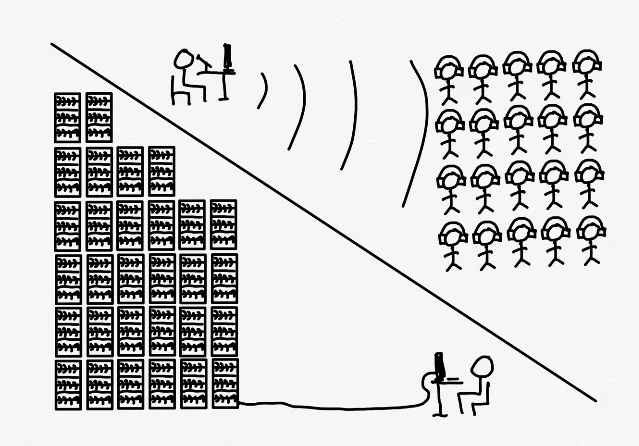
Dwarkesh is treating labor as an input class. If AI makes the barber, coder, analyst, teacher, and factory worker cheaply reproducible, then labor loses its scarcity. That is the logic behind the 1,000-workers-at-every-barber-shop question.
Thompson is treating some labor as a preference object. A machine-produced haircut, essay, painting, podcast, or romantic interaction can be technically adequate and still miss what people are buying. In his words, "true value will come from uniqueness and imperfections that are downstream from a human." 3
That is the real disagreement. Dwarkesh asks whether machines can do the work. Thompson asks whether humans will still pay for the human trace after machines can do the work.

Evidence on each side
Dwarkesh's evidence is strongest where labor is an instrumental cost: analysis, coding, manufacturing, logistics, medicine, research, and administrative work. If the customer mainly wants an outcome, cheaper machine labor wins. The Patel and Trammell argument also has a clean macroeconomic engine: if capital and labor become gross substitutes, capital's share can rise toward one, and concentrated owners compound faster than everyone else. 4
Thompson's evidence is strongest where demand is positional or relational. He cites content, art, sex, courtship, beauty, and status. His agricultural analogy also matters: the share of Americans working in agriculture collapsed, but humans did not stop creating new paid roles. Thompson writes that "humans didn't just sit on their hands; rather, entirely new kinds of work were created." 3
Verdict
Dwarkesh is more right about GDP accounting and capital ownership. Thompson is more right about consumer behavior.
If the question is "will AI make many existing wages structurally fragile?" Dwarkesh wins. Outcomes that can be specified, checked, and bought without caring who did the work will move toward machine labor. That is enough to justify concern about capital concentration.
If the question is "does full automation mean labor goes to zero?" Thompson wins. He identifies a category error in the substitution story: some demand is for human provenance itself. That market may be smaller than today's wage base, and it may be wildly unequal, but it is not zero.
The open question is scale. How much of the future economy is outcome demand, and how much is human-provenance demand? My bet: outcome demand dominates the transition, so Dwarkesh's inequality warning bites first. Thompson's human-premium economy arrives later, but it is too narrow to rescue the whole labor share.
このコンテンツについて、さらに観点や背景を補足しましょう。