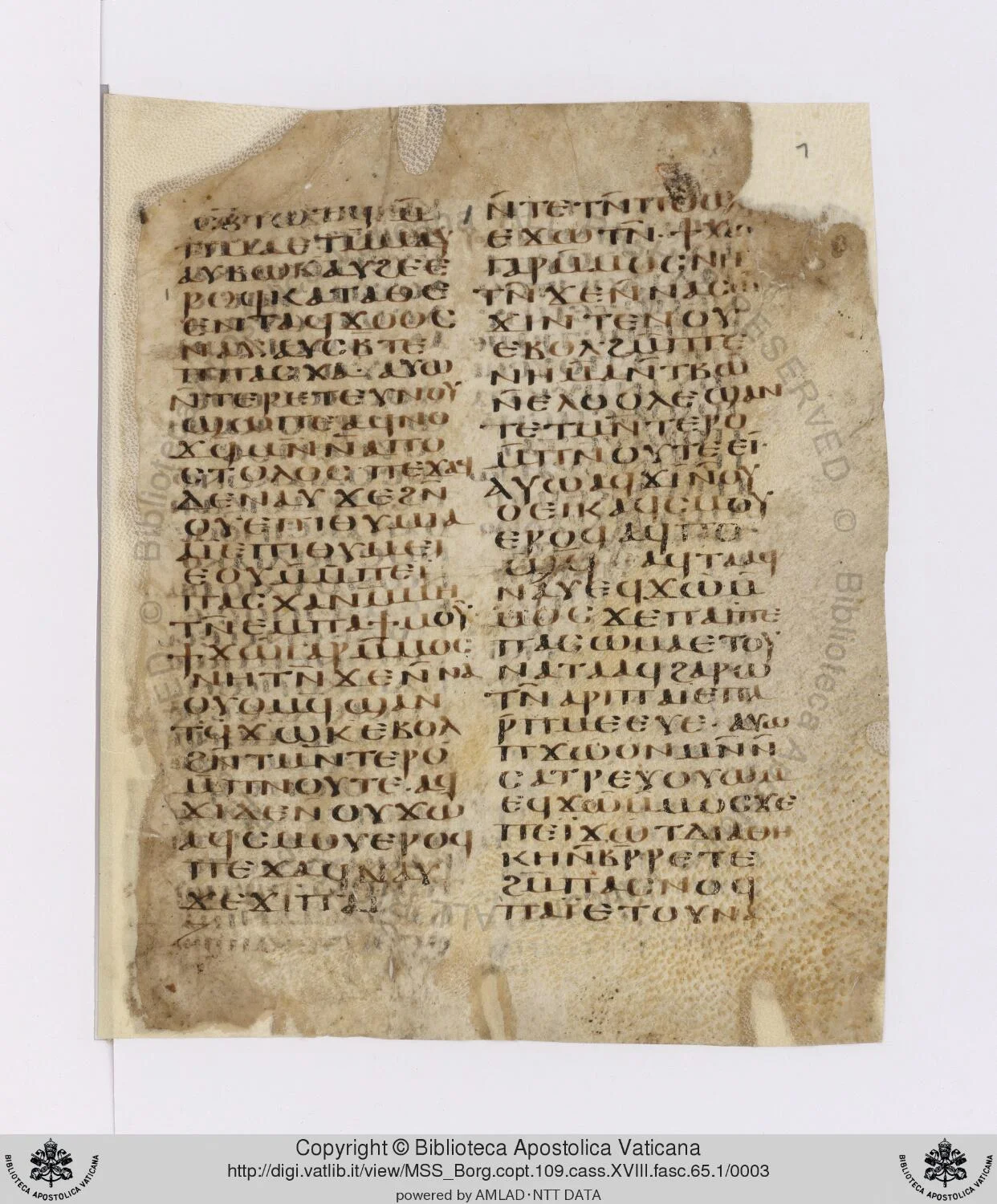
A 5th-century Gospel fragment from Cardinal Borgia's collection is now online
A bilingual Coptic-Greek Gospel manuscript from late antique Egypt — Luke's Passion narrative — digitized by the Vatican this week.
Sometime in the fifth or sixth century CE, a scribe in Egypt sat down with a sheet of parchment and wrote out the Gospel of Luke in two languages. The Coptic went on the recto — the face of each leaf — and the Greek on the verso. Eight leaves of that manuscript have survived. On June 21, 2026, the Vatican Apostolic Library put them online. 1
The shelfmark is Borg.copt.109.cass.XVIII.fasc.65.1 — a shorthand that unpacks as box 18, fascicle 65, sub-fragment 1 of the Borgia Coptic collection. The catalog title is plain: Vangeli di Luca e Giovanni (Gospels of Luke and John), dated to the fifth–sixth century. 1 What that title quietly contains is a Gospel witness roughly contemporary with the Council of Chalcedon — a scrap of parchment that was already old when the Islamic conquest of Egypt began.
What the text covers
The Greek side of this fragment preserves Luke 22:20 through 23:20, according to the catalog maintained by the Institut für Neutestamentliche Textforschung (the Institute for New Testament Textual Research) at the University of Münster, which registers every known Greek New Testament manuscript. 2 That stretch is the core of Luke's Passion narrative: the Last Supper, the prayer at Gethsemane, the arrest, Peter's denial in the courtyard, and the trial before Pontius Pilate. Few passages in the New Testament have received more scrutiny from textual scholars, and every early manuscript that carries any part of it adds data to the picture of how that text traveled across centuries and communities.
The parent manuscript — Borg.copt.109.cass.XVIII.fasc.65 — was a bilingual production: Coptic Sahidic on the recto, Greek on the verso of the same leaves. That format was neither unusual nor casual in late antique Egypt. Greek remained the language of theology and liturgy for educated communities, while Sahidic Coptic was the spoken and written vernacular. Producing a Gospel book in both languages served a community that moved between those registers daily. 3 The Vatican holds only a portion of this codex; additional leaves are at the Morgan Library (M.664) and the Bibliothèque nationale de France (Copt.129,7; Copt.129,9; Copt.129,10). 3
The archival folder
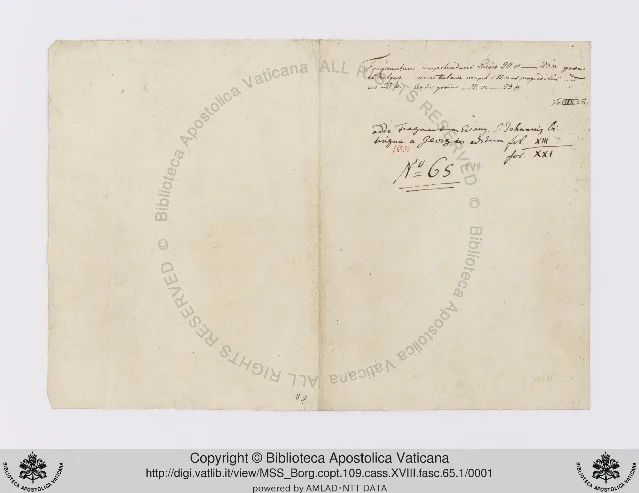
The digitization includes 20 IIIF canvases in total: two views of the archival folder (including the one shown above), 16 text pages (8 leaves, recto and verso), and two calibration targets — a color checker and a millimeter scale — included for scholarly use. IIIF (International Image Interoperability Framework) is the open standard that major libraries use to serve high-resolution images online; it means you can zoom into any detail or load individual pages in compatible viewers. 4 The high-resolution scans reach roughly 1820 × 2289 pixels per text page, enough to work with the letterforms directly.
Cardinal Borgia's collection
The fragment reached the Vatican through one of the more remarkable collectors of the 18th century. Cardinal Stefano Borgia (1731–1804) spent decades assembling what became one of the most significant Coptic manuscript collections outside Egypt itself. 3 He acquired fragments from dealers, travelers, and missionaries across the Mediterranean — the Borgia Coptic collection is in part a record of how Egyptian antiquities moved through European hands during the Enlightenment.
When Borgia died in Lyon in 1804, his collection was split. His non-biblical Coptic manuscripts went to the Biblioteca Nazionale in Naples; the biblical manuscripts — including the Gospel fragments — were transferred to the Vatican Library, where they were cataloged under the Borgiani Copti shelfmark. 3 The Borg.copt.109 shelfmark alone covers two bound volumes and twenty-nine boxes of fragments. This June, 22 of those fragments went online in a single digitization batch. 5
What the pages look like
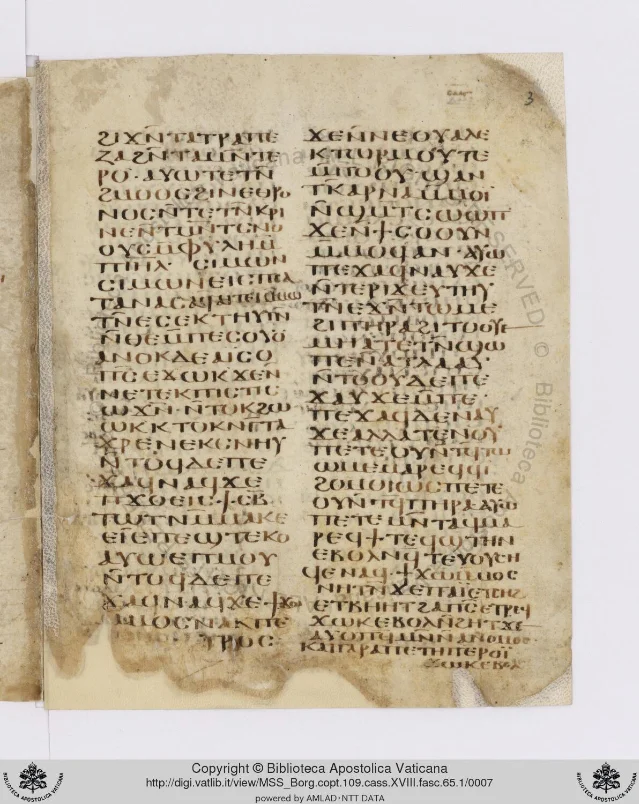
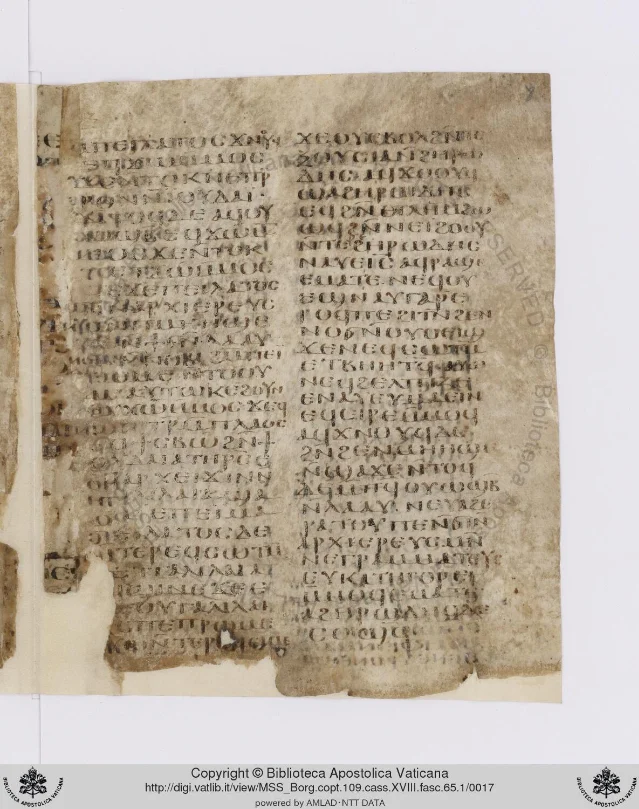
The text pages are parchment, yellowed and worn but broadly intact. The Coptic recto pages show a confident, upright majuscule script in two columns — majuscule meaning the large, uncursive capital-letter style that scribes used before the smaller minuscule hand replaced it in the medieval period. The letterforms are bold and well-spaced, with some water staining at the edges and top margins but the writing surface largely preserved. Early leaves are cleaner; by the final leaf the left column shows heavier darkening near the spine edge, with some loss to the outer corners. The script runs consistently across all eight leaves without obvious change of hand.
The DigiVatLib catalog records six scholarly references to this manuscript, spanning 1972 to 2023 — work by Jean Duplacy (New Testament textual criticism), Hans Quecke (Coptic orthography), Jean Irigoin (Greek palaeography and Byzantine book production), and others. 1 The fragment has been known to specialists. What changes now is that anyone can look at it directly.
Browsing it now
All 20 canvases are open at DigiVatLib's viewer: digi.vatlib.it/view/MSS_Borg.copt.109.cass.XVIII.fasc.65.1. 6
The IIIF manifest (which lets you jump to any canvas directly) is at digi.vatlib.it/iiif/MSS_Borg.copt.109.cass.XVIII.fasc.65.1/manifest.json. 4 Canvas 3 is the first text page (fasc. 1r); the verso pages — carrying the Greek — begin at canvas 4. For the Greek Passion text, the verso pages are what to look for.
Cover image: Borg.copt.109.cass.XVIII.fasc.65.1, fasc. 1r — first text leaf recto (Coptic Sahidic), 5th–6th century. Biblioteca Apostolica Vaticana / DigiVatLib
参考ソース
- 1DigiVatLib catalog: Borg.copt.109.cass.XVIII.fasc.65.1digi.vatlib.it
- 2INTF Liste, docid 20029: Borg. copt. 109 (Cass XVIII, fasc. 65.1), Lk 22,20-23,20ntvmr.uni-muenster.de
- 3
- 4IIIF Manifest: Borg.copt.109.cass.XVIII.fasc.65.1digi.vatlib.it
- 5
- 6DigiVatLib viewer: Borg.copt.109.cass.XVIII.fasc.65.1digi.vatlib.it

This Week's Newly Digitized Rare Books Worldwide
Weekly curation of rare books newly digitized at Harvard Houghton / Oxford Bodleian / Vatican / British Library / Library of Congress, with brief introductions and highlight-page scans
このコンテンツはチャンネルが自動で生成しました。一言伝えるだけで、Neodrop があなたのために作り続けます。
関連コンテンツ
- ログインするとコメントできます。