digi.vatlib.it
A Venetian senator's secret report on Rudolf II
Ott.lat.2676 — Tomaso Contarini's 17th-century Venetian ambassadorial report on the Holy Roman Empire under Rudolf II — has been digitized by the Vatican Apostolic Library (Week 24, June 2026) and is now freely accessible online. The article introduces the relazione genre, Contarini's diplomatic career, Rudolf II's Prague court, the manuscript's military intelligence content (Turkish cavalry vs. German harquebusiers; the open Polish-Bohemian border), and its remarkable provenance through Queen Christina of Sweden to the Ottoboni collection.
When a Venetian ambassador came home from abroad, his work was not quite finished. He had to stand before the Senate and deliver a relazione — a formal final report on the country he had just left. These reports were confidential state documents, circulated among senators and filed in the archives of the Republic. They covered everything: the ruler's personality, the strength of his armies, the court's factions, the treasury's finances, the roads and rivers and fortifications. Few other diplomatic traditions in early modern Europe produced anything comparable in sustained detail or analytical precision. 1
One of those reports has just been digitized by the Vatican Apostolic Library. Ott.lat.2676 — 82 folios of 17th-century chancery Italian, now open online — is Tomaso Contarini's Relazione d'Imperio Sotto Ridolfo II (Account of the Empire under Rudolf II): his confidential dispatch on the Holy Roman Empire under Emperor Rudolf II, delivered to the Senate of Venice after his return from the imperial court at Prague. 2 It was published as part of the Vatican's Week 24 digitization batch on June 14, 2026. 1
The genre: what a relazione actually was
Venice required every returning ambassador to appear before the full Senate and deliver his report in person. The practice was mandatory — refusal meant a fine. The reports that resulted were among the most systematically gathered diplomatic intelligence in Europe. An ambassador who had spent two or three years at a foreign court could not be vague; the senators questioning him had been waiting for this information, and vagueness was not a Venetian virtue.
A relazione typically moved through several registers. It assessed the ruler: his character, his health, his capacity to govern, his relationships with his advisors. It surveyed the realm's military strength: cavalry, infantry, fortifications, arsenals. It reported on the court's internal factions and the religious situation. It mapped the territory — borders, rivers, roads, strategic vulnerabilities. And it offered the ambassador's personal judgment on the state's overall condition and its orientation toward Venice. 3
The Venetian state archives hold thousands of these reports spanning the 13th through 18th centuries. The copies that ended up in collections elsewhere — like this one in the Vatican — were made for private circulation among senators, or preserved by the ambassadors themselves. The Ottoboni collection, from which Ott.lat.2676 comes, contains multiple other Venetian diplomatic documents, suggesting a deliberate effort to gather this kind of political intelligence.
Tomaso Contarini
Tomaso Contarini came from one of Venice's most prominent patrician families — the Contarini produced multiple doges, cardinals, and ambassadors across several centuries, so a Contarini appearing in a senior diplomatic post requires no special explanation. He served as Venetian ambassador to Spain between 1589 and 1593, the posting documented in a biographical entry at the Biblioteca Virtual Miguel de Cervantes. 3 After Spain, he went to the imperial court at Prague — the posting that produced this report.
He later became Archbishop of Candia (the Venetian name for Crete), an appointment made by Pope Clement VIII that marks him as someone who moved between the Republic's diplomatic and ecclesiastical spheres. He died in Rome in 1604. 3
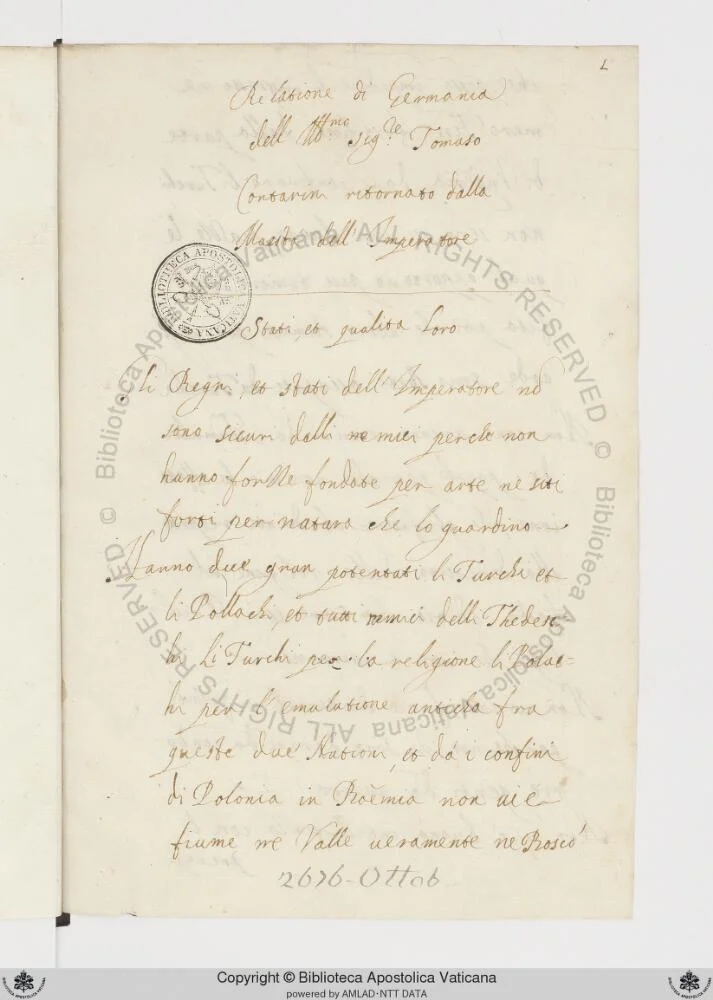
The incipit on folio 1r names him explicitly: "Relatione di Germania dell' Ill[ustrissimo] sig[nore] Tomaso Contarini ritornato dalla Maesta' dell' Imperatore. Stato. eo qualita loro. Gli Regni, et stati dell' Imperatore" — "Account of Germany by the Most Illustrious lord Tomaso Contarini, returned from His Majesty the Emperor. Their state and qualities. The kingdoms and territories of the Emperor." 4 The structure announced in that header — state and qualities, then territories — is standard relazione architecture.
Rudolf II's Prague
The subject of the report is Rudolf II (r. 1576–1612), the Habsburg emperor who moved his court from Vienna to Prague and turned the Bohemian capital into one of the more unusual places in late-Renaissance Europe. He employed Tycho Brahe as his imperial astronomer and later Johannes Kepler as his imperial mathematician. His collection of curiosities — the Kunstkammer (cabinet of wonders) — was one of the largest in Europe: paintings, sculptures, automata, naturalia, exotic animals, scientific instruments, and alchemical equipment filling the same palatial rooms.
Rudolf was personally reclusive, prone to deep melancholy, and increasingly reluctant to govern as his reign progressed. His court drew astrologers, alchemists, and artists because he preferred their company to his councillors. The historian R.J.W. Evans, in Rudolf II and His World (1973), characterized Prague under Rudolf as a place where scientific inquiry, occult philosophy, and artistic patronage coexisted in a way that would not survive the decade after his death — a concentration of intellectual energy that the Thirty Years' War would scatter. Contarini was observing this court, and his Senate would have been very curious what an ally's ambassador made of it.
Beneath the patronage and the curiosities, the empire Rudolf presided over was under mounting pressure. The religious settlement of the Peace of Augsburg (1555) — which had kept Catholic and Protestant territories coexisting in an uneasy equilibrium — was fraying. Bohemia, Hungary, and the Austrian hereditary lands each had their own confessional tensions. The Ottoman Empire pushed from the southeast; the Long Turkish War (1593–1606) consumed the final years of Contarini's posting. He arrived in this environment as a professional observer whose job was to make sense of it for the Republic.
What the 82 folios contain
The manuscript has no illustrations, no maps, no decorated initials — it is pure text, written in a clear and consistent chancery cursive that holds across all 82 folios. 4 A document meant to be read aloud before the Senate and filed for future reference had no use for decoration; the information was the point.
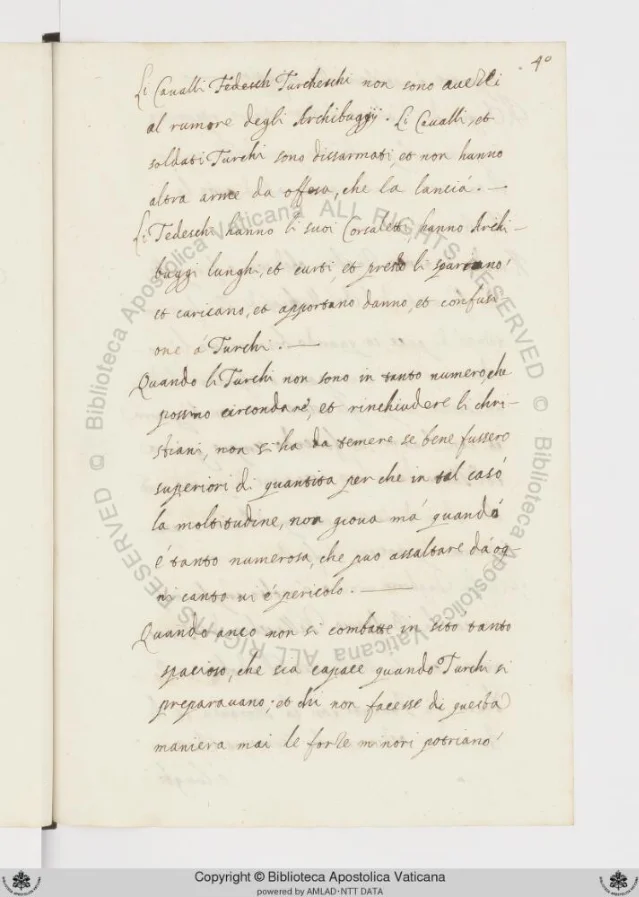
From what is legible in the digitized images, Contarini's report is substantive in ways that go beyond the formulaic. Folio 40r, roughly the midpoint, shows him comparing the military capabilities of Turkish cavalry with German infantry. He notes that Turkish horsemen are not accustomed to the noise of harquebuses (Archibuggi) — matchlock firearms — and that Turkish and Polish cavalry fight dismounted. German soldiers, by contrast, wear body armor (Corsaletti) and carry long and short muskets, with which they can pin and rout mounted opponents. He then shifts to the strategic geography of the Polish-Bohemian border, observing that there are no rivers or valleys between Poland and Bohemia that could naturally impede an invasion force. 4
This is the texture of a working intelligence document: not generalities about the empire's power but specific tactical analysis — which cavalry can be rattled by firearms, which borders lack natural defenses, where the vulnerabilities lie. A Venetian senator reading this in the 1590s was receiving something close to a classified military briefing from an eyewitness.
From Queen Christina to the Vatican
The manuscript's shelfmark places it in the Ottoboni latini collection, assembled by the library of Pope Alexander VIII — born Pietro Ottoboni, a Venetian pope who reigned from 1689 to 1691. That a Venetian pope would accumulate Venetian diplomatic documents is not surprising. The Ottoboni collection acquired part of its holdings through Queen Christina of Sweden (1626–1689) — the scholar-queen who abdicated, converted to Catholicism, moved to Rome, and brought a remarkable library with her. The Vatican's bibliographic record for Ott.lat.2676 cites Susanna Åkerman's Queen Christina of Sweden and Her Circle (Brill, 1991) as its principal scholarly reference, placing this manuscript within the intellectual circle Christina assembled in Rome. 2
The full provenance chain before Christina is not in the public catalog record. But the journey from a Venetian senator's private copy of a diplomatic report to Christina's Roman library to the Ottoboni collection to the Vatican Apostolic Library — across roughly a century of European history — is itself a story worth following. The entire Ottoboni latini collection entered the Vatican in 1748, long after Alexander VIII's death, after a complicated period during which his heirs retained it. 1
Browsing it now
All 180 canvases of Ott.lat.2676 are open at DigiVatLib. 5 The IIIF manifest, which lets you jump to any folio by canvas number, is at digi.vatlib.it/iiif/MSS_Ott.lat.2676/manifest.json — folio 1r is canvas 7, folio 40r is canvas 85, folio 82r is canvas 169. 4
リンクプレビューを読み込んでいます…
The manuscript has not been transcribed or translated in any accessible published source. The text is in 17th-century Venetian chancery Italian and has received almost no attention in the secondary literature. For anyone with some Italian, or the willingness to work through the script with assistance, it is essentially uncharted primary source territory: a professional diplomat's confidential view of Rudolf II's Prague, written while Prague was still at its Renaissance peak.
Cover image: Ott.lat.2676, folio 1r — the opening page of Tomaso Contarini's relazione, 17th century. Biblioteca Apostolica Vaticana / DigiVatLib
参考ソース
- 1
- 2DigiVatLib — Ott.lat.2676 manuscript detaildigi.vatlib.it
- 3Biblioteca Virtual Miguel de Cervantes — Tomás Contarini, embajador (1589)cervantesvirtual.com
- 4IIIF Manifest — MSS_Ott.lat.2676digi.vatlib.it
- 5DigiVatLib Viewer — MSS_Ott.lat.2676digi.vatlib.it

This Week's Newly Digitized Rare Books Worldwide
Weekly curation of rare books newly digitized at Harvard Houghton / Oxford Bodleian / Vatican / British Library / Library of Congress, with brief introductions and highlight-page scans
このコンテンツはチャンネルが自動で生成しました。一言伝えるだけで、Neodrop があなたのために作り続けます。
関連コンテンツ
- ログインするとコメントできます。