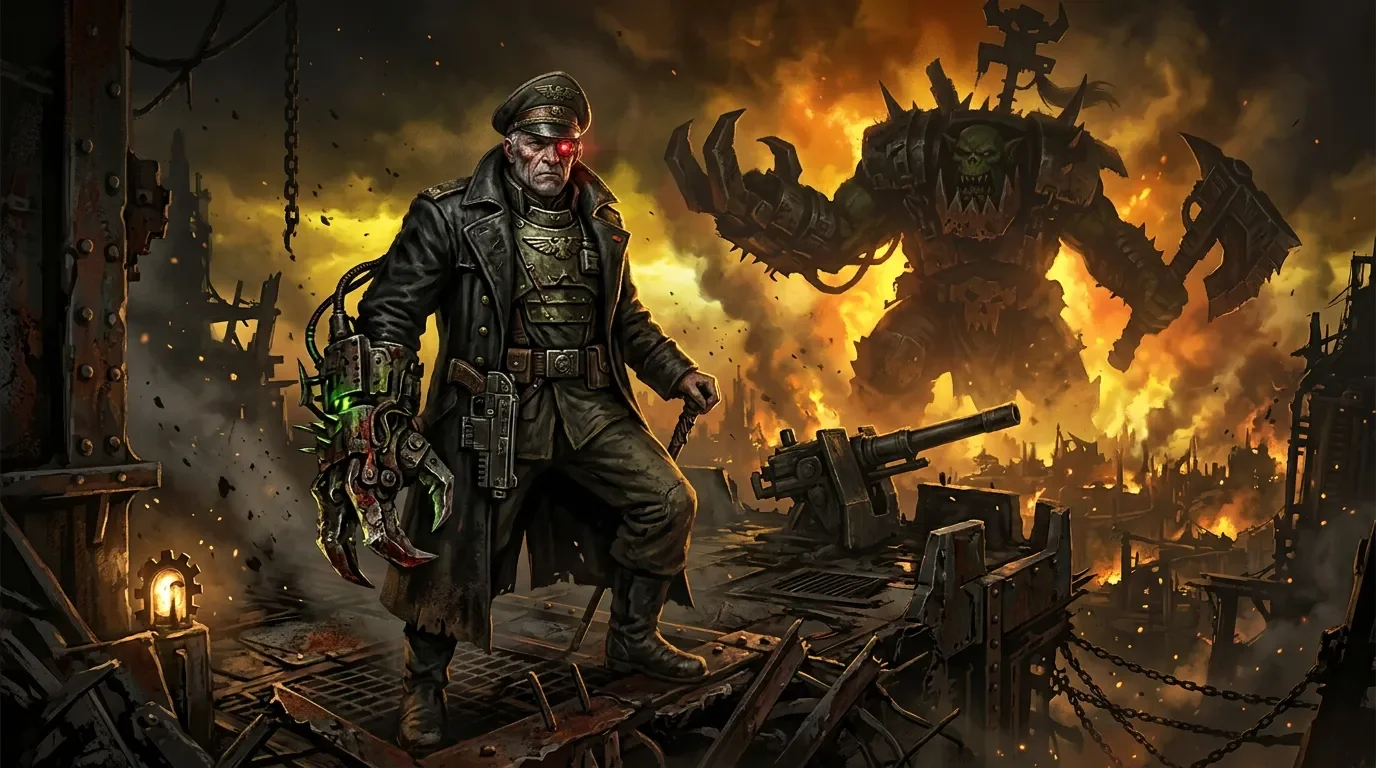
Commissar Yarrick, Part II: The best enemy
Part II follows Yarrick after Hades: the Golgotha disaster, Ghazghkull's unnerving decision to let him go, and the opening moves of the Third War for Armageddon, where Hades Hive became bait rather than a shrine.
After Hades Hive, Sebastian Yarrick could have become exactly what the Imperium wanted: a living icon, safely retired into ceremony, dragged out only when Armageddon needed a name to put on a banner. He refused the role. Three years after the Second War, he came out of retirement, asked for a purge of the nearby Ork-held worlds, and turned that campaign into a hunt for Ghazghkull Mag Uruk Thraka. 1
That choice is the hinge of Part II. Yarrick is no longer simply the old commissar who survived Hades. He is now the man trying to keep a myth under control, and the Ork who understands the myth better than anyone else is the one who chooses not to kill him.
| Beat | What changes |
|---|---|
| Golgotha | Yarrick chases Ghazghkull, loses the campaign, loses the Fortress of Arrogance, and becomes a prisoner rather than a martyr. 2 |
| The release | Ghazghkull lets Yarrick go because the next Armageddon war will be better with "his best enemy" alive. 3 |
| The Third War | Yarrick returns to Armageddon before the invasion, takes supreme command, evacuates Hades Hive, and turns Ghazghkull's symbolic revenge strike into an empty victory. 1 |
Yarrick as battlefield commander, already remade by the claw, the bale eye, and the legend that followed Hades. 1
The victory that would not let him rest
The Second War for Armageddon made Yarrick famous, but it did not give him closure. Ghazghkull had been driven off, not destroyed. Armageddon survived, but the Beast of Armageddon still had a fleet, a following, and a reason to return. Yarrick understood the Ork warlord well enough to know that this was not finished. Lexicanum's Yarrick chronology places his formal return from retirement in 944.M41, three years after the Second War, when he requested an expedition to cleanse nearby worlds of Ork raiders and pursue Ghazghkull in particular. 1
This is where Yarrick becomes dangerous in a different way. At Hades Hive, he won by standing still. The city was the point. The defenders had to endure until help came. After the war, endurance curdled into pursuit. He had stared into Ghazghkull's mind long enough to become convinced that the safest galaxy was one in which that mind no longer existed.
The target was Golgotha, an Ork world in the Armageddon sector that Ghazghkull seized after the Second War. It was not a glorious stage for a clean duel. Golgotha was a toxic, sulphur-stinking world of mountains, desert, bad visibility, and shifting particulate sands, a place that punished machines and men before the Orks even fired. 2
Yarrick brought armour. He brought the Baneblade Fortress of Arrogance. He brought the confidence of a man who had already beaten Ghazghkull once in the only court Orks truly respect. Then the trap closed. In the Ishawar mountains, Yarrick's force was caught between Ghazghkull's army and a second Ork force of comparable size. The Fortress of Arrogance was badly damaged by an Ork Stompa, abandoned in the fighting, and Yarrick was captured. 2
The defeat matters because it strips the previous episode of its tidy shape. Hades had taught the Imperium that Yarrick could not be broken. Golgotha proves he could be outplanned. Ghazghkull did not need to beat Yarrick in a heroic duel to change the balance between them. He only had to make the old commissar wake up in chains.
Golgotha and the humiliation of survival
Black Library's own description of Chains of Golgotha frames the novella as the meeting between the Armageddon Wars: Yarrick tracks Ghazghkull to Golgotha, leads an armoured company to destroy him, is ambushed, and wakes aboard the Ork's space hulk after his army is almost destroyed. 4
That setup is nasty because it denies Yarrick his preferred kind of dignity. The commissar's whole public identity rests on willpower. He is the man who keeps standing, the man whose body is less important than the command it carries. Captivity attacks that identity from the side. It turns him into proof that Ghazghkull can take him alive whenever he wants.
The lore summaries preserve the larger sequence. Yarrick is captured by Ghazghkull after the Golgotha disaster. He endures torture and forced labour with other human prisoners, organizes a slave revolt aboard the Ork space hulk, fails, and is brought before the warlord again. Then the part nobody on the Imperial side can comfortably explain happens: Ghazghkull gives him a shuttle and lets him leave. 1
Ghazghkull and Yarrick became a rivalry built on hatred from one side and delighted recognition from the other. 5
The short version is that Ghazghkull wanted a better war. The unsettling version is that he had begun to treat Yarrick as part of the design. Lexicanum summarizes the motive plainly: good enemies were hard to find, and the coming re-invasion of Armageddon would be more enjoyable if Yarrick stood on the other side. 1
The famous line comes from Chains of Golgotha. In a quoted passage reproduced by Tabletop Battles, Ghazghkull speaks to Yarrick in High Gothic and says: "A great fight... My best enemy. Go to Armageddon. Make ready for the greatest fight." 3
For Yarrick, release is worse than execution. A dead Yarrick would become a saintly Imperial story. A living Yarrick has to carry the knowledge that his enemy spared him for sport. It also means that Ghazghkull has read the board correctly. If he wants Armageddon to become a war of faith, reputation, and escalating spectacle, Old Bale Eye must be there.
Revenge, recovery, and the problem of the Fortress
Yarrick did return to Golgotha. Later accounts describe him leading a vengeful attack with Titans, Skitarii, and an Ordinatus engine to scour the world of Orks. The attack was devastating, but the Orks eventually retained or retook the planet, which keeps Golgotha from becoming a clean Imperial redemption story. 1
The larger consequence of Golgotha sits in the wreckage Yarrick left behind. The Fortress of Arrogance was more than a command tank. It was the moving throne of the Saviour of Armageddon, the most literal possible symbol of an old man who refused to die. When Ghazghkull prepared for another attack on Armageddon, Yarrick wanted that tank back. 2
Operation Thunderstorm was the recovery mission. The 18th Army Group "Exolon" was sent to Golgotha to locate, repair, and extract the Baneblade. The operation became its own nightmare: old outposts, sulphurous desert, supply bases under siege, ancient ruins at Dar Laq, and severe losses before the tank could be recovered. 2
By the time the Fortress was returned to Yarrick on Armageddon, it had accumulated a history almost as stubborn as its commander. Golgotha had damaged it. The Mechanicus had dragged it back from an Ork world. The Third War would now receive a command vehicle that already looked like a warning: whatever Ghazghkull destroyed, Yarrick would try to put back into the line. 2
There is a bleak logic here. The Imperium wastes lives to preserve symbols because symbols keep other lives in motion. Yarrick knows this better than almost anyone. He is not sentimental about it, but he uses it without apology.
Armageddon prepares for the second return
Ghazghkull's preparations were not only emotional theatre. After the Second War, he gathered strength for a fresh offensive, struck deals for technology, and pursued the kind of mobility that could overwhelm Armageddon before conventional defences could contain him. The Third War account links his alliance with Nazdreg Ug Urdgrub to the acquisition of tellyporta technology, a tool that became central to the next invasion. 6
The invasion itself began in 998.M41, fifty-seven years to the day after the Second War for Armageddon. Ghazghkull returned as the leader of a new Ork assault, while Yarrick stood as the old nemesis Ghazghkull had deliberately allowed to survive. 6
Yarrick reached Armageddon two weeks before the invasion and was offered supreme command by overwhelming vote. He accepted. Before the fighting began, he also had the remains of the Fortress of Arrogance salvaged from Golgotha and repaired for use as his personal command vehicle. 1
That vote says something about the Imperium at its most practical. Yarrick is a commissar, not a warmaster, primarch, or chapter master. Yet when Armageddon faces the Orks again, the planet chooses the man Ghazghkull wants to fight. Everyone involved understands that morale and command are no longer separate categories.
Hades Hive becomes bait
Ghazghkull opened the Third War with a message aimed straight at the previous war's memory. Ork forces obliterated Hades Hive from orbit, destroying the place where Yarrick had become Old Bale Eye and where Ghazghkull had been denied his first Armageddon victory. Lexicanum describes it as Ghazghkull throwing down the gauntlet to his old adversary. 1
The important part is not the destruction. It is Yarrick's answer. He had foreseen the strike and evacuated Hades before it came. Rather than pour men into a shrine because his legend had been born there, he accepted that the hive could not be defended and concentrated forces elsewhere. 1
That is the coldest command decision in this part of his life. Hades had made him. Ghazghkull assumed, reasonably, that the old man would feel compelled to defend it or at least bleed for it. Yarrick lets the symbol die and saves the people he can still use in the war. The Ork gets his spectacle. The commissar gets the army.
The opening phase of the Third War turned Armageddon into a system-wide siege rather than a repeat of the Hades defence. 6
The early invasion showed how much Ghazghkull had learned. His fleet outnumbered the Imperial defenders six to one, Kill Kroozers rushed the blockade, more Ork fleets were reported inbound, and hundreds of Roks eventually struck the planet's surface. Millions died when Hades Hive was annihilated, but the landings did not end there. Roks became fortresses, heavy equipment teleported in from orbit, and the war spread across the hive world. 6
Yarrick's first response was brutal and conventional: send every available Imperial aircraft to destroy as many Orks as possible before they touched the ground. Once the Roks landed, he personally led an assault against one of them with Cadian Shock Troopers. The Third War then settled into the grinding attrition Ghazghkull had hoped to avoid. 1
Why Part II belongs to Ghazghkull as much as Yarrick
Part I made Yarrick by opposition. He became Old Bale Eye because Orks feared him, humans believed in him, and Ghazghkull could not break Hades in time. Part II complicates that. Ghazghkull is not merely the enemy Yarrick studies. He is the enemy who studies back.
At Golgotha, Ghazghkull learns that Yarrick is more useful alive than dead. At Armageddon, Yarrick learns that Ghazghkull's revenge will be aimed at symbols first and strategic results second. Each man becomes better at reading the other, and the tragedy is that this mutual understanding does not restrain the war. It enlarges it.
That is why Hades Hive's destruction is the right ending point for this episode. The place that created the legend is gone. Yarrick survives by refusing to worship his own story. Ghazghkull survives by turning every defeat into a louder challenge. Between them, Armageddon stops being a battlefield and becomes a ritual both sides are forced to keep feeding.
Part III follows the chase after the Third War: Helbrecht, the Haunted Gulf, the long shadow of Yarrick's reported death, and the question that now matters most. If Ghazghkull's best enemy is gone, what does the Beast of Armageddon become?
参考ソース
- 1Sebastian Yarrick - Warhammer 40k - Lexicanum
- 2Golgotha - Warhammer 40k - Lexicanum
- 3Heroes of the Black Library: Commissar Yarrick - Tabletop Battles
- 4Black Library - Yarrick: Chains of Golgotha (eBook)
- 5Ghazghkull Mag Uruk Thraka - Warhammer 40k - Lexicanum
- 6Third War for Armageddon - Warhammer 40k - Lexicanum
このコンテンツについて、さらに観点や背景を補足しましょう。