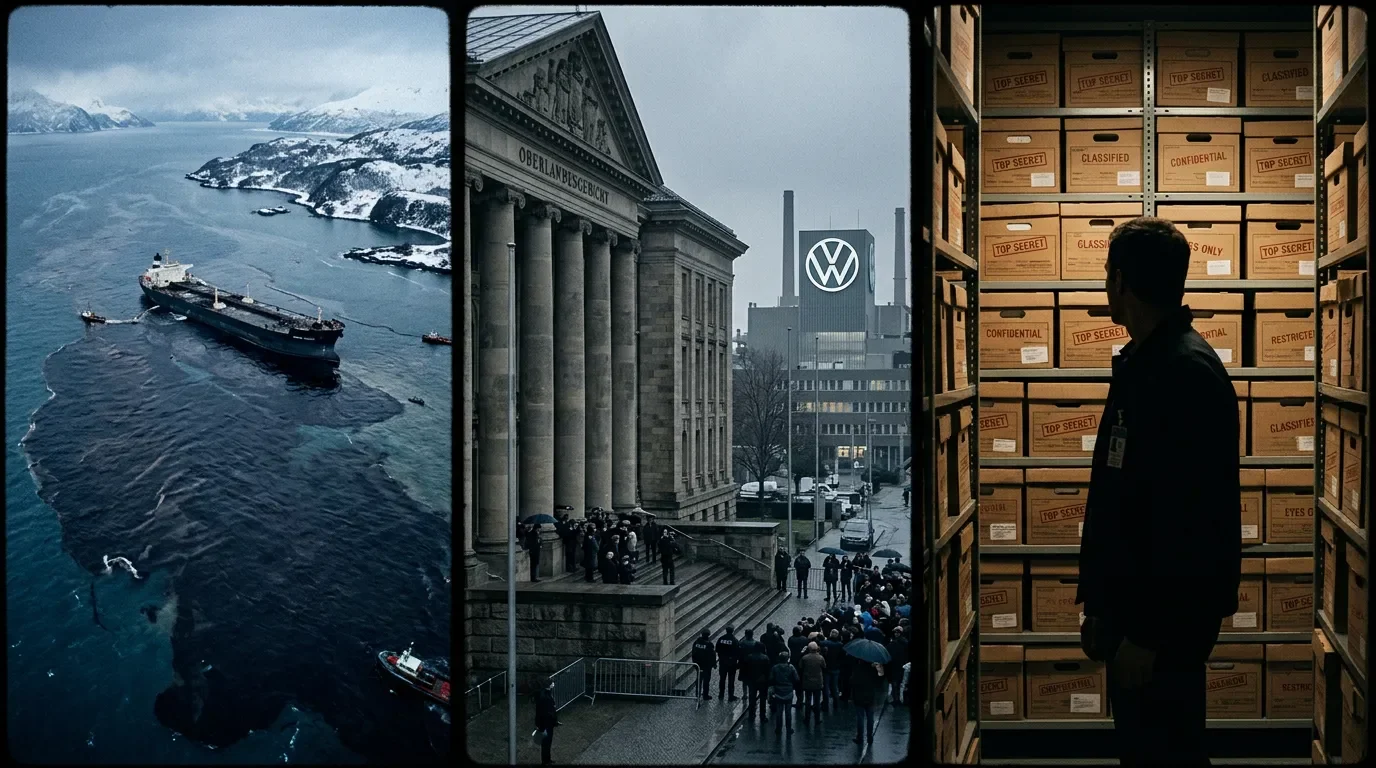
June 13 in business history: A $15 billion verdict, a billion-euro fine, a newspaper that refused to flinch, and a ballplayer who walked away from $15.7 million
Four June 13 events: Exxon found reckless (1994), VW's €1B Dieselgate fine (2018), NYT publishes Pentagon Papers (1971), Ryne Sandberg forfeits $15.7M.

リサーチノート
Four events on June 13, separated by 47 years. A federal jury called a trillion-dollar oil company reckless. A German prosecutor fined the world's largest automaker €1 billion. A 37-year-old newspaper publisher decided to run classified documents over the objections of his own lawyers. And one of baseball's greatest second basemen forfeited a guaranteed $15.7 million because he didn't think he'd earned it. The thread connecting them is not coincidence — it is the recurring question of what an organization actually values when money, reputation, and principle point in different directions.
1994 — A jury calls Exxon reckless. The stock falls $2.50 and analysts call the verdict "the easy part."
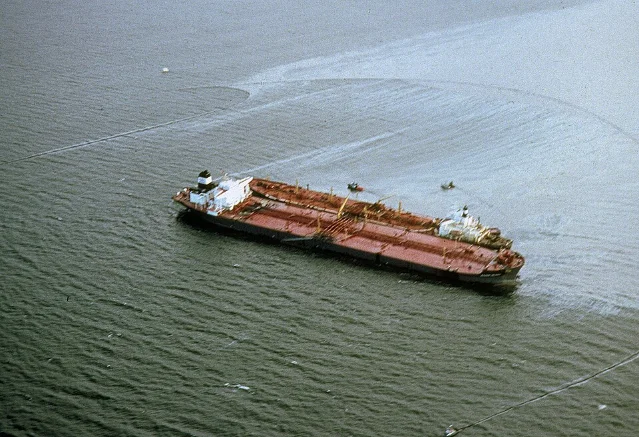
Five years after the Exxon Valdez ran onto Bligh Reef in Alaska's Prince William Sound, a federal jury in Anchorage delivered the first of what would become three verdicts against the company. On June 13, 1994, the panel of nine women and three men — presiding Judge H. Russel Holland on the bench — found that Exxon Corporation and Captain Joseph Hazelwood had acted with recklessness, not mere negligence. 1
The legal distinction was decisive. Recklessness unlocked punitive damages. More than 10,000 plaintiffs — commercial fishermen, Alaska Native communities, landowners — were now in position to argue for $15 billion in punitive awards when the damages phase began. 2 Exxon's stock dropped $2.50 to $59.625 on the news. Analysts estimated the uncertainty over the trial had already erased roughly $8 billion in market value. Bernard Picchi of Kidder Peabody described the verdict as "the most important part of the trial" — adding that for a company Exxon's size, the potential number could be "eye-popping." 2
The spill itself had happened on March 24, 1989, when Hazelwood left the bridge of the 900-foot tanker in the hands of a third mate who lacked Alaska waters certification, with the ship's collision-avoidance radar broken — and had been for more than a year. 3 Roughly 11 million gallons of Prudhoe Bay crude poured into the Sound. By any ecological measure, the damage was severe: an estimated 250,000 seabirds, 2,800 sea otters, and 22 orca dead; 1,300 miles of coastline affected; the Pacific herring fishery effectively collapsed and never commercially recovered. 4 5
Plaintiff attorney Brian O'Neill, speaking after the June 13 verdict, put the case plainly: "Nobody wants to cripple Exxon. We want to change Exxon. We want to make the Exxons of the world aware of the fact that they're responsible." 2
The outcome arc over the next 15 years tells a different story than O'Neill hoped. In September 1994, the jury awarded $5 billion in punitive damages — the largest such verdict in American legal history at the time. What followed was one of the most effective uses of appellate litigation as a cost-reduction strategy on record. By 2002, Judge Holland had reduced the amount to $4 billion, then revised it to $4.5 billion with interest. In 2006 the Ninth Circuit cut it to $2.5 billion, citing Supreme Court precedent. Then in June 2008, the Supreme Court in Exxon Shipping Co. v. Baker (554 U.S. 471) established a 1:1 cap between punitive and compensatory damages in maritime cases — and reduced the award to $507.5 million, one-tenth of the original verdict. 6 Exxon paid it in December 2009 — 20 years after the spill. Marine biologist Riki Ott, whose fishing career was ended by the disaster, summarized the strategy plainly: "What industry learned is all they have to do is stall and they can get the Supreme Court to let them wiggle out of the punitive damages." 5
In 1991, well before the jury phase, Exxon had already paid roughly $2.2 billion in cleanup costs, $125 million in criminal fines and civil restitution under a plea agreement, and $900 million in civil damages to federal and state trustees. 7 Total all-in costs exceeded $3.8 billion — serious, but against Exxon's annual revenues, manageable.
The mirror: The Exxon Valdez case established the corporate playbook for large-scale liability: accept cleanup costs quickly, contest punitive damages through every appellate mechanism available, and let time compress the number. The June 13 recklessness finding was supposed to be the moment accountability arrived. It took 15 more years and a Supreme Court ruling to settle what "accountability" actually cost. Executives managing crisis liability today operate in a legal environment partly shaped by this case — punitive awards in maritime settings are now capped at 1:1 by precedent, and the lesson on patience in appellate courts remains intact.
2018 — Volkswagen accepts a €1 billion fine. The market yawns. The $33 billion bill is elsewhere.
On June 13, 2018, the Braunschweig public prosecutor's office imposed a €1 billion ($1.18 billion) fine on Volkswagen AG — at that point one of the largest penalties ever imposed by German authorities on a single company. The legal basis was organizational oversight failure: VW's management had not prevented "impermissible software functions" from being installed across 10.7 million diesel vehicles sold between 2007 and 2015 under the VW, Audi, SEAT, and Škoda brands. 8 9
VW accepted without appeal. CEO Herbert Diess issued a statement: "Volkswagen takes responsibility for the diesel crisis. Further steps are necessary to restore trust in the company and the auto industry." 9 VW shares closed up 0.1% on the day. Evercore ISI analyst Arndt Ellinghorst framed the market reaction in a line that says more about the scale of modern corporate liability than it does about leniency: "Paying out 1 billion euros is extremely painful but in the broader context it isn't a material number." 8 At the time of the fine, VW's net cash position was €24.3 billion.
The defeat device itself had been exposed on September 18, 2015, when the U.S. Environmental Protection Agency issued a Notice of Violation. West Virginia University researchers, commissioned by the International Council on Clean Transportation, had run real-world emissions tests and found VW's diesel vehicles emitting up to 40 times the legal U.S. limit for nitrogen oxides under normal driving conditions. Laboratory tests had shown the cars compliant because the software detected test conditions — steering wheel angle, vehicle speed, barometric pressure — and activated full emissions controls only in that setting. 10
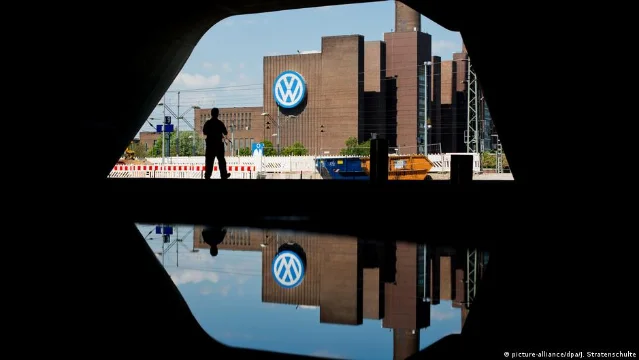
The €1 billion German fine landed inside a much larger financial reckoning. By June 2020, VW's cumulative global costs from Dieselgate reached $33.3 billion: a $4.3 billion U.S. Department of Justice criminal fine (January 2017 guilty plea), a $2.8 billion EPA civil settlement, a U.S. consumer buyback and civil settlement reaching $14.7 billion, plus fines in Australia, Canada, and a separate €800 million Audi fine in October 2018. 10 12 VW emissions compliance manager Oliver Schmidt was arrested by the FBI in January 2017 and sentenced to 7 years in prison. CEO Martin Winterkorn, who had resigned five days after the EPA notice in September 2015, was indicted by U.S. federal prosecutors on four counts of fraud and conspiracy in May 2018 — two weeks before the German fine — and remains the subject of criminal proceedings in Germany. 10
In November 2018, VW announced a €44 billion investment in e-mobility, autonomous driving, and digitalization. By March 2019 the plan had expanded to 70 electric models by 2028. 12 VW stock crashed roughly 30% in September 2015, hit an all-time high of €219.68 in June 2021 on EV optimism, and by mid-2026 trades near €88. 13 The reputational damage and strategic pivot cost far more than any single fine.
The mirror: VW's case makes a point the June 13 fine date crystallizes neatly. The €1 billion that dominated that day's headlines was less than 3% of total eventual costs. It also did not close the matter — Jan-Eike Andresen of the MyRight plaintiff platform noted on the day of the fine that "courts will now hardly be able to dismiss consumer complaints," since VW's acceptance of responsibility in Germany would follow it into every subsequent civil proceeding. 8 The lesson is not that the fine was too small — it is that admissions of liability in one jurisdiction do not stay in that jurisdiction.
1971 — The New York Times publishes the Pentagon Papers. The publisher had fired his own lawyers 48 hours earlier.
On Sunday, June 13, 1971, The New York Times ran a front page with two lead stories: a photo of President Nixon escorting his daughter Tricia at her White House wedding, and a 6,000-word article by Neil Sheehan headlined "Vietnam Archive: Pentagon Study Traces 3 Decades of Growing U.S. Involvement." 14 The documents Sheehan had spent months analyzing — 47 volumes, 7,000 pages of classified Defense Department history — had been leaked by Daniel Ellsberg, a former RAND Corporation analyst who had worked on the study and concluded it demonstrated "unconstitutional behavior by a succession of presidents." 14
The decision to publish had been made on Friday, June 11, by Arthur Ochs "Punch" Sulzberger, the Times publisher. It was, by his own subsequent description, among the most frightening decisions of his professional life. The paper's outside law firm, Lord Day & Lord — which had represented the Times since 1948 — had advised strongly against it. Herbert Brownell, the firm's senior partner and Eisenhower's former Attorney General (who had drafted the executive order creating the document classification system), told Sulzberger privately that publishing would land him in jail and damage the Times "beyond imagining." Sulzberger recalled: "He scared the bejesus out of me." 15
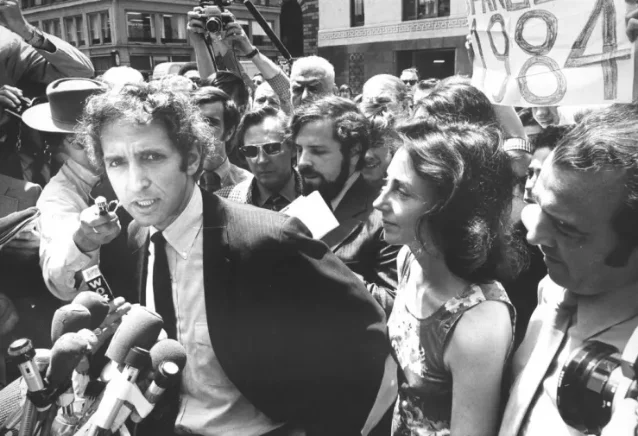
Sulzberger made his decision anyway. He then fired Lord Day & Lord when the firm refused to defend the paper in court. 15 In-house general counsel James Goodale, who had argued that the First Amendment would ultimately protect the publication, took over. The Times' managing editor Abe Rosenthal had threatened to resign if Sulzberger decided not to publish. Sulzberger's stated framework for the decision was plain: "We weren't writing for the benefit of the government; we were writing for the benefit of the reader, who is entitled to know." 15
After the third installment, Attorney General John Mitchell obtained a temporary restraining order on June 15 from a federal judge — the first time in American history a court had restrained a newspaper from publishing a specific article in peacetime. 17 The Washington Post began publishing its own Pentagon Papers coverage on June 18. The Supreme Court ruled 6-3 in favor of the newspapers on June 30, finding the government had not met the "heavy burden" required to justify prior restraint. 17 Justice Hugo Black's concurrence became the most cited First Amendment language in modern American law: "Only a free and unrestrained press can effectively expose deception in government." 17
The Times won the 1972 Pulitzer Prize for Public Service for the coverage. Under Sulzberger's leadership, the paper's revenues grew from roughly $101 million when he took over in 1963 to $2.6 billion by the late 1990s. Floyd Abrams, the First Amendment attorney who argued the case, later said: "In retrospect, the decision may seem obvious, but it was by no means an easy one at the time, and it remains one for which Sulzberger deserves enormous credit." 15
The mirror: Sulzberger's decision contains a structure that reappears in every high-stakes institutional call: the person with the most formal legal authority to advise caution (Brownell, a former U.S. Attorney General) gave that advice, and the person with accountability for the institution's mission overruled it. The question Sulzberger's framework answers — "who are you writing this paper for?" — is one that applies with equal force to any organization deciding whether to disclose something it would rather not. His answer cost the Times its outside counsel. It built the institution's reputation for the next 50 years.
1994 — Ryne Sandberg retires and forfeits $15.7 million because he didn't think he'd earned it
The same day a federal jury was calling Exxon reckless in Anchorage, a press conference at Wrigley Field in Chicago produced a different kind of statement about standards and accountability.
At age 34, second baseman Ryne Sandberg — a 10-time All-Star, 9-time Gold Glove winner, the 1984 NL MVP — announced his immediate retirement from the Chicago Cubs. He was batting .238, mired in a 1-for-28 slump, and had been sitting out games. 18 By retiring, he forfeited approximately $10.2 million in guaranteed salary for the 1995 and 1996 seasons, plus a $5.9 million club option for 1997 — roughly $15.7 million in total from a four-year, $28.4 million extension he had signed in March 1992 as the highest-paid player in baseball. 19 In 2025 dollars, that figure is roughly $30 million.
His explanation, read at the press conference, has been quoted in business schools and leadership seminars ever since:
"I am not the type of person who can be satisfied with anything less than my very best effort and my very top performance. I am not the type of person who can leave my game at the ballpark and feel comfortable that my future is set regardless of my performance. And I am certainly not the type of person who can ask the Cubs organization and Chicago Cubs fans to pay my salary when I am not happy with my mental approach and my performance." 19
Cubs GM Larry Himes responded by publicly praising the decision: "Ryne is walking away from a lot of money because he didn't feel he could live up to the standards he had set. It's nice to hear that money isn't the No. 1 priority with every player. I have great admiration for him." 19
The story was almost entirely buried in the news cycle; Nicole Brown Simpson was murdered the same day, and the O.J. Simpson case consumed the national press for the next year. 20
Sandberg returned to baseball in 1996 at age 36 on a $2 million contract — a fraction of what he'd left. He hit .244 with 25 home runs and 92 RBI. On April 26, 1997, he hit his 267th career home run as a second baseman, passing Joe Morgan's MLB record. His final game at Wrigley Field, on September 21, 1997, drew a sellout. He told the crowd: "I truly lived my field of dreams right here at Wrigley Field." 20
He was elected to the Baseball Hall of Fame in 2005 with 76.2% of the vote. His induction speech used the word "Respect" 19 times. 21 Hall of Famer Joe Morgan had publicly questioned Sandberg's candidacy, asking: "When things are going bad, you don't just walk away, do you?" Morgan did not attend the ceremony. 20 Sandberg died on July 28, 2025, at 65, after a battle with prostate cancer. 18
The mirror: The counter-argument to Sandberg's decision is Morgan's — that integrity sometimes means fighting through a slump, not walking away from it. Both positions are defensible. What makes the Sandberg case instructive for business leaders is not the specific choice, but the internal test he applied: not "am I still valuable to the organization?" (the board's question) but "am I delivering what I agreed to deliver?" (his own question). The corporate incentive structure almost universally rewards staying. Golden parachutes, severance packages, and rolling contracts are designed to keep executives in place regardless of performance. Sandberg's self-applied standard — refuse payment you don't believe you've earned — has no formal analogue in corporate governance. Which is perhaps why the story still travels.
Cover image: AI-generated composite illustration.
参考ソース
- 1Washington Post: Exxon Found Reckless in Alaska Spill
- 2Los Angeles Times: Verdict on Valdez Could Cost Exxon Billions
- 3Wikipedia: Exxon Valdez oil spill
- 4NOAA DARRP: Exxon Valdez
- 5Yale Environment 360: Twenty Years Later, Impacts of the Exxon Valdez Linger
- 6Supreme Court: Exxon Shipping Co. v. Baker, 554 U.S. 471
- 7EPA: Exxon to Pay Record One Billion Dollars
- 8Reuters: Volkswagen fined one billion euros by German prosecutors
- 9BBC News: Diesel emissions scandal: VW fined €1bn by German prosecutors
- 10Wikipedia: Volkswagen emissions scandal
- 11Deutsche Welle: VW fined €1 billion in Germany for Dieselgate
- 12Clean Energy Wire: Dieselgate timeline
- 13CompaniesMarketcap.com: Volkswagen stock price history
- 14Wikipedia: Pentagon Papers
- 15Nieman Reports: Punch Sulzberger's Pentagon Papers Decision
- 16The Pulitzer Prizes: The Race to Publish the Pentagon Papers
- 17Wikipedia: New York Times Co. v. United States
- 18Wikipedia: Ryne Sandberg
- 19Los Angeles Times: Citing Attitude, Sandberg Retires
- 20SABR: Ryne Sandberg biography
- 21American Rhetoric: Ryne Sandberg Hall of Fame Induction Speech
このコンテンツについて、さらに観点や背景を補足しましょう。