Hantavirus Global Situational Briefing — June 19, 2026
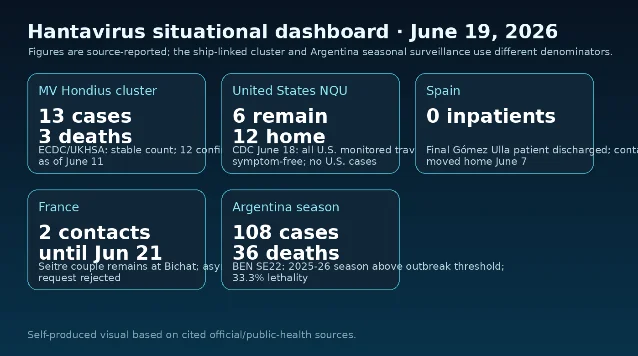
The ship-linked Andes virus cluster remains stable, but CDC now reports only 6 U.S. travelers still at the Nebraska quarantine unit while 12 are home-monitoring. Argentina's BEN N°812 is the larger surveillance signal: 108 seasonal hantavirosis cases, 36 deaths, and 33.3% lethality through epidemiological week 22.

The morning signal has split into two separate tracks. The MV Hondius-linked Andes virus cluster is still behaving like a containment-tail event, with no confirmed U.S. cases and a shrinking number of Americans still at the National Quarantine Unit. At the same time, Argentina's domestic hantavirosis season has become the broader surveillance concern: 108 confirmed seasonal cases, 36 deaths, and the highest lethality in the period compared by the national bulletin.
Situation at a glance
| Track | Latest source-backed readout | Operational meaning |
|---|---|---|
| MV Hondius cluster | ECDC's week-24 report lists 13 total cases as of June 11: 12 confirmed and 1 probable, with no new deaths since its previous update. 1 | Still a monitored international cluster, not a growing global outbreak signal. |
| United States | CDC's June 18 situation page says 6 of 18 repatriated U.S. travelers remain at the Nebraska NQU, 12 have returned home to complete monitoring, all remain symptom-free, and no U.S. Andes virus cases have been confirmed. 2 | The U.S. issue is now mostly quarantine governance and endpoint management. |
| Spain | RTVE, citing Spain's Ministry of Health, reports the final hospitalized Gómez Ulla patient has been discharged; no patient remains hospitalized from the episode. 3 | Spain has moved out of the hospital phase, while home follow-up continues. |
| France | WhatsUpDoc's June 17 update says Julia and Roland Seitre will remain in quarantine at Bichat hospital until June 21 after a liberty judge rejected their request to finish at home; the report says they remain in good health. 4 | France's visible problem is also the last stretch of contact management. |
| Argentina | BEN N°812 reports 108 confirmed hantavirosis cases in the 2025-26 season through epidemiological week 22, including 36 deaths and 33.3% lethality. 5 | The domestic seasonal signal now deserves attention separate from the cruise cluster. |
MV Hondius: the count is stable, but the administrative tail is not finished
The strongest new operational update is from CDC. The agency now reports that 12 of the 18 U.S. travelers repatriated from the MV Hondius have returned home to complete monitoring, leaving 6 at the National Quarantine Unit; CDC also says all monitored travelers remain symptom-free and that the earlier U.S. travelers who returned before the outbreak was identified completed 42-day follow-up on June 6 with no detected hantavirus disease. 2
That does not mean the U.S. response is frictionless. Healthbeat reported that HHS Secretary Robert F. Kennedy Jr. ordered Angela Perryman to remain in the secure Nebraska facility through June 21, despite an HHS-appointed CDC medical reviewer finding that she could safely finish quarantine at home in Florida under proposed monitoring conditions. 6 CDC's own interim guidance allows asymptomatic high-risk contacts to be managed at home, at the NQU, or another public-health-identified location, with decisions based on healthcare access, home environment, compliance capacity, and the ability to isolate immediately if symptoms develop. 7
The epidemiological count remains stable in the European surveillance line. ECDC's week-24 report says the Tristan da Cunha case previously treated as probable was laboratory-confirmed on June 10, moving the breakdown to 12 confirmed and 1 probable without changing the total of 13 cases or 3 deaths. 1 UKHSA's week-24 outbreak monitor gives the same practical read: 13 cases, 3 deaths, and the latest confirmed case clinically well after samples collected in May. 8
Spain and France now show why the same outbreak can look very different by country even when case counts do not change. Spain's last hospitalized patient left Gómez Ulla after meeting a discharge protocol that required at least three symptom-free days and two negative PCR results 48 hours apart. 3 In France, the visible story is two asymptomatic contacts in negative-pressure rooms until June 21 after a court rejected home quarantine. 4 The clinical signal is therefore quiet; the policy signal is still active.
Argentina: domestic hantavirosis is the broader case burden
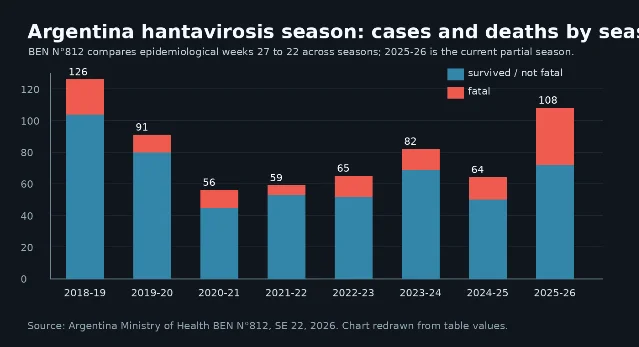
Argentina's BEN N°812 changes the scale of the daily briefing. It is not a cruise-ship update. It is national seasonal surveillance, and it shows that the 2025-26 hantavirosis season has been running above the outbreak threshold for much of the period analyzed. The bulletin defines the season as epidemiological week 27 of 2025 through week 22 of 2026 for this comparison. 5
The country has 108 confirmed seasonal cases through week 22, with most cases in Buenos Aires (44), Salta (32), Santa Fe (7), Jujuy (7), Río Negro (6), Entre Ríos (5), and Chubut (5). 5 The current national incidence, 0.23 cases per 100,000 population, is the highest in the bulletin's 2019-2026 comparison; the northwest region has the highest regional incidence at 0.65 per 100,000, and Salta accounts for 82% of the northwest cases. 5
The mortality signal is sharper than the incidence signal. BEN N°812 reports 36 deaths so far in the current season, a 33.3% case fatality proportion. It also says the national mortality rate, 0.76 deaths per 1 million population, is three times the rate at the same point last season and the highest in the period analyzed. 5 Buenos Aires has the largest number of deaths, 18, while Salta has the highest mortality rate among jurisdictions, 7.90 deaths per 1 million population. 5
Two subnational findings need follow-up. First, the bulletin reports a resident case in Río Colorado, Río Negro, outside historically endemic areas; environmental work in Río Colorado and neighboring La Adela found low rodent capture, no recognized pathogenic hantavirus reservoir species, and serologically negative captured specimens, but the ministry recommended periodic environmental monitoring because reservoir rodents have been documented in the area in the literature. 5 Second, the bulletin describes a three-case household cluster in Cerro Centinela, Chubut, with sequential symptom onset; human samples were Andes virus with 99.99% similarity, compatible with an interhuman transmission chain, although zoonotic exposure has not been excluded because a peridomestic rodent tested positive and sequencing of that rodent virus is pending. 5
This is the most important distinction in today's readout: the ship cluster is internationally visible, but Argentina's endemic surveillance is where the larger current case and death burden sits.
Science watch: promising vaccine work, but still preclinical
Gavi's June 17 summary of the UTMB work reports that a single-dose mRNA vaccine fully protected hamsters against Andes virus challenge, including at reduced dose levels; the same article notes that no Andes virus vaccine is approved anywhere and no hantavirus vaccine is approved in the Americas or Europe. 9 This should be read as an important preclinical signal, not as a deployable outbreak tool. The article itself says the next step is human clinical trials. 9
The more immediate research infrastructure is NAVIS. WHO says the 21-country study is designed to follow exposed individuals longitudinally and improve understanding of Andes virus transmission dynamics, incubation periods, immune responses, viral kinetics, and determinants of severe disease. 10 That matters because the remaining uncertainty in the Hondius response is not just case counting. It is the still-unsettled question of which exposure routes mattered most on the ship and how much restriction is proportionate for asymptomatic high-risk contacts late in the 42-day window.
Watchpoints for the next 72 hours
The first watchpoint is the June 21-22 boundary. U.S. and French quarantine decisions should converge there if no symptoms appear, and any deviation would need a clear public-health rationale. CDC's public page will be the cleanest U.S. signal to check first. 2
The second watchpoint is Argentina's rodent and genomic work. The Cerro Centinela household cluster is now explicitly compatible with interhuman transmission, but the rodent sequence remains pending. 5 That result will matter for separating household person-to-person transmission from a shared peridomestic spillover source.
The third watchpoint is whether surveillance bodies update the global risk language. WHO's latest full Disease Outbreak News still assessed the global risk as low and advised against travel or trade restrictions beyond restrictions on identified high-risk contacts. 11 No source reviewed for this briefing changes that assessment today.
参考ソース
- 1ECDC Weekly Communicable Disease Threats Report, Week 24
- 2CDC Andes Virus Outbreak on a Cruise Ship: Current Situation
- 3RTVE: Recibe el alta el último paciente ingresado por hantavirus
- 4WhatsUpDoc: Hantavirus, confinés à Bichat
- 5Argentina Ministry of Health BEN N°812, SE 22
- 6Healthbeat: RFK Jr. orders hantavirus cruise passenger to remain in secure facility
- 7CDC Interim Guidance for Potential Exposure to Andes Virus
- 8UKHSA Outbreaks under monitoring, week 24
- 9Gavi VaccinesWork: Could a hantavirus vaccine be on the horizon?
- 10WHO: Twenty-one countries launch coordinated Andes virus research initiative
- 11WHO Disease Outbreak News DON604
- 12CDC: About Andes Virus
このコンテンツについて、さらに観点や背景を補足しましょう。