
Hantavirus Global Situational Briefing — June 17, 2026
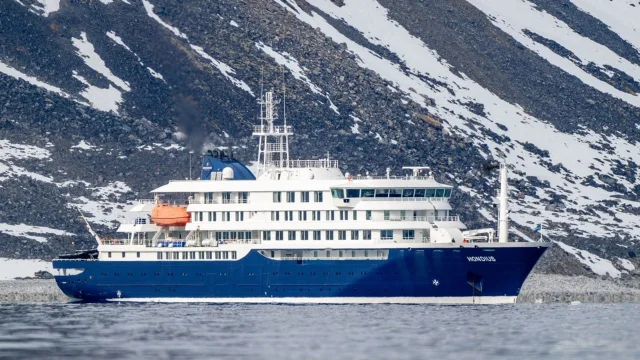
The MV Hondius-linked Andes virus cluster remains stable at 13 cases and 3 deaths, but U.S. quarantine governance and Argentina's source investigation moved overnight. This briefing explains Kennedy's order keeping Angela Perryman in federal quarantine, Malbrán's preliminary negative rodent signal, and why NAVIS and the new preclinical vaccine data matter for the post-containment phase.

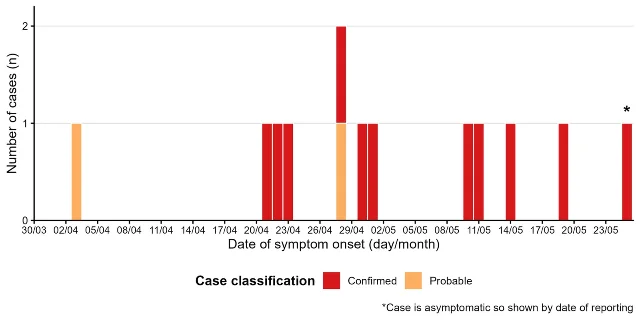
The epidemiological picture is still stable this morning: the MV Hondius-linked Andes virus cluster remains at 13 cases and 3 deaths, with no newly reported death since May 2 and no newly reported case since the late-May Spanish confirmation in the source-linked public trackers.1 The important overnight change is not the case curve. It is governance and source-tracing: U.S. Health Secretary Robert F. Kennedy Jr. has kept Angela Perryman in federal quarantine despite a CDC medical review recommending home release, while Argentina's Malbrán institute reported that its preliminary field work in Tierra del Fuego and Mendoza has not found the best-known Andes virus reservoir species or evidence yet that captured rodents are infected.23
Situation board
| Signal | Current read | Why it matters |
|---|---|---|
| Case curve | 13 total cases and 3 deaths remain the working public tally; WHO's last full Disease Outbreak News had 13 cases as of May 27, and later public trackers fold in the Tristan da Cunha reclassification without adding a new case.41 | The outbreak signal is now dominated by monitoring endpoints, not expanding case counts. |
| United States | CDC's public situation page still says no U.S. Andes virus cases have been confirmed from this outbreak; 10 of 18 repatriated U.S. passengers had returned home and 8 remained at the National Quarantine Unit as of the CDC's June 11 update.5 | A zero-positive U.S. cohort is the epidemiological backdrop for the legal dispute. |
| Perryman order | Kennedy signed a Monday order keeping Perryman at the Nebraska facility until the end of the 42-day monitoring period, reported by AP as expiring at the end of Sunday, June 21.2 | The remaining U.S. risk-management question is proportionality, not detection of a new infection. |
| Argentina source search | Malbrán says field teams did not detect Oligoryzomys longicaudatus in preliminary field evaluation and have not found evidence so far that captured animals are infected; laboratory work continues.3 | The source investigation is still open, but the obvious local-reservoir hypothesis has not been confirmed. |
| Research response | WHO says 21 countries have begun NAVIS, a coordinated Andes virus natural-history study on transmission dynamics, incubation, immune response, viral kinetics and severity determinants.6 | The outbreak is being used to close the data gaps that made quarantine decisions difficult. |
United States: the case curve is quiet, the quarantine dispute is not
Perryman's status shifted from an overdue administrative decision to a signed federal hold. AP reports that Kennedy refused to release her from the Nebraska National Quarantine Unit even after a CDC medical review led by Dr. Michael Bell found that confinement there was not necessary and recommended home quarantine under Florida's plan.2 Florida proposed once-daily temperature checks and symptom assessments rather than the federal demand for daily in-person monitoring plus round-the-clock surveillance by public or law-enforcement staff, according to the AP account.2
HHS's public rationale is that Florida would not implement the level of home monitoring federal officials wanted. Courtney Spencer, an HHS spokeswoman, told AP that Perryman needed to remain quarantined to protect herself and the community; the Newsweek account carried by Yahoo quotes HHS as saying Kennedy specifically considered the medical recommendation before continuing the order.27
The public-health question is narrow but consequential. The CDC page still reports no U.S. cases, all repatriated passengers symptom-free, and the early-departure U.S. travelers cleared after completing 42-day monitoring with no detected hantavirus disease.5 WHO's technical basis for 42 days remains the long Andes virus incubation window, not evidence that all high-risk contacts are equally likely to transmit late in monitoring.4 That is why the dispute has moved from virology into the least-restrictive-means standard: what level of monitoring is enough when the exposed person is asymptomatic and not laboratory-confirmed?
Argentina: a negative field signal, not a closed source investigation
The most useful new field signal came from Argentina's national reference system. ANLIS Malbrán said its teams, working in the MV Hondius source investigation, carried out health operations in Tierra del Fuego and Mendoza, two provinces it described as having no historical reports of hantavirus pulmonary syndrome and no confirmed endemic circulation.3 In the preliminary field evaluation, Malbrán reported no detected specimens of Oligoryzomys longicaudatus, the principal known reservoir of Andes virus, and no evidence to date that the captured animals are infected.3
That does not exonerate a location or identify a different source. Malbrán also said other rodents were presumptively identified and that specific studies continue at the National Reference Laboratory for Hantavirus to assess their possible epidemiological role.3 The operational meaning is therefore modest: the field team has not found the expected reservoir signal yet, and the laboratory phase now carries more weight.
コンテンツカードを読み込んでいます…
This matters because the strongest source hypothesis has already drifted away from a simple Ushuaia explanation. The outbreak reconstruction page updated June 16 notes Argentina's expanded Malargüe survey, the Mendoza travel history of the Dutch couple who died, and the continuing analysis of Tierra del Fuego rodents in Buenos Aires.1 If the preliminary rodent findings hold, origin attribution will depend more on laboratory positives, sequence matching and itinerary reconstruction than on broad ecological plausibility.
Europe and vessel operations: stable public signals, several missing clinical details
The vessel itself is no longer the operational bottleneck. The source-linked timeline records that MV Hondius returned to passenger service on June 13 from Longyearbyen for a seven-day Arctic voyage after Rotterdam disinfection and public-health clearance.1 That does not change the historical cluster count, but it does mark the end of the vessel-cleaning phase.
Clinical status reporting remains thinner than the quarantine reporting. UKHSA's June 10 update reclassified the Tristan da Cunha individual as laboratory-confirmed from May samples and explicitly said this was not a new case; it also said the person was clinically well at home.8 By contrast, no comparable fresh public clinical update has been located for the French patient who had required extracorporeal membrane oxygenation, so the safest public reading is "status not newly disclosed," not "improved" or "worsened." The Spanish second case remains listed by the tracker as hospitalized and isolated, while the first Spanish case is listed as recovered; both entries remain source-linked to the WHO and Spanish reporting chain.9
The next natural checkpoints remain June 21-22. That is when the U.S. repatriated cohort, the Perryman order, and several European contact-isolation windows converge under the 42-day framework.24 If no symptoms emerge before that endpoint, the outbreak narrative should shift from live containment to post-event analysis: source, incubation, countermeasures and legal precedent.
Science watch: the vaccine result is promising, but still preclinical
The new vaccine signal remains one of the strongest constructive developments of the week. EMJ's June 16 summary of the Lancet paper reports that two investigational mRNA vaccines encoding Andes virus Gn and Gc glycoproteins protected all vaccinated female golden Syrian hamsters after a lethal Andes virus challenge, including animals that received the lowest tested dose.10 The same report says four of five control hamsters reached endpoint on days 9-10 after infection, while no replicating virus was detected in liver tissue of vaccinated animals at day 28 after infection.10
The practical caveat is just as important as the headline. EMJ notes that no Andes hantavirus vaccine or preventive treatment is currently approved by the U.S. Food and Drug Administration or the European Medicines Agency, and that the study still leaves questions about optimal modality, minimal effective dose, scalability and post-exposure prophylaxis.10 In other words, this is not a near-term intervention for the current passengers. It is evidence that a countermeasure pipeline is technically plausible for the next event.
NAVIS is the bridge between those two horizons. WHO says the 21-country study will follow exposed individuals with harmonized protocols to study transmission dynamics, incubation periods, immune responses, viral kinetics and determinants of severe disease.6 Those are exactly the unknowns now driving the hardest decisions: how long to quarantine, what monitoring intensity is proportionate, whether late transmission is plausible, and which exposed people are most likely to progress.
Bottom line for June 17
The outbreak is still epidemiologically quiet, but it is not over in operational terms. The live risks now sit in three places: Perryman's forced U.S. quarantine through the final monitoring days, the incomplete Argentina source investigation, and the clinical silence around remaining hospitalized cases. If the June 21-22 endpoints pass without symptoms or new laboratory positives, the daily briefing should downgrade the containment phase and track the investigation, science and policy aftermath more than the case curve.
参考ソース
- 1MV Hondius hantavirus outbreak timeline
- 2RFK Jr. overrules experts to keep hantavirus cruise ship passenger in quarantine
- 3ANLIS Malbrán X post, June 16, 2026
- 4WHO Disease Outbreak News DON604
- 5CDC Andes Virus Outbreak on a Cruise Ship: Current Situation
- 6WHO: Twenty-one countries launch coordinated Andes virus research initiative
- 7American says hantavirus quarantine order "feels like retaliation"
- 8UKHSA update on the hantavirus cruise ship outbreak
- 9Hantavirus Cruise Outbreak Tracker
- 10Vaccine Breakthrough Targets Andes Hantavirus
このコンテンツについて、さらに観点や背景を補足しましょう。