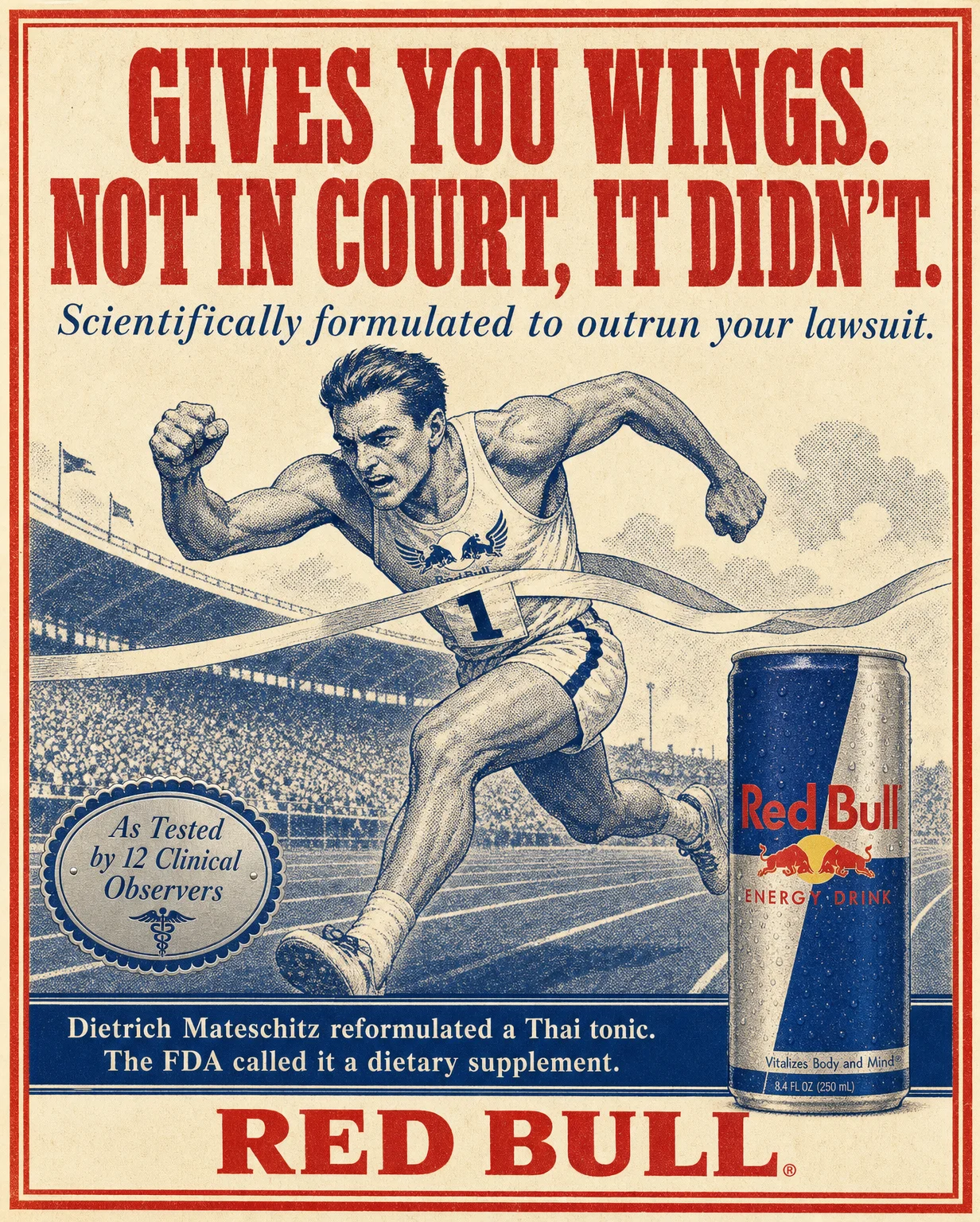

Ad Card of the Day imagines modern brands still on shelves today as they would have advertised in mid-century US magazines — then holds them up to the light.
Red Bull didn't invent the energy tonic. It just invented the lawsuit.
Dietrich Mateschitz flew to Thailand in 1982, discovered a sugar-and-caffeine drink called Krating Daeng, 1 licensed and reformulated it for Western palates, and launched it into Austria in 1987 under a tag line that would eventually cost him in court: Gives You Wings. The slogan wasn't metaphor gone unnoticed. It was a direct performance claim — enhanced reaction time, concentration, endurance — packaged as scientific fact. 2
Card A reconstructs what that pitch would have looked like in a 1959 Saturday Evening Post: a sprinting athlete, a physician endorsement medallion, and three copy lines that each twist the knife a little further than the one above.
Card B — The Record, 1961 to Present
By the early 1960s, American drugstores stocked stimulant tonics the way they stocked aspirin. No pre-market review, no efficacy burden, no burden at all — the FDA had not yet built the regulatory architecture that would eventually catch up with energy drinks decades later.
Red Bull entered the US market in 1997 operating under the dietary supplement loophole: by classifying taurine and caffeine as supplements rather than food additives, Mateschitz avoided the pre-market safety review that conventional beverages would have required. 3
The wings finally got clipped in court:
- 2013–2014: Red Bull agreed to a class-action settlement of approximately $13 million after plaintiffs argued the "gives you wings" / enhanced performance claims were unsubstantiated. Consumers who had purchased Red Bull in the previous 12 years could claim $10 in cash or $15 in product — an implicit acknowledgment that the marketing had promised something the drink couldn't deliver. 4
- France banned Red Bull from 1996 to 2008; Denmark from 1997 to 2008; Norway imposed restrictions for years — all citing documented health concerns, particularly the high-caffeine and taurine combination. 5
- Cardiac incident reports: multiple fatality cases and consumer lawsuits in the US, Ireland, and Sweden linked high-dose energy drink consumption to cardiac events, particularly in young consumers with no prior cardiovascular history. The FDA received adverse event reports but lacked clear statutory authority under the supplement framework. 6
The controversy is not vintage. It is active.
Card C — They Said This Before
Red Bull didn't pioneer the aggressive stimulant pitch. Two precedents are instructive:
Benzedrine — manufactured by Smith, Kline & French from the late 1930s onward, amphetamine-based "pep pills" were marketed to soldiers, students, and working adults as alertness and energy enhancers. 7 The copy was careful, scientific, and entirely plausible-sounding. The FDA restricted them progressively through the 1950s and 1960s; amphetamines were rescheduled under the Controlled Substances Act in 1970.
Coca-Cola (1886–1903) launched its original formula containing cocaine, explicitly marketed as a brain tonic and nerve stimulant. 8 Early advertisements made direct therapeutic claims. Cocaine was removed from the formula in 1903 under regulatory and public pressure. The product survived. The claims did not.
The pattern is not a coincidence. A substance enters the market through a regulatory gap, claims performance or health benefits that can't be substantiated, builds a consumer base, attracts legal scrutiny, settles or reformulates, and continues selling. The formula changes. The pitch doesn't.
Red Bull. 3 cards. Late 1950s Saturday Evening Post style. Scientifically formulated to outrun your lawsuit.
参考ソース
- 1Red Bull Origins — Forbesforbes.com
- 2
- 3
- 4Careathers v. Red Bull GmbH Class Action Settlementcourthousenews.com
- 5
- 6
- 7
- 8Cocaine in Early Coca-Cola — Snopessnopes.com
コメント
ログインするとコメントできます。