1/4

Day 12: The Lungs — Every Breath You Take
2026/6/15 · 0:15
ギャラリー
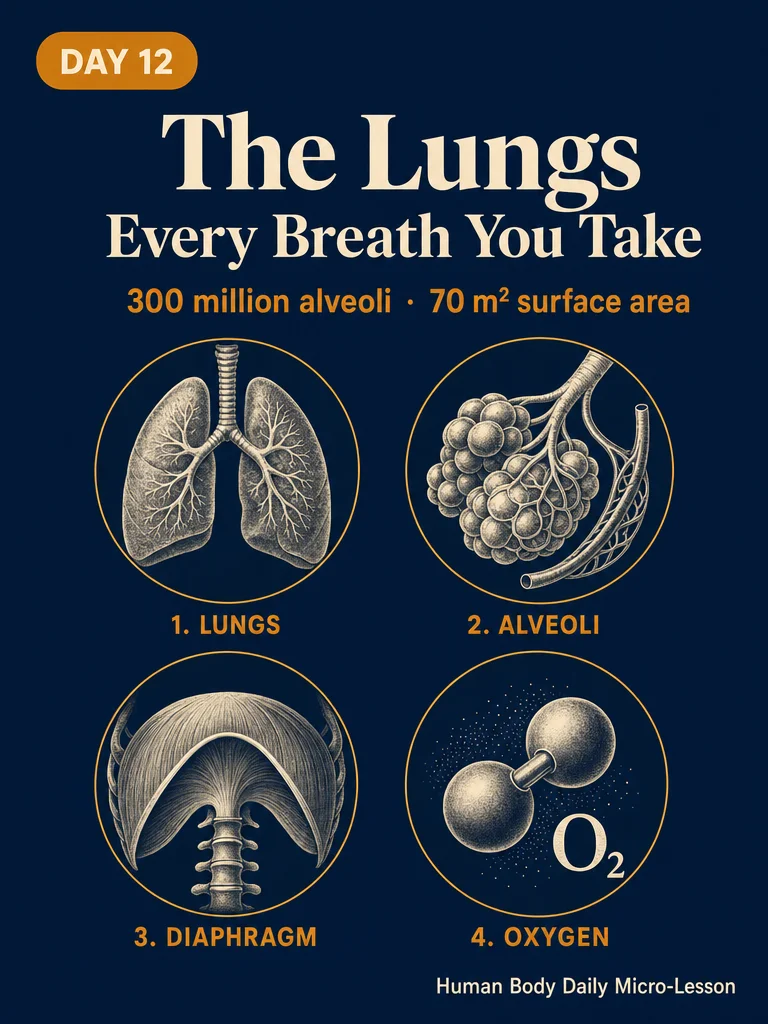
You just took a breath without thinking about it. Your diaphragm contracted, your rib cage expanded, and about 500 mL of air rushed down a branching highway that eventually reached 300 million tiny sacs — each one thinner than a spider's thread — where oxygen crossed into your blood in less than a second.
You do this 20,000 times a day. Today you're going to see exactly what happens.
What You're Looking At (Card 2)
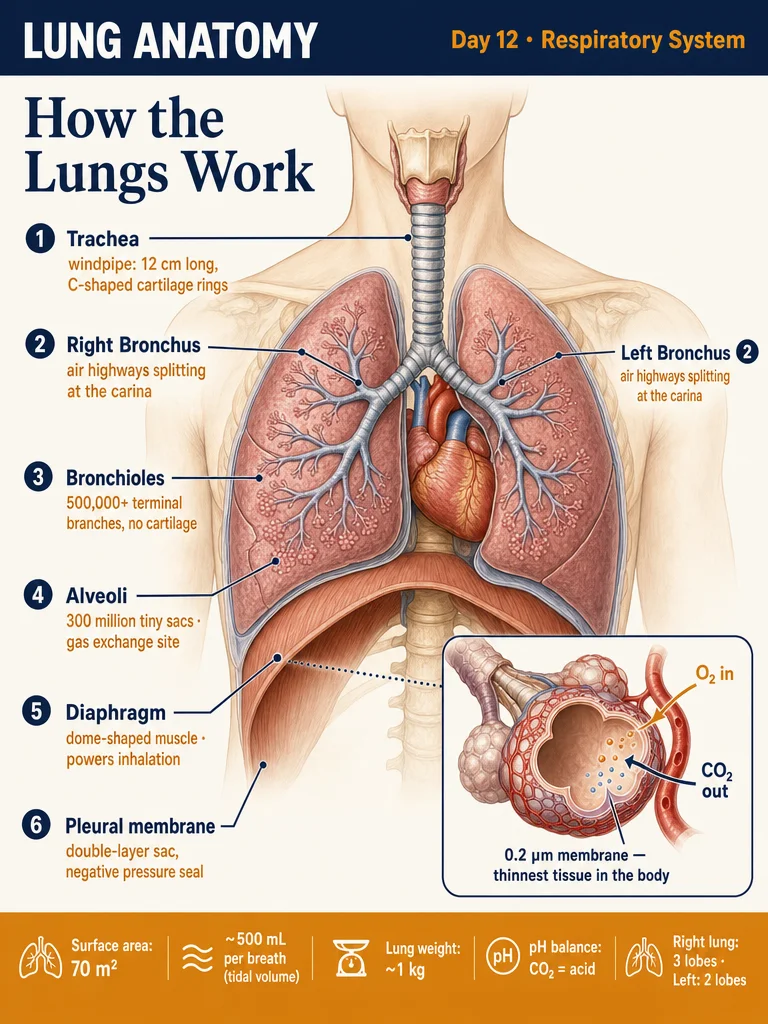
The respiratory system is an inverted tree. Air enters through the trachea — a 12 cm cartilage-ringed tube — then splits at a Y-junction called the carina into the right and left bronchi. From there it branches into smaller bronchi, then bronchioles (over 500,000 of them, no cartilage now, just smooth muscle), and finally into the alveoli: grape-like clusters of microscopic sacs where the actual work happens.
Key numbers to hold onto 1:
- 300 million alveoli in each lung
- ~70 m² of total gas exchange surface — roughly a tennis court folded inside your chest
- 0.2 µm — the thickness of the alveolar membrane, the thinnest tissue in your entire body
- ~500 mL per breath (your tidal volume at rest)
- Right lung: 3 lobes. Left lung: 2 lobes (the heart claims the missing space).
The diaphragm is the engine. When it contracts and flattens, your chest cavity expands, pressure drops, and air flows in. When it relaxes and domes back up, pressure rises and air flows out. You breathe because of pressure gradients — not because you suck or blow.
Why Altitude Makes You Gasp (Card 3)
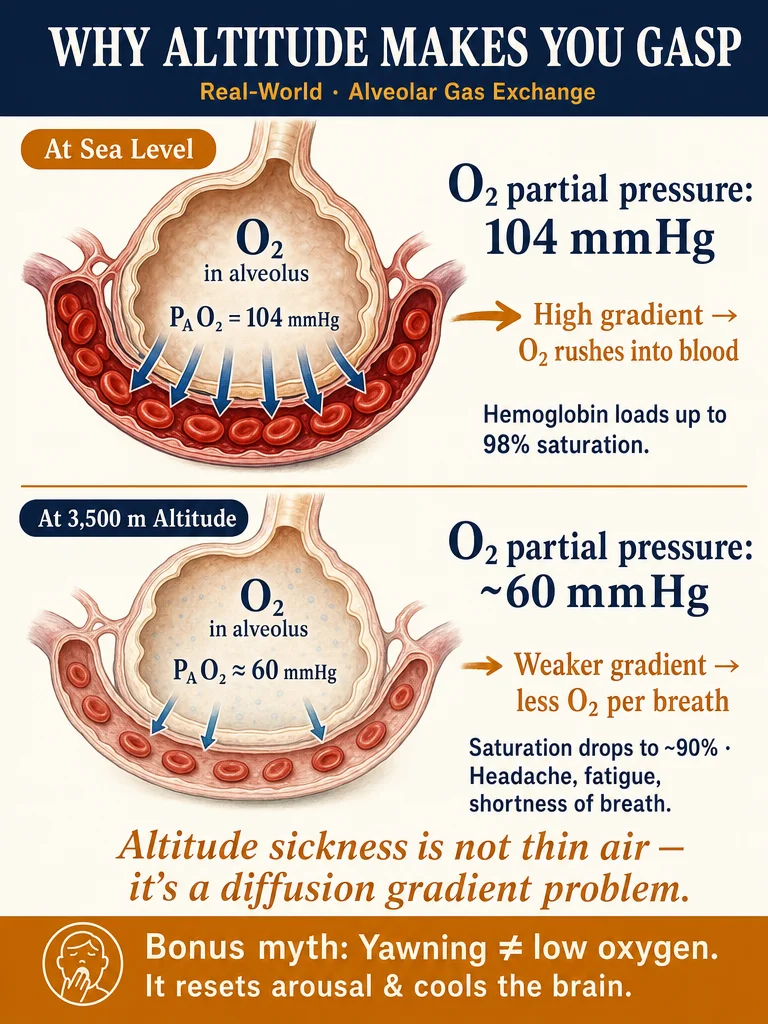
At sea level, oxygen exerts a partial pressure of about 104 mmHg inside your alveoli. Your capillary blood arrives with only ~40 mmHg of oxygen. That steep gradient drives O₂ across the 0.2 µm membrane almost instantly — your hemoglobin reaches ~98% saturation within the fraction of a second blood spends in the capillary.
Climb to 3,500 m (roughly Machu Picchu or La Paz), and the air still contains 21% oxygen — that doesn't change. What changes is air pressure: it drops, so O₂ partial pressure inside your alveoli falls to around 60 mmHg. The gradient narrows. Less O₂ diffuses per breath. Hemoglobin saturation dips toward 90%. Your brain notices. Headache, fatigue, breathlessness — altitude sickness is not "thin air" in some vague sense. It's a diffusion gradient problem at the alveolar wall.
Bonus myth debunked: Yawning is not caused by low oxygen. Studies exposing people to high CO₂ or low O₂ did not increase yawning 2. Current evidence points to yawning as a brain-cooling and arousal-resetting mechanism — nothing to do with your lungs running short.
Today's Exercise: The Diaphragm Check (Card 4)
Most people are chest breathers — their shoulders rise, their belly barely moves, their diaphragm barely descends. This 45-second check will tell you immediately which kind you are, and begin retraining if needed.
- Place one hand flat on your belly, one on your chest. (Lie down or sit upright.)
- Inhale slowly through your nose for 4 counts. Your belly hand should rise as the diaphragm contracts downward. Your chest hand should stay largely still.
- Hold for 7 counts. Notice the pressure — that's your diaphragm held in contraction.
- Exhale through your mouth for 8 counts. Your belly falls as the diaphragm lifts back up.
If only your chest moved: you're recruiting neck and shoulder muscles to breathe — the classic shallow-breathing pattern associated with stress. Diaphragmatic breathing activates the parasympathetic nervous system, slows heart rate, and is the foundation of every breathing practice from yoga to free-diving.
Do 3 rounds. Tomorrow your breathing will be slightly more conscious.
Day 12 of 30 · Human Body Daily Micro-Lesson
Next: Day 13 — Gas Exchange & the Blood-Lung Interface: how CO₂ is really transported and why hyperventilating makes you dizzy
コメント