Glamorous Glennis: The Orange Rocket Plane That Broke the Sky
On October 14, 1947, Air Force Capt. Chuck Yeager climbed into a bullet-shaped, international-orange rocket plane above the Mojave Desert with two broken ribs and a sawed-off broom handle — and flew faster than sound. The Bell X-1 "Glamorous Glennis" (NASM accession A19510007000) reached Mach 1.06 in 18 seconds, ending a decade-long aeronautical impasse and opening the supersonic era. This long-form narrative traces the aircraft's construction at Bell's Buffalo plant, the engineering solutions that made the flight possible, Yeager's own biography and the love story behind the name on the nose, the provenance chain from Muroc to the Smithsonian in 1950, and the aircraft's current home in NASM's Boeing Milestones of Flight Hall.

On the morning of October 14, 1947, a 24-year-old Air Force captain from West Virginia walked into a hangar at Muroc Army Air Base in the California high desert with two freshly broken ribs and a secret. His name was Charles E. "Chuck" Yeager — a wartime ace, a gifted natural pilot who had grown up tinkering with engines in the Mud River country of Lincoln County — and he was about to attempt something that a serious fraction of the aeronautical community believed was physically impossible: fly a manned aircraft faster than sound. 1
His team greeted him with a bag of props: a raw carrot, a length of rope, and a pair of glasses. A whimsical reference to the previous evening's horseback ride, in which the horse had won. "The horse won," Yeager wrote later. "I broke two ribs." 2
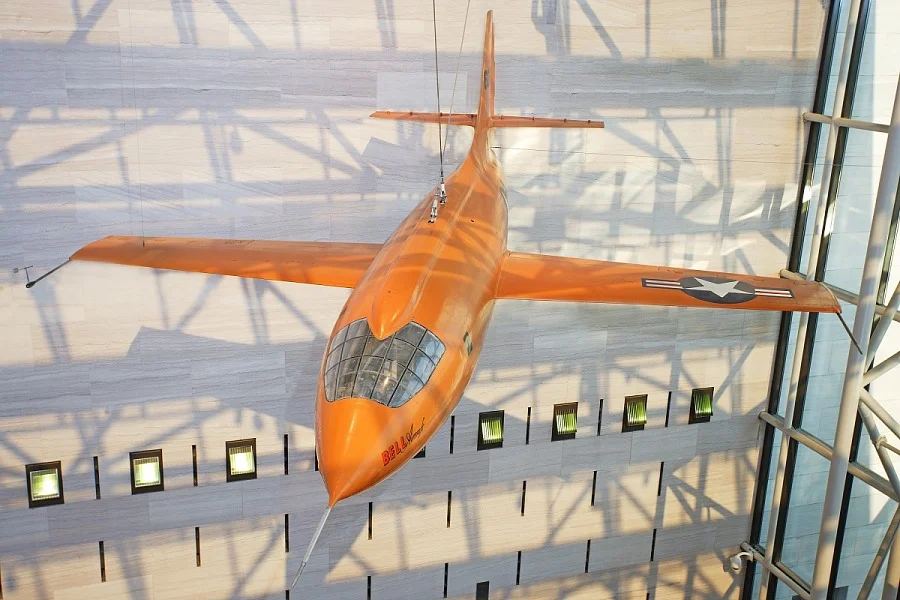
That story — the broken ribs, the broom handle, the coded radio transmission that followed — has been told so many times it has acquired the grain of legend. But behind the legend sits an actual machine: an aluminum and steel rocket plane, 30 feet 9 inches long, painted a vivid international orange, built by Bell Aircraft Corporation in Buffalo, New York, and now suspended from the ceiling of the Smithsonian National Air and Space Museum's Boeing Milestones of Flight Hall in Washington, D.C. The aircraft's official accession number is A19510007000. Its nose reads GLAMOROUS GLENNIS. 3
This is the story of how that machine came to be, what it did in 14 minutes over the Mojave Desert, and why it has hung in the heart of America's most visited museum for nearly half a century.
A bullet-shaped solution to an unsolvable problem
By the mid-1940s, aeronautical engineers had a problem with a name: the sound barrier. The term itself was nearly accidental. In 1935, British aerodynamicist W. F. Hilton was showing wind-tunnel data at the National Physical Laboratory when he described how drag "shoots up like a barrier against higher speed, as we approach the speed of sound." A reporter heard the phrase and ran it. The next morning London's papers were full of it. 4
The barrier was real, even if poorly named. As an aircraft's speed approached Mach 1 (approximately 767 mph at sea level, lower at altitude), shock waves built up across the wings and fuselage, drag spiked, lift dropped, and conventional control surfaces became useless. Hinged elevators failed because shock waves formed at their hinge points and shifted the pressure center backward — the faster you flew, the less control you had. Several aircraft had already disintegrated in the transonic zone. In September 1946, Geoffrey de Havilland Jr. was killed when his DH 108 research aircraft broke apart approaching Mach 0.9 over the Thames Estuary. 5
The National Advisory Committee for Aeronautics (NACA — the precursor to NASA, founded by Congress in 1915 to oversee "the scientific study of the problems of flight") had been attacking transonic aerodynamics for years. 6 Researcher John Stack — head of NACA's Compressibility Research Division at Langley — argued for a dedicated high-speed research aircraft that would climb above the worst of the atmospheric turbulence, be dropped from a mother plane to avoid the drag of a ground takeoff, and push incrementally through the transonic regime instead of lunging at it. 7
In early 1944, NACA and the Army Air Forces joined forces. The design brief that emerged had two elegant solutions to the barrier problem: it borrowed the shape of a known supersonic object, and it replaced the failed elevator with an entirely new control mechanism.
The shape was a .50-caliber machine gun bullet. Weapons engineers had long known that the round was aerodynamically stable at supersonic velocities. If a bullet's profile worked at Mach 2, it seemed reasonable to build a cockpit around one. The result was a fuselage that tapered to a long spike nose, with thin straight wings and an equally thin horizontal tail set unusually high on the vertical stabilizer. 3
The control solution came partly from British intelligence. In 1944, the secret Miles M.52 program at Miles Aircraft had already designed a supersonic research plane with an all-moving tailplane — a horizontal stabilizer that rotated as a single unit rather than deflecting a hinged flap at the rear. Miles chief aerodynamicist Dennis Bancroft confirmed that Bell Aircraft received the M.52's drawings and research data. The British government canceled the M.52 in February 1946 for budgetary reasons (the prototype was 82% complete at cancellation), but the intellectual transfer had already occurred. 8 Bell did not adopt a full all-moving tail but incorporated a variable-incidence horizontal stabilizer that could be adjusted in-flight — a compromise that turned out to be decisive.
On March 16, 1945, the Army Air Technical Service Command awarded Bell Aircraft Corporation a contract for three transonic/supersonic research aircraft under project MX-653. The aircraft were designated XS-1 (Experimental Sonic-1). Serial 46-062 would become the most famous. 3
What they built in Buffalo
The finished aircraft was compact to the point of claustrophobic. Measuring 30 feet 9 inches (937.3 cm) long with a 28-foot (853.4 cm) wingspan, it stood only 10 feet 8.5 inches (326.4 cm) tall. Empty weight: 6,130 pounds (2,780.5 kg). The fuselage was high-strength aluminum; the two propellant tanks inside were steel. Buried within that aluminum cylinder were twelve nitrogen pressure spheres, the pilot's pressurized cockpit, three pressure regulators, retractable landing gear, the rocket engine, and more than 500 pounds of flight-test instrumentation. 3
The engine was a Reaction Motors Inc. XLR-11-RM-3: a four-chamber liquid-fueled rocket burning ethyl alcohol diluted with water, with liquid oxygen as the oxidizer. Each chamber produced roughly 1,500 pounds of thrust and could be switched on or off independently, giving the pilot coarse throttle control. Total static thrust: 6,000 lbf (26,500 N). On Aircraft #1, fuel delivery used nitrogen pressurization rather than turbopumps — a simpler system that avoided the mechanical complexity of rotary machinery but meant the fuel could not be loaded until shortly before flight. 5
There was no ejection seat. The pilot entered through a side hatch that locked from the inside by slamming a heavy lever downward with the right arm.
Bell's first test pilot, Jack Woolams, made nine glide flights from a B-29 drop over Florida's Pinecastle Army Airfield beginning January 19, 1946. After modifications, the aircraft moved to Muroc Army Air Base in the Mojave Desert — the dry lakebed providing miles of flat emergency landing surface. Chalmers "Slick" Goodlin flew the first powered test on December 9, 1946, reaching Mach 0.795. 5
Goodlin flew well, but the program stalled. He reportedly sought a $150,000 bonus to push past Mach 1. The Army Air Forces, unwilling to pay, terminated Bell's flight contract on June 24, 1947, and handed the project to their own Flight Test Division at Muroc. The new pilot assigned was Chuck Yeager. 2
Chuck Yeager: the pilot behind the name on the nose
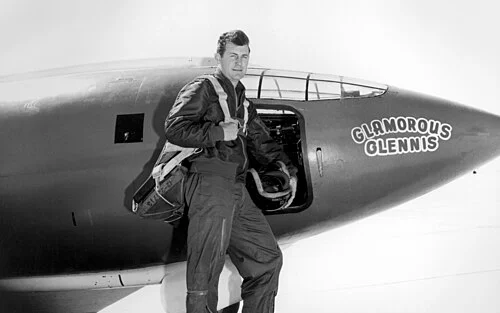
Charles Elwood Yeager was born February 13, 1923, in Myra, West Virginia, and graduated from Hamlin High School in 1941. He had no college degree — the standard prerequisite for officer flight training — but the wartime Army Air Forces was flexible about such things. His vision tested at 20/10. His mechanical intuition, noted by everyone who flew with him, was the kind that could not be taught: he could feel an aircraft's behavior through the seat of his pants the way a pianist feels tension through the keys. 9
In World War II he flew P-51 Mustangs over Europe and shot down 11.5 enemy aircraft officially — including a Messerschmitt Me 262 jet fighter, the most advanced combat aircraft of the era. On March 5, 1944, he was shot down over France on his eighth mission. The French Maquis resistance helped him cross the Pyrenees into Spain; he returned to England in May. When regulations threatened to keep him out of combat — pilots who had evaded capture were considered too security-sensitive for further missions over occupied territory — he "raised so much hell," he later said, that General Eisenhower personally approved his return to his squadron. 9 On October 12, 1944, he became an "ace in a day," shooting down five Bf 109s in a single mission; two of the pilots jumped without being fired upon.
The name on the aircraft's nose came from Glennis Faye Dickhouse, whom Yeager had met in 1944 when she was 18 and working at the USO in Oroville, California. As she later recalled, Yeager "come sauntering in with another airman" looking to arrange a dance for thirty men. When she protested that finding thirty women by that evening was impossible, he replied, "No. Twenty-nine, 'cause I'm taking you." 10 They married in February 1945. During the war, Yeager had named his successive P-51s "Glamorous Glen," "Glamorous Glen II," and "Glamorous Glen III." In August 1947, near the start of his X-1 flights, he painted GLAMOROUS GLENNIS — the full name, spelled correctly for once — on the aircraft's nose. 2
NASM curator Bob van der Linden later described Yeager as "a superb pilot with an innate understanding of machines and the rare ability to convey his feel for subjective flight characteristics into performance data." 11 It was that combination — physical gift and analytical precision — that made him the right person to push the X-1 through a regime where previous pilots had lost control.
The nine powered flights
Through the summer and early autumn of 1947, Yeager flew the X-1 in a carefully paced series of powered tests, each one a small increment faster than the last. The methodology was deliberate: NACA's philosophy of incremental flight testing held that no single flight should reach further into the unknown than the data from the previous flight could justify. Every run produced reams of oscillograph records that were analyzed overnight. 12
At Mach 0.94 on an early flight, Yeager encountered a crisis: he ran out of elevator authority. The hinged control surfaces were useless — exactly as theorists had predicted. He and project engineer Jack Ridley studied the data. The adjustable horizontal stabilizer — the variable-incidence surface borrowed, at least conceptually, from the Miles M.52 work — could be shifted in flight. They tried moving the stabilizer's angle directly, without the elevator. It worked. 5
That fix was in place on the morning of October 14.
"Something wrong with this Machmeter"
Two nights before the scheduled flight, on October 12, Yeager went horseback riding with Glennis near Muroc. The horse spooked, Yeager fell, and two ribs on his right side cracked. He drove to a civilian doctor in the nearby town of Rosamond rather than the base flight surgeon — reporting the injury to the Air Force would have meant being grounded. The doctor taped his ribs and said nothing. 2
The problem was mechanical. The X-1's cockpit hatch sealed from the inside by a lever that had to be slammed down with the right arm — an action that required full lateral rotation at the shoulder. With two broken ribs on that side, Yeager could not generate the force. He told Jack Ridley. Ridley sawed a ten-inch piece off a broom handle. Used as a lever extension, it gave Yeager enough mechanical advantage to dog the hatch shut with a fraction of the normal effort. 2
On the morning of October 14, the X-1 was loaded into the bomb bay of a Boeing B-29 flown by Maj. Bob Cardenas. Two chase aircraft — Richard Frost low, Lt. Bob Hoover high, both in Lockheed P-80s — took station. The B-29 climbed for about thirty minutes, then leveled at approximately 20,000 feet over Rogers Dry Lake. 1
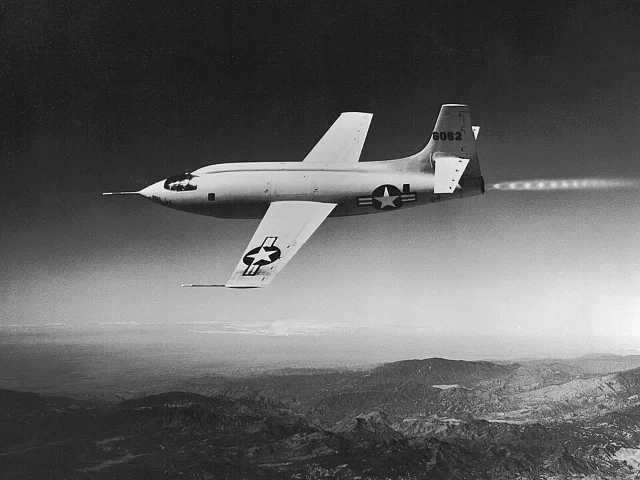
Yeager dropped away from the B-29 and began firing chambers in sequence: number four first, then two, then three, then all four together. The X-1 climbed under full power to 42,000–43,000 feet. Yeager trimmed the stabilizer to hold level flight. He watched the Machmeter climb. At Mach 0.965, the needle hesitated. Then it jumped — past 1.0, settling at 1.06. The transition was, in Yeager's word, "smooth." No buffet. No jolt. The shock wave had passed over the tail. 2
In his dry flight report he described the Machmeter's behavior clinically: "With the stabilizer setting at 2 degrees, the speed was allowed to increase to approximately .95 to .96 Mach number… At this indication, the meter momentarily stopped and then jumped up to 1.06, and the hesitation was assumed to be caused by the effect of shock waves on the static source." 2
On the radio, he was less clinical. "Hey Ridley!" he called to Jack Ridley in a chase plane. "Make another note. There's something wrong with this Machmeter. It's gone completely screwy!" Ridley replied: "If it is, we'll fix it. But personally, I think you're seeing things." 2
The supersonic run lasted approximately 18 seconds before Yeager shut down the engines and glided to a landing on the dry lakebed. Total time from release to touchdown: 14 minutes. It was the 50th flight of the XS-1 program and the ninth powered flight. 5
The breakthrough was not announced. The Air Force classified the result for security reasons — the Cold War was eight months old, and supersonic flight was understood to have direct implications for future bombers and interceptors. The story leaked to Aviation Week in December 1947, but the official public announcement did not come until June 10, 1948, when Air Force Secretary Stuart Symington confirmed it. 5
Reflecting on the flight years later, Yeager wrote that the moment after going supersonic was oddly deflating: "I realized that the mission had to end in a let-down because the real barrier wasn't in the sky but in our knowledge and experience of supersonic flight." 1
Beyond Mach 1: what the aircraft proved next
The October 14 flight was not the last time Glamorous Glennis made history. On March 26, 1948, Yeager pushed the X-1 to Mach 1.45 (957 mph) at 40,130 feet — the fastest any manned aircraft had flown to that point. On January 5, 1949, he made the only conventional ground takeoff in the X-1 program's history, climbing to 23,000 feet in 90 seconds directly from the Muroc dry lakebed — rocket planes had previously been air-launched exclusively because of safety and performance concerns. On August 8, 1949, Maj. Frank K. Everest Jr. took the aircraft to 71,902 feet, the highest it ever flew. 3
In total, the aircraft flew 78 times — 19 contractor demonstration flights and 59 Air Force test flights — before its last flight in mid-1950. None of the flights after October 14, 1947 were its most famous, but all of them mattered: the data they generated on transonic buffet, compressibility effects, and control behavior fed directly into the design of the next generation of American combat aircraft, including the North American F-100 Super Sabre — the first production supersonic fighter. 12
The cockpit that didn't have room for doubt
The aircraft's interior tells its own story about what the pilots endured.
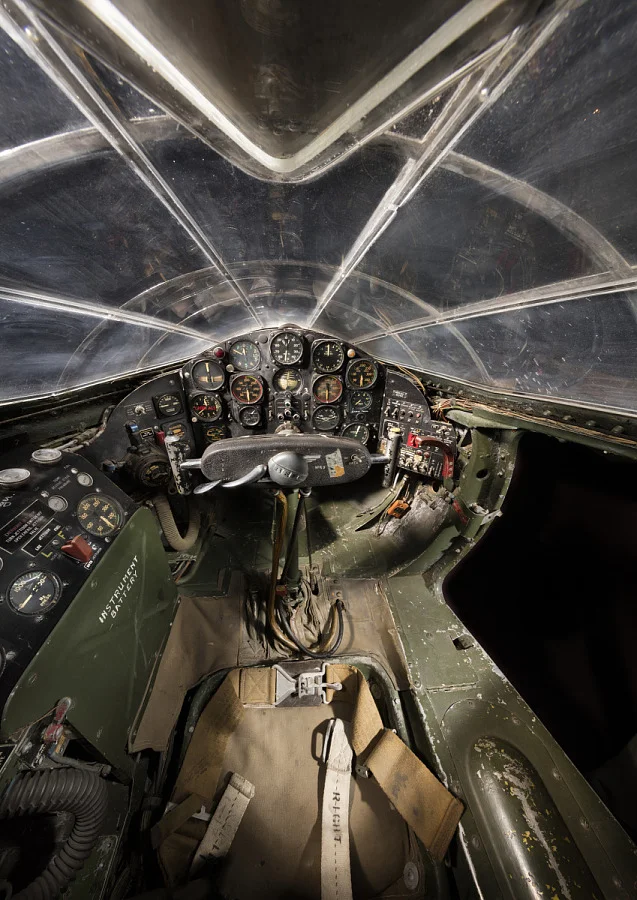
The cockpit is coffin-sized. The multi-pane plexiglass canopy provided adequate forward and upward visibility but almost none to the sides. The instrument panel carried a Mach meter, altimeter, rate-of-climb indicator, accelerometer, and engine gauges — all analog, all requiring interpretation under g-load. The green-painted aluminum side walls, dented with wear, come within inches of the pilot's elbows. There was no ejection seat: if something went wrong at altitude, the pilot's options were to bail out through the side hatch (a violent and uncertain procedure) or ride the aircraft down. 3
The full materials list in the Smithsonian's accession record includes aluminum, steel, glass, paint, foam, fabric, rubber, asbestos, magnesium, radium paint (for instrument illumination), plexiglass, and leather. 3 The presence of radium paint — used for luminous instrument dials, standard practice in that era — means the aircraft carries mild residual radioactivity; the Smithsonian's conservation team accounts for this in its handling protocols.
The Collier Trophy and the institutionalization of speed
On October 14, 1947, the three men most responsible for the flight were Lawrence D. Bell (Bell Aircraft Corporation's president), John Stack (NACA), and Chuck Yeager. In 1948, President Harry S. Truman presented them jointly with the Robert J. Collier Trophy at the White House — aviation's most prestigious annual prize, awarded since 1911 for "the greatest achievement in aeronautics or astronautics in America." 13
The Collier had gone previously to Orville Wright (1913) and Howard Hughes (1938), among others. The 1947 award recognized not just the flight but the institutional methodology behind it: NACA's incremental, data-driven approach to probing unknown flight regimes. Stack would win a second Collier Trophy in 1951, for the Langley transonic wind tunnel. 13
That methodology — fly a little faster, measure everything, analyze overnight, fly a little faster — became the template for every subsequent American experimental aircraft program. The X-1B that followed was equipped with early reaction rocket controls for attitude adjustment, a system later adopted by the North American X-15. The X-15 itself flew to the edge of space. The X-15 program, staffed by pilots trained partly at the USAF Aerospace Research Pilot School that Yeager commanded from 1962, fed directly into the astronaut selection process for Mercury and Gemini. 5 14
The lineage runs from the B-29 that dropped Glamorous Glennis to the Saturn V that carried Apollo 11 — a line of institutional knowledge and engineering methodology that NACA built and NASA inherited when it absorbed NACA on October 1, 1958. 6
From Muroc to the Mall: the provenance chain
The X-1's transfer to the Smithsonian was staged as a formal ceremony — fitting for an aircraft that the Air Force understood had changed the world. On August 26, 1950, USAF Chief of Staff Gen. Hoyt Vandenberg presented the aircraft to Smithsonian Secretary Alexander Wetmore at a ceremony in Washington. The X-1 made one final flight to get there: carried beneath the bomb bay of a B-29 for the cross-country trip.
Vandenberg was not given to understatement. "The X-1 marked the end of the first great period of the air age," he said at the ceremony, "and the beginning of the second. In a few moments the subsonic period became history and the supersonic period was born." 3
The provenance chain from that handover is unusually clean for an artifact of this age. The aircraft passed from Bell Aircraft Corporation to the U.S. Army Air Forces (which became the U.S. Air Force in September 1947), and from the Air Force directly to the Smithsonian — a government-to-government transfer, no auction house, no private collection, no contested acquisition. The Smithsonian's accession record carries serial number 46-062, the original manufacturer's designation. 3
For the next quarter-century, the aircraft was displayed in the Smithsonian's Arts and Industries Building on the National Mall — the cramped, Victorian-era space that served as the original National Air Museum before a dedicated building existed. On July 1, 1976, the current National Air and Space Museum building opened, and the X-1 was installed in what is now the Boeing Milestones of Flight Hall, the museum's central gallery. It has been suspended from that ceiling, almost without interruption, ever since. 15
Yeager's complaint, and the painter who fixed it
At some point after 1976, the museum noticed a problem that Chuck Yeager noticed first. The paint scheme on the displayed aircraft was wrong — it did not match the aircraft's appearance on October 14, 1947. On his visits to the museum over the years, Yeager "frequently complained the aircraft had the wrong paint scheme." 15
A museum staff painter eventually restored the finish to its correct international orange, matching photographic documentation from the Muroc period. The precise year of that restoration is not in the publicly accessible record — the Smithsonian's internal conservation files hold that detail. But the paint currently visible on the aircraft is the result of that restoration: the warm, high-visibility orange that test aircraft of the era wore to make them easy to spot against the desert floor if they went down. 16
The color is not purely pragmatic. International orange — the same shade used for the Golden Gate Bridge and for the Mars rovers — has a specific visual weight that makes photographs of the X-1 immediately recognizable. It is part of what the aircraft means, visually. An incorrect paint scheme would have quietly falsified the record every day it was on display.
The 1997 anniversary: returning to the cockpit
On October 14, 1997 — the 50th anniversary of the flight — Yeager came back to NASM. NASM Deputy Director Donald Lopez, who had known Yeager from their overlapping tenures at Edwards Air Force Base, arranged for Yeager to be lifted up to the suspended aircraft and climb back into the cockpit while it hung high above the Milestones of Flight Hall floor. 11
After the visit, Yeager donated his personal collection to the museum: his flight jacket, personal memorabilia, and other items from the X-1 program. The donated jacket is now part of the NASM artifact record, one floor away from the aircraft.
Down to earth: the 2015 conservation
On April 29, 2015, the Bell X-1 was lowered to the floor of the Boeing Milestones of Flight Hall for the first time in the museum's history. 15 Alongside the Spirit of St. Louis and SpaceShipOne, it was brought to eye level for conservation work as part of the hall's renovation in preparation for the museum's 40th anniversary in 2016.
For visitors who had only ever seen the aircraft as a bright orange shape suspended improbably above their heads, seeing it at floor level was a different experience. At 30 feet long it is not large. Standing next to it, you can trace the rivets in the aluminum skin, read the hand-painted name on the nose, look through the plexiglass canopy at the cramped cockpit interior. The scale that makes it seem small also makes the achievement inside it more legible: this machine, about the size of a large touring motorcycle stretched into a fuselage, flew faster than any human being had ever flown.
The Milestones of Flight Hall, and what the X-1 is doing there
When NASM opened its present building in 1976, the Milestones of Flight Hall was conceived as a gallery of firsts: Mercury Friendship 7 (John Glenn's orbital capsule), the Bell XP-59A Airacomet (America's first jet aircraft), Telstar (the first active communications satellite), and the X-1. The hall was the museum's statement about which moments in aviation and space history had mattered most — a curatorial judgment expressed in architecture by placing these objects in the building's central, most-trafficked space. 14
The X-1 fits that frame precisely. NASM's own description calls it "the first of a series of 'X' experimental piloted and unpiloted projects that continue to this day" — a lineage that runs through the X-15 to the X-43 and beyond. 3 Curator van der Linden has noted that the data gathered on transonic and supersonic flight by the X-series has "made new generations of subsonic civil airliners safer and more efficient" — which is to say, the X-1's work is embedded not only in military aircraft but in every commercial jetliner flying today. 11
During the NASM building's $360-million, seven-year renovation that began in 2018, the X-1 spent part of its time at the Steven F. Udvar-Hazy Center in Chantilly, Virginia, where visitors could see it at floor level a second time. By mid-2025, it had been returned to the National Mall building and re-suspended in the Boeing Milestones of Flight Hall. 17
The cultural resonance: The Right Stuff and what it preserved
The X-1's place in American memory was solidified not by the Smithsonian but by a book. Tom Wolfe spent seven years working on The Right Stuff, published in 1979 by Farrar, Straus and Giroux. It won the National Book Award for nonfiction. Wolfe had begun the project after covering Apollo 17 for Rolling Stone in 1972 and found himself more interested in the test pilots at Edwards — particularly Yeager, who had never become an astronaut because he lacked a college degree — than in the astronauts NASA chose. 18
Philip Kaufman's 1983 film adaptation, in which Sam Shepard played Yeager with a taciturn precision that matched the original, spread the story to a wider audience. Yeager himself appeared in the film as a bartender at Pancho's Place — a cameo that acknowledged the mythology while standing slightly outside it. 18 On October 14, 1997, Yeager flew again as a passenger in an F-15D Eagle over Edwards, reaching supersonic speed on the 50th anniversary. On October 14, 2012 — his 89th year — he did it a final time, as copilot in an F-15. 9
He died December 7, 2020, in Los Angeles at 97. 9
Object significance: what the aircraft means as an artifact
Museum curators distinguish between an object's historical significance (what it did) and its artifact significance (what it carries, physically, as a witness). The Bell X-1 Glamorous Glennis is unusual in that both are maximal.
Historically: it was the instrument of the first supersonic manned flight, an event that opened the era of high-performance aviation and set the methodological template for every American experimental aircraft and human spaceflight program that followed.
As an object: this specific airframe — serial 46-062, not a replica, not a representative example — was present. The rivets, the instrument panel, the plexiglass canopy scratched from decades of display: all of it was at 43,000 feet on October 14, 1947. The paint on the nose was applied by Chuck Yeager's own hand, or at his direction, in August 1947, honoring a woman he had known since she was 18 years old and married for 45 years until her death in 1990. 19
Yeager had a phrase for the aircraft. "The best damned airplane I ever flew." 2 It is a test pilot's judgment, stripped of sentiment — the kind of assessment that takes a lifetime of flying to make and means exactly what it says.
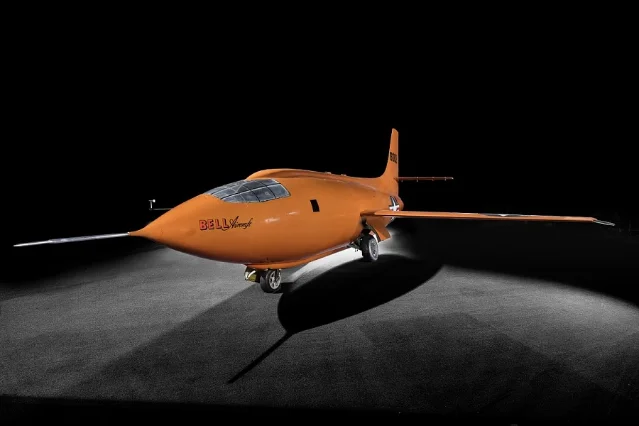
It hangs now above the hall, pointing toward a wall of glass overlooking the National Mall, orange as a flame.
Cover image: Bell X-1 "Glamorous Glennis" (NASM accession A19510007000) suspended in the Boeing Milestones of Flight Hall at the Smithsonian National Air and Space Museum, Washington, D.C. Image from National Air and Space Museum Lowers Bell X-1 to Floor Level — Smithsonian Open Access (CC0).
参考ソース
- 1Chuck Yeager Broke the Sound Barrier in the Bell X-1
- 2Oct. 14, 1947 — This Week: The Sound Barrier
- 3Bell X-1 Glamorous Glennis — NASM Collection
- 4Sound barrier — Wikipedia
- 5Bell X-1 — Wikipedia
- 6NACA — Wikipedia
- 7John Stack (engineer) — Wikipedia
- 8Miles M.52 — Wikipedia
- 9Chuck Yeager — Wikipedia
- 10Glennis Dickhouse Sees Chuck Yeager for the 1st Time
- 11Record-Breaking Chuck Yeager, a Pilot with the Right Stuff
- 12Research in Supersonic Flight and the Breaking of the Sound Barrier — NASA SP-4219
- 13Collier Trophy — Wikipedia
- 14Boeing Milestones of Flight Hall
- 15National Air and Space Museum Lowers Bell X-1 to Floor Level
- 16Bell X-1 (Osprey X-Planes 1) — Peter E. Davies
- 17National Air and Space Museum — Smithsonian Magazine
- 18The Right Stuff (book) — Wikipedia
- 19Together Again Forever — ChuckYeager.org
このコンテンツについて、さらに観点や背景を補足しましょう。