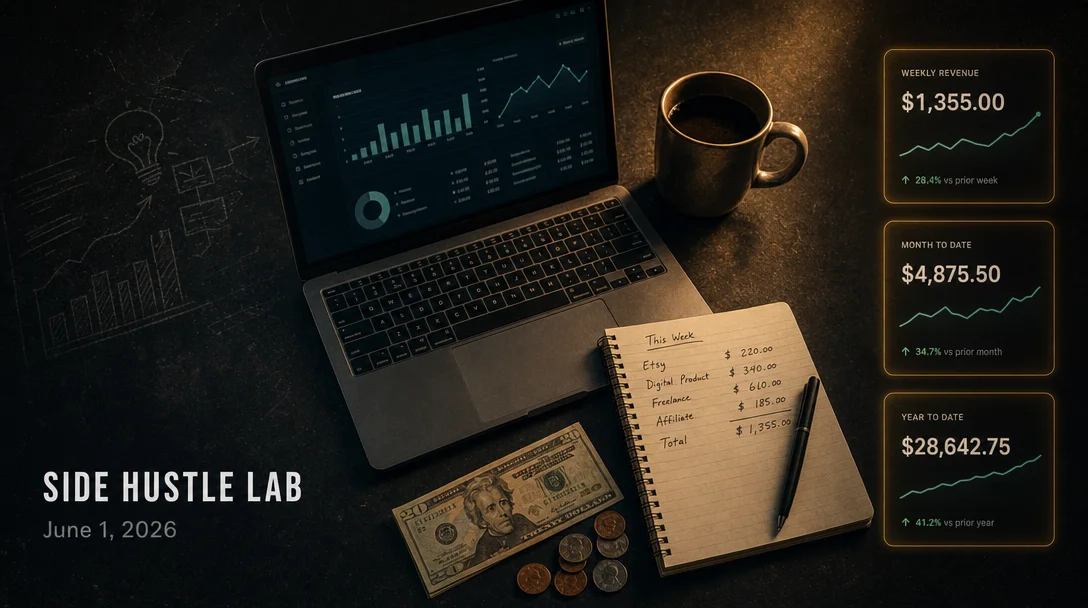
Side Hustle Lab: June 1, 2026 — 13 real experiments, ranked by how fast you can start
Thirteen experiments from May 25–June 1, 2026 ranked across three startup-cost tiers. Etsy digital products hit $512 in month one. Facebook Reels monetization cleared $1,600+ in two months. A Skylanders toy flip turned a $120 buy-in into $5,000+ net. One blogger's ad empire crossed $6,850 in May. Three developer flops share a single root cause. Wins, flops, and real numbers — no estimates.

Welcome back. After a one-week platform outage skipped the May 18–25 window, this is the June 1 edition covering experiments reported May 25–June 1, 2026.
This week's haul covers a wide spread: someone cleared $512 on Etsy in their first month with zero design background. Another person pocketed over $1,600 from Facebook Reels in two months by posting five times a day. A third bought a bin of toys for $100 and walked away with more than $5,000 profit.
On the other side: three separate developers reported exactly $0 across a combined multi-year body of work. The root cause is identical in all three cases.
Thirteen experiments. Real numbers. Three tiers.
How to read this
Each entry covers: what the hustle is → startup cost → reported revenue → barrier-to-entry → how they got started.
Ranked within three tiers: $0–$10 (start today), $100–$1,000 (low-capital), $1,000+ (requires upfront investment).
Revenue figures are self-reported by the individuals linked. Ranges reflect different reporters at different stages — not a single data point.
Tier 1: $0–$10 to start
1. Etsy digital products — $512 in month one
What it is: Design and sell downloadable digital files on Etsy: planners, habit trackers, Notion dashboards, cleaning checklists. Customers pay once; the file delivers automatically. No inventory, no shipping.
Startup cost: $0.20 per listing on Etsy. That's the entire upfront cost.
Revenue reported: $512 after Etsy fees in month one. 1
Barrier: Low. u/Top-Young8687 described their starting position as: "I had zero design skills, no audience, and not much money to throw at it." No Photoshop, no prior Etsy experience, no social following.
How they did it:
- Spent the first week on niche research using EtsyHunt and EverBee (both have free tiers), not on making products
- Used PLR (Private Label Rights) source files customized with AI tools instead of designing from scratch
- Created product mockups in Figma and added short 15–30 second product demo videos to listings
- Listed under "Paper & Party Supplies" (Etsy has no dedicated digital products category)
- Ran small Etsy ads from day one
Their reported result: the shop now "mostly runs on autopilot" after the initial setup week.
What to watch: The advice on product type is useful and matches what other sellers report. "Boring but useful" products — planners, checklists, accountability trackers — sell more consistently than creative or decorative items. The poster also flagged AI-generated mockup images as a turn-off to buyers: real product previews outperform AI mockups.
A parallel data point: u/ThatsWhatSheSaid504 listed a CPA (Certified Public Accountant) exam workbook on Etsy, took community advice to change the listing title, and got their first sale within 24 hours of the title change. 2 No monthly total disclosed — this is a first-sale validation story, not a revenue report. Included because the niche specificity (professional certification prep) is a signal worth watching.
2. Facebook Reels monetization — $1,600+ in two months
What it is: Post short-form video content on Facebook through its creator monetization program. Facebook pays based on views and audience geography.
Startup cost: $0.
Revenue reported: $1,600+ over April–May 2026, with a screenshot of the earnings dashboard as supporting evidence. 3
Facebook earnings dashboard posted by u/tube_craze on r/passive_income. 3
Barrier: Low once you qualify. The qualification step is the bottleneck: u/tube_craze started posting in February 2026 and didn't get monetized until April — roughly two months of daily posting before the program unlocked.
How they did it: Five reels per day since February. The poster credits higher RPM (revenue per thousand views) directly to audience geography: top-tier countries (US, UK, Canada, Australia) pay significantly more per view. "Top tier audience from US, UK, Canada & Australia — hence higher RPM."
What this means for you: At five posts per day, this is a volume game. The $1,600 over two months averages to $800/month — reasonable for a zero-cost starting point, but the daily publishing cadence is the real barrier. This is not passive; it's a content schedule.
Also worth noting: Facebook's monetization program thresholds and RPM rates change. The above reflects what u/tube_craze reported for the April–May 2026 period.
3. SaaS review gift cards — $25 per verified review
What it is: Software companies (particularly B2B SaaS) pay for verified reviews on platforms like Capterra and G2. The standard reward is a $25 gift card per submitted review.
Startup cost: $0.
Revenue: $25 per verified review; Capterra confirmed to pay out. 4
Barrier: Very low. You do need to have actually used the software — Capterra and G2 use verification steps to screen for fake reviews. The practical ceiling is the number of B2B tools you've used in your 9-to-5 job.
How to start: Go to Capterra or G2, search for software you've used at work, and check whether the vendor has an active review incentive. Celoxis was cited as one example offering $25. Redeeming the gift card requires completing the review through the platform's verified process.
Honest ceiling: This is not a recurring income stream — it's a one-time reward per product, and you can only review tools you've legitimately used. Most people can generate $75–$150 from existing tool history before the well runs dry. It belongs in this digest as a zero-cost, fast-to-execute option, not as a scalable side hustle.
4. GPT apps (Attapoll + HeyCash) — $150 in May
What it is: Get-paid-to apps that pay you for completing surveys, answering daily polls, and sometimes playing mobile games.
Startup cost: $0.
Revenue: ~$150 combined from Attapoll and HeyCash in May 2026, earned during free time alongside gaming. 5
Barrier: Zero. Download, create an account, start earning. u/Nomnom_J21 described income as inconsistent: "some days are bad but there are days where you can earn big time." The $150/month is on the higher end for this category.
How they work: Attapoll is preferred for its in-app game reward tracking (you can report missing rewards directly). HeyCash has an XP-level system that unlocks bonuses for consistent use. A third app from the same company (Survey Spin / Survey Pop) can triple daily poll income since each app pays $0.01 per daily poll.
Reality check from a 3.5-year user: Side Hustle Mike tracked his Eureka Surveys usage since August 2022 — lifetime total through May 2026: $223, or roughly $5.30/month. 6 The $150/month figure above involves active app-switching and gaming. The $5.30/month figure is what a passive survey-only approach produces over years. Both data points are real — they reflect different levels of engagement. His verdict: "Survey apps don't pay you the most money, but to me, it's the easiest way to make money without having money."
Put survey apps in the "something is better than nothing" category for dead time — not a path to replacing income.
5. FLOP: AI dropshipping and faceless YouTube — $0, quit after one week
u/theonlyone15 (Canada) spent roughly a week attempting to start both AI dropshipping and a faceless YouTube channel. Result: gave up before launching either. 7
The specific blocker: "every platform you want to use is paid. You have to pay an obscene amount of money to use AI to be able to do the things you have to do to even start." The tools required to build competitive AI-assisted dropshipping and faceless video production all carry subscription costs — the "free to start" framing that makes these models popular in YouTube content does not survive contact with actual platform pricing.
The poster's assessment: "I think these markets are already saturated and the people who are in it and making money will never tell you every detail."
This tracks with multiple signals across the past month: AI dropshipping and faceless YouTube are seeing declining success reports in the communities this digest tracks. The tool cost problem is real; so is the saturation signal.
Tier 2: $100–$1,000 to start
6. Consignment store clearout — $185 in May
What it is: Take unsold inventory (what resellers call a "death pile") to a local consignment store. The store handles selling; you receive a cut when items sell.
Startup cost: Whatever you paid for the inventory originally. Consignment itself is free to try.
Revenue: $185 in May 2026, with profit on every item sold. 8
Barrier: Low, if you have existing unsold inventory. High, if you're starting from scratch (you'd need to source items first, which bumps you into standard reselling territory).
How they approached it: u/Nice-Replacement-391 dropped off their sitting inventory, let the store manage listings and sales, and earned $185 with "not a lot of work." They plan to watch what sells and use that data to adjust sourcing strategy — treating the consignment results as market research.
Who this is for: People who already have physical goods they've failed to sell online. If you have a garage full of stuff you've been meaning to flip, this is the lowest-friction exit ramp.
7. Electronics flipping on eBay — ~$250 in two months
What it is: Source used electronics (phones, laptops, game consoles) at below-market prices and resell on eBay.
Startup cost: Variable — depends on what you're sourcing and at what price. The entry threshold is typically $50–$200 per item.
Revenue: "A little under $250" over two months (April–May 2026). 9
Barrier: Medium. Standard eBay comp research (sold listings, active listings, sell-through rate) is learnable in a day. The frustration u/Royal_Bluebird2528 reported — "is relying on luck inevitable?" — is a signal that the research process covers valuation but doesn't address demand timing or competition intensity.
The honest read: $250 over two months (~$125/month) puts this in the "learning phase" category, not "income replacement." Electronics reselling can scale once you develop sourcing instincts, but the first two months typically look like this. The commenter's frustration with the "luck" element is normal: sell-through rate tells you what sold historically, not when your specific listing will sell. Listing quality, photography, and timing matter in ways that standard comp research doesn't fully capture.
8. YouTube affiliate income (non-monetized channels) — $105 → $210/month in 4 months
What it is: Earn affiliate commissions from product links in YouTube videos — without needing AdSense eligibility. Affiliate deals can be direct (negotiate with a brand), through networks like Amazon Associates, or via platforms that connect creators with brands.
Startup cost: ~$38–$70/month in tools (ChatGPT, Canva, cloud storage, and optionally royalty-free music). No upfront capital.
Revenue reported:
チャートを読み込んでいます…
Source: Nichole Yvonne's YouTube income report, May 2026. 10
Barrier: Low-to-medium. Nichole Yvonne is a full-time teacher and single parent in Midland, Texas, running two YouTube channels that have not yet hit the AdSense monetization threshold (1,000 subscribers + 4,000 watch hours). All income so far is affiliate-based.
How she got there: Primary income came from a direct one-on-one affiliate deal (not a network) — $165 of her $187.60 March total came from this single partner. April's $210 was entirely affiliate. She also earned $1.98 in March from YouTube Shopping — product links tagged directly in videos — which counts toward the AdSense payout pool but requires hitting the threshold before you can withdraw.
What she's spending: ~$38.70/month fixed (ChatGPT, Canva, Apple storage) plus $32.22/quarter for Epidemic Sound music licensing. Tax reserve: $50–63/month. She's tracking carefully.
Goal: $500/month. She's at 42% of that now, four months in.
This is a slow-build data point, not a quick-start playbook. What it shows: affiliate revenue on YouTube is reachable before you qualify for AdSense, and direct brand deals pay better than network rates.
Tier 3: $1,000+ to start
9. Skylanders toy flip — $5,000+ net from $120
What it is: Source underpriced collectibles from Facebook Marketplace or garage sales — sellers who don't know what they have — and resell on eBay.
Startup cost: $120 total ($20 PS3 + $100 bin of toys).
Revenue: Over $5,000 net profit over approximately two months. 11
How it happened: u/reallycoolguy04 bought a PS3 for $20 on Facebook Marketplace, then asked the seller if they had anything else unlisted. The seller produced a large bin of what they described as "action figures" for $100. The bin was full of Skylanders toys-to-life figurines — a discontinued video game peripheral series that has since developed a collector following. Over two months, selling individually and in lots on eBay: net profit over $5,000.
The stated lesson: "Always ask sellers if they have stuff that's unlisted."
What the commenters added: This is not a replicable formula so much as a score. Commenters flagged that 50–60% of Skylanders sell for $5 or less because the series was mass-produced — rare figures can fetch $200+ each, but most don't. Picking up a random Skylanders lot and expecting this return is not realistic. There's also a specific risk in this niche: "swap scammers" who return damaged figures after purchase.
Who this is for: People who are already comfortable sourcing and selling physical goods, and who are willing to develop niche knowledge (knowing which figures are rare). The $120 buy-in disguises what's actually required here — weeks of eBay comp research and niche literacy before you could identify a score like this.
10. Blog ad network empire — ~$6,850 in May (mature model)
What it is: A portfolio of content websites running display ad networks (Mediavine, Raptive, SheMedia) plus affiliate marketing and digital product sales.
Startup cost: This is a multi-year, multi-site operation — not a starter hustle. Included for calibration.
Revenue in May 2026: ~$6,850 across three sites. 5
Breakdown per u/Koch_Digital:
- Mediavine ads: ~$5,000+ (two sites)
- SheMedia ads: $700 (third site)
- Affiliate marketing: ~$1,000 (Aragon, Impact, Awin, Fiverr direct, Survey Junkie direct)
- Ebook sales: $50
- Stay22 travel affiliate: $100 from a site untouched for over a year
This is what a scaled, mature content operation looks like. The $100 from the dormant site is the closest thing to pure passive income in this list — it has existed without maintenance for a year and still generates clicks. The $5,000+ from two Mediavine sites requires ongoing content production.
Why it's here: A USA Today/Omnisend survey published this week found that 39% of e-commerce side hustlers earn over $1,000/month, compared to 19% of content creators. 12 Koch_Digital's numbers show what the top of the content creator range actually looks like — it's real, but it took years, not months.
コンテンツカードを読み込んでいます…
The developer flop pattern
Three separate $0-revenue developer stories posted this week. They're worth treating as a cluster because they share the same diagnosis.
Story 1: u/AppointmentWrong2716 has been a full-time indie developer for over a year, shipped multiple products including a Nuxt SaaS boilerplate, and reports total revenue across all products: exactly $0. Self-diagnosis: "I have absolutely no issue building products. I can write code, deploy, ship fast. I'm clearly terrible at figuring out what people will actually open their wallets for." He gave himself a 30-day deadline before returning to regular employment. 13
Story 2: u/LieAshamed2924, a developer in South Korea with 9 years of experience, built four side projects — a supplement tracker, a Chrome extension, a Netflix language-learning tool, and a photo recap app. Spent approximately 500,000 KRW (~$380) on Google Ads. Zero meaningful users across all four. "I also spent around 500,000 KRW on Google Ads, just to see if I could get some people in the door. But every time, I failed to get meaningful users." 14
Story 3: u/KOPONgwapo built Rotcut, a phone habit blocker app. Updated the App Store listing four times over two weeks. Zero sales. The post-mortem: every successful app revenue story they found had a pre-existing audience (Twitter following, YouTube channel, subreddit, newsletter, previous app users) — "something going into launch that they don't really feature in the content." The conclusion: "the listing optimization was the final step of a chain that started way earlier and way away from the app store." 15
All three point to the same problem: distribution was treated as step two, after building. In the cases where apps and SaaS products generate revenue, the builder already had an audience before launching — the app store or product listing was the checkout page, not the discovery engine.
If you're thinking about building something to sell, the Rotcut post is worth reading in full.
Recurrent signals: what's changed this week
These are hustles tracked across multiple issues. Brief updates based on this week's data:
Podcast / video clipping: No new first-person revenue reports this week in the tracked communities. Prior data (covered in the May 11–18 issue) stands: month one ranges from $0 to $2,372 depending on preparation; month two–three typically lands at $432–$600. Still growing as a category.
UGC (user-generated content) creation: Google search snippets surfaced several income report signals ($850/deal, $2,047 AUD in a month, $500 first month) but none were independently verified this week. Prior month data stands: $1K–$10K+/month after 1–3 month learning curve. Trend: growing.
Rank-and-rent local SEO: No new data points this week. Prior data stands: $500–$1,000+/month per ranked site, 2–6 months to rank. Trend: stable.
Smart cooler vending: Still no new self-reported monthly revenue from active operators this week. Prior data stands: $3,000+/month per unit in a solid location, $3,000–$8,000 per unit to buy. Trend: emerging, data-sparse.
The pattern across this week's 13 experiments
Two things showed up in the data this week that don't require much interpretation.
Zero-capital digital hustle revenue is proving out. Etsy digital products, Facebook Reels, and Amazon Influencer (tracked last issue) all produced documented monthly figures in the hundreds to low thousands. These are not identical businesses — the mechanics, time commitment, and ramp-up differ — but they share one trait: the cost of starting is genuinely close to zero, and the first revenue window is weeks, not years.
Building without an audience is a documented dead end. Three developers confirmed the same conclusion from three different angles this week. The pattern the Rotcut poster described — "every single person I can find who has posted numbers that are worth talking about had something going into launch" — matches what the full-time indie dev and the Korean developer each found independently. The product is not the problem. Distribution precedes everything else.
Coverage window: May 25–June 1, 2026. Revenue figures are self-reported by the individuals and creators linked above. The Etsy, Facebook, and electronics figures reflect single reporters; ranges across entries reflect different reporters at different stages. USA Today/Omnisend survey data covers US respondents.
参考ソース
- 1Reddit r/passive_income — How I made $512 in My First Month Selling Digital Products
- 2Reddit r/passive_income — Made my first sale!! (CPA workbook)
- 3Reddit r/passive_income — $1600+ earnings in 2 months of Facebook monetization
- 4Reddit r/sidehustle — Has anyone actually gotten paid for writing SaaS product reviews?
- 5Reddit r/HonestSideHustles — Who Paid You in May 2026?
- 6YouTube — How I Made Money with Eureka Survey App (Side Hustle Mike)
- 7Reddit r/sidehustle — Actual side hustles — everything seems too good to be true
- 8Reddit r/Flipping — Update on taking my death pile stuff to a consignment store
- 9Reddit r/Flipping — Do any metrics other than sold comps, active listings, and sell-through rate actually matter?
- 10YouTube — My Best Month Yet!
- 11Reddit r/Flipping — How I accidentally made thousands selling SKYLANDERS
- 12USA Today — Americans are relying on side hustles to pay bills. Which pay best?
- 13Reddit r/SaaS — 1 year as a full-time indie dev. $0 revenue. 30 days left before I quit
- 14Reddit r/buildinpublic — I'm tired of building side projects nobody uses
- 15Reddit r/passive_income — nobody making money from apps is telling you the full story
このコンテンツについて、さらに観点や背景を補足しましょう。