June 22 in business history: the DOJ, Dairy Queen, the GI Bill, and Virgin Atlantic
On June 22, 1870, President Grant signed the Act creating the Department of Justice — 81 years after the government hired its first lawyer. On June 22, 1940, the first Dairy Queen opened in Joliet, Illinois, pioneering the franchise model a decade before McDonald's. On June 22, 1944, FDR signed the GI Bill, which returned at least $6.90 in economic output for every dollar invested in veterans' education. On June 22, 1984, Virgin Atlantic flew its inaugural London–Newark route on a single leased 747 with an explicit return clause if the experiment failed. All four decisions built durable systems under structural constraint.

Four events on June 22 — 1870, 1940, 1944, 1984 — each required someone to build something that didn't exist yet: a federal law firm, a franchise system, a human-capital guarantee, an airline with one plane. None of the decisions looked obvious at the time. The Department of Justice was created 81 years after the government hired its first lawyer. The first Dairy Queen opened on a product category that had no commercial market 24 months earlier. FDR signed a bill whose original draft asked "Is this too generous?" in the margin. And Richard Branson launched his airline by leasing a single secondhand 747 with the explicit option to give it back if the whole thing failed. Three of the four are still operating today. The fourth — the GI Bill — remade the American economy so completely that its architecture got replicated seven more times over the following eight decades.
1870 — Department of Justice: building the government's law firm from scratch
On June 22, 1870, President Ulysses S. Grant signed H.R. 1328, the Act to Establish the Department of Justice (P.L. 41-97, 16 Stat. 162), creating the DOJ as a cabinet-level executive department headed by the Attorney General. 1 The department became operational nine days later, on July 1, 1870 — exactly 81 years after the Judiciary Act of 1789 had first created the office of Attorney General. 2
The 81-year gap requires some explanation. The Library of Congress called it "a curiosity of history" 1 — but it wasn't accidental. For most of those eight decades, the AG was a part-time position. Congress didn't authorize the government's top lawyer to hire a single clerk until 1818, 29 years into the republic. Each executive department hired its own lawyers independently: Treasury supervised US Attorneys in revenue cases from 1797 onward, State had its own legal staff, Interior ran the federal court system. 3 Under Lincoln, Attorney General Edward Bates ran an operation with six staff whose primary function was generating legal opinions on demand. He had no authority over US Attorneys across the country. 1
The Act's consolidation was sweeping. It placed all US Attorneys under the Attorney General's supervision, required the DOJ to handle all federal litigation, created the office of Solicitor General to argue government cases before the Supreme Court, and explicitly prohibited executive departments from hiring outside private attorneys — ending the practice of case-by-case outside counsel. 2 Grant appointed Amos T. Akerman as the first Attorney General and Benjamin H. Bristow as the first Solicitor General in the same week. 3
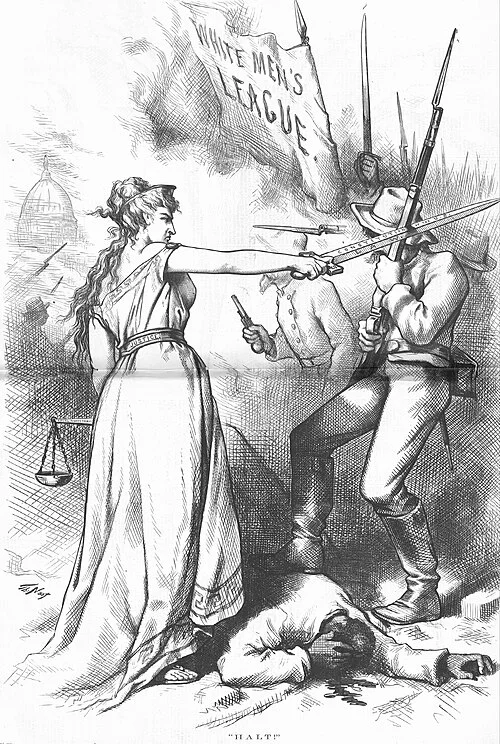
The department's first major test came immediately: Reconstruction-era KKK prosecutions. By 1871, the DOJ had secured 3,000 indictments and over 600 convictions against Klan members, resulting in a dramatic decrease in violence across the South. 3 Akerman described Grant's commitment to prosecuting domestic terrorists as unmatched — telling a friend no one was "better" or "stronger" than Grant on that count.
From there, the scope widened to match the economy. The Sherman Antitrust Act passed in 1890, giving the DOJ authority over monopolies. The Antitrust Division was formally established in 1919. 3 The DOJ's 1906 suit against Standard Oil — which controlled over 90% of US petroleum refining — ended in the Supreme Court's 1911 ruling that broke the company into 34 entities and established the "Rule of Reason" for antitrust enforcement. 4 AT&T's 1984 divestiture, which the DOJ forced via a 1974 lawsuit, broke the Bell System into seven Regional Bell Operating Companies and reduced AT&T's book value by approximately 70%. 5 In April 2025, the DOJ won its second major antitrust case against Google in three years — this one for monopolizing digital advertising markets, following a 2024 ruling on search. 6 The department now employs over 115,000 people on a $37.5 billion annual budget. 7
Decision mirror. The 81-year gap between creating the government's chief lawyer and giving that lawyer actual authority is less a quirk than a lesson in how legal infrastructure gets built. Every department preferred to hire its own outside counsel — more flexible, more controllable. Centralization required Reconstruction's urgency to become politically viable. The modern version of this problem shows up in large organizations where legal, compliance, and regulatory affairs each report through different business units, producing fragmented advice and inconsistent enforcement. The DOJ's founding logic was that a fragmented legal function can't develop institutional memory, precedent, or the prosecutorial muscle to take on powerful opponents. That logic hasn't aged.
1940 — Dairy Queen: the franchise model before anyone called it that
On June 22, 1940, Sherb Noble opened the world's first Dairy Queen at 501 North Chicago Street in Joliet, Illinois. 8 9 The opening menu was minimal: soft-serve cones, pints, quarts, and sundaes. No seating. No hot food.
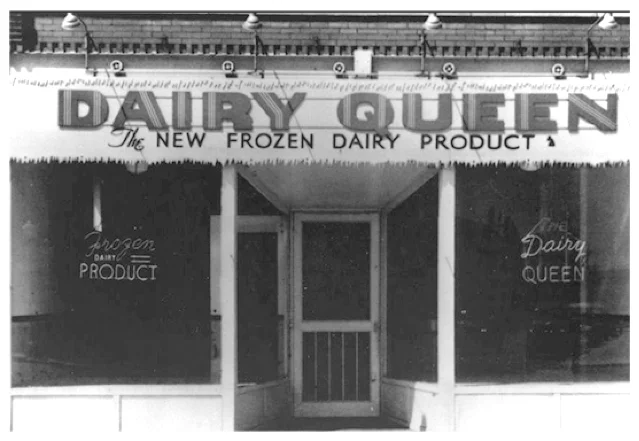
The product itself was only two years old. J.F. "Grandpa" McCullough and his son Alex had developed the soft-serve formula in 1938 in Moline, Illinois — McCullough called cows "the queen of the dairy business," which is where the name came from. 10 They ran their first market test that summer: Noble offered "All You Can Eat for 10 Cents" at his Kankakee ice cream shop and sold through 1,600 servings in two hours. 11 In 1939, McCullough signed an agreement with Harry Oltz, an Indiana inventor who had developed the continuous freezer machine that could dispense soft-serve at the right temperature — the missing piece of the distribution puzzle. 11
The franchise model emerged directly from the opening structure. McCullough and Oltz licensed equipment rights and collected royalties per gallon sold; Noble operated the store. Harry Axene formalized this in 1943 with a territorial franchise system that let the chain scale nationally without McCullough owning or operating anything. 10 The growth rate makes the point: 10 stores in 1941, 100 in 1947, 1,446 by 1950, 2,600 by 1955. 10 McDonald's franchising began in 1955, KFC in 1952, Burger King in 1954 — Dairy Queen was doing it a decade before any of them. 9
The early growth was also chaotic. Warren Buffett — who acquired International Dairy Queen in 1998 for $585 million — later noted the company had "a bumpy history" in its first three decades: thousands of independent operators running wildly inconsistent stores with no centralized quality control. 12 The Mooty and Luther families, who acquired the company in 1970 for $5 million, spent the following decade converting the loose licensing network into a modern franchise system with standardized operations. 10 Buffett's $585 million price in 1997 bought a royalty machine: International Dairy Queen (IDQ) collected a 4% royalty on all system sales plus 5–6% advertising fees without owning a single restaurant. 12 At the time of acquisition there were 5,792 DQ locations in 23 countries; today there are roughly 7,800 across 27 countries with a $6.4 billion annual system-wide sales run rate. 12 8
Decision mirror. The Dairy Queen story has two distinct phases: the product phase (1938–1943) and the system phase (1943–1970). The product validated fast. The 1938 Kankakee test was essentially a demand proof — 1,600 servings in two hours for 10 cents each is market research with real money. What took 30 more years was building the operational infrastructure to make each franchisee deliver the same product consistently. Buffett's insight in 1997 was that the second phase had finally been completed: IDQ had become an asset-light royalty business where the upside from franchisee growth flows entirely to the brand owner. The 85-year compound from Joliet to Buffett to a $6.4 billion system is a case study in what happens when the right business model catches up to the right product.
1944 — The GI Bill: $6.90 back for every dollar spent
On June 22, 1944, President Franklin D. Roosevelt signed the Servicemen's Readjustment Act of 1944 (Public Law 78-346), known universally as the GI Bill. 13 The legislation had been drafted by Harry W. Colmery — a World War I veteran and former American Legion national commander — on Mayflower Hotel stationery in December 1943. Colmery noted in the margin of one draft, questioning whether the four-year education benefit was "too generous." It wasn't. 14
FDR's original version had included a means test — only veterans who couldn't afford college would get help. The American Legion's proposal extended full benefits to all eligible veterans regardless of wealth. That version won. 15
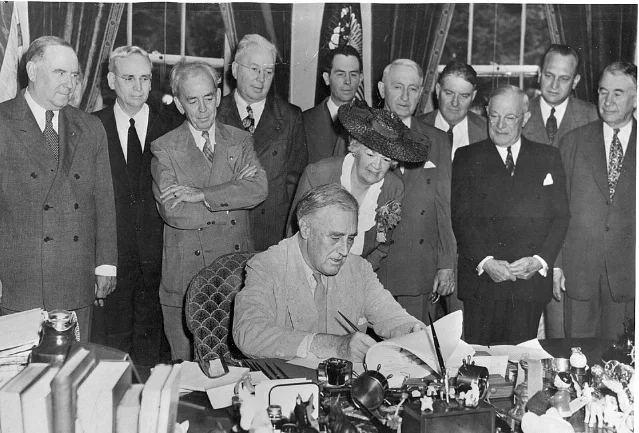
The act had four main pillars: tuition coverage up to $500 per year (Harvard's full cost including room and board was $525 at the time); VA-guaranteed home loans with no down payment; unemployment compensation of $20 per week for up to 52 weeks (the "52-20 Club"); and low-interest loans for business or farm startup. 16 Benefits were tax-exempt. Eligibility required 90 days of wartime service and an honorable discharge. 16
The design decision behind all four pillars was deliberate: invest in capabilities, not cash. The contrast with 1924 was explicit. The World War Adjusted Compensation Act had awarded WWI veterans a deferred cash certificate worth $500–$625, redeemable in 1945 — and when veterans tried to cash out early during the Depression, the federal government sent in the Army. On July 28, 1932, General Douglas MacArthur commanded troops, cavalry, and tanks to clear the Bonus Army encampment in Washington; two veterans were killed and 55 were injured. 17 FDR's advisors understood the political and economic catastrophe of a repeat performance when 16 million service members came home simultaneously.
The economics are measured. The total education and training cost of the original GI Bill was $14.5 billion in 1952 dollars, with $7 billion going directly to the 2.2 million veterans who attended college or graduate school. 18 A 1988 Joint Economic Committee report calculated the return: for every dollar invested in college education under the GI Bill, the government received at least $6.90 back in increased economic output ($35.6 billion in 1952 dollars) and federal tax revenue ($12.8 billion). 18 By 1947, veterans made up 49% of all college enrollment in the United States, and the number of college graduates in America doubled between 1940 and 1950. 15 By 1955, VA had guaranteed 4.3 million home loans worth $33 billion, financing roughly 20% of all new housing starts. 19
The bill had real limits. In Mississippi, of 3,200 VA-guaranteed mortgages issued after the war, only two went to Black veterans. 16 Columbia University historian Ira Katznelson has characterized the GI Bill as "affirmative action for whites" — race-neutral on paper, racially administered in practice through state-level VA offices operating under Jim Crow. 16 The for-profit education problem also appeared early: a 1950 House investigation found "hundreds of millions of dollars had been frittered away on worthless training" at schools that had been certified specifically to capture GI Bill revenue. 20
The framework was replicated in 1952, 1966, 1984, 2008, and 2017, with each iteration adjusting eligibility, benefit levels, and transferability. The 2017 Forever GI Bill — named for Colmery — eliminated the 15-year usage deadline and extended STEM scholarships. 21 The 2008 Post-9/11 GI Bill, which covers full in-state tuition at public universities plus monthly housing stipends, costs approximately $10 billion per year and reaches around 600,000 people annually. 20
Decision mirror. The $6.90 return on $1 invested is the most-cited number from the GI Bill — but the more instructive data point is the 1950 House investigation finding. The for-profit schools that extracted hundreds of millions from the GI Bill program without delivering useful training were doing exactly what the market allowed them to do: capturing a guaranteed revenue stream with no accountability mechanism. The same failure mode has shown up in every major human-capital investment since, including the 2021 NBER finding that Post-9/11 GI Bill users who attended for-profit colleges earned $900 less per year nine years after graduation than non-users. 20 When you design a benefits program with guaranteed payment and variable quality, the market optimizes for capturing the payment. The design question that recurs in corporate learning budgets, tuition reimbursement programs, and subsidized training isn't "how much should we invest in people?" It's "what accountability mechanism prevents the money from flowing to the lowest-quality providers?"
1984 — Virgin Atlantic: one plane, one year, an explicit exit option
On June 22, 1984, a leased Boeing 747-200 registered G-VIRG — named "Maiden Voyager," previously operated by Aerolíneas Argentinas — lifted off from London Gatwick bound for Newark Liberty International Airport. 22 It was Virgin Atlantic's first commercial flight.
The airline had been conceived roughly six months earlier, when Richard Branson's American Airlines connection from Beef Island, British Virgin Islands, was cancelled at the last minute. Branson chartered a small plane, wrote "Virgin Airways — $39 single flight" on a chalkboard, and filled the seats with stranded passengers. After landing, one of them told him: "Virgin Airways isn't too bad — smarten up the service and you could be in business." 23 The next day, Branson called Boeing to ask about secondhand 747s. Boeing agreed to lease one on the condition that if the airline failed within a year, the plane could be returned — giving him, as Branson later put it, "a clear escape route if it all failed." 23
Before launch, Branson sought advice from Freddie Laker, whose cut-price transatlantic carrier Laker Airways had been pushed into administration in 1982 after British Airways and other incumbents aggressively undercut its fares. Laker's advice: "British Airways will try to wipe you off the map like they did to me. Three words of wisdom: sue the bastards." 23
The inaugural flight's entertainment was a live cello recital by Julian Lloyd Webber (brother of composer Andrew Lloyd Webber). Round-trip economy fares on the London–New York route ran approximately £200 — roughly half the prevailing rate. 24 British Airways was still state-owned at the time; it wouldn't be privatized until February 1987.
Laker's warning proved accurate. From 1991, BA ran what became known as the "Dirty Tricks" campaign: employees impersonated Virgin staff and called Virgin passengers to transfer them to BA; BA's reservation system was used to access Virgin's passenger records; private investigators went through the rubbish of Virgin employees and journalists; false stories about Virgin's financial collapse were planted in the media. 25 Branson found out via a BA insider. On January 11, 1993 — the day the libel trial was set to begin — BA settled: £500,000 to Branson personally, £110,000 to Virgin Atlantic, and approximately £3 million in legal costs. 26 Branson distributed the entire personal settlement to his staff as a "BA Bonus." 25
The financial arc was less clean than the PR arc. Virgin Atlantic lost money through much of the 2010s. From 2010 to 2013 alone, cumulative losses reached £233 million. 22 Delta Air Lines acquired 49% from Singapore Airlines (which had bought the stake in 1999 for £600 million) for $360 million in 2013, establishing a transatlantic joint venture that gave Virgin essential feed traffic and codeshare revenue. 27 In 2020, COVID-19 cut Virgin's bookings by 89%; the airline filed for Chapter 15 bankruptcy protection in August 2020 as part of a £1.2 billion private rescue. 28 By 2024, the airline had revenue of £3.3 billion, operating profit of £230.5 million, but still posted a net loss of £131.8 million — the balance sheet still in repair 40 years on. 22 It runs 43 widebody aircraft to 22 destinations with 8,760 employees. 22
Decision mirror. The Boeing return option wasn't just risk management theater — it was a structural signal to Branson himself. By limiting the initial commitment to one year and one plane, he constrained the downside to embarrassment and a modest capital loss, while keeping the upside unlimited. That discipline shaped the first year's decisions: every operational choice was made through the lens of "can we sustain this on one plane's economics?" rather than "how do we scale?" The harder lesson from the 40-year arc is that service differentiation alone — better food, better entertainment, friendlier crew — doesn't protect route economics. Virgin's chronic profitability problem came from the structural cost disadvantage of operating as an independent carrier without the feed traffic or network scale of the BA/Oneworld or Skyteam mega-alliances. The Delta joint venture in 2013 was the actual strategic answer. Branson reached it 29 years after launch.
June 22 has a consistent signature: the decisions that shaped the most durable outcomes were each made against a structural constraint. Grant's DOJ was born from Reconstruction's urgency — without the KKK prosecutions to justify immediate centralization, the fragmented status quo would have persisted for another generation. McCullough's franchise model worked because the ice cream machine couldn't scale without licensed distribution. FDR signed a human-capital bill rather than a cash bill precisely because the 1932 Bonus Army had demonstrated what cash-only programs produce. Branson leased one plane with a return option because he had no margin for an open-ended commitment. The constraint isn't a handicap in any of these cases. It's what forced the architecture.
参考ソース
- 1Library of Congress: The Creation of the Department of Justice
- 2U.S. Department of Justice: Establishment of DOJ (P.L. 41-97)
- 3Wikipedia: United States Department of Justice
- 4Wikipedia: Standard Oil Co. of New Jersey v. United States
- 5Wikipedia: Breakup of the Bell System
- 6DOJ: Department of Justice Prevails in Landmark Antitrust Case Against Google
- 7DOJ: About DOJ
- 8DQ Official: About Us — History
- 9Northern Public Radio: This Week In Illinois History (June 22, 1940)
- 10Wikipedia: Dairy Queen
- 11International Dairy Queen: The DQ Story
- 12brk-b.com: Dairy Queen at 85 — The Soft-Serve Empire Berkshire Barely Mentions
- 13U.S. National Archives: Servicemen's Readjustment Act (1944)
- 14VA History: Object 46 — Harry Colmery's Handwritten Draft of GI Bill
- 15The National WWII Museum: The GI Bill and Planning for the Postwar
- 16Wikipedia: G.I. Bill
- 17Wikipedia: Bonus Army
- 18The Labor Party: GI Bill of Rights — A Profitable Investment
- 19VA Home Loans: GI Bill 75th Anniversary
- 20Federal Reserve Bank of Richmond: The Post-9/11 GI Bill
- 21Wikipedia: Forever GI Bill
- 22Wikipedia: Virgin Atlantic
- 23Virgin Group / Richard Branson: What if travelling by plane could be fun?
- 24MilesGeek: Virgin Atlantic at 40
- 25Wikipedia: Dirty Tricks (scandal)
- 26UPI Archives: BA apologizes to Virgin Atlantic for libel (Jan 11, 1993)
- 27PRNewswire: Delta Air Lines Acquires 49 Percent Stake in Virgin Atlantic
- 28Business Insider: Virgin Atlantic Chapter 15 Bankruptcy
このコンテンツについて、さらに観点や背景を補足しましょう。