AI Compliance Impact Map — Week of May 29–June 5, 2026
Trump signed two AI directives in four days — a voluntary executive order on June 2 (banning mandatory licensing) and NSPM-11 on June 5 (military AI acceleration, repealing NSM-25). States moved independently: Colorado enacted 3 AI laws, Illinois sent the nation's first mandatory frontier AI safety audit law (SB 315) to Pritzker's desk, and Florida AG filed the first state-led AI safety lawsuit naming OpenAI and CEO Sam Altman personally. The EU seated its Scientific Panel (60 experts) and Advisory Forum (174 members). China's Decree 837 outbound investment controls take effect July 1. 35 inline citations; 30-day deadlines table covers through January 1, 2027.

This week's immediate action items:
- SIGNED — Trump AI EO (June 2): Voluntary 30-day pre-release review window is now active. Frontier AI developers should assess whether any planned model release falls within it.
- ENROLLED — Illinois SB 315: Nation's first mandatory frontier AI safety audit law awaits Gov. Pritzker's signature. The 60-day governor clock started May 29. Effective January 1, 2027.
- SIGNED — Colorado HB 1263 and HB 1139: Chatbot safety for minors and health insurance AI guardrails both effective January 1, 2027. Compliance planning starts now.
- LAWSUIT — Florida AG v. OpenAI (June 1): First state-led AI product safety lawsuit, naming Sam Altman personally. Monitor for preliminary injunction filings and copycat AGs.
- EFFECTIVE July 1 — China Decree 837: New outbound investment controls with AI/data implications. 26 days to effective date; compliance frameworks need to be in place.
US federal: one week, two directives
Trump signs AI executive order establishing voluntary frontier review framework
President Trump signed the executive order "Promoting Advanced Artificial Intelligence Innovation and Security" on June 2 in a private ceremony. 1 The order was notably low-key — no photo opportunity, no industry CEOs present — a deliberate contrast to the high-profile May 21 ceremony that was canceled hours before it was scheduled after Trump spoke with David Sacks and tech industry figures.
The EO's compliance-relevant provisions:
- 30-day voluntary pre-release window: AI developers may voluntarily submit frontier models for government review up to 30 days before public release. The order says nothing about consequences for not participating. Former White House AI adviser David Sacks called the cut from 90 to 30 days "a game changer because it allows our AI labs to comply with the voluntary framework without delaying new model releases." 2
- No mandatory licensing: The EO explicitly states: "Nothing in this section shall be construed to authorize the creation of a mandatory governmental licensing, preclearance, or permitting requirement for the development, publication, release, or distribution of new AI models." 1
- Treasury AI cybersecurity clearinghouse: Treasury is directed to form a clearinghouse for vulnerability scanning and remediation coordination with AI developers and critical infrastructure operators.
- 60-day classified benchmark process: NSA, CISA, NIST, and Treasury must jointly develop a classified process to determine when a model qualifies as a "covered frontier model." No public definition of that threshold yet exists.
- 30-day CISA directive: CISA must release Binding Operational Directives to harden civilian federal systems.
The internal White House dynamic that produced this order is relevant context: the Wiles/Bessent moderate faction prevailed over both Sacks (deregulate entirely) and Hegseth (impose tighter restrictions on frontier models). The result is a framework that defers the real enforcement question — who qualifies as a frontier developer and what review actually entails — to a classified interagency process with no fixed public timeline. 3
Compliance signal: No new mandatory obligation for private-sector AI developers. The 30-day window is opt-in; the frontier model threshold definition is not yet public. Companies whose model release pipelines are active should decide internally whether to participate voluntarily before the classified benchmark criteria are published — after which the calculus may shift.
コンテンツカードを読み込んでいます…
Trump signs NSPM-11: military AI acceleration replaces Biden-era NSM-25
On June 5, Trump signed National Security Presidential Memorandum NSPM-11, "Artificial Intelligence in the National Security Enterprise." 4 The memorandum rescinds and replaces Biden's NSM-25, which the administration characterized as "an outdated document that burdened American AI adoption with ideological mandates and fostered dangerous single-vendor dependencies that left our warfighters exposed." 5
NSPM-11's four pillars and associated deadlines:
| Pillar | Core mandate | Deadline |
|---|---|---|
| Adoption | Eliminate barriers to AI deployment across intelligence and defense | 120 days: update procurement processes for rapid vendor onboarding |
| Adaptation | Leverage commercial and open-source AI from diverse suppliers | 120 days: establish AI National Security Strategic Reserve of non-governmental AI talent |
| Assurance | Reliable, robust, steerable, controllable AI systems | 90 days: roadmap for advanced AI computing facilities; update DOD Directive 3000.09 on autonomous weapons |
| Accountability | No censorship, ideological bias, or unlawful surveillance | Ongoing: contractual clauses requiring no third-party ability to disable or degrade warfighter AI |
The Secretary of War (Defense) must update DOD Directive 3000.09 on Autonomy in Weapon Systems within 90 days, with annual reviews thereafter. Agencies are directed to ensure no commercial entity can "disable, degrade, or materially modify" AI systems that warfighters depend on — a requirement with significant implications for vendors deploying AI on classified government networks. 4
Compliance signal: NSPM-11 is a government procurement directive, not a private-sector obligation. Its compliance relevance for commercial AI companies is indirect: vendors seeking DOD contracts should expect the 120-day procurement reforms to accelerate and diversify the supplier base. Contractual clauses prohibiting third-party interference with deployed AI will likely become standard in federal AI agreements.
Congressional activity: H.R.8881 on the floor, two new House AI bills
H.R.8881 (SBA Artificial Intelligence Utilization Act of 2026) was placed on the Union Calendar (No. 594) on June 3 after the House Small Business Committee formally reported it by a 23–0 vote. 6 The bill requires annual reporting on how the Small Business Administration uses AI and machine learning. It is now eligible for a House floor vote.
Two new AI bills were introduced within 24 hours of the EO signing, both from House Democrats: H.R.9125 (Sectoral AI Governance Act, Rep. Sara Jacobs, D-CA) on June 3 and H.R.9155 (CONSENT Act, Rep. Jennifer McClellan, D-VA) on June 4. Both were referred to committee and have no co-sponsors at introduction. 6
NIST separately confirmed expansion of its AI Consortium (formerly the AI Safety Institute Consortium) through a Federal Register notice published May 29, adding six task groups focused on measurement, innovation, and adoption. The renaming — dropping "Safety" — was formalized in June 1 announcements. 7
US states: Colorado signs three, Illinois enrolls five
Colorado: three AI laws signed, one vetoed
Governor Jared Polis signed three AI-related bills this week and vetoed one, producing a mixed but substantial week for Colorado compliance teams.
HB 1263 — Conversational AI Service Operator Requirements (signed May 29, effective January 1, 2027) 8: Applies to any AI system "accessible to the general public that primarily simulates human conversation." Operators must:
- Estimate user age using commercially reasonable methods
- For users known or estimated to be minors: provide mandatory disclosures, prohibit content that simulates emotional dependence or generates sexual material, implement self-harm protocols, and provide parental privacy tools
- Prohibit representations that AI output is equivalent to services by licensed professionals
- File annual safety protocol reports with the Colorado Attorney General
HB 1139 — Use of AI in Health Care (signed June 2, effective January 1, 2027) 9: Applies to health insurers, PBMs, behavioral health ASOs, and managed care entities using AI for utilization review. Key requirements:
- AI-based utilization review must use individual clinical history, not group data alone
- Any denial of coverage based on medical necessity requires review by a "licensed clinician or physician or other competent regulated professional" — AI output alone is insufficient
- Disclosure to state regulators of which utilization review functions use AI and the human oversight process for adverse determinations
- Prohibits payers from paying for AI-only psychotherapy services
HB 1195 — Psychotherapy AI Restrictions (signed June 3) 10: Prohibits licensed mental health professionals from allowing AI to directly interact with clients, generate therapeutic recommendations without human review, or detect client emotions or mental states. AI may be used only for administrative and supplementary support. Advertising AI as providing psychotherapy is an unfair trade practice under the Colorado Consumer Protection Act. Exceptions exist for education, IRB-approved research, and disclosed self-help/wellness tools. Final passage votes: House 62–0–3; Senate 33–2–0.
HB 1210 VETOED (June 2): Governor Polis vetoed the Surveillance Price and Wage Setting bill, which would have prohibited using surveillance data and automated decision systems for individualized consumer pricing or worker wage-setting. Official veto message not yet published. The bill passed the Senate 19–15–1 and House 43–21–1 — the tightest margin of any Colorado bill this cycle. 11
Compliance signal: Colorado now has three enacted AI obligations taking effect January 1, 2027 — less than seven months out. Chatbot operators, health insurers using AI review, and mental health platforms all have distinct, non-overlapping compliance targets.
Illinois: five bills reach Governor Pritzker — 60-day clock running
The Illinois General Assembly adjourned sine die at 4:30 a.m. on June 1 after passing a package of five AI-related bills, all now awaiting action from Governor JB Pritzker. Pritzker has 60 days from transmittal to sign, veto, or allow each to become law without signature.
SB 315 — Artificial Intelligence Safety Measures Act (AISM Act) (passed both chambers May 29) 12: This is the most significant AI bill in the package. It creates the nation's first statutory requirement for mandatory third-party safety audits of frontier AI developers. Key provisions (effective January 1, 2027):
- Applies to "large frontier developers" — threshold expected to be $500 million+ in annual revenue, capturing OpenAI, Anthropic, and Google DeepMind
- Annual third-party audits with full access, reporting, and publication requirements
- Pre-deployment transparency reports before releasing new or substantially modified frontier models
- 72-hour critical safety incident reporting to the Illinois Emergency Management Agency
- Whistleblower protections: prohibition on retaliation, mandatory internal reporting processes
- No private right of action; civil penalties for violations
- FOIA exemption for certain Act-related information
Senate vote: 52–5–0; House Executive Committee: 12–0–0. Bipartisan chief co-sponsors in both chambers.
SB 3114 — Transparency in Downcoding Act (passed May 27, effective January 1, 2028) 13: Prohibits health care payors from using algorithms or automated processes that bypass evaluation of all claim information to downcode claims. All downcoding determinations must be made or reviewed by a natural person using AMA CPT coding guidelines. Prohibits downcoding based solely on diagnosis codes or targeted at physicians treating complex/chronic conditions. Senate Insurance Committee: 10–0–0.
SB 343 — Rental Property Price Fixing with AI (passed June 1) 14: Amends the Illinois Antitrust Act to prohibit contracts or conspiracies — including through AI services — that fix, control, or maintain residential rental pricing. Makes it a violation to "use, subscribe to, or contract with a service that involves price coordination" for residential rental units. The narrowest vote of the five-bill package: Senate 34–21–0, House 75–34–1.
SB 2909 — Prohibiting AI in Teacher Evaluations (passed May 27) 15: Prohibits evaluators from using AI tools to assign numerical scores or qualitative ratings for any component of a teacher's evaluation or any task requiring professional judgment. Teachers must also disclose the name and purpose of any AI tools used in generating evidence for evaluation. Senate 55–0–0; House 113–0–0.
SB 318 — Prohibition on Bots Purchasing Tickets Act (passed May 31): Bans using bots to purchase tickets above posted limits, use multiple IP addresses or accounts to circumvent limits, or disable electronic queues. Civil penalty up to $2,000 per violation; Attorney General enforcement. Senate: 57–0–0. 16
Compliance signal: SB 315 is the most consequential pending state AI bill in the US. Frontier AI developers over the $500M revenue threshold should begin audit vendor selection and internal governance documentation now — the 60-day governor window is the last gap before the clock starts running toward January 1, 2027.
Other state activity this week
Vermont: Legislature adjourned May 29 after granting final approval to H 816 (therapy bot ban — prohibits AI from providing psychotherapy) and H 211 (data broker regulation). Both await governor action. 17
Louisiana: Governor Jeff Landry signed HB 369 (AI disclosure in campaign telephone communications) and SB 386 (social media opt-out from personal information sharing) on May 29. Three additional bills enrolled June 1: HB 119 (deepfake criminalization), HB 459 (AI disclosure in political campaigns), and HB 475 (patient consent for medical visit recording). All five await or have received governor action. Legislature adjourned June 1. 17
New York: S 9408A (ban on sale of AI chatbot toys to children) cleared both Senate and Assembly this week. S 1169 (high-risk AI audit and algorithm discrimination prohibition requiring independent audits, AG enforcement) passed the Senate June 3 and was delivered to the Assembly. 17
California: Approximately 30 AI bills have crossed to second-chamber committees. Key active bills include SB 947 (worker protections re: AI and automated decision systems), SB 951 (90-day digital displacement notice for workforce reductions ≥25%), SB 1000 (AI disclosure and provenance data, 33–1 vote), and AB 1988 (PAUSE Act — chatbot safety). Next deadline: July 2 summer adjournment. 17
EU and UK: enforcement bodies seated

EU AI Act Scientific Panel and Advisory Forum seat simultaneously
The European Commission seated two bodies on June 1 that together form the AI Act's expert backbone. 18
The AI Act Scientific Panel comprises 60 independent experts drawn from 24 countries, selected with geographic balance (maximum 3 per country) and gender balance. Known members include Yoshua Bengio (Canada), Miles Brundage (US), Marius Hobbhahn (Germany), and Maarten de Rijke (Netherlands). The panel's mandate: 19
- Warn the AI Office of systemic risks from general-purpose AI (GPAI) models
- Advise on GPAI classification and evaluation methodology
- Support cross-border market surveillance
The AI Act Advisory Forum comprises 174 members selected from 700+ applicants, representing civil society, academia, and industry including SMEs and startups. Permanent members include the EU Fundamental Rights Agency (FRA), ENISA (EU cybersecurity agency), and the three main European standards bodies (CEN, CENELEC, ETSI). 20
The two bodies' chairs have not yet been appointed — members will nominate candidates and the Commission will confirm.
Separately, 19 of 27 EU member states have still not designated their National Competent Authorities (NCAs) under the AI Act, more than 10 months past the August 2025 legal deadline. No new designations were announced this week. Enforcement in most of the EU remains structurally incomplete. 21
Compliance signal: The Scientific Panel's seating activates the mechanism by which the AI Office can flag specific GPAI models as posing systemic risk. Providers of GPAI models covered by the AI Act should ensure their technical documentation is current — a panel risk determination can accelerate enforcement timelines.
Article 50 consultation closed; Omnibus still not in the Official Journal
The five-week stakeholder consultation on EU AI Act Article 50 transparency obligation guidelines closed June 3. The Commission has not yet published a summary of responses or indicated a timeline for final guidelines. The draft guidelines cover: transparency requirements for AI systems interacting with humans, AI-generated content labeling, and deepfake disclosure. 21
The AI Act Omnibus amendment — which reached political agreement May 7 — remains unpublished in the EU Official Journal as of June 5, nearly a month later. EUR-Lex still shows the original Regulation (EU) 2024/1689 with no Omnibus updates. TLT's June legal brief described OJ publication as "expected in coming weeks." 22
Key Omnibus changes awaiting OJ publication before they formally take effect:
- Article 50(2) AI-generated content labeling deadline: December 2, 2026 (extended from August 2026)
- Independent high-risk AI system compliance: December 2, 2027
- High-risk AI embedded in products: August 2, 2028
- Other Article 50 transparency obligations (chatbot disclosure): August 2, 2026 — these are not extended
The EC also launched a stakeholder survey on AI in healthcare and pharmaceuticals on June 2 (closes June 26), feeding into the Apply AI Strategy policy pipeline. 23
On June 3, the Commission released the European Technology Sovereignty Package, including the Cloud and AI Development Act (CADA) proposal and an EU Open Source Strategy. Jim Hagemann Snabe was simultaneously named Special Envoy for Industrial AI. 24
UK: DRCF opens AI consumer protection solicitation; ICO announces statutory AI code
The UK Digital Regulation Cooperation Forum (DRCF) — the joint forum of ICO, FCA, CMA, and Ofcom — opened a two-stage call for input on AI consumer protection on June 3. 25
Stage 1 (questions 1–16, consumer attitudes): closes July 3, 2026. Stage 2 (questions 17–28, protection tools and frameworks): closes September 2, 2026. Questions 25 and footnote 7 explicitly test whether a Consumer Duty-style outcomes obligation could serve as a cross-sectoral AI consumer protection framework — the first such formal test in the UK. Questions 18 and 22 directly engage UK GDPR Article 6 lawful bases and the automated decision-making regime. 25
The UK Information Commissioner's Office (ICO) CEO Paul Arnold separately announced, in a May 27 letter to the Science and Technology Secretary, plans to develop a statutory code of practice for AI and automated decision-making, publish an AI procurement "transparency resource" for SMEs and public bodies, and release GDPR compliance guidance for agentic AI systems. 21
The UK's Regulating for Growth Bill — announced in the May 13 King's Speech and designed to put AI regulatory sandboxes on a statutory footing — had still not been introduced in Parliament as of June 5. 26
Compliance signal: AI companies operating consumer-facing products in the UK should respond to the DRCF Stage 1 input by July 3. The Consumer Duty framing in question 25 signals the direction of travel; FCA-regulated entities should assess whether Consumer Duty obligations already reach their AI deployments.
Courts and enforcement
Florida AG sues OpenAI and Sam Altman — first state-led AI product safety lawsuit
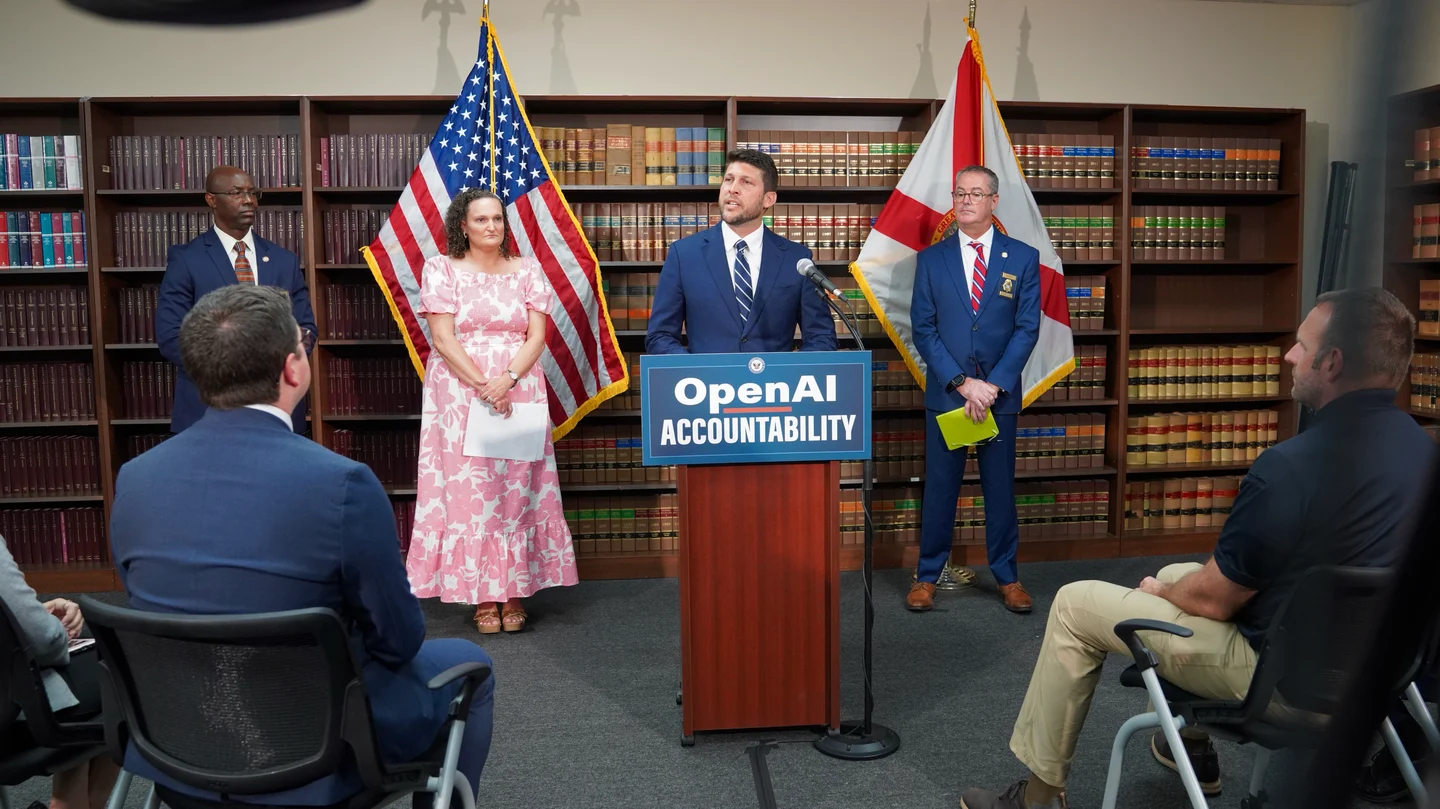
Florida Attorney General James Uthmeier filed an 83-page civil complaint against OpenAI and CEO Sam Altman personally in Florida's 10th Judicial Circuit (Highlands County) on June 1. 27
This is the first state-led lawsuit in the US against an AI company over product safety — distinct from prior AI-related litigation in that the theory of harm centers on the AI product itself, not data practices or copyright. The complaint alleges:
- OpenAI and Altman knowingly released and marketed ChatGPT as safe while concealing internal safety warnings
- Data collection from minors without meaningful parental oversight
- ChatGPT interactions caused behavioral addiction, cognitive harm, and contributed to user violence — the complaint references the April 2025 Florida State University campus shooting, in which the gunman had prior ChatGPT interactions, and the 2026 deaths of two University of South Florida graduate students
- Violations of the Florida Deceptive and Unfair Trade Practices Act
The complaint seeks injunctions, a halt to data collection from minors, new product guardrails, and potentially millions in penalties. A related criminal investigation, launched in April 2026 after the FSU chat logs surfaced, remains ongoing. 27
Uthmeier stated: "Today, we announced the first-in-the-nation state-led lawsuit against OpenAI and its CEO, Sam Altman." 27
Compliance signal: The personal naming of a sitting CEO in a state AG complaint is a significant escalation. AI companies should assess whether their documented product safety review processes and minor-user protections could withstand a similar UDAP (Unfair or Deceptive Acts or Practices) theory. This case is likely to attract copycat filings from other state AGs.
コンテンツカードを読み込んでいます…
Bartz v. Anthropic — 22 days post-hearing, no ruling; opt-out authors file separate suit
Judge Araceli Martínez-Olguín (N.D. Cal.) held the $1.5 billion Bartz v. Anthropic class settlement fairness hearing on May 14. She took the matter under submission and suggested short orders could follow "as early as tomorrow." As of June 5 — 22 days later — no final approval order has appeared on the public docket. 28
The settlement's mechanics: claims rate reached 92.77% (447,576 works submitted), with 350 valid opt-outs covering 1,802 works. Per-work payout has declined to approximately $3,000 — down from the originally projected $5,000 — due to the high claims volume. Class counsel requested fees of approximately $187.5 million (12.5% of the $1.5 billion fund), against a lodestar figure of roughly $27 million, a multiplier of 6.92x that drew active questioning from the judge. Authors Guild now predicts disbursements "late fall at the earliest." 29
Separately, 28 authors who opted out of the class settlement filed a new copyright infringement suit against Anthropic in the Northern District of California on May 13, reported June 1. 30 The complaint alleges direct and contributory copyright infringement and removal of copyright management information under 17 U.S.C. §§ 1201–1205.
Compliance signal: Bartz will not be the last word on AI training data regardless of how the judge rules. The opt-out plaintiffs' separate filing means litigation continues even if final approval is granted. Monitor docket No. 3:24-cv-05417.
xAI v. Colorado — stay holds; SB 26-189 governs going forward
The preliminary injunction stay in xAI v. Weiser (D. Colo., 1:26-cv-01515), granted May 26, remains in effect. No new filings have appeared since April 27. The stay freezes enforcement of both the now-repealed SB 24-205 and any replacement legislation — a category that includes SB 26-189, which Governor Polis signed May 14 and which repeals SB 24-205 entirely. 31
SB 26-189 (Automated Decision-Making Technology Transparency Act, effective January 1, 2027) shifts Colorado's framework from risk-based algorithmic discrimination compliance to a disclosure-and-rights model: developers must provide deployers with technical documentation; deployers must notify consumers at point of ADMT interaction; consumers get a right to request human review of adverse outcomes. The original SB 24-205 enforcement date of June 30, 2026 is moot. 31
FTC $930K AI-washing settlement — active enforcement signal
On May 21, the FTC announced $930,000 in combined settlements with Cox Media Group and two affiliated marketing companies over allegations that the companies falsely claimed an AI "Active Listening" tool monitored consumer conversations through smart devices to serve targeted ads. In fact, the companies purchased email lists from data brokers. This is the FTC's 13th AI-washing enforcement action. 32
Compliance signal: Any marketing claim about AI capabilities — to consumers, enterprise buyers, or investors — must be substantiated with actual system functionality. The FTC also published enforcement trend analysis this week emphasizing COPPA enforcement against AI products interacting with children, consistent with the Florida AG's theory in the OpenAI suit.
China: outbound investment controls and trade secret expansion
Decree 837: new ODI regulation effective July 1
China's State Council issued Decree No. 837, the "Regulations on Outbound Investment," on June 1. 33 Effective July 1, it elevates outbound direct investment (ODI) governance from administrative rules to a State Council-level regulatory framework. China Briefing described the shift as moving ODI from "capital-flow management into a national security and strategic coordination paradigm." 33
Three provisions directly affect AI/tech companies with cross-border operations:
- Article 13: Prohibits exporting or using goods, technology, services, or data that are export-controlled under Chinese law — including indirectly through cross-border model training, overseas staffing, or remote technical assistance
- Article 15: Establishes a formal ODI security review mechanism (NDRC + MOFCOM), triggered by investments involving sensitive technologies, critical resources, or data-intensive platforms
- Article 22: Limits foreign enforcement cooperation — Chinese entities in overseas litigation or arbitration must comply with China's data security, personal information, and export control laws before providing evidence to foreign authorities
Penalties: fines up to 1% of the investment amount, forced divestiture of overseas assets, and investment bans of up to 3 years for individuals. 33
Compliance signal: AI companies with China-based operations that train models on or transfer data across borders, or that provide remote technical support to overseas AI infrastructure, should conduct an Article 13 gap assessment before July 1. Article 22's evidence-production restriction has direct implications for companies involved in US or EU litigation.
China trade secret rules now cover algorithms and AI assets
SAMR's new "Provisions on the Protection of Trade Secrets" took effect June 1, explicitly including data, algorithms, computer programs, and code within the scope of trade secret protection for the first time in Chinese law. 34 The rules add extraterritorial applicability — overseas infringing acts that disrupt China's domestic market may now attract liability — and establish third-party liability for inducing or assisting in infringement.
SAMR's official statement framed the expansion as follows: "With the deepening development of the digital economy, digital assets including data, algorithms, computer programs, and codes have become key commercial secrets for businesses." 34
Practical note: MIIT Expert Committee member Pan Helin observed that protecting black-box machine learning algorithms directly remains difficult — what is more likely to receive protection is the underlying code that implements them. 34
SAMR approves 8 AI standardization documents
The State Administration for Market Regulation (SAMR) and Standardization Administration of China (SAC) approved 8 national standardization guidance technical documents on AI, announced June 3. The lead document is "Artificial Intelligence — Agent Interconnection Part 1: Overall Architecture." These are voluntary guidance standards, not mandatory requirements, but carry regulatory weight as compliance reference points. SAMR and the NDRC also jointly issued AI Metrology System and Capability Building Guidance (2026 Edition) on May 28. 35
30-day compliance deadlines
| Priority | Date | Obligation | Jurisdiction | Who is affected |
|---|---|---|---|---|
| URGENT | Jun 15, 2026 | Florida Supreme Court Rule 2.515(d)(2): all court filing signatories must certify legal citations exist and are accurately cited. Sanctions include dismissal and fees. | Florida | All attorneys filing in Florida courts; companies with Florida litigation exposure |
| HIGH | Jun 23, 2026 | EU AI Act high-risk AI classification guidelines (Article 6 / Annex III) — public consultation closes. Final opportunity to influence HRAI definitions before EC adopts guidelines. | EU | AI providers conducting Annex I or Annex III self-classification |
| HIGH | Jun 26, 2026 | EU AI in healthcare and pharmaceuticals stakeholder survey closes (17:00 CEST). 23 | EU | Healthcare AI solution providers, pharmaceutical companies, medical AI developers |
| HIGH | Jul 1, 2026 | China State Council Decree 837 (Outbound Investment Regulations) effective. AI/tech companies with cross-border operations must have Article 13 and 15 compliance frameworks in place. | China | AI companies with China-based operations conducting cross-border data transfer, model training, or overseas investment |
| HIGH | Jul 3, 2026 | UK DRCF AI consumer protection solicitation — Stage 1 closes. 25 | UK | Consumer-facing AI companies; FCA-regulated entities deploying AI |
| HIGH | Jul 15, 2026 | China CAC Order No. 21 (Interim Measures for AI Anthropomorphic Interaction Service Management) effective. No implementation guidance published as of June 5. | China | AI companion, emotional support, digital-persona, and chatbot service providers targeting Chinese users |
| WATCH | Aug 2, 2026 | EU AI Act Article 50 transparency obligations effective (chatbot disclosure, deepfake identification, human-AI interaction disclosure). Note: AI-generated content labeling extended to Dec 2, 2026 under Omnibus (pending OJ publication). | EU | All AI system providers and deployers on EU market |
| WATCH | Jan 1, 2027 | Colorado HB 1263 (chatbot safety for minors), HB 1139 (health care AI utilization review), SB 26-189 (ADMT transparency); Illinois SB 315 (frontier AI safety audits — if signed) | Colorado, Illinois | Chatbot operators, health insurers using AI review, frontier AI developers |
Cover image: Florida Attorney General's Office. Image from FL AG press release, June 1, 2026.
参考ソース
- 1Promoting Advanced Artificial Intelligence Innovation and Security
- 2AI executive order sets stage for new cybersecurity directives
- 3Trump Signs Executive Order Seeking Oversight of A.I. Models
- 4National Security Presidential Memorandum/NSPM-11
- 5Fact Sheet: President Donald J. Trump Signs Historic Directive on AI in the National Security Enterprise
- 6H.R.8881 — SBA Artificial Intelligence Utilization Act of 2026
- 7NIST expands goals for renamed AI consortium
- 8HB26-1263 Conversational AI Service Operator Requirements
- 9HB26-1139 Use of Artificial Intelligence in Health Care
- 10HB26-1195 Psychotherapy Artificial Intelligence Restrictions
- 11HB26-1210 Prohibit Surveillance Price & Wage Setting
- 12SB0315 — Artificial Intelligence Safety Measures Act
- 13SB3114 — Transparency in Downcoding Act
- 14SB0343 — Rental Property Price Fixing with AI
- 15SB2909 — Prohibiting AI in Teacher Evaluations
- 16SB0318 — Prohibition on Bots Purchasing Tickets Act
- 17AI Legislative Update: June 5, 2026
- 18AI Act enforcement gets independent expert support
- 19AI Act Scientific Panel
- 20AI Act Advisory Forum
- 21TLT's AI Brief: June 2026
- 22Regulation (EU) 2024/1689 — EUR-Lex
- 23European Commission survey: AI in healthcare and pharmaceuticals
- 24European AI Office
- 25AI consumer protection UK: DRCF call for input
- 26Parliamentary Bills — UK Parliament
- 27Attorney General James Uthmeier Files First-in-the-Nation State-Led Lawsuit Against OpenAI, CEO Sam Altman
- 28Bartz v. Anthropic Fairness Hearing: Observations and Takeaways
- 29Writers sued AI giant Anthropic. Their payout? Pocket change.
- 30After Opting Out Of Bartz, Authors File New Suit Against Anthropic
- 31Colorado's AI Discrimination Enforcement Paused After xAI Court Challenge
- 32FTC Settlement Highlights Risks of Deceptive AI Marketing Claims
- 33China's New ODI Regulation: What the 2026 State Council Rules Mean for Outbound Investment
- 34China's new rules on protection of trade secrets become effective on June 1
- 35SAMR AI Standards Approval Announcement
このコンテンツについて、さらに観点や背景を補足しましょう。