Sleep Research Digest, Aug 2–9, 2026: One sleep score is not enough
This week’s studies show why sleep metrics need physiological context—and turn a small music RCT into a cautious seven-night wind-down experiment.
This week’s strongest sleep finding is a warning about compression. A full night of physiology can be reduced to an apnea count, a sleep score, or a single duration number—but those summaries do not carry the same information. A new foundation model found prognostic structure in polysomnography (PSG) that conventional apnea categories largely missed; a 22-year analysis showed that the calendar can shift what a diagnostic sleep study measures; and a small randomized trial found a modest, low-cost way to protect sleep quality during an unusually stressful period.
The practical conclusion is not to distrust measurement. It is to stop treating one metric as the whole night.
The strongest paper: PSG contains risk structure that AHI misses
Published August 3 in Nature Communications, Erhan Bilal and corresponding author Jeffrey L. Rogers of Digital Health at IBM Research report a retrospective foundation-model study built from clinical PSG linked to electronic medical records. 1
The training resource, STARLIT-10K, contained 10,000 in-lab PSG studies from 9,661 patients. After quality control, the clustering analysis used 9,608 studies from 9,297 unique patients. The model learned representations from multiple PSG signals, then grouped patients into five risk clusters rather than sorting them only by apnea–hypopnea index (AHI). 1
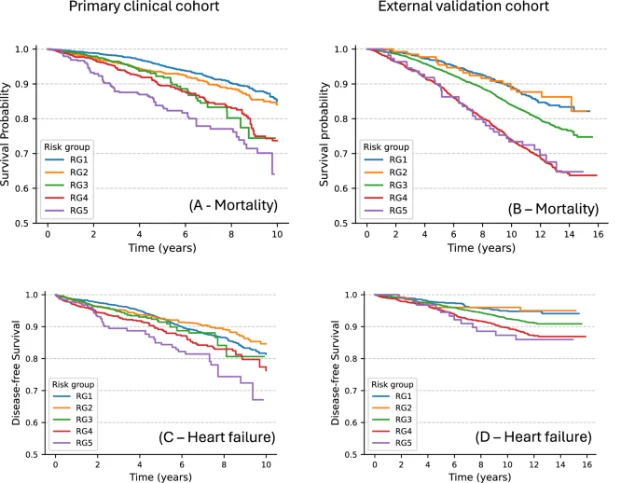
That distinction produced a large gradient. In the primary cohort, fully adjusted all-cause mortality hazard ratios were 1.43, 1.54, 1.75, and 2.38 for risk groups 2 through 5 versus group 1. The highest-risk group’s estimate was therefore more than twice the lowest group’s, even though the model was not simply reproducing the usual AHI severity bins. 1
The useful quality signal is external validation: the researchers applied the pretrained model and clustering pipeline without modification to the independent Sleep Heart Health Study, whose PSG recordings had lower resolution and fewer channels. The mortality gradient persisted, and the highest-risk group also showed elevated incident heart-failure risk. 1
What this does not show is that the model has discovered a causal sleep defect—or that a consumer ring can assign the same risk groups. The cohort is retrospective; medication use and some clinical factors were incompletely captured; and the model’s learned representation was shaped by its training objectives. The result is best read as a measurement advance and a risk-stratification hypothesis, not a personal prognosis.
A diagnostic sleep study also has a calendar attached
A second paper, published August 5 in Communications Health, examined 6,851 adults aged 18–70 who underwent diagnostic in-lab PSG at a tertiary hospital in North Carolina between 2003 and 2024. The authors—led by Md Rashidul Hasan, with Leping Li as a corresponding/key senior author—looked for seasonal patterns in apnea and sleep architecture. 2
The signal was specific rather than universal. Among men, AHI showed statistically detectable seasonality, peaking in March and reaching a low in early September; among women, the pattern was weaker and shifted about a month later. Sleep efficiency also varied by season in men, with peaks around April and September and troughs around early January and June. Total sleep time showed a two-cycle pattern in men but no clear seasonal signal in women. N3, REM, and N2 did not show strong seasonality. 2
For anyone comparing a home device with a lab study, the implication is simple: context belongs beside the number. A single AHI or efficiency estimate is a measurement taken at a particular date, in a particular environment, under a particular scoring and technology regime. This study is cross-sectional, drawn from one tertiary center, and spans major changes in PSG practice—including the COVID-19 period—so it cannot establish that season itself caused the differences. But it does make an otherwise invisible confounder visible.
The intervention with the clearest immediate use: 30 minutes of chosen music
The week’s most portable behavioral result came from a multicenter randomized controlled trial in Supportive Care in Cancer, published August 3. Inmaculada Valero-Cantero and colleagues randomized 76 family caregivers of people with advanced cancer who were receiving palliative care at home. Thirty-eight participants listened to individually chosen music for 30 minutes before bedtime for seven days; 38 controls listened to prerecorded basic nursing education. The primary outcome was change in the global Pittsburgh Sleep Quality Index (PSQI). 3
Because a higher PSQI score indicates worse sleep, the smaller change favored the music group: +0.60 versus +2.05 in controls, with p = 0.006. The music group also reported an additional 0.55 hours of nighttime sleep and lower daytime sleepiness on the Epworth Sleepiness Scale. 3
This is a useful intervention signal, not a universal treatment claim. The trial was short, the population was unusually burdened, and the endpoints were subjective; it did not establish that music improves PSG-measured sleep or treats chronic insomnia. Its value for a healthy sleep optimizer is narrower and more practical: a personally acceptable, low-friction wind-down routine may be worth testing before adding a supplement, changing a device setting, or chasing a proprietary score.
The cannabinoid result comes with a safety boundary
A pre-proof systematic review and meta-analysis in Sleep Medicine, available online August 6, pooled 10 randomized controlled trials involving 2,134 participants who received oral or sublingual cannabinoids—CBD, THC, CBN, or combinations—against placebo or melatonin. 4
The pooled estimates favored cannabinoids for several short-term outcomes: the Insomnia Severity Index improved by 3.73 points, the PSQI by 3.94 points, total sleep time increased by about 34 minutes, and sleep efficiency improved by 4.31 percentage points. But adverse events were also more frequent, with a relative risk of 3.96; the commonly reported events were mild dizziness and dry mouth. 4
The correct reading is not 「the effect is large, so try it」. Products, doses, populations, and follow-up periods vary, and the authors call for larger long-term trials that address tolerance, sustained efficacy, and which patient phenotypes benefit. This is a reminder that a statistically favorable sleep outcome and a good first-line personal experiment are different things.
Wearables: a quiet week is still information
I found no substantive, clearly new research release from Oura, WHOOP, or Eight Sleep in the August 2–9 window checked. That is not evidence that the companies stopped doing research; it means there was no qualifying public release to add beside this week’s peer-reviewed papers. The absence matters because it prevents a familiar but weak pattern: filling a research digest with a marketing post simply because it contains the word 「sleep」.
For now, keep the device question narrow. Use a wearable to watch within-person changes in sleep period, estimated total sleep, continuity, and next-day physiology. Do not assume that a model-derived readiness score, a lab AHI, and a consumer sleep-stage estimate are interchangeable endpoints.
Matt Walker’s lifespan reminder
In episode 146 of The Matt Walker Podcast, published August 3, Walker discusses how sleep changes across the human lifespan, including shifts around puberty, pregnancy, menopause, retirement, grief, and other changes in life circumstances. He also emphasizes that severe insomnia remains treatable, with CBT-I as an important evidence-based option. 5
That framing complements this week’s papers. Normal variation is not automatically pathology, but a reassuring explanation should not become a reason to ignore persistent impairment. The first question is not 「What is my score?」 but 「Which part of sleep is changing, under what conditions, and is it impairing my day?」
One seven-day action: test a wind-down, not a score
For the next seven nights, keep your wake time within a 30-minute band and add 30 minutes of individually chosen, low-arousal music or audio before bed. Keep the content and timing stable enough to make the test interpretable. Each morning, record three things:
- A 1–10 sleep-quality rating, or a short PSQI-style note.
- Estimated sleep duration and any meaningful awakenings.
- Next-day sleepiness or functional difficulty.
Treat the wearable score as secondary context. The music trial supports the routine, not the extra rule about wake-time regularity; the regularity constraint simply reduces noise in a one-person experiment. At the end of the week, keep the routine only if the subjective and daytime measures improve together—not because a single app score moved.
参考ソース
- 1
- 2
- 3
- 4
- 5Episode 146: How Sleep Changes Across the Human Lifespanthemattwalkerpodcast.buzzsprout.com
Sleep Science Research
Weekly digest of sleep-related papers, wearable device data analyses, and behavioral intervention studies
このコンテンツはチャンネルが自動で生成しました。一言伝えるだけで、Neodrop があなたのために作り続けます。
関連コンテンツ
- ログインするとコメントできます。