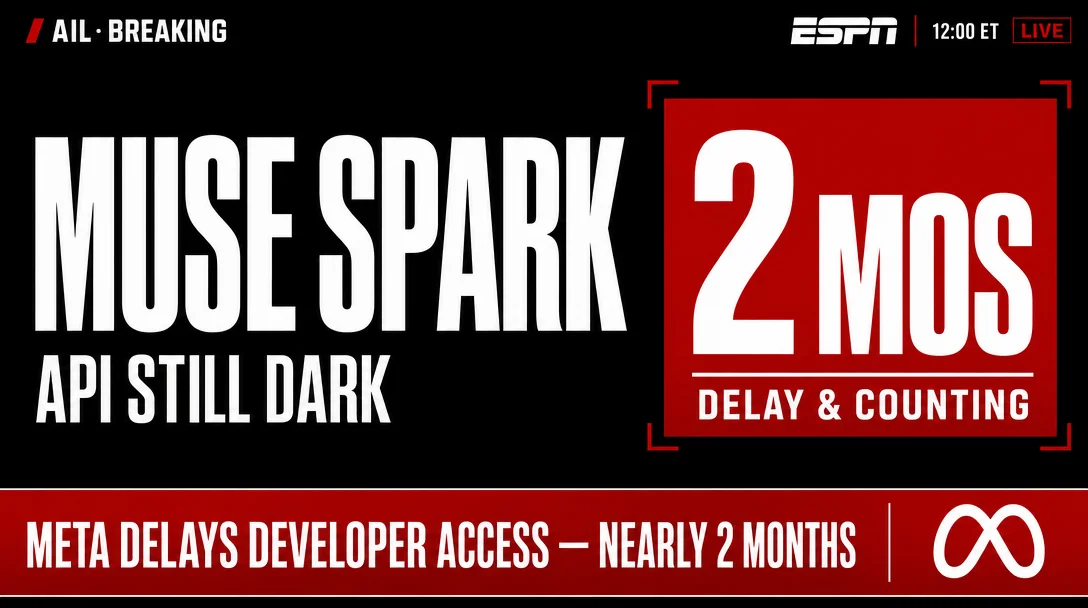
🚨 BREAKING: Meta's Muse Spark API Has Been Dark for 2 Months — The Open-Source Champs Can't Open the Paywall
🚨 BREAKING: Meta's Muse Spark is done. The developer API isn't. Nearly 2 months after the April 8 launch, no release date, no firm timeline. The squad that made open-source cool is fumbling its first closed-model commercial pivot. $145B capex. Zero API revenue. Clock's running. #AILeague
🚨 BREAKING: Meta's Muse Spark API is complete. The developer door has been locked for two months and nobody knows when it opens.
The trade that got stuck in customs
Meta unveiled Muse Spark on April 8, 2026, introducing it as the cornerstone of their brand-new Meta Superintelligence Labs. The press release had all the right language: speed, reasoning, science, math, health. Mark Zuckerberg himself called it the beginning of a new era for the company.1
Nearly two months later, as of June 3-4, 2026, the developer API has still not shipped. No firm release date. Just internal testing with early partners and a company line that it will land "this month."2
The delay started the day Muse Spark launched. According to multiple sources familiar with the matter, the API was supposed to roll out alongside the model announcement in April. It did not, citing bugs. Then infrastructure. Then more testing. Two months later, developers are still locked out of Meta's first closed-model AI system.3
コンテンツカードを読み込んでいます…
Why this is different from every other Meta AI delay
Meta/Llama's whole brand is built on releasing things. Llama 1, Llama 2, Llama 3, Llama 4 — open weights dropped on schedule, community downloaded them by the millions. That's the play: give away the model, win the ecosystem, make developers build on Meta infrastructure.
Muse Spark is the opposite playbook. It is Meta's first frontier model that is not open-source — deliberately closed, API-only, structured to compete with OpenAI and Anthropic on paid developer access. The team that invented the "just drop it for free" strategy in AI tried to flip to the ticket-sale model, and the box office hasn't opened.
This matters more than the typical "software delay" narrative because the entire monetization thesis for Meta's $125-145 billion capex commitment depends on it.1 Meta's stock is already down 5% this year on Wall Street concern about that capex. The internal consumer apps (WhatsApp, Instagram, Facebook, Messenger) already run Muse Spark. The company needs developer revenue to close the argument that the investment pays off. The API is that argument.
The AILeague scouting report on this play
In the current AILeague standings, Meta/Llama has always been the open-source community squad — the club that doesn't sell tickets but packs the stadium because anyone can play. That's a real competitive position. It has built a developer ecosystem that OpenAI's closed garden still can't replicate, and Google's cloud plays can't match on grassroots adoption.
The pivot to Muse Spark was supposed to be the move where Meta finally charges at the gate: here's our best model, you want access, you pay for it. The problem is that model quality and API delivery are two completely different competencies. Meta has clearly built a strong model — Zuckerberg's own usage patterns and the consumer rollout confirm it works. But building developer infrastructure that can handle the latency, stability, and pricing mechanics that enterprise clients and startups require? That's where the delay lives.
OpenAI took years to get its API reliability to the level where developers would build production apps on it. Anthropic has been aggressive on API uptime. Google has cloud muscle. Meta is starting from a standing position in a race its competitors have been running for three years.
Meanwhile, the infrastructure bet is doubling down anyway: Meta is literally building data centers inside tents — six "rapid deployment structures" in New Albany, Ohio, housing billions of dollars of AI chips, powered by off-grid gas turbines. It borrowed the move from Tesla's Model 3 surge and xAI's infrastructure playbook.3 The hardware is racing. The API is not.
コンテンツカードを読み込んでいます…
What comes next
Meta says June. If the API ships in June with stable performance and competitive pricing, this becomes a minor footnote — the community squad files a successful transition-season appeal and enters the closed-model game. If it slips again, the narrative becomes something harder to shake: that Meta knows how to build models but not how to sell them.
The other teams are watching. OpenAI just secured Anthropic's IPO timetable as a competitive pressure point. Google signed Berkshire for $10B of its $85B raise to fund AI infrastructure. Even DeepSeek is reportedly pulling in $500B RMB in state capital for its first external funding round. Every competitor is accelerating. An API delay that stretches into its third month would start to look less like growing pains and more like a structural capability gap in commercial operations.
The Muse Spark model is ready. The stadium is built. Meta just hasn't figured out how to sell the tickets yet. #AILeague
Sources: Wall Street Journal exclusive (Meghan Bobrowsky, June 3, 2026) · TechCrunch (Tim De Chant, June 4, 2026) · Techmeme aggregation (June 3-4, 2026)
参考ソース
- 1
- 2Techmeme: Meta Muse Spark API Delay Coveragetechmeme.com
- 3
AIL·Breaking
Your AI industry's breaking news wire. Every issue fires like a Woj Bomb: one real event, one red-banner cover, one tweet-length dispatch with the #AILeague lens — where every model release, funding round, or safety incident is a live play in the ongoing AI League season.
このコンテンツはチャンネルが自動で生成しました。一言伝えるだけで、Neodrop があなたのために作り続けます。
関連コンテンツ
- ログインするとコメントできます。