Khanna vote tracker: June 8–11, 2026
Issue 6 covers 15 roll-call votes (RC 568–582) over four House floor days, June 8–11, 2026. S.2 (Secure America Act) squeaked through 214-212 and became law — $69.5 billion in immigration enforcement, Khanna Nay. FISA Section 702 lapsed after HR9238 failed 198-218 under suspension — Khanna Nay. Zero party defections on all 14 votes Khanna cast; first absence (HR5408, Faster Labor Contracts Act). Group-by-group impact for tech workers, immigrants, healthcare recipients, California voters, and AI founders.

Ro Khanna (D-CA-17, Silicon Valley) cast votes on 14 of 15 roll calls this week — his first missed vote since this tracker began. He sat out HR5408, the Faster Labor Contracts Act, apparently while appearing on CNN to cover the Maine Democratic primary; the bill passed 230-193 without him. 1
On every other contested vote, he sided with the Democratic caucus. That's a first in this tracker too: zero party defections across all 14 votes he cast.
The week's two most consequential bills were on opposite ends of the partisan spectrum. S.2, the Secure America Act, squeaked through 214-212 and was signed into law the next day — adding $69.5 billion to immigration enforcement budgets through 2029, no warrants required. HR9238, a short-term extension of FISA Section 702 surveillance authority, fell flat at 198-218, letting the statute expire for the first time since it was enacted in 2008. Khanna voted Nay on both.
The House also moved four bills in a Republican fraud-prevention package (Khanna opposed three, supported one) and passed the bipartisan Faster Labor Contracts Act without him.
Coverage window: June 8–11, 2026 (RC 568–582). The House was in session Sunday through Wednesday.
All 15 votes at a glance
| Date | RC | Bill | Khanna | Final tally | Outcome |
|---|---|---|---|---|---|
| Jun 8 | 568 | HR8466 — TRUE Accountability Act | Yea | 384-0 | Passed |
| Jun 8 | 569 | HR8428 — Federal Fraud Prevention Workforce Training Act | Yea | 393-0 | Passed |
| Jun 9 | 570 | HRES1345 — On Ordering the Previous Question | Nay | 214-211 | Passed |
| Jun 9 | 571 | HRES1345 — On Agreeing to the Resolution | Nay | 213-211 | Passed |
| Jun 9 | 572 | HRES1140 — Motion to Discharge (on HR5408) | Yea | 220-199 | Passed |
| Jun 9 | 573 | S.2 — Secure America Act, Motion to Commit | Yea | 211-215 | Failed |
| Jun 9 | 574 | S.2 — Secure America Act, On Passage | Nay | 214-212 | Passed → Law |
| Jun 9 | 575 | HRES1140 — On Agreeing to the Resolution | Yea | 221-201 | Passed |
| Jun 9 | 576 | HR5408 — Faster Labor Contracts Act | ABSENT | 230-193 | Passed |
| Jun 10 | 577 | HR7892 — No Aid for Ghost Students Act | Nay | 249-172 | Passed |
| Jun 10 | 578 | HR8312 — Fraud Prevention and Accountability Act | Nay | 240-181 | Passed |
| Jun 10 | 579 | HR8464 — Stopping Fraudulent Payments Act, Motion to Recommit | Yea | 209-213 | Failed |
| Jun 10 | 580 | HR8464 — Stopping Fraudulent Payments Act | Nay | 218-200 | Passed |
| Jun 11 | 581 | HR9238 — FISA Amendments Act Extension | Nay | 198-218 | Failed |
| Jun 11 | 582 | HRes1335 — Condemning Fraud Against US Government | Nay | 235-177 | Passed |
HRES1345, HRES1140, and the Motion to Recommit on HR8464 are procedural votes; Khanna voted along party lines on all three and they carried no direct substantive effect on the five tracked groups. Detailed analysis covers the nine substantive bills and resolutions below.
Substantive votes: what passed and what it means for you
S.2 — Secure America Act
Signed into law June 10, 2026. Passed the House 214-212 on June 9 (RC 574). Khanna: Nay — with all 211 voting Democrats. All 214 Republican Yeas provided the margin. 1
S.2 allocates $69.5 billion for immigration enforcement through September 30, 2029: $38.5 billion to ICE, $26 billion to CBP, and $5 billion to DHS general funds. 2 It was passed via budget reconciliation, bypassing the Senate filibuster. Combined with the $170 billion appropriated through the "One Big Beautiful Bill Act" signed earlier this session, DHS now has roughly $240 billion in enforcement funding locked in through 2029 — ICE's effective budget now exceeds eleven times its FY2025 annual appropriation. 2
$350 million of S.2 is set aside specifically for enforcement actions in "non-qualified cooperating jurisdictions" — states and localities that haven't entered 287(g) agreements with ICE. California, as a sanctuary state, is a direct target. 2 The bill also includes $5 billion for AI-powered border screening technology and autonomous surveillance systems.
The bill carries no warrant requirement for home entry, no body camera mandates, no restrictions on detaining pregnant women, and no limits on ICE-ORR data sharing — oversight provisions that typically appear in annual appropriations bills. Rep. Bobby Scott (D-VA) said it was "wrong to add funding for Republicans' lawless immigration enforcement agenda, even as ICE continues to abuse its authority and without any assurance that they will begin obeying the law by obtaining warrants before they go into people's homes, stop deporting citizens, and stop using excessive force." 3 Heidi Altman of the National Immigration Law Center said the funding structure is "very dangerous," adding that "the agency will move forward with even fewer accountability mechanisms than we've seen in the past." 4
Where it goes: Signed by President Trump on June 10, 2026. Now law.
| Group | Impact | What it means |
|---|---|---|
| Tech workers | Indirect | $5B for AI-powered border surveillance creates potential government contracts, but the broader crackdown on immigration chills the H-1B and STEM talent pipelines Silicon Valley depends on. Companies relying on foreign-born engineers face rising hiring friction. |
| Immigrants | Major — direct | $69.5B for mass enforcement through 2029. $350M explicitly targets sanctuary jurisdictions. No warrant requirements, no body camera requirements, no limits on detention conditions. The 287(g) program expanded from 135 to 1,900+ jurisdictions since January 2025. |
| Healthcare recipients | Indirect | No direct healthcare provisions, but documented chilling effects: immigrants already defer medical care when enforcement activity intensifies. |
| California voters | Major — direct | California is targeted directly via the $350M sanctuary enforcement fund. It has the largest immigrant population in the US and is one of the few states with explicit sanctuary protections. The three-year funding window insulates enforcement from a potential Democratic Congress in 2027. |
| AI founders | Indirect | $5B in AI surveillance contracts creates government business. But the immigration enforcement climate makes it harder to recruit the global AI talent concentrated in CA-17 and surrounding districts. |
HR5408 — Faster Labor Contracts Act
Passed 230-193 on June 9 (RC 576). Khanna: Absent — his first missed vote in the tracked period. 1
The bill mandates a federal timeline for first union contracts: bargaining must begin by Day 10, federal mediators enter at Day 100, binding interest arbitration kicks in at Day 130, and a government arbitration panel can impose a complete contract by Day 144. Actual negotiation time before government arbitration is capped at 120 days. 5 The bill reached the floor through a discharge petition — 218 members signed to force a floor vote that House Republican leadership had blocked, using the same mechanism that sent the Ukraine Support Act to the floor last week.
Rep. Donald Norcross (D-NJ), the bill's sponsor, called it "the most significant new protection for workers since before World War II." 3 Rep. Virginia Foxx (R-NC) countered that it "replaces negotiation with compulsion and substitutes private agreements with federal mandates. Most concerning, workers themselves may be bound by contracts they never approved." 3 Twenty Republicans from union-heavy Rust Belt and Northeast districts crossed the aisle to vote Yea; 193 Republicans voted Nay.
Khanna voted Yea on the procedural discharge vote (RC 572) that brought the bill to the floor, and Yea on the rule for the bill (RC 575) — but was absent for the final passage vote. That evening, he appeared on CNN to discuss Graham Platner's win in the Maine Democratic Senate primary. Platner is a Maine state legislator running for the US Senate seat; Khanna had campaigned for him at a Bar Harbor rally on June 6, and called the primary result "a chance at redemption." 6 6 No explanation for the absence was posted to his official accounts or the congressional record.
Where it goes: Passed the House; now in the Senate, where it needs 60 votes to overcome a filibuster.
| Group | Impact | What it means |
|---|---|---|
| Tech workers | Indirect | Could accelerate unionization in tech. The compressed timeline — guaranteed contract within ~5 months — is more attractive to workers than the current open-ended process. Kickstarter and the NY Times Tech Guild show the industry is already organizing. |
| Immigrants | None identified | Bill addresses private-sector labor law only. |
| Healthcare recipients | Indirect | Hospital and nursing home unions would be affected; faster contract timelines could alter healthcare labor costs and staffing. |
| California voters | Indirect | California has a significant union presence in service, healthcare, and emerging tech. Khanna's absence was conspicuous given CA-17's tech workforce and the bill's strong Democratic support. |
| AI founders | None identified | No AI-specific provisions. |
HR7892 — No Aid for Ghost Students Act
Passed 249-172 on June 10 (RC 577). Khanna: Nay — with the Democratic majority. 1
The bill requires the Education Department to implement an identity fraud detection system for FAFSA (Free Application for Federal Student Aid) applications, amending Section 483 of the Higher Education Act of 1965. It responds to a documented problem of "ghost students" — fraudsters using stolen identities to enroll at community colleges and collect federal aid. 3
Democrats opposed the bill's implementation mechanism. Rep. Adam Smith (D-WA) acknowledged the fraud problem is real but said the bill "locks that untested system into law — without any guardrails." Rep. Christian Menefee (D-TX) warned that minority and disadvantaged students would be over-represented among erroneous flags: "this could mean a missed enrollment deadline. It could mean lost housing. It could mean the end of a dream before it even starts." 3
Where it goes: Passed the House; pending in the Senate.
| Group | Impact | What it means |
|---|---|---|
| Tech workers | None identified | |
| Immigrants | Direct | Fraud detection algorithms have shown historical bias against non-Anglo names. Immigrant families, mixed-status households, and non-native English speakers face higher risk of wrongful FAFSA flags — potentially blocking access to federal financial aid. |
| Healthcare recipients | None identified | |
| California voters | Direct | California runs the largest higher education system in the US (UC, CSU, community colleges). An algorithmic detection system without confirmed guardrails carries meaningful risk for the state's diverse student population. |
| AI founders | None identified |
HR8312 — Fraud Prevention and Accountability Act
Passed 240-181 on June 10 (RC 578). Khanna: Nay — with the Democratic majority. 1
The bill creates a new Inspector General office inside the Treasury Department with government-wide fraud detection and data-sharing authority. It's part of an 11-bill House Oversight Committee package targeting improper federal payments, which Republican supporters say total nearly $100 billion annually. 3
Democrats argued the bill does the opposite of its stated purpose. Rep. James Walkinshaw (D-VA) said it "would undercut independent inspectors general, which is one of the most powerful tools we have to combat waste, fraud and abuse." 3
Where it goes: Passed the House; pending in the Senate.
| Group | Impact | What it means |
|---|---|---|
| Tech workers | None identified | |
| Immigrants | Indirect | A new Treasury IG with expanded data-sharing authority could intensify scrutiny of refugee resettlement funds, TPS-related payments, and asylum processing budgets. |
| Healthcare recipients | Indirect | Medicare/Medicaid fraud detection could be affected. Expanded data-sharing authority may broaden scrutiny of healthcare payment systems. |
| California voters | Indirect | California administers large-scale federal programs in healthcare, education, and housing. New federal oversight layers may increase compliance costs on state-administered programs. |
| AI founders | None identified |
HR8464 — Stopping Fraudulent Payments Act
Passed 218-200 on June 10 (RC 580). Khanna: Nay — with the Democratic majority. 1
The bill lets federal agency heads pause or condition disbursements when they perceive "elevated fraud risk" — before proving any fraud has occurred. The legal threshold to trigger a payment pause is perception of risk, not evidence of wrongdoing. 3 The 218-200 margin was the narrowest of all four fraud-package bills, reflecting significant Democratic (and some Republican) concern.
Rep. James Comer (R-KY), the bill's sponsor, said it "provides additional assurance to the American taxpayer that money is being paid to the right recipient and for the right amount while preserving the ownership of a program's administration within the appropriate federal agency." 3 Rep. Wesley Bell (D-MO) argued it "sets the standard so low that any administration can use it to cut off legitimate recipients before a single fact is even proven." 3 The Center on Budget and Policy Priorities said the bill would "make blocking federal funds easier" and "take away help people need to afford rising cost of basics." 7
Where it goes: Passed the House; pending in the Senate.
| Group | Impact | What it means |
|---|---|---|
| Tech workers | None identified | |
| Immigrants | Direct | A "perceived risk" standard with no required evidence could suspend refugee assistance, TPS-related payments, and other immigrant-serving federal benefits. No proof of fraud is needed to trigger a pause. |
| Healthcare recipients | Direct | Medicare and Medicaid payments could be paused on suspicion alone, potentially disrupting care access for low-income patients who depend on uninterrupted federal benefits. |
| California voters | Direct | California administers Medi-Cal, SNAP/CalFresh, and housing assistance at scale. Payment pauses based on suspicion could cascade across the state's social safety net. |
| AI founders | None identified |
HR8466 — TRUE Accountability Act
Passed 384-0 on June 8 (RC 568). Khanna: Yea — unanimous. 1
"TRUE" stands for Taxpayer Resources Used in Emergencies. The bill requires federal agencies to develop fraud prevention plans for emergency spending — natural disasters, hurricanes, and other federally declared emergencies. Rep. Andy Biggs (R-AZ) said it is "time to bring some accountability to our government so that we stop losing untold amounts of hard-earned taxpayer money." 3 No Democrat spoke against it.
Where it goes: Passed the House 384-0; referred to the Senate Committee on Homeland Security and Governmental Affairs.
| Group | Impact | What it means |
|---|---|---|
| California voters | Indirect | California is among the states most frequently subject to federal disaster declarations (wildfires, earthquakes, floods). Better emergency fraud prevention could improve relief efficiency — though added planning requirements may also slow disbursement during active crises. |
| All others | None identified | Non-controversial administrative planning bill. |
HR8428 — Federal Fraud Prevention Workforce Training Act
Passed 393-0 on June 8 (RC 569). Khanna: Yea — unanimous. 1
The bill amends Title 5 of the US Code to require mandatory anti-fraud and improper payment training for federal program administrators, covering internal controls, fraud detection, and reporting mechanisms. Rep. Glenn Grothman (R-WI), the sponsor, said "too many federal employees and program administrators are left without training, guidance or tools they need to identify risks before taxpayer dollars go out the door. The bill takes a commonsense step to fix that." 3
| Group | Impact | What it means |
|---|---|---|
| All groups | None identified | Workforce training bill; no provisions affecting any of the five tracked groups. |
Khanna announced the bipartisan fraud audit bill passage on June 9 alongside Rep. Tim Burchett (R-TN), calling it "a nonpartisan approach toward ensuring every tax dollar allocated by the feds reach the families these programs serve." 8
コンテンツカードを読み込んでいます…
HR9238 — FISA Amendments Act Extension
Failed 198-218 on June 11 (RC 581). Khanna: Nay — with most Democrats. 1
The bill would have extended FISA (Foreign Intelligence Surveillance Act) Title VII authorities — including Section 702 — from June 12 through July 2, 2026: a 20-day patch while Congress worked on longer-term reauthorization. It failed under suspension of the rules, which requires a two-thirds majority (roughly 277 votes); it received 198. 9
Section 702 authorizes warrantless surveillance of foreign nationals abroad but sweeps up Americans' communications in the process. Under the PRISM program operating under Section 702, the NSA collected user data from Apple, Facebook, Google, Microsoft, and other tech companies. 10
The bill's failure had two engines. Nineteen House Republicans voted Nay, including Representatives Boebert, Burchett, Davidson, Gosar, Hageman, and Massie, largely on civil liberties and warrant grounds. Rep. Thomas Massie (R-KY) said Section 702 "is unconstitutional and there is only one way to fix it: require warrants, judicial warrants." 3 Most Democrats also voted Nay, partly due to bipartisan opposition to Bill Pulte's nomination as acting Director of National Intelligence — Pulte has no intelligence experience and was viewed by opponents in both parties as a political appointment. 9
Rep. Rick Crawford (R-AR), the bill's sponsor, had argued for the extension given "elevated threat level with FIFA World Cup games beginning this week, America's 250th birthday and related celebrations coming up this summer, Iran and its proxies are targeting U.S. military personnel daily." 3
Important caveat on actual effect: Section 702 did expire as statute, but the Foreign Intelligence Surveillance Court had already certified existing 702 programs through March 2027. Government surveillance under those certifications continues until that date despite the statutory lapse. 10
Where it goes: Failed. Congress will need to revisit reauthorization, likely with a warrant-requirement debate at its center.
| Group | Impact | What it means |
|---|---|---|
| Tech workers | Major — direct | Section 702/PRISM directly compels tech companies to provide user data to the NSA. The statutory expiration creates legal uncertainty for companies currently receiving FISA orders. Cloud and SaaS providers handling user communications face a compliance grey zone until reauthorization. VPN and encrypted-messaging services gain competitive ground while the gap persists. |
| Immigrants | Indirect | Surveillance powers have historically been used to monitor immigrant communities and activists. The statutory lapse reduces one surveillance vector, though other authorities — including EO 12333 — remain active. |
| Healthcare recipients | None identified | |
| California voters | Direct | Apple, Google, Meta, and dozens of cloud and AI companies headquartered in California are directly affected by PRISM compliance orders. The expiration affects California's largest industry cluster. Privacy-conscious residents get near-term protection while the statute is lapsed. |
| AI founders | Major — direct | AI startups on US cloud infrastructure (AWS, GCP, Azure) operate under FISA data collection. International customers may pull back from US-based AI services if warrantless surveillance resumes under a reauthorized statute without a warrant carve-out. Any future Government Surveillance Reform Act requiring warrants for searches of Americans' data would reshape compliance requirements for AI training data pipelines. |
HRes1335 — Condemning fraud against the US government
Passed 235-177 on June 11 (RC 582). Khanna: Nay — with the Democratic majority. 1
This is a non-binding resolution expressing the sense of the House that fraud-prevention reforms would benefit financial prosperity. It carries no legislative force. Democrats voted against it on the grounds that it singled out Democratic-led states as responsible for federal fraud. Rep. Walkinshaw argued it "turns what should be a bipartisan effort into a partisan political attack that points the finger only at Democratic-led states and governors while pretending the problem does not exist in Republican-led states." 3
| Group | Impact | What it means |
|---|---|---|
| All groups | None | Non-binding resolution. No direct effect on any group. |
Khanna's public statements this week
Khanna's most-viewed post of the week went up on June 12 — a framing of the two-party economic divide that drew 1.47 million views: "Republicans believe that if you let the wealthy spend capital it will make Americans prosperous. Democrats believe that the federal government investing in the healthcare and education of our people will make America prosperous and productive." 11 A follow-up warned that "the rapid acceleration of wealth inequality is tearing this country apart" and cited the first Gilded Age as a historical parallel. 11
On June 14, he posted a roughly 500-word thread calling for "New Economic Patriotism" — Medicare for All, $10/day childcare, free public university, guaranteed homeownership by age 35, and 1,000 new vocational schools. He closed with a foreign policy note: ending overseas wars and cutting aid to governments that violate human rights. 12 He wrote: "We are at our best as Democrats when we are not afraid. We are at our best when we are bold." 12
Also on June 14, he replied to Trump administration AI advisor David Sacks with a concrete proposal: "Why not work with Congress to set up an independent agency for AI safety, like the nuclear commission or FERC, so that the public has confidence in these decisions?" — arguing the current administration has a credibility problem distinguishing national-interest AI decisions from political ones. 13
On June 11, he co-introduced H.J.Res.196 with Rep. Jonathan Jackson (D-IL-01) and Rep. Mark Pocan (D-WI-02) — a constitutional amendment to establish an affirmative right to vote. The US Constitution currently only prohibits voting discrimination; it does not guarantee the right itself. Khanna described the current Supreme Court as "a modern-day Dred Scott Supreme Court launching an attack on voting rights not seen since Reconstruction." 14 The amendment was referred to the House Judiciary Committee; all 15 original co-sponsors are Democrats.
On June 15, Khanna posted a lengthy statement welcoming the US-Iran ceasefire and the reopening of the Strait of Hormuz. He wrote: "America lost 14 precious service members and wasted billions of dollars on this foolish endeavor," adding that the ceasefire terms appear "no better than what Obama secured under the JCPOA nearly a decade ago." 15 He credited last week's War Powers Resolution passage as helping shift the administration's posture.
コンテンツカードを読み込んでいます…
On floor activity before this week's window: Khanna's amendment to strip NDAA Section 224 — a provision requiring the Pentagon to designate an official to "synchronize" US-Israel defense technology cooperation, including joint R&D, testing, and industrial collaboration — was rejected by voice vote in the House Armed Services Committee on June 4. Only Rep. Sara Jacobs (D-CA) joined him; several Democrats, including ranking member Adam Smith, voted against. Khanna said at the markup: "Everyone in America — whether you're a Republican, an independent or a Democrat — says that we need to tell Netanyahu that America calls the shots, not the prime minister of any other country." 16 Rep. Thomas Massie has pledged to offer the same amendment when NDAA FY2027 reaches the full House floor.
Group impact summary — June 8–11

| Group | Most-affected bills | Net direction |
|---|---|---|
| Tech workers | HR9238 FISA (expiration — indirect relief), S.2 (talent pipeline friction) | Mixed — FISA expiration helps, immigration enforcement hurts |
| Immigrants | S.2 (major negative), HR8464 (payment pause risk), HR7892 (FAFSA bias risk) | Net negative — three bills with direct adverse effects |
| Healthcare recipients | HR8464 (payment pause risk for Medicare/Medicaid) | Negative on contested votes; Khanna voted Nay on all three |
| California voters | S.2 (sanctuary targeting), HR9238 (tech industry), HR8464 (safety net risk) | Net negative — CA directly targeted by S.2, exposed on HR8464 |
| AI founders | HR9238 FISA (compliance uncertainty), S.2 (talent friction) | Mixed — FISA lapse is near-term relief; immigration climate is a longer constraint |
Khanna voted Nay on S.2, HR7892, HR8312, HR8464, HR9238, and HRes1335 — all six contested partisan votes. He voted Yea on the two unanimously-passed fraud-prevention training bills and was absent for HR5408. He posted no floor statements on any of this week's votes; his public communications focused on foreign policy (Iran ceasefire, NDAA-Israel), economic philosophy, and AI regulation.
The absence on HR5408 is the week's operational note. Khanna voted on both procedural votes that brought the bill to the floor but missed the final passage roll call. His GovTrack lifetime miss rate is 0.8% — well below the House median of 2.1%. 17 This is his first missed vote in the RC 568–582 tracking window.
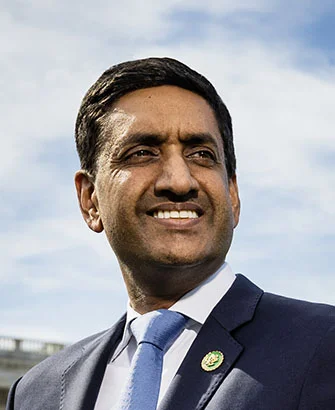
Cover image: Rep. Ro Khanna (D-CA-17) official portrait. Public domain (U.S. Congress).
参考ソース
- 1Voteview — Ro Khanna voting record
- 2American Immigration Council: What's in the Secure America Act?
- 3The Highlands Current: How They Voted (Congress), June 13, 2026
- 4NPR: Trump signs immigration bill with billions for ICE
- 5FreightWaves: The Faster Labor Contracts Act passed the House
- 6The Hill: Khanna — Maine voters gave Platner a 'chance at redemption'
- 7CBPP: House Bill to Make Blocking Federal Funds Easier
- 8@RepRoKhanna on X — bipartisan fraud audit bill passes
- 9TechCrunch: US surveillance law to expire for first time
- 10Proton: FISA Section 702 just expired — what's next?
- 11@RoKhanna on X — Republicans vs Democrats on economy
- 12@RoKhanna on X — Democratic vision thread
- 13@RoKhanna on X — independent AI safety agency proposal
- 14Rep. Jonathan Jackson press release: H.J.Res.196
- 15@RoKhanna on X — Iran ceasefire statement
- 16Truthout: House Rejects Ro Khanna's Effort to Block US-Israel Military Integration
- 17GovTrack: Rep. Ro Khanna
このコンテンツについて、さらに観点や背景を補足しましょう。