The Social Contract: Why We Obey — and When We Don't Have To
Every government claims some right to your obedience. The social contract is the philosophical answer to why — and when — that claim is legitimate. This issue traces the idea from Hobbes's war-of-all-against-all through Locke, Rousseau, and Rawls, then maps the live debates it still generates today.

What is the social contract?
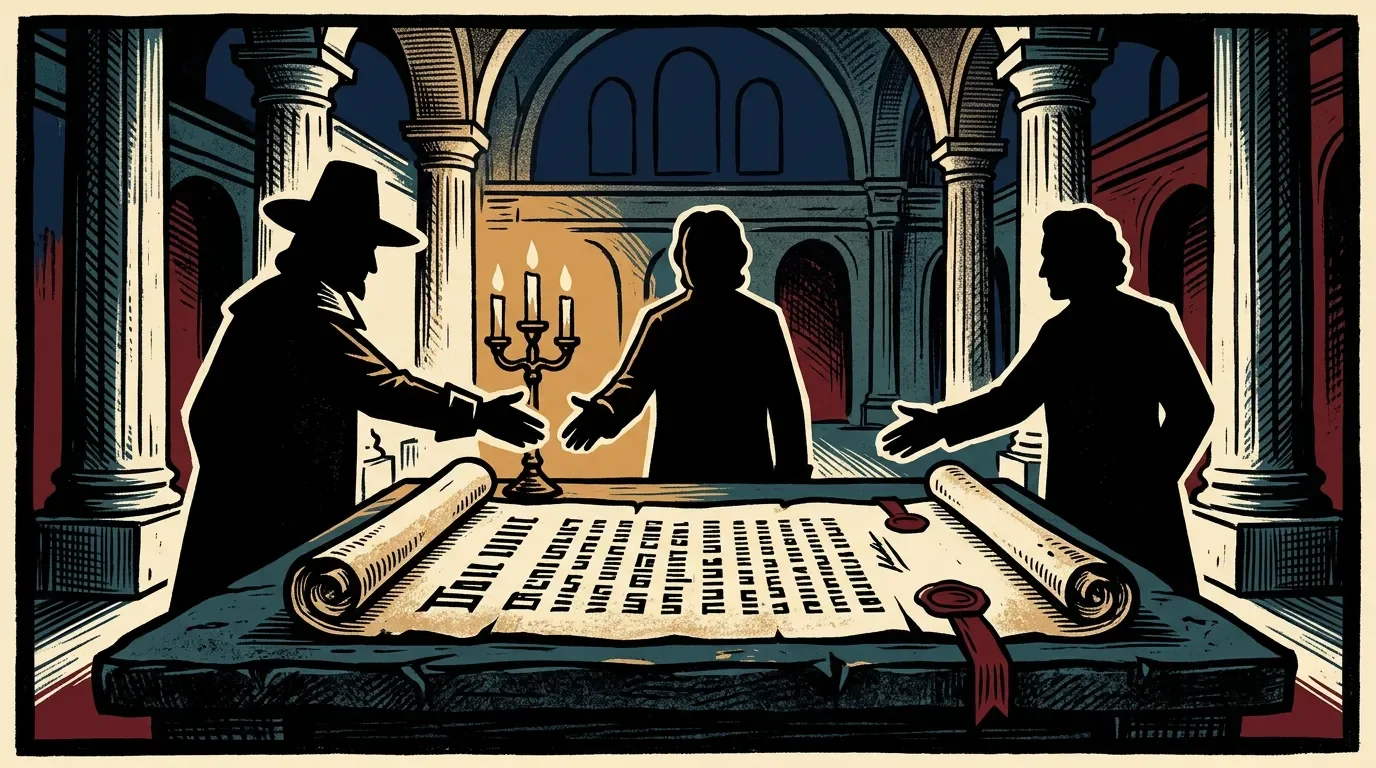
The social contract is the view that governmental authority rests not on divine mandate or force, but on consent — an agreement through which individuals give up certain freedoms in exchange for the protections organized society provides. 1
The concept raises three uncomfortable questions: What would life be like without political authority? What exactly did we agree to? And who counts as a party to the contract? The history of social contract theory is largely the history of philosophers arguing those three points.
The term comes from Rousseau's 1762 Du Contrat Social, but the argument reaches further back — Glaucon in Plato's Republic proposed that justice is simply the bargain struck to avoid harming and being harmed in return. 2 The modern tradition, however, begins in the seventeenth century, amid religious wars, civil conflict, and collapsing monarchies.
Three founding visions
Hobbes: the war of all against all
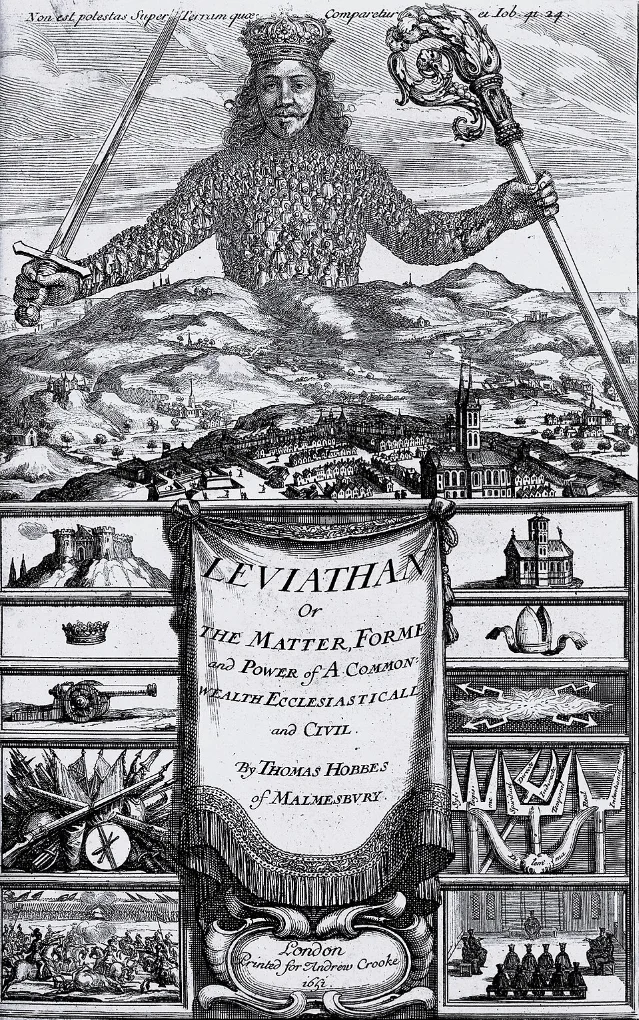
Thomas Hobbes wrote Leviathan in 1651 during the English Civil War. His premise: without political authority, life is a state of perpetual mutual threat — "solitary, poor, nasty, brutish, and short." 1
The contract works in two steps: individuals renounce their unlimited natural freedom, then invest that combined power in a Sovereign with absolute authority. The Sovereign is not party to the contract and cannot break it — citizens are never justified in resisting, because any authority beats perpetual war.
Hobbes is conservative in intent but radical in foundation: political authority no longer requires God or noble blood, only rational self-interest among equals.
Locke: limited government and the right to revolt
John Locke uses the same device but arrives somewhere different. His state of nature is not a war zone — it is governed by a natural law prohibiting harm to others' "life, health, liberty, or possessions." 1 People already have rights; what they lack is reliable enforcement.
For Locke, government is a trustee, not an owner, of the authority it holds. When it breaks that trust, citizens don't merely have the right to resist — they have an obligation. Jefferson's "life, liberty, and the pursuit of happiness" is a near-direct paraphrase of Locke's formula. 2 The right to revolution is not a footnote; it's the load-bearing beam.
Rousseau: the general will
Jean-Jacques Rousseau accepted the classical problem and rejected almost every prior answer. His Discourse on Inequality (1755) argues that the original social contract in history was a trick: the rich persuaded the poor to accept laws that dressed inequality as justice.
His normative contract — in The Social Contract (1762) — centers sovereignty in the general will, the collective interest of all citizens. Citizens overruled by the general will are not being oppressed; they are being corrected — the basis of his phrase that society may need to "force men to be free." 2
| Theorist | State of nature | What the contract achieves | Can citizens resist? |
|---|---|---|---|
| Hobbes | War of all against all | Absolute sovereign ends the war | No — any authority beats chaos |
| Locke | Peaceful but insecure; natural rights exist | Limited government to protect existing rights | Yes — when government breaks its trust |
| Rousseau | Peaceful; corrupted by property and inequality | Sovereignty of the general will | Only by acting as the general will |
Rawls and the twentieth-century revival
By mid-century, contract theory had been largely displaced by utilitarianism. John Rawls revived it with A Theory of Justice (1971) via the "original position" and "veil of ignorance": imagine choosing the principles governing your society before knowing your race, sex, class, or talents. What would you pick? 2
Rawls argued you'd choose two principles: equal basic liberties for all, and that social inequalities must benefit the worst-off (the "difference principle"). The contract is explicitly hypothetical — no one actually sits behind the veil. Its purpose is analytical: to identify principles no reasonable person could reject on self-interested grounds.
Contemporary critiques
Feminist critiques — most sharply by Carole Pateman in The Sexual Contract (1988) — argue that the classical contract's "free and equal individuals" were implicitly male heads of household. Women and domestic labor were excluded structurally, not accidentally: the liberal public contract depends on an unacknowledged sexual contract underneath it. 1
Race-conscious critiques — from Charles W. Mills's The Racial Contract (1997) — make a parallel case: the social contract functioned in practice as an agreement among white people to maintain racial hierarchy, operating in a world of colonial dispossession and chattel slavery that its universalist language ignored. The Declaration of Independence, often cited as Locke's legacy, was signed by slaveholders. 1
Neither critique dismisses contract theory outright — both argue for expanded contracts that actually include all human beings.
Modern debates
統計カードを読み込んでいます…
Digital governance. Platform "terms of service" mimic contractual consent — but critics note they're drafted by one party, incomprehensible in length, with no real alternative to accepting. Whether genuine consent is possible in platform capitalism is now a live question in political theory and regulatory law.
Intergenerational obligations. The classical contract was written between contemporaries and says nothing about future generations or the environment. Rawls's veil of ignorance has been extended by some theorists to include future generations: if you didn't know which generation you'd be born into, would you accept current rates of carbon emissions?
The legitimacy crisis. In many liberal democracies, the sense that the governing contract is broken — that institutions serve concentrated interests — has intensified. Whether the diagnosis is Hobbesian (need a stronger sovereign), Lockean (government has forfeited its trust), or Rousseauian (institutions don't express the general will) depends on which version of the contract you find most plausible.
The social contract is not a settled doctrine but a contested set of arguments about a question that doesn't go away: on what terms do we owe each other political obedience, and when — if ever — is that obedience rightly withdrawn?
参考ソース
- 1
- 2Social Contract — Wikipediaen.wikipedia.org
- 3Ancient Scroll Illustration — Pixabaypixabay.com
関連コンテンツ
- ログインするとコメントできます。