PassiveShorts auto-posts faceless Shorts to YouTube and TikTok, but it automates your format before it proves it
PassiveShorts turns a topic, voice, and schedule into recurring faceless Shorts for YouTube and TikTok; its low-cost test is useful, but the launch proves workflow automation rather than audience performance.

PassiveShorts is a Product Hunt launch that turns a topic, voice, and schedule into faceless short videos for YouTube and TikTok. The public launch trail places it on August 3, 2026: an X post from Vijayabhaskar J that day links to the Product Hunt listing and refers to PassiveShorts' launch, while the Next in AI newsletter lists it among that day's Product Hunt launches. 12
The interesting part is not that it can generate a script, voiceover, images, and captions. Plenty of tools claim that. PassiveShorts packages those steps as a recurring channel: choose a premise once, connect a destination, and let the service keep producing and publishing on a schedule. That is a useful shift for creators who want a repeatable Shorts operation. It is also a faster way to publish a weak format at scale.
The new thing is the channel runner
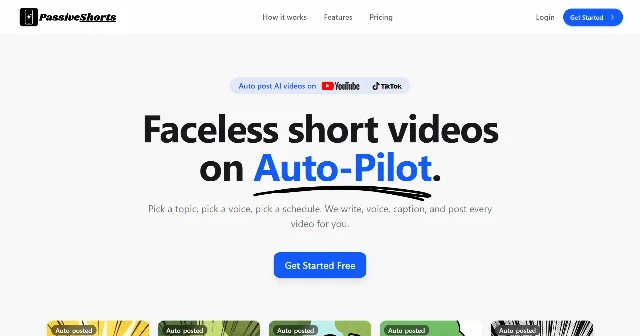
A normal AI video tool starts with an asset: a prompt, a script, or a clip. PassiveShorts starts with a series. Its homepage asks the user to choose a niche, visual style, voice, and posting days, then says it will generate the script, voiceover, visuals, and captions for every episode before publishing to the connected channel. 3
That makes the unit of work larger than one video. A creator is configuring a small content system with a topic boundary and a cadence. The service can use one of five built-in topics, such as Scary Stories, Jokes, Life Pro Tips, Today I Learned, and You Should Know, or a custom topic written by the user. 3
The distinction matters because scheduled generation creates a different failure mode. If one video is bad, you can delete it. If the premise is bad, the tool can repeat the mistake three times a week or every day until someone notices.
What a creator can actually do with it
The workflow is deliberately narrow:
- Define the series. Choose a built-in topic or write a custom one, then select a visual style and voice.
- Connect a destination. The homepage says a series can post to one YouTube channel and one TikTok account, with the posting days and time chosen by the creator. 3
- Let the service assemble the episode. Its public description says it writes the script, generates an image for each line, adds a voiceover and word-by-word captions, then posts the result. 3
- Choose the review boundary. Videos can be published publicly, published privately, or sent to TikTok drafts for approval inside the TikTok app. 3
That last option is the difference between automation and surrender. A creator can use PassiveShorts as a scheduled generator while keeping a review step for TikTok. YouTube private uploads offer another checkpoint, though the public page does not explain how much editing is possible after generation or how long an episode remains private.
There is a second workflow for creators who already have the idea. The pricing page says users can paste their own script, choose the voice, visual style, and caption style, and request one video without creating a series or consuming one of the account's ten series slots. That video still comes from the plan's normal video allowance. 4
That one-off path is more important than it sounds. It lets a creator test a premise, voice, and visual treatment before putting an automated schedule behind them. PassiveShorts' own case study recommends testing a single script first, then moving a working custom topic and prompt into a series. 5
The plan is priced around frequency
The current public pricing page presents plans per series and makes posting frequency the main plan difference. It lists the following:
| Plan | Price per series | Listed cadence | Listed allowance |
|---|---|---|---|
| Basic | $19/month | Three posts per week | 12 videos and 240 generated slideshow images per month 4 |
| Pro | $39/month | One post per day | 31 videos and 620 generated slideshow images per month 4 |
Both plans include auto-posting to YouTube and TikTok, 19 visual styles, custom caption styles, natural AI voices, one connected YouTube and TikTok destination per series, and the ability to run up to ten series at once. The page also says a new subscription has a seven-day money-back guarantee, and that yearly billing charges for ten months instead of twelve. 4
The arithmetic is simple, but the commitment is not. A single Basic series costs $19 for a modest test. Five Pro series would be $195 every month before a creator has proved that five different premises deserve daily output. The service's pricing makes it easy to scale the schedule; it does not make the editorial review cheaper.
The useful constraint: repetition needs a premise
PassiveShorts is better suited to a repeatable format than to a creator who wants every upload to be a new production. Its own case study treats a channel's premise as a sentence shape: keep the framing and recurring character stable, then change the historical setting or subject. It also says a custom prompt is applied to the narration and image prompts, which can help keep those elements consistent across a series. 5
That is a sensible design choice. A series needs a rule that can survive dozens of episodes. A vague instruction such as "make interesting history videos" gives the generator too much freedom; a rule such as "speak to the viewer in second person, use one historical setting per episode, and keep the same glass skeleton in every image" gives it something repeatable.
The catch is that consistency is not originality. A stable voice, character, and caption style can make a channel recognizable while the underlying scripts remain thin or repetitive. The public launch material explains how to configure that loop, but it does not provide independent retention data, comparisons against human-edited Shorts, or evidence that the generated videos perform well on either platform.
What the launch does not prove
The strongest claims are about workflow, not audience results. PassiveShorts shows that it can connect accounts, schedule output, and assemble a faceless video from a topic or script. It does not, in the public material reviewed here, prove four things a creator may care about more:
- whether the scripts stay factually reliable on open-ended topics;
- whether repeated generated images and voices become visibly repetitive;
- whether the YouTube and TikTok publishing connections survive platform policy or API changes; and
- whether the time saved in editing turns into better watch time, subscribers, or revenue.
Those are not small omissions. The product removes the editing and upload bottleneck, but the creator still owns topic selection, quality control, platform risk, and the cost of publishing a bad idea repeatedly. The ability to send a video to TikTok drafts or publish it privately is a useful safety valve, not proof that the output is ready for a public feed. 3
Who should try it first
PassiveShorts makes sense for a creator who already has a narrow, repeatable format and wants to test a low-touch distribution loop. Start with one series or one pasted script. Keep the topic specific enough to constrain the writing, use a review boundary for early episodes, and watch for repeated errors before increasing the cadence.
It is a weaker fit for a creator whose advantage is personal editing, visual craft, or reporting that needs source-by-source verification. It is also a poor first choice if the goal is to discover a niche from scratch: an automatic schedule can multiply uncertainty before the creator knows what deserves to be repeated.
The launch's real promise is modest but concrete. PassiveShorts does not replace the creative decision about what a channel should be. It makes the downstream loop—script, voice, visuals, captions, and posting—run with fewer manual steps. At $19 per Basic series or $39 per Pro series, that is cheap enough to test. The test should be of the format, not just whether the generator can make a video.
参考ソース
- 1
- 2Next in AI: Issue #230linkedin.com
- 3PassiveShorts official homepagepassiveshorts.com
- 4PassiveShorts pricingpassiveshorts.com
- 5Bernard Films: 31 Videos, 174 Million Views, Six Monthspassiveshorts.com
関連コンテンツ
- ログインするとコメントできます。