
Claude Code artifacts turn agent work into private team pages
Anthropic launched Claude Code artifacts, a beta feature that turns active coding-agent sessions into live internal web pages for Team and Enterprise users. The brief explains what changed, why it matters for enterprise adoption, and where the feature is still constrained.

リサーチノート
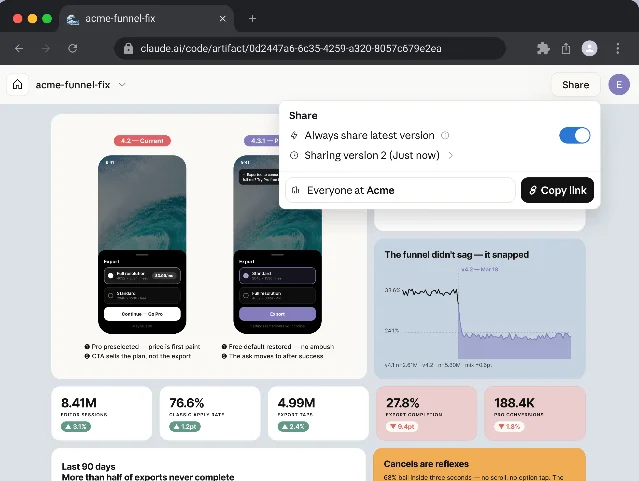
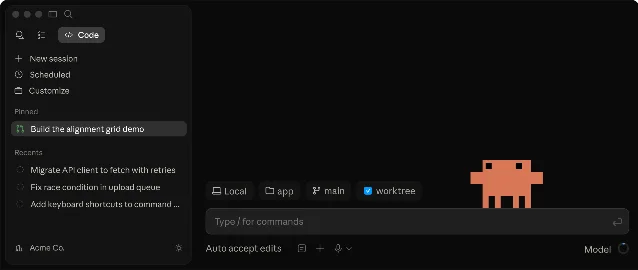
Claude Code added artifacts on June 18, giving Team and Enterprise users a way to turn an active coding session into a live internal web page: a PR walkthrough, incident timeline, dashboard, release checklist, or system explainer that teammates can open while the agent keeps working. Anthropic says the beta is available from the Claude Code CLI and desktop app, with pages viewable in any browser. 1
The launch is small in surface area but important for Anthropic's enterprise push. Claude Code is no longer only a terminal agent that writes status back into the developer's screen. Artifacts make the agent's intermediate work easier to inspect, share, and govern inside a company, which is exactly where many enterprise AI deployments get stuck.
What changed
Artifacts are live, interactive pages published from a Claude Code session to a private URL on claude.ai. The docs say an artifact can update in place as the session continues, so a reviewer or stakeholder can keep the page open while Claude republishes new versions to the same link. 2
Anthropic's launch examples focus on work that is hard to communicate through terminal logs: annotated PR diffs, dashboards from session data, implementation options side by side, investigation timelines, and release checklists. 1 The docs add that Claude builds the page from session context, including the codebase, connected tools, and the conversation itself. 2
The feature also changes the review loop. Instead of pasting agent output into Slack or asking an engineer to narrate what Claude found, a teammate can open a page that shows the reasoning, code references, charts, or checklist in one place. Anthropic says every publish becomes a version, and the same URL can show a selected version or the latest version depending on the share setting. 2
Why it matters for Anthropic
This is a product launch, not a model release. Its strategic value is distribution: Claude Code becomes easier to bring into teams where work must be reviewed by people who never watched the terminal session.
For enterprise buyers, the relevant question is not whether an agent can produce output. It is whether the output can be inspected, handed off, retained, and revoked. Artifacts address that handoff layer. Anthropic says artifacts are private to their author by default, can be shared with specific teammates or the organization, and are only viewable by authenticated members of the publishing organization. 2
That puts the feature in the same enterprise-adoption lane as Claude Code desktop, managed agents, connectors, and admin controls: Anthropic is adding collaboration surfaces around the coding agent, not just more coding capability. The launch post lists legal, privacy, security, FinOps, software engineering, design, architecture, SRE, and engineering-management examples, which signals that Anthropic wants Claude Code artifacts to be read by cross-functional teams, not only the developer who started the session. 1
Limits and watch points
Artifacts are deliberately constrained. The docs say each artifact is a self-contained page with no backend, no external requests, no live API calls, no multi-route app behavior, and a rendered-size limit of 16 MiB. Published source files must be HTML, HTM, or Markdown. 2
Availability is also narrower than the headline might imply. The docs say artifacts require a Team or Enterprise plan, authentication through
/login, the Anthropic API as model provider, and Claude Code CLI or Claude desktop version 1.13576.0 or later. They are not available when using Amazon Bedrock, Google Cloud Vertex AI, or Microsoft Foundry credentials. 2There is a governance tradeoff. Sharing an artifact can expose the context that produced it. Claude's help center says viewers of a shared artifact may also gain access to attachments and files in the conversation that created it, so teams need review habits before sharing artifacts from sessions with sensitive documents. 4
The near-term signal to watch is whether Anthropic customers use artifacts as lightweight internal reporting for agent work, or whether the constraints keep them as demos and review aids. If teams start treating artifact pages as the default handoff from Claude Code sessions, Anthropic will have made the coding agent easier to evaluate inside the organizations it is trying hardest to win.
このコンテンツについて、さらに観点や背景を補足しましょう。