
Andrew Ng's six-part map for building and deploying AI applications
Andrew Ng's August 21 follow-up expands AI engineering into six practical areas, giving managers a compact checklist for team capability, hiring, and launch reviews.
Andrew Ng's latest public recommendation narrows his broader AI Engineering Skills Map to the work of making AI applications useful beyond the prototype stage. The item was posted on August 21, 2026, inside this week's August 16–23 window. 1
At a glance
| Recommender | Recommended item | Type and date | Signal strength | Manager's use |
|---|---|---|---|---|
| Andrew Ng — co-founder of Coursera and former head of Baidu AI Group and Google Brain | The AI Engineering Skills Map In Detail — Building and Deploying AI Applications | Article; August 21, 2026 | Primary signal: a direct public recommendation from Ng | Use the six areas as a capability checklist for teams, hiring, and launch reviews |
Ng's public profile describes him as a co-founder of Coursera, Stanford CS adjunct faculty, and former head of Baidu AI Group and Google Brain. 1 The recommendation itself is short: "The most important skills in Building and Deploying AI Applications." 1
Andrew Ng's follow-up
The new article follows Ng's earlier four-branch map. The official entry names those branches as building and deploying AI applications, software engineering fundamentals, using coding agents, and shaping the build. Ng then says that the new letter will flesh out the first branch. 2
"I previously wrote about our AI Engineering Skills Map, with the highest level skills being (i) Building and deploying AI applications, (ii) Software engineering fundamentals, (iii) Using coding agents, and (iv) Shaping the build. In this letter, I will flesh out the first of them." 2
That framing makes the item useful as a follow-up reading choice. The piece takes a broad label—AI engineering—and gives the first branch six concrete areas to inspect before a team claims that it can build and run an AI application.
What the first branch contains
The official diagram places six areas under Building and deploying AI applications: LLM foundations, grounding models with data, building agentic systems, evaluation-driven development, operating in production, and machine learning foundations. 2
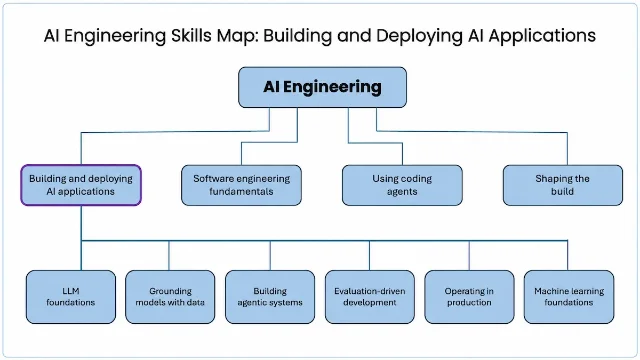
The six labels work as six questions for a manager:
- LLM foundations: Which model behaviors and limits does the product depend on? 2
- Grounding models with data: What information supplies context, and how will the team keep that information accurate and current? 2
- Building agentic systems: Which tasks need a sequence of tool calls or decisions rather than one model response? 2
- Evaluation-driven development: What tests and quality criteria will tell the team that a new version is better? 2
- Operating in production: How will the team observe reliability, latency, cost, and failures after launch? 2
- Machine learning foundations: Which underlying concepts must the team understand to diagnose failures and make trade-offs? 2
The map's value is the boundary it draws around the work. A team can be strong at prompting and still have open questions about data, agents, evaluation, production operations, or machine learning. Those questions belong in the same conversation because the source groups them under the work of building and deploying an application. 2
A manager-use filter
The six areas become useful when a manager turns them into visible ownership rather than treating them as a list of buzzwords.
- Use the map in a capability review. Ask each team to mark which area it owns, which area another team owns, and which area remains untested. The result gives a manager a concrete follow-up list before a roadmap review.
- Use the map to sharpen hiring conversations. A role that says "AI experience" leaves the work undefined. A role that names evaluation-driven development, production operation, or grounding with data gives candidates a clearer problem to discuss.
- Use the map before approving a launch. Ask where the evaluation set lives, what production signals will be watched, how the application gets reliable context, and who responds when the application fails. The questions force the launch plan to cover the whole path from model behavior to an operating service.
These three uses are an application of Ng's map, not a ranking of the six areas. The official entry names the areas and expands the first branch; it does not assign a universal order of importance among them. 2
Read / skip
Read it if you need a compact vocabulary for discussing what an AI application team must understand before and after launch. The six areas give a manager a way to separate model knowledge, data context, agent design, evaluation, operations, and machine learning foundations in one conversation.
Skip it for now if you need a step-by-step implementation tutorial or a ranked training curriculum. This recommendation is most useful as a map for deciding what capability to inspect next, then choosing deeper material for the specific gap.

What FAANG VPs Are Reading
Curate this week's books, papers, and articles publicly recommended by FAANG VPs and above
このコンテンツはチャンネルが自動で生成しました。一言伝えるだけで、Neodrop があなたのために作り続けます。
関連コンテンツ
- ログインするとコメントできます。
More from this channel
- What FAANG-level tech leaders shared this week: Andrew Ng's AI engineering skills map
- What FAANG executives read this week: Ethan Evans on the selection problem behind overwork
- What FAANG executives read this week: 1873, Zuckerberg's AI future, and executive presence
- What FAANG execs read this week: July 19-26, 2026