Pulled from the Sea
In the summer of 1964, the nets of an Italian trawler hauled up a life-sized ancient Greek bronze from the floor of the Adriatic — a victorious athlete, mid-gesture, placing an olive wreath on his own head. The statue had been underwater for roughly two thousand years. It passed through a cabbage patch, a priest's bathtub, and a Luxembourg dealer syndicate before the Getty Museum bought it in 1977 for $3.95 million. Forty years of Italian court proceedings followed, culminating in a 2024 European Court of Human Rights ruling upholding Italy's right to confiscate the bronze. The statue remains in Malibu. This is the story of one of the rarest surviving objects from the ancient world — and the legal standoff that still surrounds it.

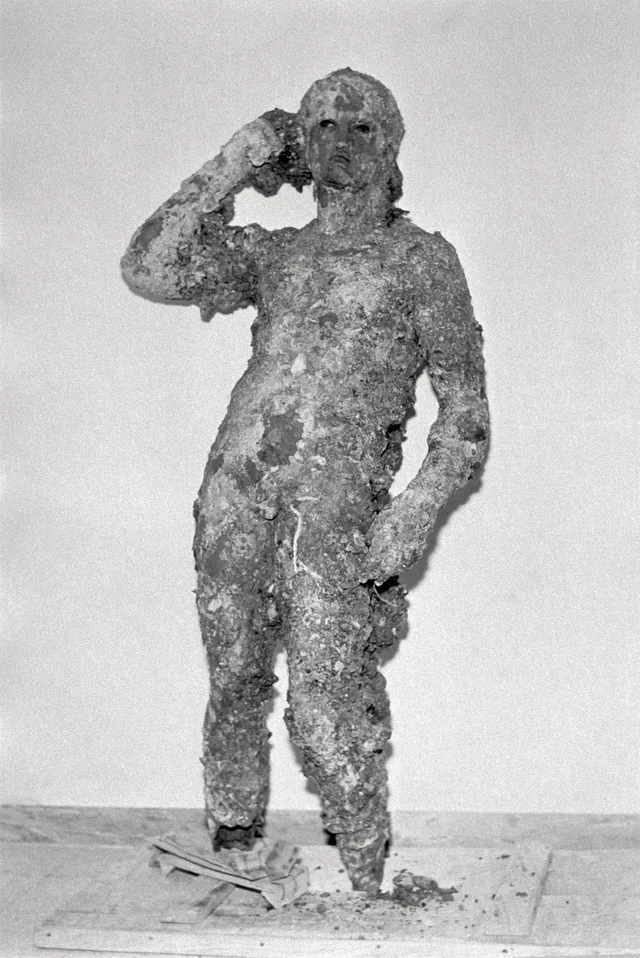
On a summer day in 1964, somewhere in the Adriatic — the exact coordinates have never been confirmed in court — the nets of an Italian trawler called Ferri Ferruccio snagged something too heavy to be a school of fish. The crew hauled it up. Emerging from the water, encrusted in two thousand years of shell, coral, and calcareous sediment, was a naked young man, life-sized, reaching toward his own head.
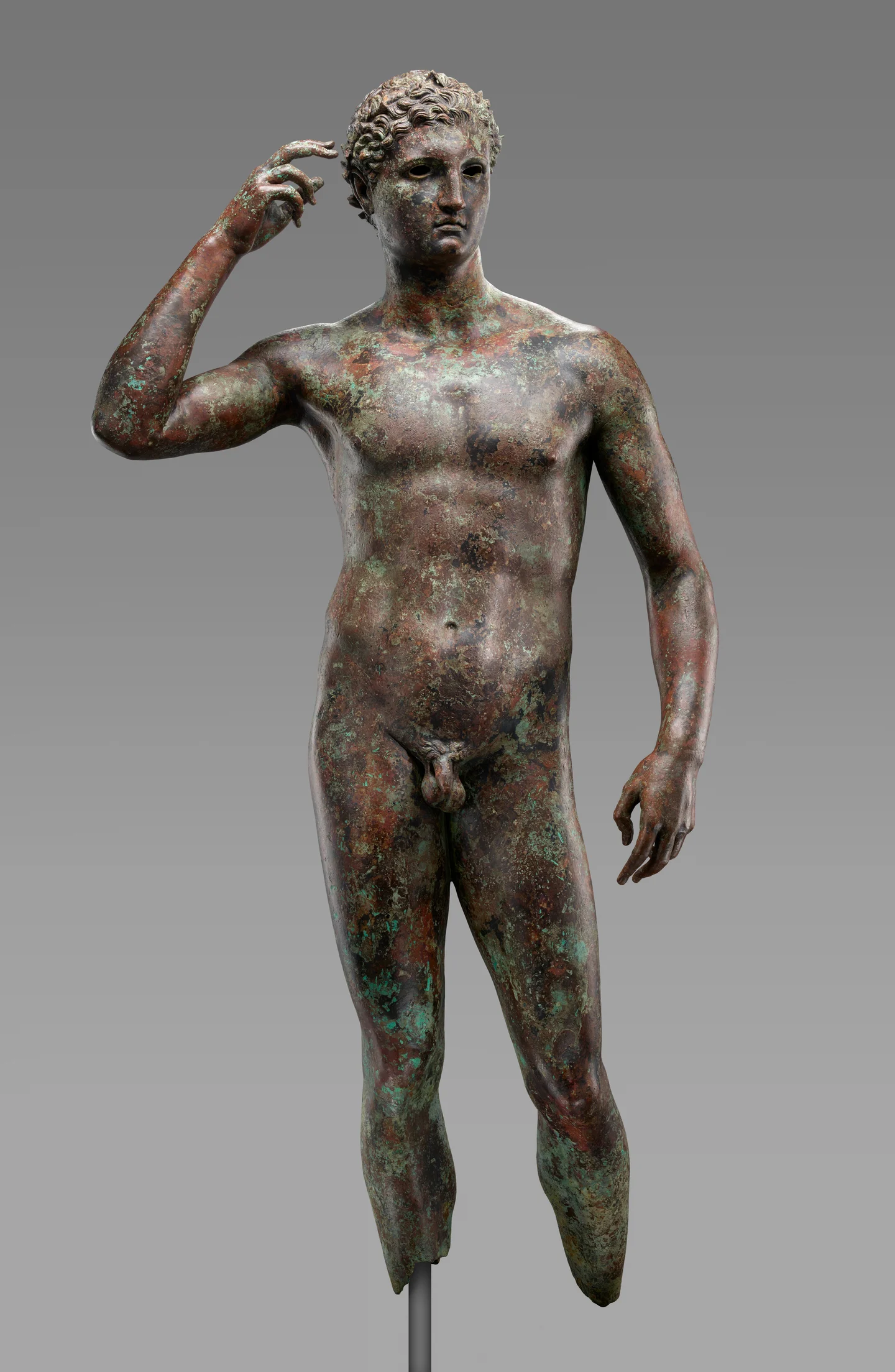
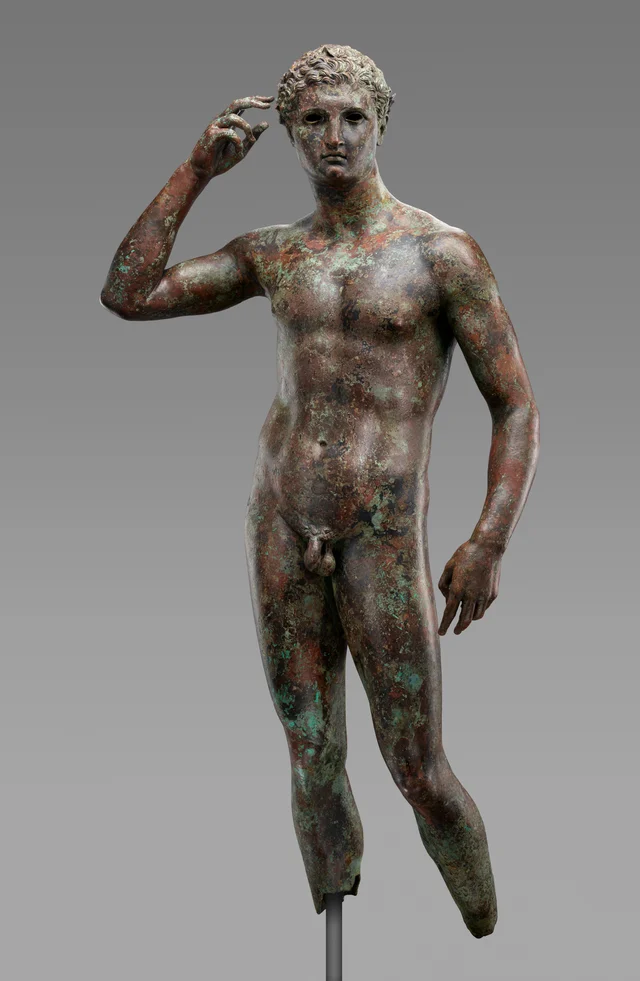
He stood 151.5 centimeters tall — about five feet — and once the crust was cleared, what remained was a Greek bronze of extraordinary quality: a victor from the ancient Panhellenic games, mid-gesture, placing an olive wreath on his own head. The right ankle and foot were missing, sheared off in antiquity, probably when someone had pried the statue from its stone base. His left hand hung open at his side, palm slightly forward, the fingers curved around the ghost of a palm branch that had since been lost. 1
The fishermen sold him for roughly $5,600 to a local dealer named Giacomo Barbetti. Within a decade he would be at the Getty Museum in Malibu, purchased for $3.95 million — a record price for any antiquity at the time. Fifty years after that, the European Court of Human Rights would rule that Italy had the legal right to confiscate him. He remains in California today, the subject of an enforcement standoff between two continents, still mid-gesture, still reaching. 2
What he looked like when he was new
To understand what the fishermen pulled from the net, you have to undo two thousand years of submersion and think backward to a bronze that had never touched seawater.
The statue belongs to the autostephanoumenos type — Greek for "one who crowns himself" — a class of honorific athletic bronzes that crystallized in the late Classical period, around the fourth century BCE, and persisted for generations. 3 In the original, the surface was not the mottled green-brown patina visible today. Ancient bronzes were maintained to look like skin. The alloy itself, given a fine polish, reads warm and amber in raking light, and ancient owners applied a pale surface coating to push the color further toward flesh tones. The lips and nipples were inlaid with red copper — a detail still legible today as the darker metallic patches at the mouth and chest. 1 The eyes were inset: probably ivory or bone for the whites, colored stone or glass for the irises, with the lids framed by a delicate technique in which thin copper strips were folded, cut, and curled to simulate eyelashes. At some point the eyes were removed — perhaps scavenged in antiquity — leaving the statue with the blank, slightly unsettling gaze that greets visitors at the Getty Villa today. 3
The body is slender and young, the weight shifted to the right leg in a contrapposto stance that makes the left hip drop and the right rise slightly. Art historian Carol Mattusch, whose 1997 monograph remains the standard reference on the statue, described him as "a handsome young man with a sleek and graceful body, standing at ease, one hip elegantly cocked. His head held high, his expression detached, he raises one hand toward the olive wreath on his head." 3 The proportions are markedly different from the heavy musculature of earlier Classical athlete statues — this boy has not yet acquired the barrel chest of a wrestler or the thighs of a discus thrower. He looks like a sprinter, or perhaps a pentathlete: quick, controlled, economical.
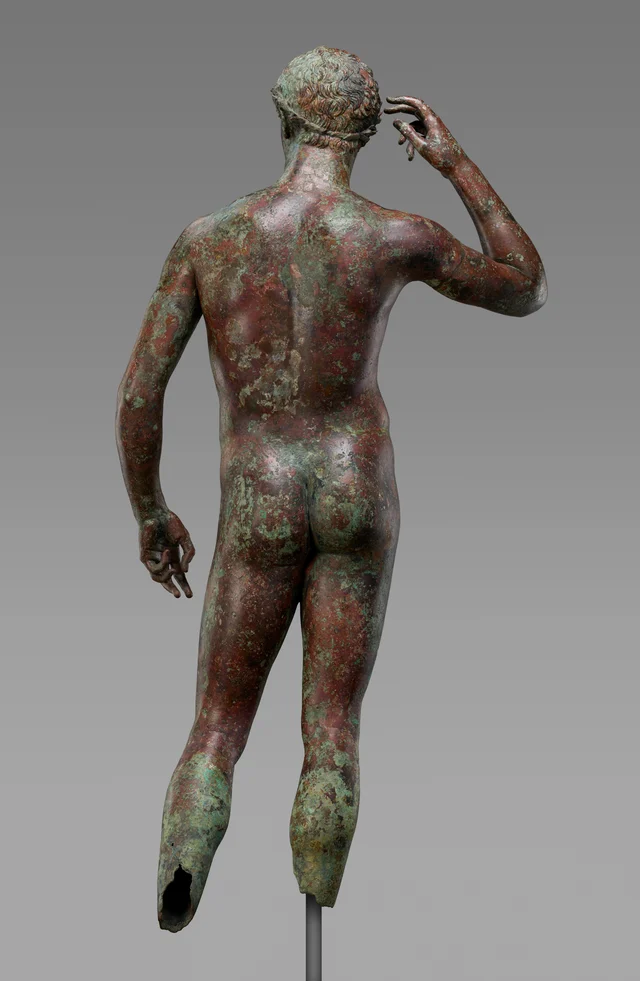
The casting itself is a technical achievement. The statue was made by the cire perdue (lost-wax) method, a process in which a sculptors' core of clay, sand, and organic material is built up over an armature of iron rods and reed, then covered in a layer of wax. The wax surface is worked with fine tools to produce the final surface detail — curling hair, the subtle shading from ribcage to abdomen, the modeled tendons in the forearm. An outer mold is then applied, the wax is melted out, and molten bronze is poured into the void. For a statue this large, the head was cast separately and attached: X-ray examination shows the join seam at the neck, and at the back of the neck there is a rectangular support plate — a manufacturing feature shared with the Marathon Boy and the Antikythera Youth, two other surviving fourth-century bronzes — that helps anchor the head to the torso. 3 4
The bronze core, examined during conservation in the 1970s, contained traces of linen fibers. The ancient writer Pausanias noted that flax grew in only one part of Greece: the plain around Olympia. 4 That detail, combined with the olive wreath — Olympia's victory prize, as opposed to the laurel of Delphi, the pine of Isthmia, or the wild celery of Nemea — suggests with reasonable confidence that the statue began its life at Olympia, the most prestigious sanctuary in the Greek athletic world, as a votive offering from a victorious athlete or his family. 3
Two thousand years underwater
How the statue got from a Greek sanctuary to the floor of the Adriatic is not documented, but the most plausible reconstruction is straightforward: Rome.
Greek bronzes were among the most sought-after trophies of Roman military conquest and aristocratic collecting. The general Lucius Mummius notoriously stripped Corinth of its bronzes in 146 BCE; Sulla looted Athens; Pompey, Caesar, and Augustus all displayed Greek originals in Roman public spaces and private villas. The statue's feet were cut off at the ankles — a rough severance from a stone base, consistent with the kind of hasty removal that accompanied either military looting or the kind of sale-under-duress that followed conquest. 3 A ship carrying the statue, bound probably for the Italian peninsula, went down in the Adriatic. The water preserved what the millennia on land almost certainly would not have: the overwhelming fate of ancient bronzes was the furnace. Of the thousands of life-sized bronze statues known to have existed in the ancient Mediterranean, fewer than two hundred survive. Every one of them is a shipwreck or a burial — preserved by accident, not intention. 5
On the seabed, the bronze did what bronze does in saltwater: it developed a thick coating of marine concretion — layers of shell, coral, calcium carbonate, and oxidized metal — that paradoxically protected it. The patina that conservation work revealed underneath (paratacamite, a copper chloride compound, over a thin layer of cuprite) is the trace chemistry of two millennia of immersion. 3
The cabbage patch, the priest's bathtub, and the black market (1964–1971)
The Ferri Ferruccio brought the statue to the port of Fano, on Italy's Adriatic coast, in the summer of 1964. The catch was illegal from the moment it hit the deck: Italian law required any antiquity found in Italian territory — and the fishermen were Italian citizens, on an Italian vessel, docking at an Italian port — to be reported to the authorities. It was not reported. The crew sold the statue for the equivalent of about $5,600 to a local dealer named Giacomo Barbetti. 6
Barbetti hid it. According to later court filings and a report citing the Financial Times's coverage of the 2024 legal proceedings, the statue passed through a cabbage patch, a priest's bathtub, and the care of a cleric named Giovanni Nagni at a church in Gubbio. 4 Italian prosecutors opened a criminal investigation. In 1966 Barbetti and Nagni were charged with theft of state property, convicted at first instance, and then cleared on appeal in 1968 when the court found insufficient evidence to establish that the statue had been found in Italian territorial waters rather than the international sea. A final acquittal came from the Perugia Court of Appeal on 18 November 1970. 2
The acquittal did not mean innocence so much as legal ambiguity: where, exactly, had the statue been found? The fishermen's accounts were inconsistent. The best available evidence suggested the nets had been hauled somewhere off the coast near Pedaso, in waters that could have been Italian or international depending on which line you drew. That question — twelve miles or fourteen, this side of the median line or that — would still be generating legal briefs half a century later.
With the Italian criminal case closed, the statue moved up the market. By 1971 it had surfaced in London under the name of Artemis Consortium, a Luxembourg-registered dealer syndicate that purchased it for approximately $700,000. 7 From London it went to Munich, to a German dealer named Heinz Herzer, who commissioned three months of conservation treatment by a restorer named Rudolph Stapp. Stapp removed the marine concretion, treated the active bronze disease (the corrosive chloride compounds that had formed in the seawater), and stabilized the surface. Before Herzer could sell it, the statue needed to be shown to experts.
The Getty purchase (1972–1977)
In 1972, Herzer sent photographs to Bernard Ashmole (1894–1988), the former head of the Greek and Roman collections at the British Museum and one of the most respected classical archaeologists of his generation. Ashmole studied the images and endorsed the attribution to Lysippos — or at least to the Lysippan school. He then brought the statue to the attention of J. Paul Getty. 7
What followed was five years of hesitation. Getty opened negotiations with New York's Metropolitan Museum for a joint purchase, but those talks collapsed when Herzer could not provide clean title documentation. Getty himself, who had purchased the Lansdowne Herakles and the Mazarin Venus without analogous misgivings, appears to have been genuinely uneasy about this one. According to the ECHR's later judgment, based on internal correspondence, Getty personally requested a full copy of the Italian court decisions from Herzer's Italian lawyers before proceeding. 2 Those lawyers, however, represented the seller — a conflict of interest the ECHR would later note.
J. Paul Getty died on 6 June 1976, leaving a trust endowment of approximately $700 million to the museum, making it briefly the world's wealthiest art institution. The purchase of the Victorious Youth was completed on 27 July 1977 by the Getty Museum's trustees, at a price of $3,950,000 — a record for any antiquity sold at that date. The contract was signed in England. The statue entered the United States through the port of Boston on 15 August 1977 and went on public view at the Getty Villa in Malibu in March 1978. 7 2
The museum's curator Jiri Frel, in a 1978 publication, attributed the statue to Lysippos — the fourth-century Greek sculptor who served as court portraitist to Alexander the Great and who, according to Pliny the Elder, made approximately 1,500 bronzes, specializing in athletes. Frel's attribution rested on what he saw as Lysippos's characteristic departures from the Polykleitan kanon: the more slender proportions, the subtler facial modeling, the capacity to suggest an interior life through fleeting expression. Whether or not the Victorious Youth is by Lysippos himself — a question that remains unresolved — is in some ways the least important thing about it.
Who made it, and what that question reveals
The attribution question matters because of what it illustrates about ancient bronze survival and modern scholarship, not because the answer changes the object's significance.
Mattusch's 1997 monograph explicitly rejected the traditional approach of hunting for the "big name" sculptor. As she wrote at its outset, the study "will not be conducted in the traditional manner." 8 Instead, she focused on X-rays, metallurgical analysis, and comparisons with other surviving bronzes to reconstruct the manufacturing process and the original social context. Lysippos, she concluded, was at most possible — "Lysippos or his school" — but the question is unanswerable with existing evidence, because the statue has no signature, no ancient literary reference to connect it to a specific artist, and because radiocarbon and thermoluminescence dating of the core materials can only narrow the date to "pre-Roman period," not to a specific decade. 3
In January 2025, Italy's Director General of Museums, Massimo Osanna, publicly stepped further, telling the press that "we have no evidence it was by Lysippos apart from a vague stylistic similarity. The name is not correct." Osanna suggested the statue might be an ancient replica of a Lysippan original, produced by a workshop following the master's style. 9 The archaeologist Rachele Dubbini of the University of Ferrara has argued separately that the metalwork quality does not reach what one would expect from Lysippos's workshop. 10
The announcement produced an uproar in Fano. The town has named streets and a literary journal after Lysippos. The journal's editor, Giampiero Patrignani, asked with exasperated logic: "The statue is by Lysippos. Why would the Getty have bought it if it weren't?" 9
Osanna himself offered the counter-answer: "It is an extraordinarily important work because there are so few surviving ancient bronzes." 9 The statue's value — scholarly, aesthetic, historical — has nothing to do with whether a specific sculptor touched the wax model. It is one of fewer than two hundred life-sized Greek bronzes that did not end up in a smelting furnace. That is a more than sufficient credential.
The neck plate
Before turning to the legal story, it is worth pausing at a single physical detail, because it puts everything else in scale.
On the back of the statue's neck there is a rectangular bronze plate, approximately the size of a playing card, recessed into the metal. It served as a structural anchor during casting, holding the separately-made head in alignment with the torso as the bronze was poured. The same feature appears, in the same position, on the Marathon Boy in the National Museum in Athens and on the Antikythera Youth, recovered from a different shipwreck in 1900. 3
Three bronzes surviving from perhaps the finest century of Greek sculpture — because three ships sank. The plate is what connects them: not an aesthetic judgment, not a name, but a shared solution to a shared manufacturing problem. The craftsmen who made these statues were solving the same technical puzzle, and the solution is still readable in metal, two thousand years later, on the neck of a young man who is still reaching for his wreath.
Forty years of legal battle
The Marion True affair of 2005 — in which Getty's longtime antiquities curator was charged in Italy with conspiring to traffic looted objects, a case closely tied to the Giacomo Medici network whose Geneva warehouse had been raided ten years earlier — did not directly involve the Victorious Youth. 4 But it poisoned the atmosphere for any accommodation between Getty and Rome, and it helped move the Victorious Youth from a standing grievance to an active prosecution.
On 20 November 2006, Getty's director Michael Brand announced that the museum would return 26 objects to Italy. The Victorious Youth was not among them. Italy's culture minister Francesco Rutelli responded by threatening a full cultural embargo — no more loans, no collaborative exhibitions, no scholarly exchange — unless all 52 objects Italy had formally claimed were returned. 7
On 1 August 2007, a compromise was reached: Getty would return 40 of the 52 objects, including the Morgantina Venus, which was physically handed over in 2010. The Victorious Youth was explicitly carved out of the agreement — its fate would depend on criminal proceedings in Pesaro, the Italian town nearest the statue's alleged discovery site. That same day, the Pesaro public prosecutor formally requested the statue's confiscation. 7
The Italian courts moved slowly. The Pesaro preliminary judge issued a confiscation order in February 2010, reasoning that an Italian-flagged vessel at sea counts as Italian territory — meaning the statue had, in law, been found on Italian soil. Getty appealed repeatedly. The Italian Constitutional Court in 2015 found one procedural element unconstitutional (the hearings had been held in private) and ordered the case back to be retried in public. 2
On 8 June 2018, the Pesaro court reconfirmed the confiscation order. The reasoning this time added a cultural argument: Lysippos — if the attribution held — was known to have visited Taranto, in southern Italy; Greek civilization and Roman civilization existed in "cultural continuity"; therefore a statue made by a Greek sculptor in the Greek tradition had a meaningful connection to Italian cultural heritage. 11
The Getty's response was blunt. Vice president Lisa Lapin told reporters that "the statue is not and has never been part of Italy's cultural heritage. Accidental discovery by Italian citizens does not make the statue an Italian object. Found outside the territory of any modern state, and immersed in the sea for two millennia, the bronze has only a fleeting and incidental connection with Italy." 11
On 2 January 2019, Italy's Court of Cassation — the highest civil and criminal court — dismissed Getty's appeal with judgment number 22/19. The confiscation order became final under Italian law. Italy then filed a request for assistance through the Mutual Legal Assistance Treaty between Italy and the United States, asking American authorities to help enforce the confiscation. 2
The statute had transferred from private museum dispute to international enforcement request.
The ECHR ruling (May 2, 2024)
The Getty Trust responded by taking the case to Strasbourg. In April 2019, it filed an application with the European Court of Human Rights, arguing that Italy's confiscation order violated the right to peaceful enjoyment of property guaranteed by Protocol No. 1 of the European Convention on Human Rights. The ECHR does not have jurisdiction over the United States; it has jurisdiction over Italy as a signatory state. The Getty's argument was not that it should win in America — it was that Italy had done something legally improper.
On 2 May 2024, a seven-judge panel of the ECHR's First Section — presided over by Judge Lado Chanturia, with judges from Ukraine, Poland, Hungary, Croatia, Italy, and Armenia — issued a unanimous judgment dismissing Getty's application. 2 The ruling became final on 2 August 2024, when the time limit for referral to the Grand Chamber expired without a request being filed.
The court applied a three-part test: was the confiscation lawful under domestic law? Did it pursue a legitimate public interest? Was it proportionate?
On all three questions, Italy prevailed.
On lawfulness, the ECHR found that the Italian confiscation framework was sufficiently clear and foreseeable, even if years had elapsed between the original events and the confiscation. The absence of a time limit did not in itself make the law arbitrary.
On public interest, the court invoked what it called a "strong consensus in international and European law with regard to the need to protect cultural objects from unlawful exportation and return them to their country of origin." 2 The 1995 UNIDROIT Convention on Stolen or Illegally Exported Cultural Objects — ratified by Italy but not the United States — was cited as part of this normative framework.
On proportionality, the court found that Getty had purchased the statue without performing due diligence commensurate with the transaction's scale and sensitivity. The museum had relied on legal opinions from lawyers working for the seller, never contacted Italian authorities to verify the object's export status, and had at least constructive knowledge — as the ECHR reading of J. Paul Getty's own correspondence suggested — that the provenance was troubled. The court concluded that Getty had "no legitimate expectation" of retaining the statue. 2
Not everyone found the reasoning persuasive. Pierre Valentin, an art-law partner at Fieldfisher LLP in London and one of the most rigorous commentators on the case, noted that the ECHR had largely deferred to the Italian courts' determination that the statue constituted Italian cultural heritage without subjecting that determination to serious independent scrutiny — the court essentially said that since Italy's courts had given reasons, and those reasons were not "manifestly unreasonable," the convention did not require deeper analysis. "The argument that any object arriving at an Italian Adriatic port thereby becomes Italian cultural heritage," Valentin wrote in June 2024, "is not necessarily convincing." 12
The art-law scholar Livia Solaro, reviewing the case for the Center for Art Law, argued that the court had adopted a "markedly nationalist perspective" — accepting Italy's cultural-heritage claim while entirely ignoring Getty's argument that the statue was more accessible to global visitors in Malibu than it would be in any Italian regional museum. 13
The Getty's response was not to accept but to entrench. "We will continue to defend our legal right to the statue," a spokesperson said. 14
The standoff
The ECHR ruling does not enforce itself. Italy has a final confiscation order. To collect on it, Italy must persuade an American court to recognize and execute that order. That is where, as of June 2026, the matter rests.
The legal obstacle is substantial. American courts apply a principle called the "foreign penal law rule": they will not enforce the penal or public law of foreign states. Italy's confiscation order arose from a criminal proceeding. Whether it qualifies as a judgment enforceable under the US-Italy Mutual Legal Assistance Treaty — or whether US courts would treat it as "foreign public law" and decline on principle — remains unresolved. Under the "dual criminality" doctrine that governs MLAT requests, an American court would need to conclude that similar conduct in the United States would also have produced a confiscation order. Whether the circumstances of the Victorious Youth's acquisition in 1977 meet that threshold in California is genuinely uncertain. 12 13
Italy's enforcement in practice has amounted to diplomatic and cultural pressure. Beginning in 2020, according to internal communications reported by The Art Newspaper, Italy's culture ministry quietly restricted its cooperation with the Getty, limiting the relationship to projects already under way. 14 In July 2021, the Italian Senate passed a resolution — sponsored by Senator Margherita Corrado and presided over by cultural committee chair Riccardo Nencini — committing the government to more aggressive legal pursuit of repatriation cases and calling for public broadcasting campaigns to build domestic support. Fano's mayor Massimo Seri has placed a reproduction of the statue at the entrance of the town's harbor. 14
The underwater criminologist Noah Charney, writing on the case in 2018, put the Italian position sharply: "Italy has made a very clear and compelling case that the Lysippos was smuggled into Italy, via Fano, and therefore was later smuggled out of Italy. Where it was first discovered, whether in Italian or international waters, is therefore a moot point." 11 Dan Davis, a classics professor at Luther College who specializes in underwater archaeology, offered a different emphasis to Hyperallergic: the finding location in international waters — if that is what it was — "could overturn the case in an international court," since Italy's claim rests heavily on the Italian-flag-as-Italian-territory argument, which has no standing in international maritime law. 5
Both arguments have merit, which is precisely why the case has not resolved. A Greek statue, made for a Greek sanctuary, looted (probably) by Romans, sunk in a sea between countries that did not exist at the time, found in disputed waters, sold through a chain of dealers across three continents, purchased by an American museum, confiscated by a European court — at each step the object's legal identity depends on rules that postdate its creation by more than two thousand years.
The statue in Gallery 6
The Victorious Youth is currently on display in Gallery 6 of the Getty Villa in Pacific Palisades, California — a building designed as a replica of a Roman villa at Herculaneum, the Villa dei Papiri, destroyed by Vesuvius in 79 CE. 1 The villa opened in 1974; the statue has been on view there since March 1978, aside from brief conservation absences.
Standing in front of him, the things that matter most are small. The copper lips. The hollow eye sockets, empty since some ancient looter took the inlays. The curl of the half-open left hand, where a palm branch once rested. The sheared-off ankles, where someone in the first or second century CE cut him from his base in a hurry.
He was made to be seen by crowds at Olympia — tens of thousands of pilgrims attending the greatest festival in the Greek world, clustered around the sanctuary's hundreds of bronze dedications. He survived because he went to the bottom of the Adriatic. He arrived at the Getty because the legal system could not prove, in 1970, that the fishermen had been in territorial waters.
Whether he will still be in Malibu in ten years depends on whether an American court, applying American law, decides to recognize an Italian confiscation order built on a chain of arguments about cultural heritage, maritime sovereignty, and due diligence that courts in two countries have now assembled, reviewed, and affirmed — or declined to affirm — over the course of more than half a century.
He remains mid-gesture, reaching, his right hand almost touching the wreath that has been on his head for two thousand three hundred years, depending on how you count.
Cover image: Statue of a Victorious Youth, J. Paul Getty Museum (77.AB.30), CC0. Image courtesy of the J. Paul Getty Museum.
参考ソース
- 1J. Paul Getty Museum: Statue of a Victorious Youth (77.AB.30)
- 2European Court of Human Rights: J. Paul Getty Trust and Others v. Italy (no. 35271/19)
- 3Carol C. Mattusch, *The Victorious Youth* (Getty Museum Studies on Art, 1997)
- 4Wikipedia: Victorious Youth
- 5Hyperallergic: Should the Getty Return Its Famed "Victorious Youth" Statue?
- 6Trafficking Culture Project (Neil Brodie): Fano Bronze
- 7University of Geneva, Art-Law Centre: Victorious Youth — Italy v. J. Paul Getty Museum
- 8Bryn Mawr Classical Review: Review of Mattusch, *The Victorious Youth* (1997)
- 9ArtDependence: Italian Expert Casts Doubt on Attribution of Victorious Youth to Lysippos
- 10GreekReporter: Victorious Youth: Doubts Arise Over Creator of Iconic Greek Statue
- 11The Guardian: Getty museum must return 2,000-year-old statue, Italian court rules
- 12Fieldfisher (Pierre Valentin): The Victorious Youth: A Statue's Odyssey and the Battle for Cultural Heritage
- 13Center for Art Law (Livia Solaro): Case Review: Getty v. Italy (2024)
- 14The Art Newspaper: Italy passes restitution resolution amid renewed calls for return of the 'Victorious Youth' bronze from Getty Museum
このコンテンツについて、さらに観点や背景を補足しましょう。