The other earth: a 17th-century counter-earth treatise opens at the Vatican

The other earth: a 17th-century counter-earth treatise opens at the Vatican

Giovanni Donato Ferrari's Antichthon Pythagoreae (Barb.lat.2119) — a short 17th-century Latin treatise arguing for the ancient Pythagorean concept of a "counter-earth" hidden on the far side of the cosmos — has been digitized by the Vatican Apostolic Library as part of its Week 22, 2026 release. The article traces the idea from Philolaus of Croton (c. 450 BCE) through Ferrari's 1630 dedication to Cardinal Francesco Barberini, describes the manuscript's physical character (13 text folios, decorated initials, a closing Horace quotation visible on the final folio), and ends with direct links for readers to browse all 54 canvases on DigiVatLib.

Today's Newly Digitized Rare Books Worldwide
2026/6/18 · 23:18
購読 1 件 · コンテンツ 34 件
Somewhere in Rome, around the year 1630, a scholar named Giovanni Donato Ferrari sat down to write a short Latin treatise for the most powerful cardinal in Italy — and chose to spend 13 folios arguing for the existence of a second Earth that no one could ever see. 1
That manuscript, Barb.lat.2119, has just been digitized by the Vatican Apostolic Library and is now fully open on DigiVatLib. All 54 IIIF canvases — from the decorated title page to the closing lines — are a click away. 2

The idea that refused to die

The counter-earth — Antichthon in Greek — is one of the stranger corners of ancient cosmology. It was proposed around 450 BCE by Philolaus of Croton, a philosopher in the Pythagorean tradition who built an entire cosmos around a single bold premise: the Earth is not the center of the universe, and it does not stand still. 3 4
In Philolaus's system, all celestial bodies — Earth included — orbit an unseen Central Fire, the true hub of the cosmos. But the Earth alone was not enough to balance the universe properly. A single dense body orbiting an empty center would leave the cosmos, as the scholar George Bosworth Burch once put it, "lopsided and asymmetric — a notion repugnant to any Greek, and doubly so to a Pythagorean." 3 The counter-earth was the solution: a second Earth on the far side of the Central Fire, perpetually hidden from us, providing the cosmic counterweight the system demanded. 3
Aristotle later gave two possible explanations for why Philolaus needed the counter-earth: it could help account for lunar eclipses in a non-geocentric framework, or it was there to bring the total number of heavenly bodies up to ten — the perfect number in Pythagorean mathematics. Aristotle's tone suggests some skepticism about the second explanation, but Philolaus's underlying astronomy was genuinely bold: it displaced Earth from the center of the universe almost two millennia before Copernicus reached the same conclusion by a different route. 3
The idea fell out of mainstream natural philosophy by the classical period and was largely treated as a curiosity by later writers. Which is what makes Ferrari's decision to revive it around 1630 so intriguing.

A scholar, a cardinal, and a Greek academy in Rome
The author of Barb.lat.2119, Joannis Donati Ferrarii (Giovanni Donato Ferrari), was a working intellectual of the early 17th century — a doctor and cataloguer at the Biblioteca Ambrosiana in Milan during the 1630s, known for signing his name on Greek manuscripts he catalogued for that collection rather than those he personally owned. 5 Beyond those Milanese records, detailed biography is sparse.
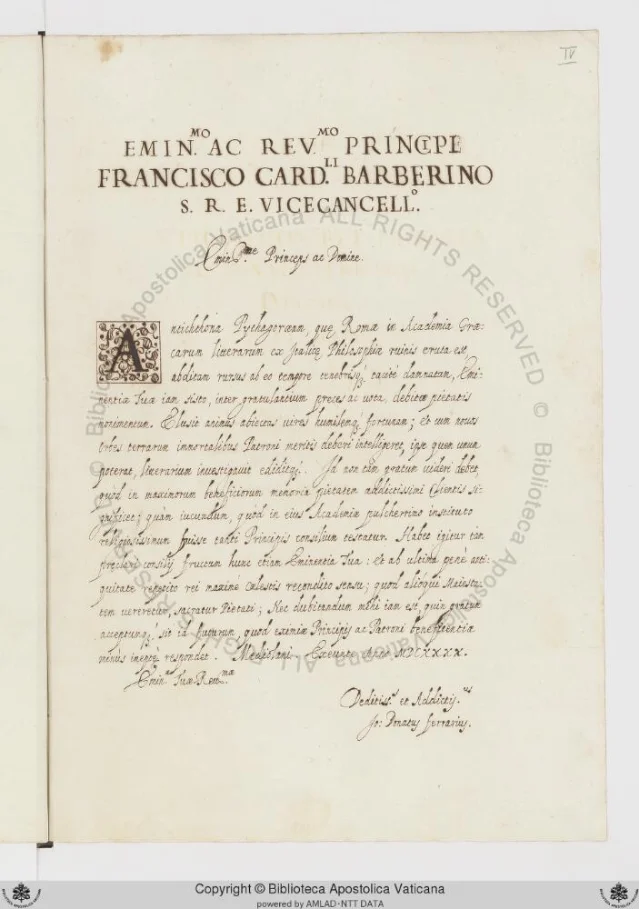
What the manuscript reveals is that Ferrari was connected to something larger: he dedicated Antichthon Pythagoreae to Cardinal Francesco Barberini (1597–1679), nephew of Pope Urban VIII and one of the defining patrons of arts and sciences in 17th-century Rome. 6 The dedication page opens with a formal three-line heading — Emin. ac Rev. Principe / Francisco Card. Barberino / S.R.E. Vicecancell. — and the body of the letter mentions that Ferrari was presenting this work in the context of a "Greek letters academy" in Rome, the Academia Graecarum litterarum, likely a scholarly circle connected to Barberini's patronage network. 1
Barberini was not a casual recipient. He served as Vatican Librarian (Bibliothecarius) from 1626 to 1633, 6 was a member of the Accademia dei Lincei (the same scientific society that enrolled Galileo), and built one of Rome's great private libraries — the Barberiniani Latini collection that now forms the Vatican's largest closed fond, with 11,072 shelfmarks, of which 2,359 have been digitized. 7 A letter from a scholar to Francesco Barberini on the subject of Pythagorean cosmology was not a private eccentricity; it was a bid for membership in Rome's most intellectually ambitious circle.
Dedication page of Barb.lat.2119, f.IVr, addressed to Cardinal Francesco Barberini as S.R.E. Vicecancellarius, with a decorated ornamental initial A opening the text and Ferrari's hand-signed subscription at the bottom
Folio IVr: the formal dedication to Cardinal Barberini, with an ornate woodblock-printed initial A and Ferrari's own signature closing the letter — Jo. Donatus Ferrarius — dated 1630. 2

Thirteen folios and a closing line from Horace

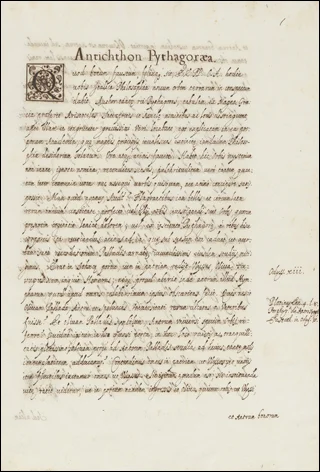
The manuscript itself is compact: 13 folios of main text (ff. 1r–13v), preceded by six preliminary folios including the dedication, and followed by three post-text folios. 8 The script is a flowing 17th-century Italian cursive, confident and legible, with marginal annotations visible in places. The first folio of the main text opens with the large heading Antrichthon Pythagoræ (note the spelling variant) followed immediately by a decorated initial Q, and the text runs in a single column of dense italic hand across pages measured at roughly 1,922 × 2,730 pixels in the digitized images. 8
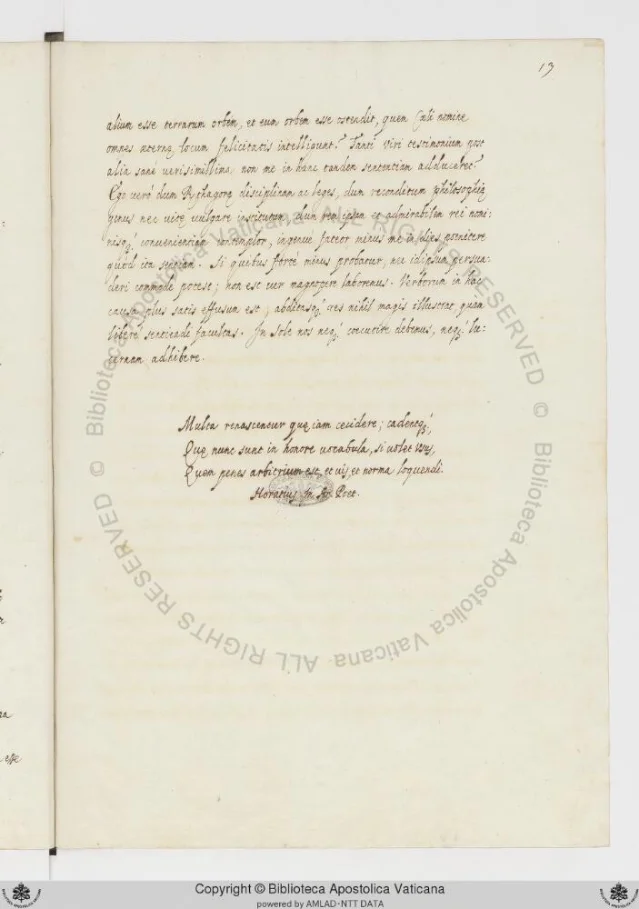
The treatise closes on folio 13r with a half-page of text followed by a quoted verse in a cleaner, slightly more formal hand — four lines from Horace's Ars Poetica, set off from the main argument:
Multa renascentur quæ iam cecidere, cadentque Quæ nunc sunt in honore vocabula, si volet usus, Quem penes arbitrium est et ius et norma loquendi. Horatius in Art. Poet.
"Many words that have fallen will be reborn, and many now in honor will fall, if usage so wills it — for usage holds the power, the right, and the rule of speech." The choice of quotation is telling: a humanist scholar arguing for a cosmology that mainstream philosophy had abandoned for two thousand years, signing off with Horace's reminder that ideas fall in and out of fashion by the force of convention alone.
Folio 13r of Barb.lat.2119: the final page of Ferrari's treatise, with the closing lines of his argument followed by the four quoted verses from Horace's Ars Poetica in a slightly more formal hand, and the lower half of the page left blank
Folio 13r: Ferrari's argument ends mid-page, the Horace verses follow in a more deliberate hand, and then the leaf falls silent. 8
The page then falls quiet. The lower half of folio 13r is blank. The argument, apparently, was complete.

Reading it today

Barb.lat.2119 was digitized as part of the Vatican Library's Week 22 batch of 2026 (released around June 2, 2026), one of eleven Barberiniani Latini manuscripts in a ninety-manuscript release. 1 The DigiVatLib catalog entry for this manuscript carries only a shelfmark notation and no structured bibliographic metadata, meaning the intellectual content of Barb.lat.2119 is presently recoverable only from the images themselves. 2
The full sequence of 54 canvases is open now at DigiVatLib — Barb.lat.2119. Begin with the cover page for the hand-written title in its original form, flip to folio IVr for the decorated dedication letter, and find folio 1r where the argument begins. If you want to browse at tile level, the IIIF manifest at digi.vatlib.it/iiif/MSS_Barb.lat.2119/manifest.json gives direct access to each canvas. 8
Two thousand years after Philolaus first posited a hidden twin to our world, someone in 1630 Rome thought the idea still worth thirteen folios and a cardinal's attention. Now anyone can read the argument for themselves.
Cover image: title page of Barb.lat.2119 showing the hand-written heading "Antrichthon Pythagoræ" with a decorated initial Q and the opening lines of the treatise. Biblioteca Apostolica Vaticana / DigiVatLib

このコンテンツについて、さらに観点や背景を補足しましょう。

  • ログインするとコメントできます。