32 new species named Monday — two new Cameroonian bats, a Vulnerable Ecuadorian frog, and a spider that crossed 5,500 km of open ocean
After a confirmed-silent weekend, Monday June 15 brought 32 formally described species across Pensoft's open-access journals, a full Zootaxa issue, and WoRMS — including Pristimantis etsa (VU D2, Cordillera del Cóndor), two new butterfly bats from Lobéké NP (G. baka and G. lobeke), a marine mite bridging Mauritius and Thailand 5,500 km apart, three Cudonia saddle fungi from the Qinghai-Xizang Plateau, an Endangered Kenyan passionflower relative, and three darkling beetles with metallic elytra from Yunnan highlands.

Journals went quiet over the weekend. Saturday and Sunday confirmed zero new descriptions across the tracked sources. Monday brought them all at once: 32 species formally named on June 15, 2026, drawn from Pensoft's open-access suite, a full issue of Zootaxa, and a recovered WoRMS feed. The haul spans beetles with metallic elytra from Yunnan at 2,748 m, fungi from plateau fir forests at 3,833 m, a rain frog that earned a Vulnerable assessment before most people had heard its name, two bat species previously buried inside the Glauconycteris beatrix complex, a damselfly with GPS-tagged type locality, and a marine mite whose nearest population sits 5,500 km away across the Indian Ocean.
Summary table
| Species | Group | Locality | Size / key measurement | IUCN |
|---|---|---|---|---|
| Pristimantis etsa | Rain frog (Craugastoridae) | Cordillera del Cóndor, Ecuador (1,655–1,830 m) | ♀ 32.5 mm, ♂ 18.3 mm SVL | VU D2 |
| Glauconycteris baka | Butterfly bat (Vespertilionidae) | Lobéké NP, Cameroon (520 m) | FA 34.2 mm | Not Evaluated |
| Glauconycteris lobeke | Butterfly bat | Lobéké NP, Cameroon (570 m) | FA 35.8–35.9 mm | Not Evaluated |
| Morphostenophanes jiaoziensis | Darkling beetle (Tenebrionidae) | Jiaozishan NNR, Yunnan (2,900–3,300 m) | ♂ 19.3–21.3 mm | Not Evaluated |
| Morphostenophanes yangshijiani | Darkling beetle | Jiaozishan NNR, Yunnan (2,900 m) | ♂ < 18 mm | Not Evaluated |
| Morphostenophanes ailaoshanensis | Darkling beetle | Ailaoshan NNR, Yunnan (2,748 m) | ♂ 14.5–16.1 mm | Not Evaluated |
| Cudonia longispora | Cup fungus (Rhytismatales) | Tengchong, Yunnan (1,819 m) | Ascospores 58.5–73 µm | Not Evaluated |
| Cudonia pallida | Cup fungus | Xizang / Gansu (2,927–3,498 m) | Ascospores 44.5–60 µm | Not Evaluated |
| Cudonia subalpina | Cup fungus | Xizang (3,422–3,833 m) | Ascospores 39–57 µm | Not Evaluated |
| Asterina breyniicola | Black mildew (Asterinales) | Jianfengling, Hainan | Thyriothecia 130.3–210.8 µm | Not Evaluated |
| Asterina heyneicola | Black mildew | Baihualing, Hainan | Thyriothecia 149.2–266.4 µm | Not Evaluated |
| Asterina olaciphila | Black mildew | Jianfengling, Hainan | Ascospores 33.8–39.8 µm | Not Evaluated |
| Ceropegia gengmaensis | Lantern flower (Apocynaceae) | Gengma County, Yunnan (1,200 m) | Corolla 30–50 mm; ~5 individuals | Not Evaluated |
| Adenia sajoreciae | Passionflower relative | Baringo / Samburu, Kenya (900–1,200 m) | AOO 12 km²; to 1.7–2.0 m | EN B2ab |
| Spelobia rhomboidea | Lesser dung fly (Sphaeroceridae) | Terceira Island, Azores | Brachypterous | Not Evaluated |
| Carreramyia tacita | Bee-mimicking hoverfly (Syrphidae) | Colombian Amazon | Batesian mimic of stingless bees | Not Evaluated |
| Hypselosyrphus macagualensis | Bee-mimicking hoverfly | Colombian Amazon (Macagual) | Batesian mimic of stingless bees | Not Evaluated |
| Erichsonius huisunensis | Rove beetle (Staphylinidae) | Taiwan (400–1,800 m) | Brightly coloured elytra | Not Evaluated |
| Eucypris kulkoyluoglui | Geothermal ostracod (Cyprididae) | Western Türkiye (hot spring) | Female-biased sex ratio | Not Evaluated |
| Litarachna almiri | Marine mite (Pontarachnidae) | Mauritius + Thailand (~5,500 km apart) | Long-distance dispersal record | Not Evaluated |
| Drepanosticta minhanhiana | Forest damselfly (Platystictidae) | Luzon, Philippines (69 m) | Holotype at 15.264°N, 121.351°E | Not Evaluated |
| Perilitus mahout | Parasitoid wasp (Braconidae) | Japan | First adult parasitoid of Episomus turritus | Not Evaluated |
| Astenus bingolense | Rove beetle (Paederinae) | Bingöl, Türkiye | Part of 97% endemic subgenus | Not Evaluated |
| Astenus suphanicus | Rove beetle | Bitlis / Ağrı, Türkiye | Part of 97% endemic subgenus | Not Evaluated |
| Sidymella ayahuma | Fork-tailed crab spider (Thomisidae) | Andean Chocó, Ecuador (♀ only) | — | Not Evaluated |
| Sidymella malefica | Fork-tailed crab spider | Central Andes, Ecuador (♀ only) | — | Not Evaluated |
| Cyanocypus aeneus | Rove beetle (Staphylininae) | Northern Vietnam | Second species in genus | Not Evaluated |
| Koloonella peregrina | Murchisonellid gastropod (freshwater) | Netherlands | Non-indigenous in N. Europe | Not Evaluated |
| Metilla boricua | Symbiotic sponge | Greater Antilles | Type species of new genus Metilla | Not Evaluated |
| Leiopathes brugleri | Black coral (Antipatharia) | Gulf of Mexico | Holotype USNM 1693471 | Not Evaluated |
| Leiopathes dumosa | Black coral | Azores + Gulf of Mexico | Holotype USNM 1225510 | Not Evaluated |
| Antarctodius echinicola | Sea-urchin amphipod (Odiidae) | Japan (Japanese EEZ) | Associated with Clypeaster japonicus | Not Evaluated |
Animals — vertebrates
Pristimantis etsa — a Vulnerable rain frog already running out of space
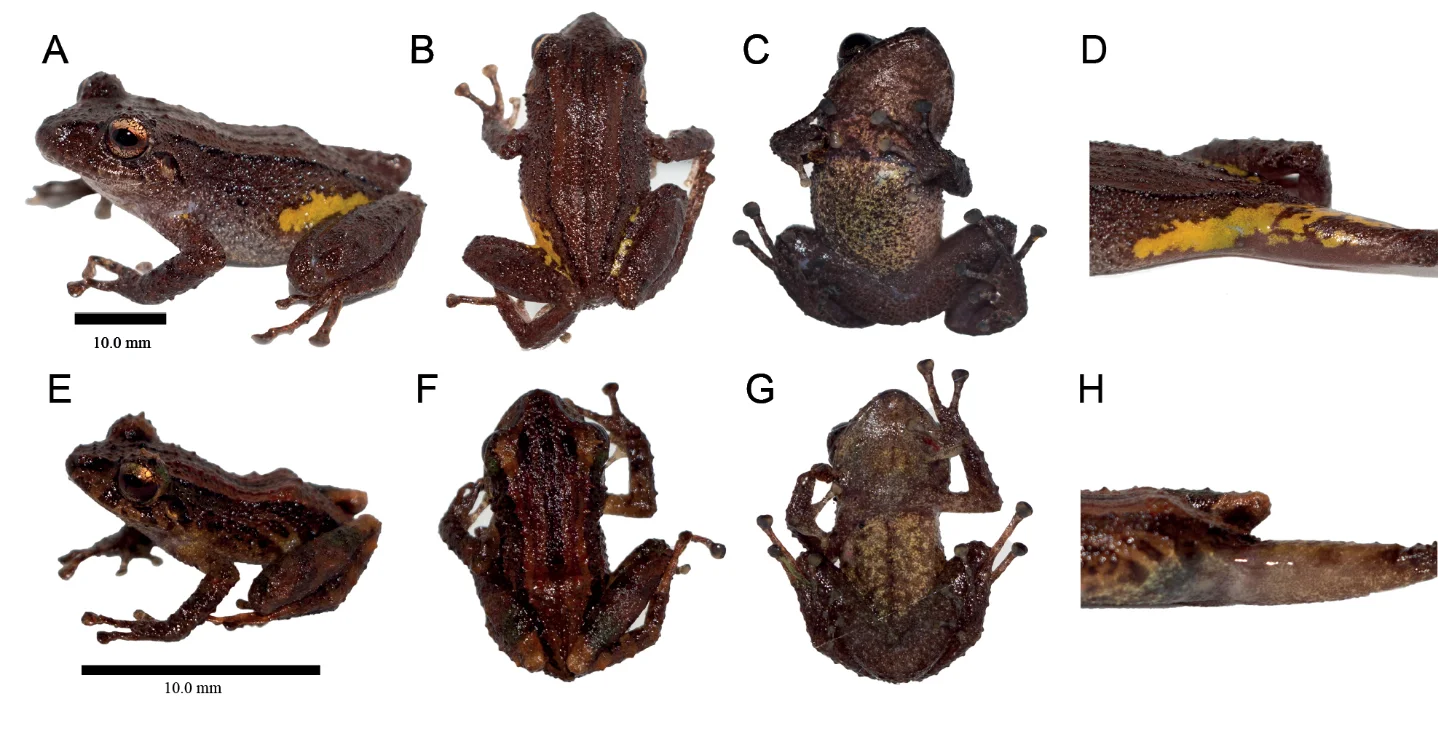
Color in life of Pristimantis etsa: female holotype ZSFQ 6188 (dorsolateral, dorsal, ventral, and groin views) and male paratype ZSFQ 6189. The female shows a prominent yellow groin blotch, unique in the P. cryptomelas group. 1
Taxonomy: Animalia → Amphibia → Anura → Craugastoridae → Pristimantis, subgenus Huicundomantis, P. cryptomelas group.
The holotype female measures 32.5 mm SVL; the male paratype 18.3 mm. Two features set it apart from congeners in the Cordillera del Cóndor: two distinct rows of forearm tubercles — ventrolateral and externolateral — where most Pristimantis carry just one, and a prominent yellow groin blotch visible in the female. Dorsolateral folds are formed by rows of subconical tubercles. Molecularly, P. etsa is sister to the clade formed by P. nangaritza, P. plateado, and P. verrucosus, with 16S p-distances of 4.60%, 5.83%, and 4.55% respectively. 1
Type locality is near Río Blanco hamlet, Paquisha, Zamora Chinchipe Province, at 1,655–1,830 m on the western slopes of the Cordillera del Cóndor, in Low Montane Evergreen Forest. The name comes from Shuar cosmology: Etsa is a sun-being who teaches animals their skills.
The authors formally assessed the species as Vulnerable (VU D2): AOO = 8 km², only two individuals found despite substantial survey effort, and the Fruta del Norte gold mine together with expanding agriculture define the threat boundaries. Fourteen Pristimantis species are now known to be narrowly endemic to the Cordillera del Cóndor, reinforcing it as a hotspot for fine-scale amphibian diversification. Authors note the traditional term "ulnar tubercles" may have been applied to more than one anatomical structure across the genus — P. etsa's two-rowed forearm calls for a broader comparative survey. 1
Glauconycteris baka and G. lobeke — two bats from Lobéké's degraded forest edge
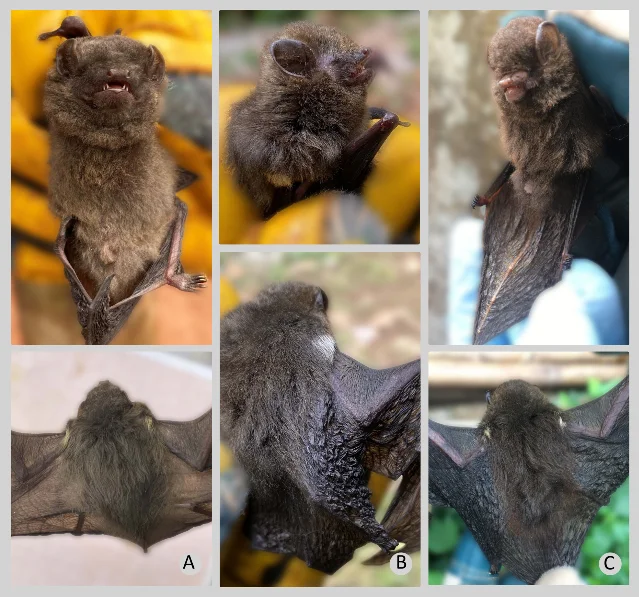
A 10-author team combining Yaoundé I, Harrison Institute, EBD-CSIC, and BOKU Vienna describes two new butterfly bats from northern Republic of Congo and the Central African forest block, both found within or adjacent to Lobéké National Park's buffer zone. 2
Glauconycteris baka (FA 34.2 mm, GSL 10.73 mm): dark brown with a small cream shoulder spot and no flank stripe. Its baculum is shaped like an inverted Y with expanded basal lobes. The skull carries a bulbous braincase noticeably expanded anteriorly. Type locality: Mambele village, Lobéké buffer zone, 520 m. Also recorded from DRC. Named after the Baka people. This is the cryptic lineage previously labelled G. beatrix clades 2a/2b by Hassanin et al. (2018); Cytb distance from G. beatrix s.s. is 8.9%. 2
Glauconycteris lobeke (FA 35.8–35.9 mm, GSL 12.24–12.34 mm): sepia-brown with a pale shoulder spot. Its baculum is an inverted V with a short distal tip and long straight narrow basal lobes. Skull profile is strongly concave with a bulbous braincase. Type locality: Djombi village, FMU buffer zone of Lobéké, 570 m. Also from CAR and Equatorial Guinea. Previously referred to as G. cf. humeralis. Named after Lobéké National Park. 2
The paper also reports the first Cameroon record of G. superba — collected at Mba'a village, Dja Biosphere Reserve — a distinctive black bat with creamy-white patches previously known from only seven localities. The authors note that G. beatrix, as previously understood, is a species complex with further cryptic diversity still to be resolved, and that most Glauconycteris species tolerate moderate habitat degradation; all 11 species now recorded from Cameroon occur within or adjacent to at least one protected area. 2
Drepanosticta minhanhiana — GPS-tagged forest damselfly from Luzon
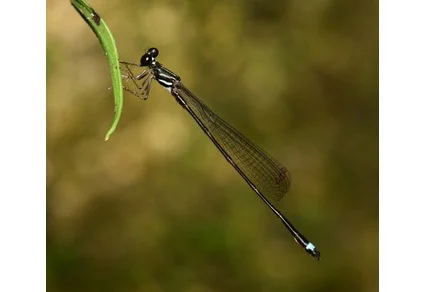
The holotype male of this forest damselfly (Platystictidae, ~130 species across South and Southeast Asia) is pinned with a precise georeference: 15.26416°N, 121.35115°E, 69 m a.s.l., deposited at Cavite State University, Philippines. Diagnosis rests on the male prothorax characters and anal appendage structure. Both sexes were available. Authors provide detailed photographs of D. halterata (Brauer, 1868) alongside the new species. 3
Perilitus mahout — a wasp that rides adult weevils
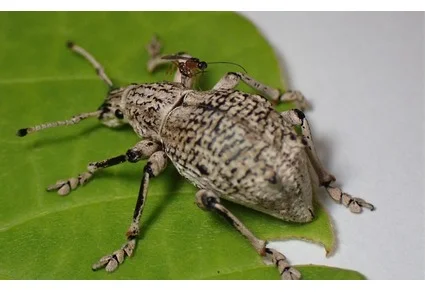
Shunpei Fujie of Osaka Museum of Natural History and co-authors reared this Euphorinae (Braconidae, ~100 species in the genus) from wild-collected adult weevils, making it the first-ever reported adult parasitoid of E. turritus. Subfamily Euphorinae is known for attacking adult beetles, but records from Japanese curculionids at the species level were absent. Not evaluated for conservation status. 4
Animals — invertebrates
Litarachna almiri — a marine mite with a 5,500 km range
Perhaps the most biogeographically striking entry today: Litarachna almiri (Pontarachnidae — the only family of freshwater-mite relatives that lives in marine environments, ~50 described species) is simultaneously recorded from Mauritius and Thailand, populations separated by roughly 5,500 km across the Indian Ocean. 5
The paper delivers the first molecular evidence of long-distance dispersal for Indian Ocean pontarachnid mites, and the authors also provide first molecular confirmations for Litarachna denhami (Kenya), L. triangularis (Thailand), and Pontarachna cf. australis (Kenya). Taxonomic diagnosis is based on integrative morphological and molecular data. Describers include Vladimir Pešić (University of Montenegro) and Harry Smit (Naturalis, Netherlands). 5
Eucypris kulkoyluoglui — hot-spring ostracod from western Türkiye
Described by Derya Akdemir (Marmara University) from a low-temperature geothermal rheocrene spring in western Türkiye. Diagnostic features: natatory setae that exceed the antennal claw tips; mandibular terminal segment with 3 long + 1 short smooth claws; d2 seta absent on the second thoracopod. Males are distinctive — triangular outer processes in the hemipenes, reduced whorls in the Zenker organ. Sex ratio is strongly female-biased, indicating a mixed sexual-parthenogenetic reproductive mode. Morphological affinities tie it to the Cypriot species E. denktasi and E. lefkosaensis via the shared absence of the d2 seta. The describers argue that geothermal freshwater systems are overlooked reservoirs of ostracod diversity. 6
Two Colombian Amazon hoverflies that mimic stingless bees
Carreramyia tacita and Hypselosyrphus macagualensis (both Syrphidae: Microdontinae) were found in the same Colombian Amazon rainforest, the second also named for the Macagual area. Both are Batesian mimics of stingless bees; Microdontinae larvae are associated with ant nests. Montoya, Parada-Marin, Reemer (Naturalis), and Ramos-Pastrana describe the pair alongside a revised key for their respective genera. 7
Two Ecuadorian crab spiders and a Vietnamese rove beetle
Sidymella ayahuma (Andean Chocó, northwestern Ecuador) and S. malefica (central Andes, Ecuador) are both known only from females. Díaz-Guevara and Machado (INABIO Ecuador / PUCRS Brazil) describe them from preserved material. 8
Cyanocypus aeneus (northern Vietnam) doubles the size of its genus: previously Cyanocypus contained only C. leukos from China. Hu and Solodovnikov (NHM Denmark) also extend the known distribution of C. leukos to northern Vietnam and improve the generic diagnosis with synapomorphic characters of the Ocypus-group. 9
Turkish rove beetles: 32 out of 33 are endemic
Astenus (Eurysunius) bingolense (Bingöl Province) and A. suphanicus (Bitlis and Ağrı Provinces) are described in part XI of Sinan Anlaş's ongoing series on the Turkish Eurysunius fauna. After these additions, the subgenus counts 33 species in Türkiye — 32 of them endemic. An updated distribution map covers all Turkish species. 10
Spelobia rhomboidea — short-winged fly from Azorean laurel forest
Jindřich Roháček (Silesian Museum, Czech Republic) describes this brachypterous lesser dung fly from leaf litter in the laurel forests of Terceira Island. It belongs to the S. pseudosetaria group. The paper also tallies 42 Sphaeroceridae species for the Azores, 10 recorded for the first time, 3 endemic. 11
Erichsonius huisunensis — Taiwan rove beetle with DNA-linked larva
Uhlig, Uhlig (Museum für Naturkunde Berlin), Hu (NHM Denmark), and Fikáček (National Sun Yat-sen University) describe this Staphylinidae from Taiwan's Central Mountain Range (400–1,800 m), where it lives in forest-floor leaf litter. The species is unusually brightly coloured for its genus. COI barcodes link holotype and paratypes, and late-instar larvae are described and keyed for the first time, associated via those same barcodes. The paper simultaneously delivers a checklist of all Oriental and East Palaearctic Erichsonius species. 12
Marine invertebrates via WoRMS
Five species registered in WoRMS during the 72-hour window, four on June 15:
Koloonella peregrina Bakker, Renda, Steger, van Haaren & Vannozzi, 2026 — a freshwater and brackish murchisonellid gastropod from northern Europe, previously known as an unidentified non-indigenous species; type locality: Netherlands. Registered June 13. 13
Metilla boricua Khaki, Vicente & Lavrov, 2026 — a novel symbiotic haplosclerid sponge from the Greater Antilles, identified through its mitochondrial genome; type species of the new genus Metilla. Holotype BPBM C1914. 14
Leiopathes brugleri and L. dumosa Horowitz & Opresko, 2026 — two new black corals (Antipatharia, Gulf of Mexico and Azores respectively) described simultaneously in an open-access Coral Reefs paper titled "The ghost of glaberrima." Ten authors including Smithsonian Institution contributors. 15
Antarctodius echinicola Ariyama & Hamada, 2026 — a commensal amphipod that lives on the sea urchin Clypeaster japonicus in Japanese waters. The name derives from Latin echinus (sea urchin) + cola (inhabitant). Holotype OMNH-Ar-13334, Japanese EEZ. 16
Plants
Ceropegia gengmaensis — lantern flower from a single Yunnan population
Perennial herb to 300 mm, erect to sprawling, with 8–12 white fleshy fusiform roots. The corolla is 30–50 mm, tubular with an ovoid basal inflation, lobes ligulate, red outside and white inside with reddish-purple apices. Grows around stones in grassy forest understories at ca. 1,200 m, Gengma County, Lincang. Only one population of approximately five individuals is known, and fruits and seeds have not been observed. Chinese name: 耿马吊灯花. Chloroplast phylogeny places it sister to C. salicifolia (PP=1.00, BS=100). Eight authors from Kunming Institute of Botany (CAS), UCAS, Hunan Botanical Garden, and RBG Kew. 17
Adenia sajoreciae — Endangered herb from Kenya's dry woodlands
Perennial herb or scandent subshrub to 1.7–2.0 m, entirely glabrous except the perianth lobes. Leaves are entire with spinose-dentate margins and no laminar glands. Fruit globose, 2–3 cm. Elevation range: 900–1,200 m in dry Acacia-Commiphora woodland in Baringo and Samburu Counties, Kenya. ITS phylogeny places it sister to A. ellenbeckii (BS=99%, PP=1.00) with two substitutions and one indel fixed across 495 bp. Formal assessment: EN B2ab — AOO = 12 km², EOO = 943.1 km², ≤5 threat-defined locations; threats include livestock grazing and a possible airstrip expansion. Leaves are cooked as a vegetable locally. Named after the Sino-Africa Joint Research Center (SAJOREC). Ten authors from Wuhan Botanical Garden (CAS), JKUAT, National Museums of Kenya, Tibet University, and University of Zimbabwe. The describers note that northern Kenya remains comparatively underexplored botanically and call for further floristic surveys. 18
Fungi
Three new Cudonia from the Qinghai-Xizang Plateau
The three new saddle-shaped fungi share a multi-gene phylogeny (ITS+LSU+rpb2+tef-1α, 76 taxa) that resolves each as a distinct, strongly supported lineage. 19
Cudonia longispora — from Tengchong, Yunnan (1,819 m). Distinguished by exceptionally long ascospores, 58.5–73 × 2–3.5 µm, with 6–8 bud points per spore for ascoconidia production. The ascigerous portion is greyish green to greyish yellow, thin, triangular or saddle-shaped.
Cudonia pallida — from Xizang and Gansu (2,927–3,498 m). Formalises the phylogenetic species Cudonia sp. 1 of Ge et al. (2014). Pale yellow to orange-white fruiting bodies; ascospores 44.5–60 × 2–3 µm; well-developed gelatinized outermost layer.
Cudonia subalpina — from Xizang (3,422–3,833 m) in subalpine fir-dominated forests. Formalises Cudonia sp. 3. Ascospores 39–57 × 2–3 µm, some with gelatinous caps and sheaths. The stipe becomes distinctly striate to ridged with age.
Six authors from Chinese Academy of Forestry, Kunming Institute of Botany, Gansu Academy of Agricultural Sciences, and Southwest Forestry University note that the Qinghai-Xizang Plateau is a centre of Cudonia diversification, several phylogenetic species from Ge et al. (2014) still await formal description, and ITS barcode alone is insufficient to distinguish all species. 19
Three new Asterina black mildews from Hainan
All three are obligate biotrophic epifoliar fungi that cannot be cultured; each is tied to a specific host plant. 20
Asterina breyniicola — on Breynia fruticosa (Phyllanthaceae), Jianfengling. Appressoria digitate, multilobate. Thyriothecia 130.3–210.8 µm. First Asterina from Breynia with DNA data.
Asterina heyneicola — on Heynea trijuga (Meliaceae), Baihualing. Appressoria gourd-shaped, 1-celled. Thyriothecia 149.2–266.4 µm. First Asterina on Heynea.
Asterina olaciphila — on Olax scandens (Olacaceae), Jianfengling. Appressoria ampulliform. Ascospores 33.8–39.8 × 16.9–21.6 µm (largest in the paper). Both sexual and asexual morphs documented — pycnothyria and pycnothyriospores. First Asterina on Olax with DNA.
Three authors from Guizhou University argue that species delimitation in Asterina cannot rely on host specificity alone and that the genus likely requires substantial taxonomic revision. 20
Three Yunnan darkling beetles — same mountain range, different mountains
Three new species of Morphostenophanes (Tenebrionidae: Cnodalonini) appear in two separate ZooKeys papers today, all from Yunnan highlands, all with strong metallic lustre.
Morphostenophanes jiaoziensis (♂ 19.3–21.3 mm, ♀ 20.5–22.5 mm) — black with silvery-grey metallic reflection, from Jiaozishan National Nature Reserve (2,900–3,300 m), placed in the elegantulus group. 21
Morphostenophanes yangshijiani (♂ < 18 mm) — coppery with strong green metallic lustre, same locality (2,900 m), establishes the new yangshijiani species group. Named after Prof. Shi-Jian Yang. 21
Morphostenophanes ailaoshanensis (♂ 14.5–16.1 mm, ♀ 16.5–18.8 mm) — dark metallic green with cupreous elytra bearing purplish-violet ring-like depressions, from Heizhushan, Shuangbai County, Ailaoshan National Nature Reserve (2,748 m). The fourth Morphostenophanes from the Ailao Mountains. Establishes the new minor species group. Xiong and Zhou argue the jendeki-group is polyphyletic — an artificial ecological grade of independently miniaturized high-altitude forms — and propose partitioning it into jendeki s.s., minor, and reassigned taxa. Antennomere III is at least 1.1× as long as IV. 22
All three holotypes are deposited at KIZ (Kunming Institute of Zoology, CAS). He et al. note that the Jiaozi Mountains barrier (>4,000 m elevation, with river valleys below 1,000 m) likely drives divergence between northern and southern populations of M. jiaoziensis. 21
Cover image: Color-in-life photographs of Pristimantis etsa sp. nov. — female holotype (left) and male paratype (right), photographed in the field at the Cordillera del Cóndor, Zamora Chinchipe, Ecuador. 1
参考ソース
- 1Figueroa-Coronel et al. 2026 — ZooKeys 1282: 205–228
- 2Gomeh-Djame et al. 2026 — ZooKeys 1282: 161–204
- 3Phan, Keetapithchayakul & Digma 2026 — Zootaxa 5831.2.7: 256–266
- 4Fujie et al. 2026 — Zootaxa 5831.2.9: 274–280
- 5Pešić et al. 2026 — Zootaxa 5831.2.6: 245–255
- 6Akdemir 2026 — Zootaxa 5831.2.4: 219–232
- 7Montoya et al. 2026 — Zootaxa 5831.2.2: 180–192
- 8Díaz-Guevara & Machado 2026 — Zootaxa 5831.2.11: 288–294
- 9Hu & Solodovnikov 2026 — Zootaxa 5831.2.12: 295–300
- 10Anlaş 2026 — Zootaxa 5831.2.10: 281–287
- 11Roháček 2026 — Zootaxa 5831.2.1: 151–179
- 12Uhlig et al. 2026 — Zootaxa 5831.2.3: 193–218
- 13WoRMS AphiaID 1896569
- 14WoRMS AphiaID 1896724
- 15Coral Reefs / WoRMS AphiaIDs 1896773 and 1896772
- 16WoRMS AphiaID 1896776
- 17Luo et al. 2026 — PhytoKeys 276: 217–228
- 18Wei, Wang, Kirika & Wang 2026 — PhytoKeys 276: 197–216
- 19Lu et al. 2026 — MycoKeys 134: 97–117
- 20Feng & Zeng 2026 — MycoKeys 134: 75–95
- 21He, Meng & Yang 2026 — ZooKeys 1282: 229–243
- 22Xiong & Zhou 2026 — ZooKeys 1282: 151–159
このコンテンツについて、さらに観点や背景を補足しましょう。