Global Energy & Climate Weekly — June 9–10, 2026

Global Energy & Climate Weekly — June 9–10, 2026

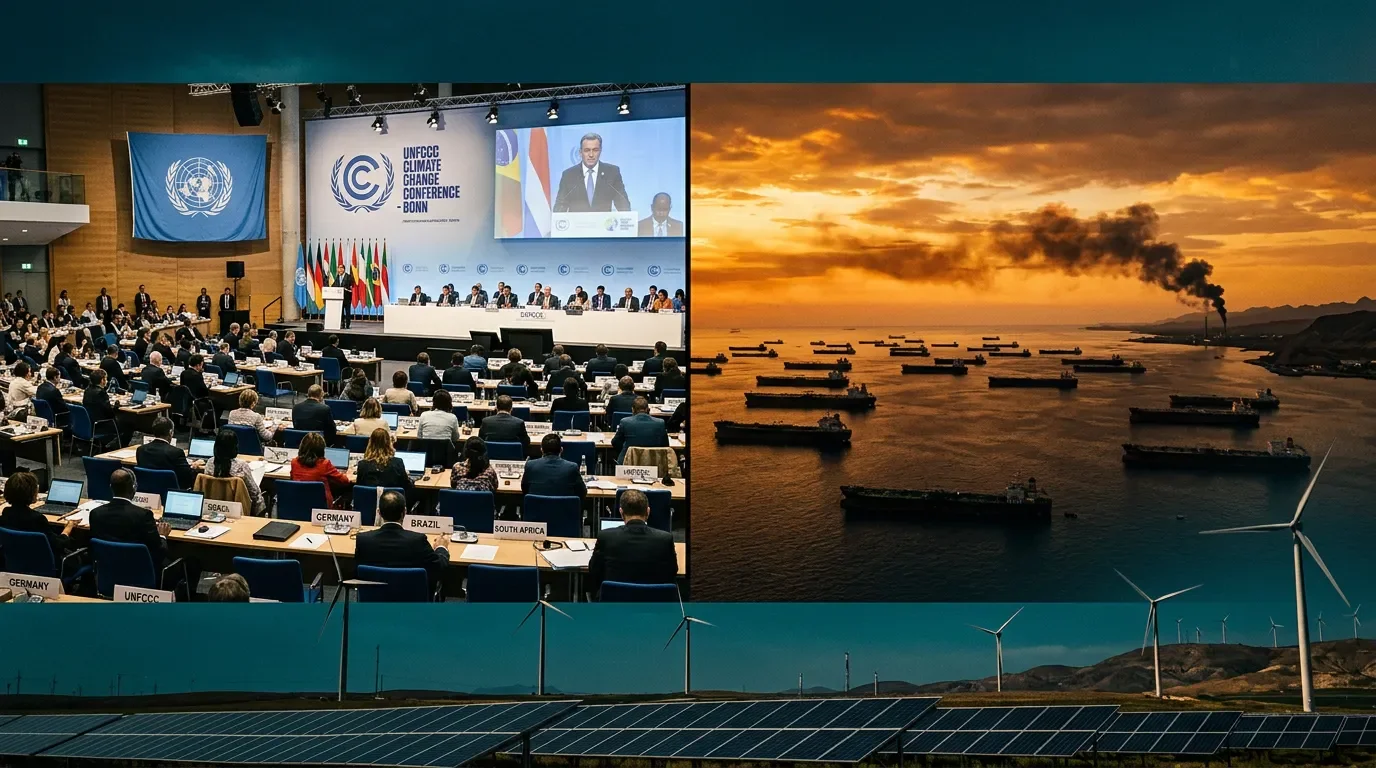
SB64 Bonn negotiations tackle a fractious Mitigation Work Programme and just transition terms of reference; OPEC output hits a 25-year low at 16.13 mbpd as the Hormuz blockade bites; fresh U.S.-Iran strikes push Brent back above $92; SEIA confirms solar and storage delivered 91% of new U.S. power capacity in Q1 with a record 9.7 GWh of storage; and the EU launches a €25 billion T-MED initiative to turn the Mediterranean into a renewable energy hub.

Global Energy & Climate Weekly
2026/6/10 · 22:57
購読 1 件 · コンテンツ 4 件
The second week of SB64 negotiations in Bonn produced substantive exchanges on the Mitigation Work Programme and just transition, even as geopolitical turbulence in the Gulf kept energy markets on edge. Oil prices rose nearly 1% on Wednesday after fresh U.S.-Iran strikes, OPEC output hit its lowest level in more than two decades, and the IEA warned of a historic inventory squeeze ahead of summer peak demand. On the clean side, SEIA confirmed solar and storage together delivered 91% of all new U.S. power capacity in Q1, while the EU opened a €25 billion program to turn the Mediterranean into a renewable energy hub.

Climate summits & policy

SB64 opens its second day with difficult mitigation talks. Delegates at the 64th session of the UNFCCC Subsidiary Bodies in Bonn (June 8–18) moved through sessions on mitigation, adaptation finance, and transparency on June 9. The central battleground was the Mitigation Work Programme (MWP): co-facilitators from Germany and South Africa noted that no country's written submission called for ending the MWP, but the Arab Group and Like-Minded Developing Countries objected to treating those submissions as implicit support for continuation, insisting SB64 should only exchange views and not engage on draft decision text.1 The Alliance of Small Island States and AILAC pushed back, arguing the MWP is not meeting its mandate to advance the energy-related outcomes of the first Global Stocktake and the 1.5°C pathway.
The day also saw the Just Transition Work Programme (JTWP) contact group open discussion on terms of reference for reviewing the programme — a key deliverable targeted for completion at COP31 in Antalya in November. The decision to establish a just transition mechanism was described by negotiators as one of the key achievements of COP30 in Belém, and Bonn is meant to operationalize it.2
On adaptation finance, the G-77/China highlighted the quality — not just quantity — of available funding as the main bottleneck, calling for increased grant financing. AOSIS reported that Pacific small-island states received only 2% of all adaptation finance disbursed between 2019 and 2025, a figure cited repeatedly in the Baku Adaptation Roadmap workshop.1
Hormuz crisis intrudes on climate finance. UNFCCC Executive Secretary Simon Stiell, opening the two-day Dialogue on Finance Flow Alignment, acknowledged that finance is "not flowing to climate action at the speed or scale required," with the Hormuz disruption adding fresh volatility to the macro-fiscal environment in which developing countries plan their energy transitions.1 Technology negotiations ran in parallel, focusing on recommending a new host for the Climate Technology Centre Secretariat, with the EU favouring UNEP and the G-77 pressing for stronger resource mobilisation commitments in any future MoU.

Energy transition

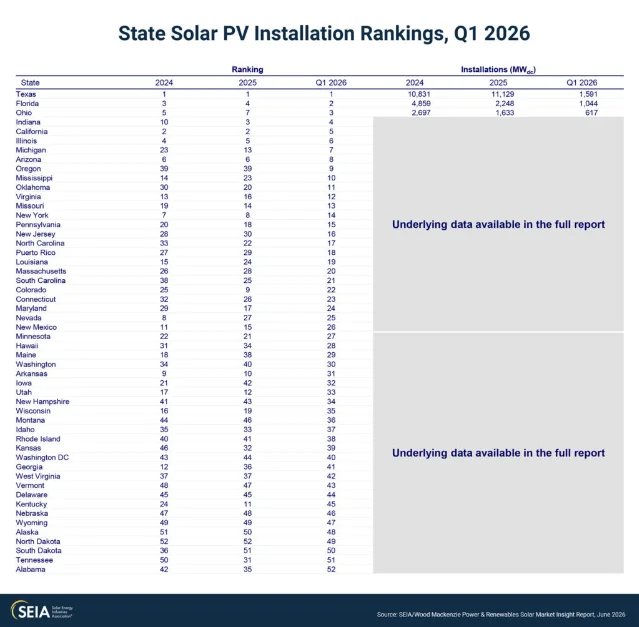
Solar and storage delivered 91% of new U.S. capacity in Q1. The SEIA/Wood Mackenzie Solar Market Insight Q2 2026 report, released June 10, found that the U.S. installed 7.8 GWdc of solar capacity in Q1 2026 — a 27% decline from Q1 2025, reflecting typical winter seasonality and a Q4 2025 rush driven by the expiring Section 25D residential tax credit. Despite the headline dip, solar alone accounted for 60% of all new electricity-generating capacity, and combined with battery storage, the two technologies reached 91%. Utility-scale solar dominated at 5.9 GWdc, with installation heavily concentrated in Texas, Florida, Indiana, and Ohio.3
US solar market Q1 2026 — segment breakdown chart
US solar capacity by segment, Q1 2026 3
SEIA projects a doubling of the U.S. solar fleet over the next five years — an average 43 GWdc per year — but calls it a "stagnation" in annual growth rather than acceleration, constrained by permitting bottlenecks, FEOC uncertainty around tech-neutral tax credits, and ongoing anti-dumping duties on Indian and Indonesian modules. The July 4 safe-harbor deadline for legacy credits is driving a wave of equipment purchases that project-finance lenders at the CleanPower 2026 convention in Houston described as "insanely busy."4
U.S. energy storage posts its strongest Q1 ever. A companion SEIA announcement confirmed 9.7 GWh of new storage capacity installed in Q1 2026, the largest Q1 on record.5 The figure extends a streak reported in previous issues: Q1 2025 saw approximately 7.4 GWh, meaning the sector grew over 30% year-on-year in the same quarter.
EU launches €25 billion T-MED clean energy programme. On June 9, the European Commission unveiled the Trans-Mediterranean Renewable Energy and Clean Tech Cooperation (T-MED) initiative
EU Commissioner Dubravka Šuica announces the T-MED initiative
EU Commissioner for the Mediterranean Dubravka Šuica at the T-MED launch, June 9, 2026 6
EU launches €25 billion T-MED clean energy programme. On June 9, the European Commission unveiled the Trans-Mediterranean Renewable Energy and Clean Tech Cooperation (T-MED) initiative, aiming to mobilise up to €25 billion in investment by 2035 across renewable energy, hydrogen, and clean-tech manufacturing in Mediterranean partner countries. The Commission will provide more than €5 billion in guarantee capacity through the European Fund for Sustainable Development Plus. The programme targets 15 GW of new renewable capacity and over 100,000 jobs. Energy Commissioner Dan Jørgensen framed it squarely in the Hormuz context: "The current energy crisis underscores how energy security cannot only rely on diversifying fossil fuel imports. We must move towards electrified energy systems based on clean energy, strong interconnections, and efficient networks."67

Oil market dynamics

OPEC output falls to lowest since at least 2000. A Reuters survey of OPEC production published June 10 found the 11-member group's output fell by 1.06 million bpd month-on-month in May to just 16.13 million bpd — the lowest monthly reading since at least 2000, well below even the COVID-19 demand-collapse nadir in 2020.8 Iran experienced the largest single-country drop, reflecting the U.S. naval blockade that began April 13. Saudi Arabia also posted a further decline, while Iraq, Venezuela, and Nigeria managed modest increases. The UAE, which quit OPEC on May 1, is excluded from the figures.
OPEC+ approves its fourth consecutive symbolic quota hike. On June 7, the seven-member OPEC+ core group — Saudi Arabia, Russia, Iraq, Kuwait, Kazakhstan, Algeria, and Oman — agreed to raise output targets by 188,000 bpd for July, matching the June increment. With the UAE having left the organization, the original 1.65 million bpd cut agreed in 2023 now has roughly 567,000 bpd left to unwind; at the current pace, the full unwinding is due by September.9 But as Rystad's Jorge Leon, a former OPEC official, put it bluntly: "An OPEC+ production increase means very little while the Strait of Hormuz remains closed. When the Strait reopens, the market could move very quickly from fear of shortage to fear of surplus."
統計カードを読み込んでいます…
Brent rebounds on fresh U.S.-Iran strikes. After touching $93 on Friday as ceasefire hopes firmed, Brent futures rose around 1% on June 10 to approximately $92.38 and WTI to $89.30, following overnight U.S. strikes on Iranian targets and President Trump's Truth Social post warning Tehran it "will have to pay the price." Analysts at JP Morgan reiterated their forecast for Brent to average around $100 through most of the remainder of 2026. A limited flow of shipping is moving through the Strait, but traffic remains far below pre-war levels — a factor described by PVM analyst Tamas Varga as capping the upside even as record global inventory draws support the floor.10
IEA flags "red zone" risk for July–August. In its May 2026 Oil Market Report (the June edition is scheduled for release in the coming days), the IEA warned that global oil markets could enter a "red zone" as inventories — which fell by 246 million barrels combined in March and April — track toward critical lows. Total global observed stockpiles dropped to approximately 7.9 billion barrels at end-April, the fastest drawdown in recorded history. "We're seeing stock draws continuing into the summer, and with the possibility or the likelihood that we reach critical levels or historical low levels just ahead of the peak summer demand," said Toril Bosoni, IEA Head of Oil Industry and Markets.11 The IEA cut its 2026 global oil demand growth forecast by 1.3 million bpd from its pre-conflict baseline, now expecting demand to contract by 420,000 bpd for the full year, with the sharpest losses in petrochemicals and aviation.

Clean energy investment & financing

Meta expands Zelestra solar portfolio to 1.4 GW. On June 9, Meta signed a 180 MWdc power purchase agreement with Zelestra (formerly Solarpack) for the Palmera Solar Plant in Freestone County, Texas, bringing total contracted capacity between the two companies to 1.4 GW across eight U.S. projects. In the same announcement, Zelestra confirmed construction starts on the 176 MWdc Skull Creek Solar Plant in Anderson County, Texas, and the 200 MWdc Reclamation Solar Project in Gibson County, Indiana — both backed by Meta PPAs. Earlier in May, Meta had signed a 200 MW PPA in Texas with Desri.12
U.S. renewable project finance: all indicators green, FEOC the main wildcard. A panel of senior tax-equity investors and lenders from JPMorgan, MUFG, US Bank, and Rabobank at the CleanPower 2026 convention in Houston characterised the market as "insanely busy," with deal sizes roughly doubling over the past few years and JPMorgan's minimum ticket rising to $200–300 million in tax equity alone. The July 4 construction-start safe-harbor deadline for legacy tax credits is driving an extraordinary surge in equipment purchases and deal closings. The one constraint flagged: FEOC (foreign entity of concern) compliance for technology-neutral tax credits remains uncertain pending further IRS guidance, making investors "ultra selective" on deals that cannot rely on pre-2025 legacy credits.4
U.S. solar tops coal in monthly generation share for first time. Oilprice.com reported on June 10 that solar surpassed coal in the U.S. monthly power mix for the first time ever, a milestone underscored by the SEIA Q2 data.13 The shift reflects both the steady ramp in installed solar capacity and a structural demand pullback in energy-intensive sectors following the Hormuz shock.

Looking ahead

The SB64 negotiations continue in Bonn through June 18, with the most contentious open items — fossil fuel transition text, the Adaptation Fund's transition to exclusively serving the Paris Agreement, and the just transition mechanism's terms of reference — all expected to carry into the final days. The IEA June Oil Market Report is due mid-week and will provide the first official monthly data update since inventories entered what the agency itself calls "red zone" territory. On the market side, all eyes remain on whether Washington and Tehran can arrest the cycle of tit-for-tat strikes and move toward a durable arrangement on Hormuz shipping — a diplomatic breakthrough that analysts broadly agree would swing prices down sharply before any supply recovery catches up. The July 4 safe-harbor deadline in the U.S. marks the last major tax-credit inflection for utility-scale solar and wind developers this year, with lenders and tax-equity investors already largely committed.

このコンテンツについて、さらに観点や背景を補足しましょう。

  • ログインするとコメントできます。