From One Prompt to a Playable Game: How OpenGame and GPT-5 Are Rewriting the Rules of AI Game Dev
A deep-dive case study on the engineering behind AI-built games: how OpenGame's open-source framework ships six browser games from single prompts using Game Skill and GameCoder-27B, what OpenAI's Codex showcase reveals about GPT-5's game-building loop, and the 10-step indie dev pipeline one solo creator used to ship 10 games in a month with Claude Sonnet 4.

Six web games. One prompt each. No manual coding. That's the headline from OpenGame, an open-source agentic framework released in April 2026 by researchers at CUHK MMLab — and it's not alone. From OpenAI's GPT-5 Codex building a browser FPS in a single session to indie devs shipping 10 games in one month with Claude Sonnet 4, AI models have quietly crossed a line from code-completion tools into full game authors. This case study tears apart exactly how they pull it off.
The Case: OpenGame — A Prompt-to-Playable Pipeline
OpenGame is the clearest engineering statement yet that LLMs can own the full game-dev loop: design, scaffold, code, debug, and ship — all from one natural-language prompt. 1
The project (2.6k GitHub stars within weeks of release) was built by a team of ten researchers from CUHK's MMLab and published alongside an arXiv paper and a benchmark suite.
What Gets Built
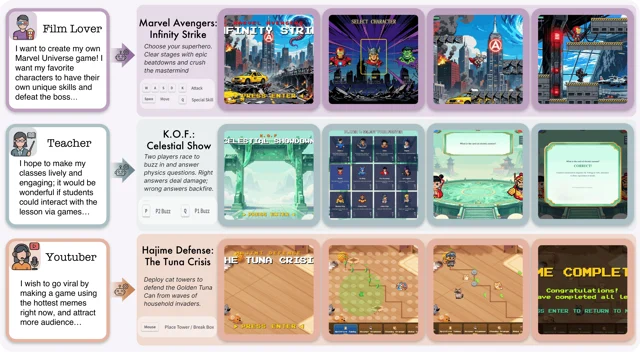
OpenGame targets interactive browser games — the kind that run in a tab, no install required. From their published demo gallery 1:
| Game Title | Prompt Style | Genre | Tech Stack |
|---|---|---|---|
| Marvel Avengers: Infinity Strike | Epic 90s Capcom arcade, 3 heroes, 3 levels, boss | Side-scroll platformer | Phaser + Canvas |
| Harry Potter: Arithmancy Academy | Turn-based card dueling + math trivia combo system | Card battle | Phaser |
| K.O.F: Celestial Showdown | 2-player physics quiz fight, SNK 16-bit style | Local multiplayer | Phaser + Canvas |
| Hajimi Defense | Cat tower defense, kawaii pixel art | Tower defense | Canvas |
| StarWars: Mandalorian Protocol | Twin-stick shooter, twin-stick + jetpack | Top-down RPG shooter | Phaser |
| Squid Game: Red Light, Green Light | Survival reflex, dead bodies don't disappear | Survival reflex | Canvas |
Every one of these shipped from a single prompt — no iterative back-and-forth, no manual patching.
The Core Architecture: Game Skill
The insight OpenGame's paper centers on is that generic coding agents fail at games for a specific reason: cross-file inconsistencies. A standard LLM can write a working
player.js and a working enemy.js, but the moment those two files need to share a state object, the wiring breaks. Scenes go blank. Controls stop responding. The agent patches one bug and introduces another.OpenGame solves this with Game Skill, a two-part reusable capability 1:
- Template Skill — Before writing a single line of game logic, the agent picks an appropriate engine skeleton (Canvas, Phaser, Three.js) and scaffolds a conventional project structure. This locks in import paths, event buses, and state shapes before code generation begins. The agent can't break what it never changed.
- Debug Skill — After generation, the framework runs the game inside a headless browser sandbox, catches
console.erroroutputs and broken interactions, and systematically works through a living protocol of verified fixes. It doesn't patch random syntax bugs — it runs the game and checks whether it's actually playable.
Together these let the model move from "plausible code that looks right" to "game that runs end-to-end."
The Specialized Model: GameCoder-27B
The default backend LLM is GameCoder-27B, a 27-billion-parameter Code LLM trained in three stages specifically for game engine mastery 1:
- Continual Pre-training on game development trajectories — engine APIs, project scaffolding, and bug-fix workflows at scale.
- Supervised Fine-Tuning (SFT) on curated game-dev conversation examples.
- Reinforcement Learning with reward signals derived from real game playability — not code correctness, but whether the game actually renders, accepts inputs, and progresses through game states.
That third stage is the break from convention. Most code LLMs are rewarded for passing unit tests on isolated functions. GameCoder-27B is rewarded for shipping something you can play.
For users who don't have access to GameCoder-27B locally, OpenGame is compatible with any OpenAI-compatible API endpoint — you can swap in GPT-4o, Claude-via-OpenRouter, or any hosted model.
The Build Flow, Step by Step
Here's how a typical OpenGame run unfolds from prompt to browser tab:
# Install
git clone https://github.com/leigest519/OpenGame.git
cd OpenGame && npm install && npm run build && npm link

# Generate a game from one prompt
mkdir -p games/snake-game && cd games/snake-game
opengame -p "Build a Snake clone with WASD controls and a dark theme." --yolo- The agent receives the prompt and selects a Template Skill — for a Snake clone, it picks a Canvas-based template with a clean game-loop structure (
update(),render(),input handler). - Game Skill scaffolds the project:
index.html,game.js,snake.js,food.js, sharedconfig.js. Import paths are locked before generation begins. - The agent populates each file, respecting the shared state contract set up in step 2.
- Debug Skill launches the game headlessly, executes scripted interactions (move snake left, eat food, trigger game-over), and checks for rendering, control response, and win/loss state.
- If checks fail, the agent runs a targeted fix loop — not "rewrite the whole file" but "this specific integration error has a verified fix pattern."
- Output:
index.htmlplus a dev-server command. Open in browser and play.
How to Evaluate It: OpenGame-Bench
The team didn't just ship demos — they built OpenGame-Bench, an evaluation pipeline that scores agentic game generation along three axes 1:
- Build Health — Does the game compile and launch without errors?
- Visual Usability — Does it render game elements correctly? Is the UI navigable?
- Intent Alignment — Does the final game match what the prompt asked for?
Scoring runs headless: the pipeline launches the generated game, drives it with scripted browser interactions, and calls a Vision-Language Model to judge visual criteria. Across 150 diverse game prompts, OpenGame establishes a new state-of-the-art on all three axes among publicly available agents.
What OpenAI's Codex Showcase Shows
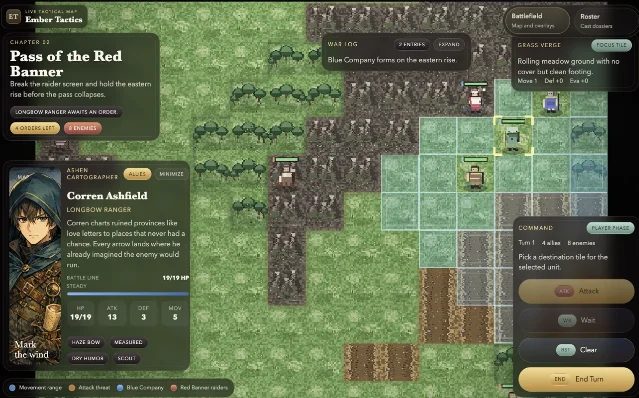
On the commercial side, OpenAI's developer showcase includes several browser games built with GPT-5 via Codex — the same setup a developer would use with the API 2. The published examples show a turn-based RPG, a Neon FPS, and a brick platformer — each described as "generated with Codex + GPT-5" and playable live in a browser tab.
The approach OpenAI demonstrates differs from OpenGame in emphasis: rather than a standalone framework with Game Skill abstractions, it leans on Codex's code-execution sandbox to let GPT-5 iteratively test and refine its own output. The model writes code, runs it in a sandboxed environment, observes errors, and patches them — a loop powered entirely by the model's reasoning rather than a separate Debug Skill protocol.
The practical upshot for developers: both paths work, but they optimize for different things. Codex's approach is more accessible (no local setup) but less reproducible at scale. OpenGame's approach is more systematic but requires running a local Node.js agent.
The Indie Dev Angle: 10 Games in One Month with Claude Sonnet 4
Kenneth Wheadon, a solo game developer on LinkedIn, published a detailed breakdown of shipping 10 indie games using Claude Sonnet 4 — the same model, but through a human-in-the-loop workflow rather than a fully autonomous agent 3.
His pipeline surfaces what the autonomous frameworks paper over — and what you actually need to control when Claude writes the code:
- Brainstorm first, commit later. Feed Claude open-ended "what if" prompts; treat output as raw creative fuel, not final design.
- One-screen MVP before the full game. Get Claude to generate a single HTML/JS/CSS page proving the core mechanic. If it's not fun at this stage, the full game won't be either.
- Modular screen architecture. Break the game into isolated screens (
title.js,battle.js,results.js) with shared state in aconfig.js. This is the human-enforced equivalent of OpenGame's Template Skill — it prevents the cross-file coherence failures that sink autonomous agents. - Separate UI/UX conversations. Switch the Claude conversation mode once mechanics work; describe what feels rough rather than asking for more code.
- Asset-last generation. Tell Claude to assume all assets exist in
/image/and/audio/, have it write code that references those paths, then generate an asset list at the end.
The ten published games include Anxiety Minotaur, Ducks All the Way Down, and Zombie Pop Payday — all live on itch.io.
What Makes These Cases Transferable
Three engineering patterns show up across every successful AI-built game, whether fully autonomous or human-guided:
Stable project scaffolding comes before code generation. The agent (or the human) locks import paths, shared state shapes, and file structure before writing game logic. OpenGame's Template Skill, Wheadon's modular screen architecture, and Codex's sandbox environment all serve this same purpose. Skip this and cross-file coherence breaks.
Playability is the reward signal, not syntax correctness. OpenGame trains GameCoder-27B on whether games actually run and respond to input. Codex loops on execution errors. Wheadon tests the one-screen MVP before expanding. Every successful case uses a form of "does this actually work when you open it in a browser?" as the gate.
The prompt carries design intent, not implementation details. The best prompts in the OpenGame demo gallery — "90s Capcom arcade style, select between Iron Man / Thor / Hulk, 3 levels, final boss Thanos" — describe game feel, visual references, and player experience. They don't specify functions, event handlers, or state objects. The model handles those; the prompt handles the vision.
Try It Yourself
The full OpenGame framework is open-source under Apache 2.0:
コンテンツカードを読み込んでいます…
The minimum setup is a Node.js 20+ environment, an OpenAI-compatible API key, and one command. If you'd rather start from the model's side, OpenAI's Codex and Anthropic's Claude.ai both surface similar game-building capabilities directly in the browser with no local setup.
このコンテンツについて、さらに観点や背景を補足しましょう。