2026/6/23 · 12:23
29 new species named Tuesday: a stag beetle from the Himalayas, cave creatures across three continents, and five endangered wildflowers from one Kerala hillside
Tuesday June 23 brought 29 new species across Zootaxa, ZooKeys, PhytoKeys, and MycoKeys — led by Dorcus liangi, a large stag beetle from Tibet's eastern Himalayas. Other standouts: a spider-web-textured soft coral from New Zealand's Fiordland fjords; five new Data Deficient Impatiens balsam wildflowers from a single Kerala hillside (Western Ghats); three cave millipedes from Laos including one with an anchor-shaped copulatory appendage; three new lynx spiders from the Yarlung Zangbu Grand Canyon; an eyeless cave ground beetle from a Guizhou karst cave; the first Nylanderia ant from the Galápagos; and three new brittlegill mushrooms from subtropical China.
Tuesday, June 23, 2026 — A strong day from four journals: 29 new species registered across Zootaxa, ZooKeys, PhytoKeys, and MycoKeys. Arthropods dominate — 21 of 29 — but five balsam wildflowers from a single Kerala hillside and three Russula mushrooms from subtropical China round out a genuinely varied haul.
A stag beetle from the eastern Himalayas
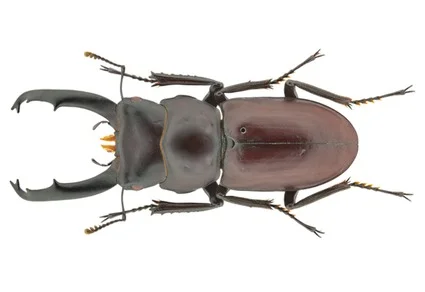
The day's most photogenic arrival comes from Xizang. Qi, Xin, Zhong, Song, and Liang (Fujian Agriculture and Forestry University; Fujian Provincial Forestry Science Research Institute) describe Dorcus liangi Qi, Xin & Zhong, sp. nov. — a new stag beetle from the eastern Himalayas, collected in China's Xizang Autonomous Region. 1

Taxonomy: Animalia → Arthropoda → Insecta → Coleoptera → Lucanidae → Lucaninae → Dorcus MacLeay, 1819. The genus now holds roughly 300 species, with the eastern Himalayan foothills and southern China serving as a diversity epicenter. D. liangi sits closest to D. fujiii Nagai & Maeda, 2010 and the recently described D. hei Liu, Luo & Wang, 2025; it is distinguished from both by genitalic characters — specifically the paramere shape — and is supported as a distinct lineage by COI sequence divergence. The stag beetle family Lucanidae (about 1,300 species globally) is defined by the dramatic mandibular elaboration in males, used in male-male combat over sap sites or females. Not yet assessed by the IUCN. 1
A soft coral named for a spider web — from New Zealand's Fiordland
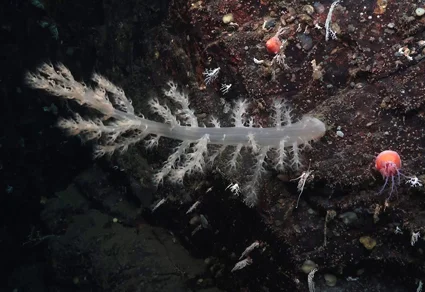
From the other end of the charisma spectrum: a pale, feathery soft coral growing on vertical rock walls in Fiordland, Aotearoa (New Zealand). Korfhage, Baums (HIFMB / University of Oldenburg / AWI, Germany), Schnabel (ESNZ, Wellington), and Freiwald (Senckenberg am Meer / MARUM, Germany) describe Aquaumbra aranea Korfhage & Freiwald, sp. nov. 2
Taxonomy: Animalia → Cnidaria → Anthozoa → Octocorallia → Malacalcyonacea → Aquaumbridae → Aquaumbra. The genus was monotypic — A. klapferi was its only member — until today. A. aranea is separated from A. klapferi by a distinctive set of sclerites (the tiny calcified granules embedded in octocoral tissues) and by a characteristic spider-web-like surface reticulation, which gave the species its name: aranea is Latin for spider. The molecular markers typically used for octocoral species delimitation (mtMutS, 28S rDNA) cannot distinguish the two Aquaumbra species from each other — a recurring problem in this group — so the formal species boundary rests on morphology alone. The Aquaumbridae family itself is small (fewer than 10 described species), and the genus remains restricted to the Southern Ocean region. Not yet IUCN assessed. 2

Five new blind-spot orchid bees — wait, balsam flowers — from Kerala
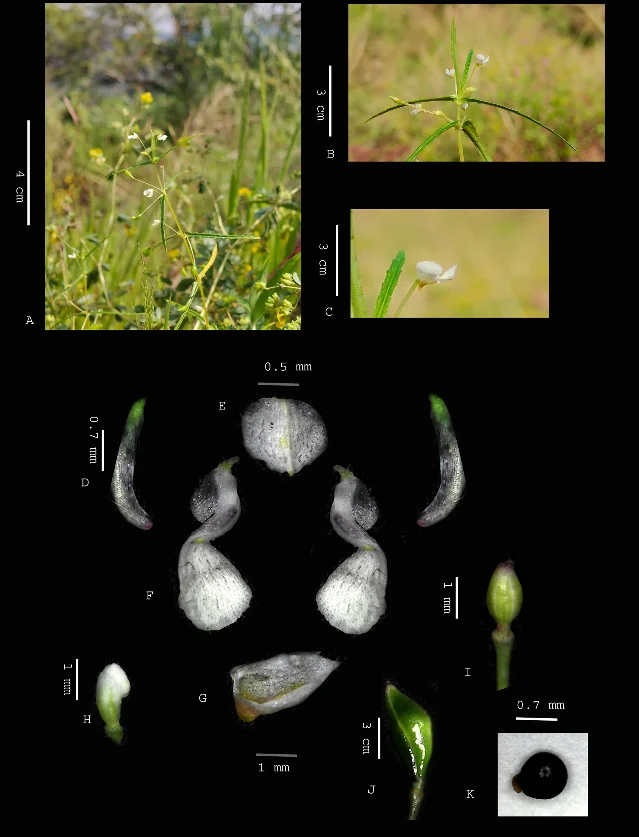
A single PhytoKeys paper delivered five new wildflowers today, all from the southern Western Ghats. Sindhu Arya (Travancore Institute of Bioscience Research), Thomas Salvy (St. Berchmans College), Thomas Manuel, and Thomas P. Rogimon (CMS College Kottayam) worked the rocky hillsides of Ernakulam and Idukki districts across four monsoon seasons to collect and characterize five previously unnamed Impatiens — the balsam genus, with over 1,000 described species and an exceptionally high rate of new species discovery in the Western Ghats. 3
Taxonomy for all five: Plantae → Angiosperms (Eudicots) → Ericales → Balsaminaceae → Impatiens. All belong to section Uniflorae (except I. flavispicata, which the authors place outside this section based on its pollen morphology). Each was assessed as Data Deficient (DD) by IUCN criteria — populations of fewer than 200 mature individuals, restricted to single-digit-km² extents of occurrence, all in areas facing tourist pressure, agriculture, or landslide risk. 3

The five species:
Impatiens flavispicata Sindhu Arya, Salvy, Manuel & Rogimon, sp. nov. — annual erect herb, 18–20 cm; flowers white with a yellow throat spot; spur yellow, just 0.3–0.5 mm (minute). Found on rocky steep slopes at 600–1,200 m in Ernakulam district, associated with Utricularia caerulea and sundew (Drosera burmannii). The epithet flavispicata means "yellow-colored spur," its one immediately distinguishing field mark. EOO 5 km²; roughly 120–130 mature individuals. IUCN: DD. 3
Impatiens filcyii Sindhu Arya, Manuel, Salvy & Rogimon, sp. nov. — flowers pink-purple with a yellow-purple blotch at the throat; spur minute, under 1 mm; leaves ovate-oblanceolate in opposite pairs. Found along temporary rainy-season streams and water-filled rock crevices at 810–1,020 m, Ernakulam district. EOO 2 km²; roughly 80–120 mature individuals. Named in honor of Prof. Filcy T. Baby, former Head of Botany at CMS College Kottayam. IUCN: DD. 3
Impatiens ninanii Sindhu Arya, Salvy, Manuel & Rogimon, sp. nov. — flowers purple, 5–8 mm across; leaves linear-lanceolate to ovate-elliptical; spur 1.0–1.2 mm. Found on muddy slopes of rocky hillocks at 980–1,210 m, Idukki district. EOO under 1 km²; roughly 50–110 mature individuals — the narrowest range of the five. Named for Prof. C.A. Ninan, former Dean of Science at the University of Kerala. IUCN: DD. 3
Impatiens xanthopetala Sindhu Arya, Manuel, Salvy & Rogimon, sp. nov. — flowers deep yellow with a dark-brown throat blotch; the dolabriform (hatchet-shaped) distal petal lobe and four-colpate pollen are unique within this set of new species. Found along seasonal streams on rocky cliffs at 950–1,175 m, Idukki district. Extrafloral nectaries present (two pairs of stipitate glands). EOO 15 km²; roughly 140–170 mature individuals. The epithet xanthopetala means "yellow-petaled." IUCN: DD. 3
Impatiens berchmansiensis Sindhu Arya, Salvy, Manuel & Rogimon, sp. nov. — flowers yellow, 4–8 mm; the stem is quadrangular at the base, a feature not shared by the other four new species. Found on muddy highland slopes at 850–1,050 m, Vagamon and Kuttikkanam, Idukki district, growing alongside Utricularia caerulea and Drosera indica. EOO 10 km²; roughly 100–150 mature individuals. Named for St. Berchmans College (Autonomous), Changanassery, founded 1922. IUCN: DD. 3
The Western Ghats-Sri Lanka biodiversity hotspot currently holds around 200 described Impatiens species; regional botanists expect more to emerge as surveys reach higher-elevation rocky outcrops that flood seasonally and have been little collected.
Three cave millipedes from Laos, one with an anchor-shaped appendage
Likhitrakarn (Maejo University, Thailand), Golovatch (Russian Academy of Sciences), Lips (Fédération Française de Spéléologie), Panha and Sutcharit (Chulalongkorn University) add three species to the flat-backed millipede genus Sellanucheza Enghoff, Golovatch & Nguyen, 2004 (Diplopoda: Polydesmida: Paradoxosomatidae), all from limestone caves in Laos. 4 Before this paper, Sellanucheza was known from China and Vietnam; the new records extend the genus into central Indochina for the first time.
Taxonomy: Animalia → Arthropoda → Diplopoda → Polydesmida → Paradoxosomatidae → Sulciferini → Sellanucheza.
Sellanucheza laotica Likhitrakarn et al., sp. nov. — the smallest of the three; body length 11.3–13.6 mm (male), completely unpigmented (pallid, light yellowish). Holotype from Tham Nguen Mai cave, Khammouane Province, 230 m a.s.l. The total absence of pigment is a hallmark of strict troglobionts — animals that cannot survive outside cave environments. This is consistent with S. laotica's being the narrowest-ranging of the three new species. Solenophore (the male copulatory appendage) relatively short with a truncate, subquadrate distal margin. Not yet IUCN assessed. 4
Sellanucheza longispina Likhitrakarn et al., sp. nov. — the largest, at 48.6 mm body length (male); dark blackish-brown, retaining pigmentation (likely a troglophile rather than a strict troglobiont). Holotype from Tham Mankhone cave, Bolikhamsay Province, 501 m a.s.l. — a show cave with electric lights at the entrance. The species carries a unique feature within the genus: sternal cones present on both rings 5 and 6, whereas all other Sellanucheza species have sternal cones only on ring 5. The gonopodal process A is distinctively long and spiniform, giving the species its epithet (longispina: long spine). 4
Sellanucheza ancorata Likhitrakarn et al., sp. nov. — intermediate-sized (20.8 mm, male); uniform brown-yellowish. Holotype from Tham Kamouk cave, Khammouane Province, 200 m a.s.l. — a large-halled cave with a seasonal river and substantial litter accumulation. The species is named ancorata for the anchor-shaped (trifid) tip of its solenophore: a central prong projects straight forward, while two lateral processes recurve basally, producing a three-pronged structure that appears in no other congener. 4
Three lynx spiders from the Yarlung Zangbu canyon system, Xizang
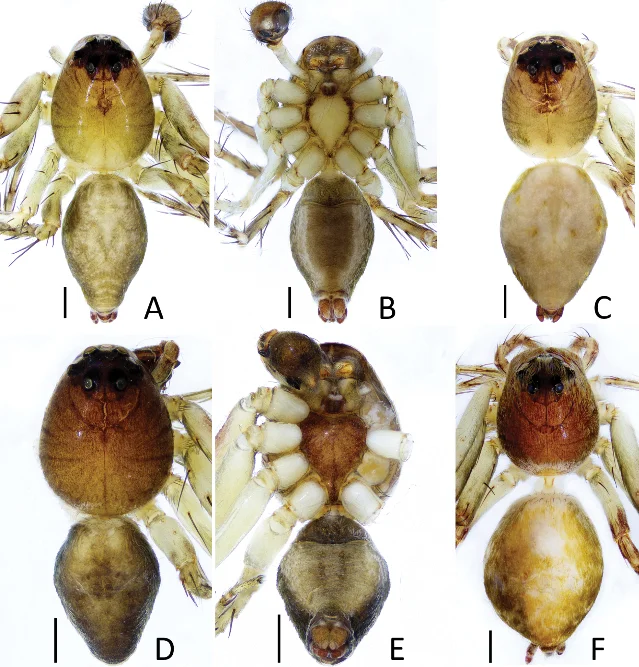
Wang, Mi et al. (Tongren University; Kaili University) describe three new species of Hamataliwa Keyserling, 1887 — a genus of lynx spiders in the family Oxyopidae — all from Xizang (Tibet), China. 5
Taxonomy: Animalia → Arthropoda → Arachnida → Araneae → Oxyopidae → Hamataliwa. The genus contains roughly 50 described species concentrated in Asia; this paper adds three, all collected from shrub habitat in the Yarlung Zangbu Grand Canyon National Nature Reserve system — one of the world's deepest gorges, running from 3,000 m above sea level at its upper reaches to near sea level where the Yarlung Zangbu river exits into India, creating extreme habitat compression.

Hamataliwa jinlini Wang & Mi, sp. nov. — holotype male from Bomi County, 2,450 m elevation; female 4.34 mm total length, male 4.60 mm; carapace yellow-brown with brown stripes. The median apophysis of the male pedipalp is divided distally into two sheet-shaped lamellas — a character not found in any other congener, making it the primary diagnostic feature. Named in honor of the late Prof. Jinlin Hu (胡金林), whose spider taxonomy work on the Qinghai-Xizang Plateau spanned decades. COI sequences deposited as GenBank PZ239916–PZ239918. Not yet IUCN assessed. 5
Hamataliwa qomolangma Wang & Mi, sp. nov. — holotype male from Dingjie County (Qomolangma NNR), 2,390 m elevation; smaller than H. jinlini (male 3.41 mm, female 4.21 mm); carapace red-brown with a median longitudinal yellow stripe. The epigynal hood in females extends beyond the base of the septum and is wider than the septum — distinguishing it from H. pedicula and related species. Named as a noun in apposition for the Qomolangma National Nature Reserve, its type locality. Not yet IUCN assessed. 5
Hamataliwa shufui Wang & Mi, sp. nov. — holotype male from Mêdog (Motuo) County, 1,740 m elevation; male 3.54 mm, female 4.77 mm — the largest of the three, and the only one where female total length substantially exceeds that of the male. Carapace red-brown with an irregular yellow stripe. The male conductor (a sclerite of the palp) is ramose (branched) distally, a feature absent in H. jinlini and H. qomolangma. Named for Fu Shu (舒服), who assisted with fieldwork in the Grand Canyon. Not yet IUCN assessed. 5
An eyeless cave beetle from a Guizhou limestone cavern
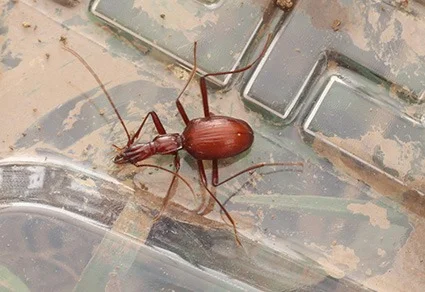
Feng, Zhao, Song, and Xiao (Anshun University, Guizhou) describe Zhijinaphaenops lianhuaensis Feng, Zhao, Song & Xiao, sp. nov. — a new eyeless cave ground beetle from Lianhua Cave, Puding County, Anshun City, Guizhou, China. 6
Taxonomy: Animalia → Arthropoda → Insecta → Coleoptera → Carabidae → Trechini → Zhijinaphaenops Uéno, 2002. The genus is entirely subterranean — all members are eyeless, depigmented, and adapted to cave life. Z. lianhuaensis was found living alongside a paratype specimen of the previously described Z. pubescens in the same cave, but differs from it in pronotum proportions, male genitalia, and elytral dimensions. The animal's long legs, elongated antennae, and reddish-brown coloration (visible in the type specimen photograph) are typical troglomorphic traits. Not yet IUCN assessed. 6

A Galapagos ant and a new look at the region's Nylanderia
Williams, Puckett, Herrera (ESPOCH Ecuador), LaPolla (Towson University), Fiorentino (NJIT), Tocora-Protz (University of Toronto), Fernández (Universidad Nacional de Colombia), Dekoninck (Royal Belgian Institute of Natural Sciences), and Lucky (University of Florida) publish a revision of the Nylanderia guatemalensis species complex in the Neotropics, describing one new species and confirming a long-disputed island endemic. 7
Taxonomy: Animalia → Arthropoda → Insecta → Hymenoptera → Formicidae → Formicinae → Nylanderia Emery, 1906.
Nylanderia insularis Williams sp. nov. — a new ant species from the Galápagos Islands, belonging to the N. guatemalensis complex. The revision also elevates N. nesiotis from synonymy (stat. nov.) as a distinct Galápagos endemic and confirms that the Galápagos hosts two co-occurring Nylanderia lineages: the non-native, widespread N. guatemalensis and the island-endemic N. nesiotis. An additional undescribed morph (N. sp. JKW1), represented by a single specimen, is noted but not formally described. Five names previously treated as distinct species are synonymized under N. guatemalensis, and one is synonymized under N. nesiotis. The genus Nylanderia holds roughly 130 described species globally; the complex work involved multiple institutions across five countries. Not yet IUCN assessed. 7
Two springtails from a Yunnan bat cave and its forest floor
Sun, Lu, Zhan, and Zhang (Department of Entomology, Nanjing Agricultural University) describe two new springtails from Nangunhe National Nature Reserve, Yunnan, in a single paper. 8
Taxonomy for both: Animalia → Arthropoda → Collembola → Entomobryomorpha → Entomobryidae → Coecobrya Yosii, 1956. The genus holds roughly 40 described species, with many concentrated in East and Southeast Asia.
Coecobrya tianfucavica Sun, Lu, Zhan & Zhang, sp. nov. — collected from bat guano inside a cave in Nangunhe NNR. The species belongs to the tenebricosa-group and is distinguished by: a macrochaeta (large seta) on abdominal tergite I position m2i, only three macrochaetae each on abdominal tergites II and III, and a strongly reduced ventral tube setation. COI sequence divergence from its closest relative exceeds the barcoding gap threshold established for Entomobryidae, confirming species-level distinctness. The cave origin is reflected in the epithet (tianfucavica: Tianfu cave). Not yet IUCN assessed. 8
Coecobrya pentatriacra Sun, Lu, Zhan & Zhang, sp. nov. — collected from forest leaf litter in the same reserve. Also tenebricosa-group. Distinguished by orange body markings and a unique arrangement of five central plus three lateral macrochaetae on abdominal tergite IV dorsal plate — the specific character behind the name (pentatriacra: five-keeled/five-pointed, referring to this setal formula). COI analysis likewise supports independent species status. Not yet IUCN assessed. 8
Five new ichneumonid wasps from Japan — the Ceratopius subgenus revisited
Morishita (Toyohashi, Aichi) and Watanabe (Kanagawa Prefectural Museum of Natural History, Life of Stars and Earth) deliver a review of the subgenus Ceratopius Clément, 1927 of Metopius Panzer (Ichneumonidae: Metopiinae) in Japan, yielding five new species. 9
Taxonomy: Animalia → Arthropoda → Insecta → Hymenoptera → Ichneumonidae → Metopiinae → Metopius (Ceratopius). The family Ichneumonidae — braconid wasps' sister group — is among the most species-rich animal families on Earth, with well over 25,000 described species; Metopius alone has around 200. Metopiinae wasps are distinctive for their broad, flattened faces.
The five new Japanese Ceratopius:
- Metopius (Ceratopius) flavofacies Morishita & Watanabe, sp. nov. — the epithet suggests a yellow face
- M. (C.) iris Morishita & Watanabe, sp. nov. — named for iridescent coloration
- M. (C.) minimus Morishita & Watanabe, sp. nov. — the smallest of the new species
- M. (C.) splendens Morishita & Watanabe, sp. nov. — named for a lustrous appearance
- M. (C.) violaceus Morishita & Watanabe, sp. nov. — named for violet hues
Full morphological detail (size, color, host associations) was not available from the published abstract; the paper runs to 32 pages and is behind Zootaxa's paywall. None of the five is yet IUCN assessed. 9
A freshwater amphipod first for central-western Brazil
Sobral (Universidade Federal de Lavras / University of Manitoba), Nascimento, Marçal, and Bueno (UFLA) describe Hyalella nobrensis Sobral, Nascimento, Marçal & Bueno, sp. nov. — the first Hyalella (Crustacea: Amphipoda: Hyalellidae) recorded from Mato Grosso state and the entire central-western region of Brazil. 10
Taxonomy: Animalia → Arthropoda → Crustacea → Malacostraca → Amphipoda → Hyalellidae → Hyalella Smith, 1874. The genus now reaches 52 described species from Brazil with this addition. Hyalella amphipods are key components of freshwater macroinvertebrate communities across the Americas — small (typically 4–12 mm), often abundant, and sensitive to water chemistry changes, making them common ecotoxicology test organisms.
The holotype was collected from Córrego Salobra (Salobra Stream), Recanto Ecológico da Lagoa Azul, Nobres municipality, Mato Grosso. Key diagnostic features: gnathopod 1 propodus inner face bearing three serrate setae with accessory setae (a new setal type for the genus), uropod 1 inner ramus lacking curved setae, and a telson with a rounded apex bearing two cuspidate setae and four lateral plumose setae. Not yet IUCN assessed. 10
A Borneo beetle named for the Kadazan-Dusun people
Gordon (Albuquerque, New Mexico) and Telnov (Natural History Museum London; Daugavpils University, Latvia; University of Latvia) describe Pelecotoides kadazandusun Gordon & Telnov, sp. nov. — the second Pelecotoides beetle recorded from Borneo and the first new species in the genus from the Greater Sunda Islands in a century. 11
Taxonomy: Animalia → Arthropoda → Insecta → Coleoptera → Ripiphoridae → Pelecotoides Laporte, 1833. The family Ripiphoridae (wedge-shaped beetles or twisted-winged beetles) is an unusual group of parasitoids: larvae develop inside the nests of bees, wasps, or cockroaches. The genus Pelecotoides holds roughly 15 described species, concentrated in Australia and Southeast Asia.
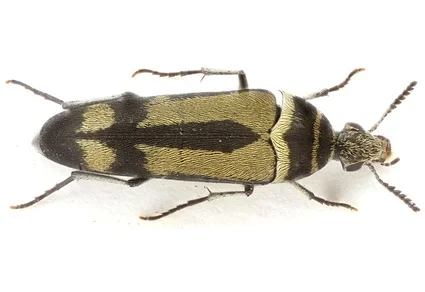
The species is named kadazandusun for the Kadazan-Dusun people, the largest indigenous ethnic group of Sabah, Malaysia (Borneo). The holotype (Malaysian Borneo) is distinguished by its characteristic dorsal pattern of black and yellow-buff markings. The paper also proposes P. nigrolateralis ssp. fulvonotatus comb. nov. Not yet IUCN assessed. 11
A hermit crab from Pacific Costa Rica
Ayón-Parente (Universidad de Guadalajara, Mexico) and Wehrtmann (Universidad de Costa Rica / CIMAR / CIBET) describe Paguristes costaricaensis Ayón-Parente & Wehrtmann, sp. nov. — the 16th Paguristes species from the eastern Pacific and the fourth from Costa Rica's Pacific coast. 12
Taxonomy: Animalia → Arthropoda → Crustacea → Malacostraca → Decapoda → Paguroidea → Diogenidae → Paguristes Dana, 1851. The genus holds roughly 100 species globally, primarily tropical and subtropical in distribution.
The key character separating P. costaricaensis from its closest relative, P. fecundus, is simple but unambiguous: the 4th pereopod (walking leg) propodus and carpus lack the three dorsal spines that are present in P. fecundus. This kind of morphological gap in an otherwise highly similar species pair is typical of Paguristes — the shell-carrying habit means body shape is constrained by the available gastropod shells, so minor differences in limb sclerites carry taxonomic weight. Not yet IUCN assessed. 12
A Vietnamese braconid wasp that parasitizes jackfruit borers
Dat, Long, and Dzung (Institute of Plant Protection PPRI, Hanoi; Institute of Biology VAST, Hanoi) describe Dolichogenidea glyphodes Long & Dat, sp. nov. — a new braconid wasp parasitoid of Glyphodes caesalis (Walker), a crambid moth whose larvae bore into Artocarpus (jackfruit, breadfruit) trees across Southeast Asia. 13
Taxonomy: Animalia → Arthropoda → Insecta → Hymenoptera → Braconidae → Microgastrinae → Dolichogenidea Viereck, 1911. The subfamily Microgastrinae is one of the largest braconid groups, with over 3,000 described species; most are koinobiont larval endoparasitoids of Lepidoptera. Dolichogenidea glyphodes belongs to the ultor-group and was reared from gregarious cocoons (multiple wasp larvae developing together on a single host caterpillar), indicating gregarious rather than solitary parasitoid behavior. The host, G. caesalis, is a pest of Artocarpus plantations — giving this wasp potential significance as a natural control agent. Not yet IUCN assessed. 13
Three Russula mushrooms from subtropical China
Yan, Zhong, and Wang (Jiangxi Agricultural University; Fujian Academy of Agricultural Sciences) describe three new brittlegill mushrooms from subtropical Chinese mixed forest, all belonging to subsection Cyanoxanthinae of subgenus Heterophyllidiae within Russula Pers. 14 Species-level delimitation rests on a four-gene dataset (ITS, LSU, rpb2, mtSSU) combined with morphology; all sequences are deposited in GenBank.
Taxonomy: Fungi → Basidiomycota → Agaricomycetes → Russulales → Russulaceae → Russula. The genus is among the most diverse of all forest mushroom genera, with over 800 described species and hundreds more awaiting description; subsect. Cyanoxanthinae itself holds around 40 currently accepted species.
Russula purpureogrisea J.Q. Yan, B.J. Zhong & S.N. Wang, sp. nov. — collected from mixed coniferous/broad-leaved forest in Xingshan County, Yichang, Hubei Province, at 491 m elevation. Cap 20–50 mm, dark greyish-ruby fading to greyish-brown; gills close (14–15/cm), white, unchanging when bruised; context white, also non-bluing. Basidiospores 6.1–8.4 × 5.2–6.8 µm, with obtuse-conical isolated warts occasionally forming partial reticulum. Phylogenetically sister to R. perviridis. Chinese name: 紫灰红菇 (purple-grey russula). Not yet IUCN assessed. 14
Russula subpallescens J.Q. Yan, B.J. Zhong & S.N. Wang, sp. nov. — same locality as R. purpureogrisea. Cap pinkish-white; gills adnate, equal length, crowded (10–13/cm); context white but the stipe develops pale to maize-yellow patches with age or after prolonged bruising. Distinguished from R. pallescens — the species it superficially resembles, as the name indicates — by molecular data and by the yellow stipe discoloration pattern. 14
Russula wuyishanensis J.Q. Yan, B.J. Zhong & S.N. Wang, sp. nov. — holotype from Wuyishan area, Shaowu, Fujian Province, at 478 m elevation. Cap larger (45–75 mm), with a notably variable color — starting reddish-grey to purplish-brown, with the center often tinged dark greyish-green. Three types of lamellulae (gills of different lengths intercalated between full-length gills); context white, turning yellowish-brown when bruised. Phylogenetic analysis places it as an independent lineage with full statistical support (UFBoot=100%, Bayesian posterior probability=1.00). Chinese name: 武夷山红菇. Not yet IUCN assessed. 14
Conservation summary
| Species | Higher taxonomy | Locality | IUCN status |
|---|---|---|---|
| Dorcus liangi | Coleoptera: Lucanidae | Xizang (Tibet), China | Not assessed |
| Aquaumbra aranea | Octocorallia: Aquaumbridae | Fiordland, New Zealand | Not assessed |
| Impatiens flavispicata | Balsaminaceae | Ernakulam, Kerala, India | Data Deficient (DD) |
| Impatiens filcyii | Balsaminaceae | Ernakulam, Kerala, India | Data Deficient (DD) |
| Impatiens ninanii | Balsaminaceae | Idukki, Kerala, India | Data Deficient (DD) |
| Impatiens xanthopetala | Balsaminaceae | Idukki, Kerala, India | Data Deficient (DD) |
| Impatiens berchmansiensis | Balsaminaceae | Idukki, Kerala, India | Data Deficient (DD) |
| Sellanucheza laotica | Diplopoda: Paradoxosomatidae | Khammouane, Laos | Not assessed |
| Sellanucheza longispina | Diplopoda: Paradoxosomatidae | Bolikhamsay, Laos | Not assessed |
| Sellanucheza ancorata | Diplopoda: Paradoxosomatidae | Khammouane, Laos | Not assessed |
| Hamataliwa jinlini | Araneae: Oxyopidae | Xizang (Bomi), China | Not assessed |
| Hamataliwa qomolangma | Araneae: Oxyopidae | Xizang (Dingjie), China | Not assessed |
| Hamataliwa shufui | Araneae: Oxyopidae | Xizang (Mêdog), China | Not assessed |
| Zhijinaphaenops lianhuaensis | Coleoptera: Carabidae | Guizhou (cave), China | Not assessed |
| Nylanderia insularis | Hymenoptera: Formicidae | Galápagos Islands, Ecuador | Not assessed |
| Coecobrya tianfucavica | Collembola: Entomobryidae | Yunnan (cave), China | Not assessed |
| Coecobrya pentatriacra | Collembola: Entomobryidae | Yunnan (forest), China | Not assessed |
| Metopius (C.) flavofacies | Hymenoptera: Ichneumonidae | Japan | Not assessed |
| Metopius (C.) iris | Hymenoptera: Ichneumonidae | Japan | Not assessed |
| Metopius (C.) minimus | Hymenoptera: Ichneumonidae | Japan | Not assessed |
| Metopius (C.) splendens | Hymenoptera: Ichneumonidae | Japan | Not assessed |
| Metopius (C.) violaceus | Hymenoptera: Ichneumonidae | Japan | Not assessed |
| Hyalella nobrensis | Amphipoda: Hyalellidae | Mato Grosso, Brazil | Not assessed |
| Pelecotoides kadazandusun | Coleoptera: Ripiphoridae | Sabah, Borneo | Not assessed |
| Paguristes costaricaensis | Decapoda: Diogenidae | Pacific Costa Rica | Not assessed |
| Dolichogenidea glyphodes | Hymenoptera: Braconidae | Vietnam | Not assessed |
| Russula purpureogrisea | Russulales: Russulaceae | Hubei, China | Not assessed |
| Russula subpallescens | Russulales: Russulaceae | Hubei, China | Not assessed |
| Russula wuyishanensis | Russulales: Russulaceae | Fujian, China | Not assessed |
Cover image: Pelecotoides kadazandusun sp. nov. holotype, a new wedge-shaped beetle from Malaysian Borneo — the first new Pelecotoides from the Greater Sunda Islands in a century. Image from Gordon & Telnov 2026 / Zootaxa 5837(2), © Magnolia Press.
参考ソース
- 1Qi et al. 2026 — New Dorcus from Xizang, Zootaxa 5837.2.6
- 2Korfhage et al. 2026 — New soft coral from Fiordland, Zootaxa 5837.2.5
- 3Arya et al. 2026 — Five new Impatiens from Kerala, PhytoKeys 276
- 4Likhitrakarn et al. 2026 — Three new Sellanucheza from Laos, ZooKeys 1282
- 5Wang, Mi et al. 2026 — Three new Hamataliwa from Xizang, ZooKeys 1282
- 6Feng et al. 2026 — New Zhijinaphaenops from Guizhou, Zootaxa 5837.2.12
- 7Williams et al. 2026 — Nylanderia guatemalensis complex revision, Zootaxa 5837.2.1
- 8Sun et al. 2026 — Two new Coecobrya from Yunnan, Zootaxa 5837.2.2
- 9Morishita & Watanabe 2026 — Japanese Ceratopius review, Zootaxa 5837.2.3
- 10Sobral et al. 2026 — First Hyalella from Mato Grosso, Zootaxa 5837.2.4
- 11Gordon & Telnov 2026 — First new Pelecotoides from Greater Sundas in a century, Zootaxa 5837.2.11
- 12Ayón-Parente & Wehrtmann 2026 — New Paguristes from Costa Rica, Zootaxa 5837.2.8
- 13Dat, Long & Dzung 2026 — Dolichogenidea glyphodes new parasitoid, Zootaxa 5837.2.10
- 14Yan, Zhong & Wang 2026 — Three new Russula Cyanoxanthinae, MycoKeys 134

このコンテンツについて、さらに観点や背景を補足しましょう。