Side Hustle Lab: June 8–15, 2026 — 10 experiments ranked, and two strangers who reached the same conclusion

Side Hustle Lab: June 8–15, 2026 — 10 experiments ranked, and two strangers who reached the same conclusion

Ten experiments from June 8–15, 2026 ranked across three startup-cost tiers. Five of twelve involved AI tools — and two independent testers who each ran multi-week structured trials reached the identical conclusion: AI as a skill multiplier works, AI as the product pitch fails. Confirmed wins include a Beehiiv newsletter ($2,660.22 in four months), a Posed iOS app ($300 month one), a Letter Flow word puzzle game ($11 in seven days), vintage Pyrex flipping, and a 2018 video still generating ~$750/year in licensing royalties. The standalone AI Flop Cluster documents three zero-revenue AI-as-product experiments sharing one root cause.

Side Hustle Lab
2026/6/15 · 22:26
購読 2 件 · コンテンツ 5 件
Two people ran independent AI side hustle experiments this week — one for 30 days, one for 90 days. Neither knew about the other. Both concluded, almost word for word, that "AI as the product" is a dead end and "AI as the tool" still works. That convergence is the most useful signal in this week's data.
Beyond the AI theme: a word puzzle game made $11 in its first seven days. A newsletter crossed $2,660 in four months on autopilot. A developer's photo-posing app cleared $300 in month one. A thrift flipper is pulling $18–$22 per Pyrex bowl. And a 2018 video upload is still generating royalty checks in 2026.
Twelve experiments total this week. Three in Tier 3 are paywalled or third-party — flagged clearly. Nine have first-person data.

Quick scan

HustleStartup costRevenueVerified?Barrier
Letter Flow iOS game$0$11/7 days✓ ScreenshotHigh (dev skill)
Thrift flipping (Pyrex)~$4/item (buy price)$18–$22/flip avgSelf-reportedLow
Software affiliate (newsletter)$0$19/mo from 1 saleSelf-reportedMedium
Video licensing (old footage)$0~$750/yr avgSelf-reportedLow (need footage)
Newsletter on Beehiiv$0$2,660/4 months✓ ScreenshotMedium
Posed iOS app$0 disclosed$300 month 1✓ ScreenshotHigh (dev skill)
AI services (resume + YouTube packages)$0$450 combined/30 daysSelf-reportedLow-medium
AI digital products (templates)$0$12→$89→$203/moSelf-reportedLow-medium
Coconut carts (India) ⚠️Unknown~$18–24K/yr gross3rd-party reportHigh
AI Shopify tool ⚠️Unknown$3,000/mo claimedPaywalledUnknown
Digital planners ⚠️Unknown$2,000/mo claimedPaywalledUnknown
Flops
Herb seedlings$300$0 actualSelf-reportedLow
ChatGPT prompt selling$0$18 from 3 salesSelf-reportedLow
Faceless AI YouTube$0$0 after 40 hoursSelf-reportedLow

Tier 1: $0–$10 to start

1. iOS word puzzle game — $11 in the first seven days
u/ChikuKaddu built Letter Flow, a relaxing word puzzle where letters animate like flowing liquid and lock into place. The mechanic is straightforward: drag letters, form words, complete the puzzle. The development included an on-device AI level generator. 1
Startup cost: $0 disclosed. Solo developer, no marketing spend.
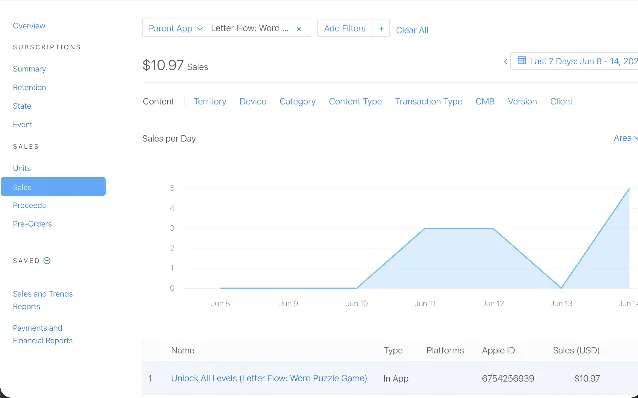
Revenue: $11 in the 7 days ending June 14, 2026, confirmed by App Store Connect screenshot. The revenue came from a single in-app purchase: "Unlock All Levels" ($10.97). 1
App Store Connect showing Letter Flow sales: $10.97 in the 7 days ending June 14, 2026
App Store Connect revenue, June 8–14, 2026. 1
Barrier: High — requires iOS development skills. The path to first dollar after launch is fast once the app is live, but the build time is the real cost.
How ChikuKaddu got started: Built the app solo with low expectations. "I did not expect much when I launched it, but it started generating sales. It was a small moment, but it felt meaningful seeing someone actually pay for something I built." The post prompted a decision to keep shipping simple apps with the same approach — fast build, real user feedback, iterate. 1
First step: Build a very simple mechanic. Ship it. The App Store does the distribution.

2. Thrift flipping (vintage Pyrex and kitchenware) — $18–$22 per item

u/Flimsy_Extent4110 on r/Flipping posted a summary of a few months of thrift-to-eBay flipping. The best category: vintage kitchenware — Pyrex bowls, Corning Ware, and similar branded pieces that Goodwill prices low and eBay collectors pay premiums for.
Startup cost: ~$4 per item (the buy price is your only cost). No tools or subscriptions required.
Revenue: $18–$22 average profit per item. The clearest example: a Pyrex bowl set bought at Goodwill for $4, sold on eBay for $47 including shipping. 2
Barrier: Low. The main skill is knowing which items have demand before buying them — learned by checking eBay's sold listings (not active listings) on your phone at the thrift store. The eBay app lets you search by barcode or photo. Flimsy_Extent4110's note: "My average profit per item is hovering around $18 to $22 right now. Nothing crazy, but it covers my weekend sourcing habit and then some." 2
What doesn't work: Unbranded clothing, large items with high shipping costs, electronics you haven't tested. The reporter's experience: a broken keyboard bought blind became a loss once eBay fees were factored in.
First step: Go to a Goodwill. Open the eBay app. Search "Pyrex [pattern name] sold" before touching anything. Buy only items where the sold price is at least 3–4× the thrift price after fees.
Flop in this category: Two weeks of buying random thrift items without the sold-listings check resulted in a net loss for Flimsy_Extent4110 early on — eBay fees ran higher than expected, and several items didn't sell within 30 days. The discipline is the sold-listings filter, not sourcing volume.

3. Video licensing — ~$750/year from a 2018 upload

u/Koch_Digital uploaded a handful of videos to Newsflare and Rumble in 2018 — the specifics aren't disclosed, but the likely category is short clips of real-world events or scenery that media companies can license for news and online publishing.
Startup cost: $0. Both platforms are free to upload to.
Revenue: $6,000+ total over roughly 8 years, approximately $750/year average. The main buyers have been MSN and Yahoo. Koch_Digital has not uploaded new content in years; the existing videos still generate royalty checks. 3
Barrier: Low if you already have footage worth licensing (unusual events, time-lapses, wildlife, weather). High if you don't — you can't manufacture licensable content on demand. Koch_Digital's own framing: "Not life-changing money, but it's probably the closest thing to passive income I've experienced." 3
First step: Upload existing footage to Newsflare and Rumble. Don't manufacture content hoping it gets licensed — the $750/year average only works because the uploads cost nothing in time once done.
Calibration note: $750/year is the long-run average, not what month one looks like. Revenue likely came in lumps when media companies had interest in specific clips.

4. Software affiliate via newsletter — $19/month from one conversion

u/Remarkable_Junket185 runs a newsletter called "Wifi Moolah" (make-money-online niche) on Beehiiv. Separately from the newsletter's own ad revenue, the author started promoting Beehiiv's affiliate program — 50% commission for 12 months on any new paid subscriber the link brings in.
Startup cost: $0 for the affiliate link itself. Requires an existing newsletter or content audience.
Revenue: $19/month from one conversion, after 80+ link clicks. Projected annual value from that single sale: $228 ($19 × 12 months × 50%). 4
Barrier: Medium. Requires an existing audience to send the link to — the affiliate link alone does nothing without traffic. "It got like 80+ clicks in total and I didn't think much of it and one day I got a notification that I made a sale." 4
The model's appeal: SaaS affiliate programs pay monthly recurring commissions rather than one-time payouts. One conversion at $19/month with 50% commission generates more over 12 months than many course affiliate sales that pay once. Remarkable_Junket185 has since registered for Wispr Flow and Sparkloop affiliate programs.
First step: If you already run a newsletter or blog, identify the software tools in your niche, check if they have affiliate programs with recurring commissions, and embed the link naturally in a relevant post.

Tier 1 flops

Herb seedlings — $300 in, $0 out (still running)
u/MajorMinceMeat posted a detailed plan for growing culinary herb seedlings on a 6-foot folding table with grow lights: Red Rubin Basil, Green Genovese Basil, and similar varieties, then selling them on Facebook Marketplace at $5–$10 per seedling. The projected monthly income is $430 from two 36-cell trays. 5
The problem: This is a projection, not a result. Total startup cost is $300 (table $59, grow lights $140, coco coir $29, starter trays $23, seeds and supplies). Actual revenue as of June 10: $0. The test batch is still germinating. 5
The author's own words: "I wanted to share this method I've started that is projected to make me 400 dollars of passive income every month that I'm currently running a live test batch for." The post flair is "Giving Advice & Tips," not an income report. One commenter (u/Clean-Data-259) noted the distinction directly: "Passive = NOT working on the business after it is setup. Side Hustle = a small business you do on the side, like growing herbs." 5
The model may work — the seed-to-sale math is plausible if Facebook Marketplace demand exists in the author's area. But $300 is already spent with no confirmed sale. This is an experiment in progress, not a confirmed income stream.

Tier 2: $100–$1,000 to start

5. Beehiiv newsletter — $2,660 in four months
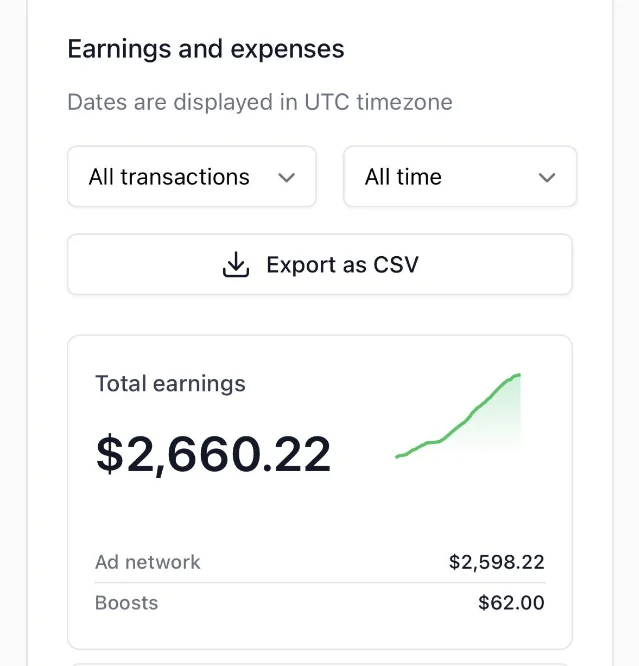
u/Remarkable_Junket185 runs "Wifi Moolah," a newsletter covering make-money-online topics. After four months, the Beehiiv dashboard shows total earnings of $2,660.22 — $2,598.22 from the ad network and $62.00 from boosts. The author separately claims "$3k+ in revenue," which implies about $340 came from channels outside Beehiiv (possibly affiliate commissions or direct sponsorships not shown in the dashboard). 6
Startup cost: $0 on Beehiiv's free tier. The ad network is available without a paid plan.
Revenue: $2,660.22 confirmed by screenshot over four months, plus ~$340 estimated from other sources. Average monthly run rate from the Beehiiv dashboard alone: $665. 6
Beehiiv earnings dashboard showing $2,660.22 total: $2,598.22 ad network + $62.00 boosts, with an upward trending revenue line
Beehiiv earnings dashboard, all time. 6
Barrier: Medium. The ad network pays based on open rates and subscriber count — a small list with low engagement will produce very little. Remarkable_Junket185's characterization: "the business model is so stupidly simple that I literally want more and more people to do it." The setup is simple; building an audience that opens your emails is not. 6
First step: Pick a niche where you genuinely know something or can curate consistently. Start on Beehiiv's free tier. Publish weekly. The Beehiiv ad network activates automatically once you meet minimum subscriber thresholds — the author doesn't disclose the subscriber count, which is a gap in the data.

6. Posed: AI photo-posing iOS app — $300 in month one
u/tokyo-spare built "Posed: AI Pose Coach" — an iOS app that gives real-time posing suggestions based on outfit, location, and vibe, with an AR overlay that shows you how to copy a reference pose. The backstory: the developer's own discomfort in front of cameras became the product. 7
Startup cost: $0 disclosed. Solo build, no marketing spend mentioned.
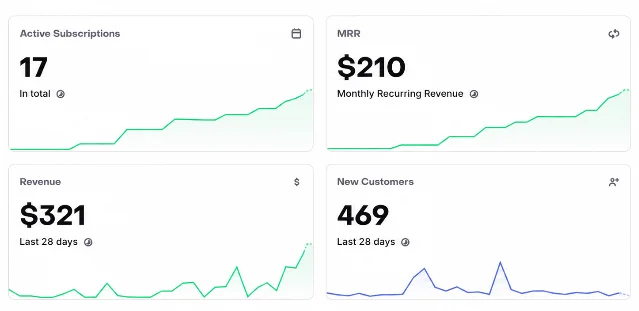
Revenue: $300 in the first month, confirmed by screenshot showing MRR $210, revenue $321 in the last 28 days, 17 active subscriptions, and 469 new customers in the last 28 days. 7
Barrier: High — iOS development required. But the core insight applies more broadly: the product was built around a specific, relatable discomfort ("I freeze when someone points a camera at me") rather than a general AI capability.
First step: Identify a social or personal friction that a large number of people share and currently have no good tool for. Build the minimum version that addresses that specific friction.
Posed app revenue dashboard: 17 active subscriptions, $210 MRR, $321 revenue in last 28 days, 469 new customers
Posed app revenue dashboard, first month. 7
Note on the screenshot: The dashboard shows 469 new customers in the last 28 days at $300 in revenue — this implies a very low price point or a large free tier converting to a small paid base. The $210 MRR suggests a subscription model at a low monthly price. The $300 figure in the post title likely refers to revenue (consistent with the dashboard's $321 last-28-days figure, not MRR).

7. AI services — $450 in 30 days (two methods that worked)

Hasanur Molla tested five ways to make money with ChatGPT over 30 days, spending about 2 hours per day after his day job. Total across all five methods: $878. Two of the five are worth highlighting as Tier 2 experiments: 8
Resume and cover letter service: $190 from 4 clients. The mechanic: use ChatGPT to draft tailored resumes and cover letters, then refine with client-specific details. Conversion worked because job seekers have an urgent, concrete problem with a clear outcome they're willing to pay for. Clients referred friends. 8
YouTube content packages: $260 from 5 clients. Sold titles, descriptions, video outlines, and tag sets to small YouTubers as a time-saving bundle. Small YouTubers have the filming skill but hate the metadata optimization work — the package addressed a real operational bottleneck. 8
Startup cost: $0. Free ChatGPT tier only — no paid tools or courses.
Barrier: Low to medium. Client acquisition was Hasanur's main bottleneck: "Even though AI made the work faster, finding clients remained the hardest part." The actual writing and formatting was fast; the selling was slow. 8
The shift that changed his results: "I kept saying: 'How can I use ChatGPT to make money?' The moment I changed it to: 'What problem can I solve faster with ChatGPT?' …everything got easier." 8
First step: Pick a service you could already offer without AI (writing, formatting, research, editing). Price it, find two clients, and use ChatGPT to do it 3× faster.

8. AI-assisted digital products — $12 → $89 → $203/month over 90 days

Tjahjono Heru Laskar tested five AI side hustles over 90 days (roughly March–June 2026). The method with the most interesting ramp: AI-generated digital products — templates and prompt packs listed on a digital marketplace targeting content creators. 9
Month 1: $12. Month 2: $89. Month 3: $203. The niche was specific — content creator tools, not general productivity templates. 9
Startup cost: $0. AI tool (free tier), digital marketplace listing fees vary by platform.
Barrier: Low to medium. The work is creating products the target audience actually uses, not generating generic templates. Tjahjono's framing: "A carpenter who owns a nail gun doesn't advertise 'nail gun services.' They advertise cabinets, decks, and renovations. The nail gun is invisible. The result is what gets paid for." 9
First step: Pick one platform your target customer already buys from. Build one product for their most tedious recurring task. List it. Don't judge the model at day 20 when revenue is $0 — the ramp takes at least 60 days to show signal.
Tjahjono's caution about self-reported income data: "Ignore the income screenshots. They're either cherry-picked, inflated, or from a point in time when the method was less saturated." He explicitly acknowledged this applies to his own report. 9

The AI flop cluster: three methods that failed for the same reason

Two separate experimenters — Hasanur Molla (30 days) and Tjahjono Heru Laskar (90 days) — both tested approaches where AI output was the product being sold. Both failed. They published their findings independently and without referencing each other.
The three methods that flopped:
  • ChatGPT prompt selling (Hasanur): $18 from 3 sales. The market is saturated with free prompts. "The market is flooded," his post notes. Demand exists but paying demand does not — people can get equivalent prompts in seconds for free. 8
  • Faceless AI YouTube channel (Tjahjono): $0 revenue, 214 subscribers, approximately 40 hours of work. The channel posted consistently for months. The problem isn't execution — it's that thousands of other channels are doing the same thing with the same AI-generated output. Tjahjono's assessment: the time horizon is 12+ months minimum to see any monetization, and even then it's not guaranteed. 9
  • AI voiceovers and content mills (Hasanur): $0. "Everyone lost" is how the post characterizes the AI voiceover market — the race to the bottom completed before most people arrived.
What they share: All three fail because AI output is now a commodity. The marginal cost of producing AI text, AI voiceovers, or AI prompts has dropped to near zero — and so has the price buyers will pay. When supply is infinite, the price converges toward zero unless you attach the output to a specific, scarce skill or problem.
Both Hasanur and Tjahjono stated the same corrective independently: stop leading with "I use AI" and start leading with "I solve X problem." Tjahjono: "Start with a skill you already have, not one AI supposedly gives you." Hasanur: "Is that life-changing? No. Was it more than I expected? Absolutely." — said about the methods that succeeded, not the ones that failed. 8 9

Tier 3: $1,000+ to start (three entries — all flagged)

All three Tier 3 experiments this week have data quality problems significant enough to prevent using their numbers for planning. They're included for tracking completeness.

Coconut water carts — ₹15–20 lakh/year gross (India)

An unnamed software engineer in Gurgaon reportedly operates four coconut water carts as a side hustle alongside a ₹1.5 lakh/month tech salary. Each cart reportedly sells 300–400 coconuts daily at ₹80 each. Annual gross revenue: ₹15–20 lakh (~$18,000–$24,000 USD). 10
Why it's flagged: This is a third-party media report based on a post by influencer Pratham Khanna on X. The subject did not self-report. No cost data is provided — no inventory costs, staff wages, transportation, initial cart investment, or operating expenses. Net profit is unknown. X commenters noted the same gap. The gross revenue figure is the only number available and it's not the useful one. 10

AI Shopify product description tool — $3,000/month claimed

Er.Muruganantham wrote on Medium that he built an AI tool generating brand-specific Shopify product descriptions, growing from $450 to $1,800 to $3,000/month over 90 days. The origin story: he spotted a recurring complaint on r/smallbusiness about spending six hours a week writing product descriptions. 11
Why it's flagged: Member-only story. The revenue trajectory, tool details, client count, pricing model, and startup costs are all behind the paywall. The origin hook is accessible; the evidence is not. 11

Digital planners — $2,000/month claimed

Shabnam wrote that she reached "a little over $2,000 a month" selling niche digital planners on an online marketplace, after the first two uploads sold nothing. 12
Why it's flagged: Member-only story. Platform, pricing, niche, customer acquisition method, and timeline are all behind the paywall. The leverage concept she describes — "create once, earn repeatedly" — is consistent with the digital products data from other sources this week, but the specific $2,000 figure cannot be evaluated without the underlying details. 12

What the data shows this week

Three patterns are visible across this week's confirmed experiments.
The AI tools vs. AI product line: Every experimenter who tried to sell AI output directly (prompts, voiceovers, faceless video) lost. Every experimenter who used AI to deliver something a client actually needed (résumés, YouTube metadata, niche templates) made money. The line between these two approaches is the same as the line between Tjahjono's $203/month digital products and his $0/month YouTube channel — one answers a specific question a paying audience has, the other produces undifferentiated content hoping an algorithm delivers customers that never arrive.
Small apps and low expectations: Both ChikuKaddu (Letter Flow, $11) and tokyo-spare (Posed, $300) mentioned shipping with low expectations as the precondition for any result at all. An over-engineered app that never ships earns $0. The $11 from Letter Flow is worth more as a feedback signal than as income — it confirms that someone paid for something. That changes what you build next.
The $300 herb seedling warning: The highest-upvoted post in this week's dataset (251 upvotes, 123 comments) presents a $430/month income projection with $0 actual revenue and $300 already spent. It's useful as a method template if the test batch succeeds — but it's currently a cost, not an income stream. High social proof and zero realized income is a recurring pattern in side hustle content; the useful question is always "what was the actual number on the day they posted."

Coverage window: June 8–15, 2026. Revenue figures are self-reported by the individuals linked unless noted as screenshot-confirmed. Hasanur Molla's 30-day experiment ran May 15 – June 14, 2026; Tjahjono Heru Laskar's 90-day experiment ran approximately March – June 2026 — both extend beyond the June 8–15 window, included because the reports were published within the window. Tier 3 entries are flagged as unverifiable and excluded from the planning data above.

このコンテンツについて、さらに観点や背景を補足しましょう。

  • ログインするとコメントできます。