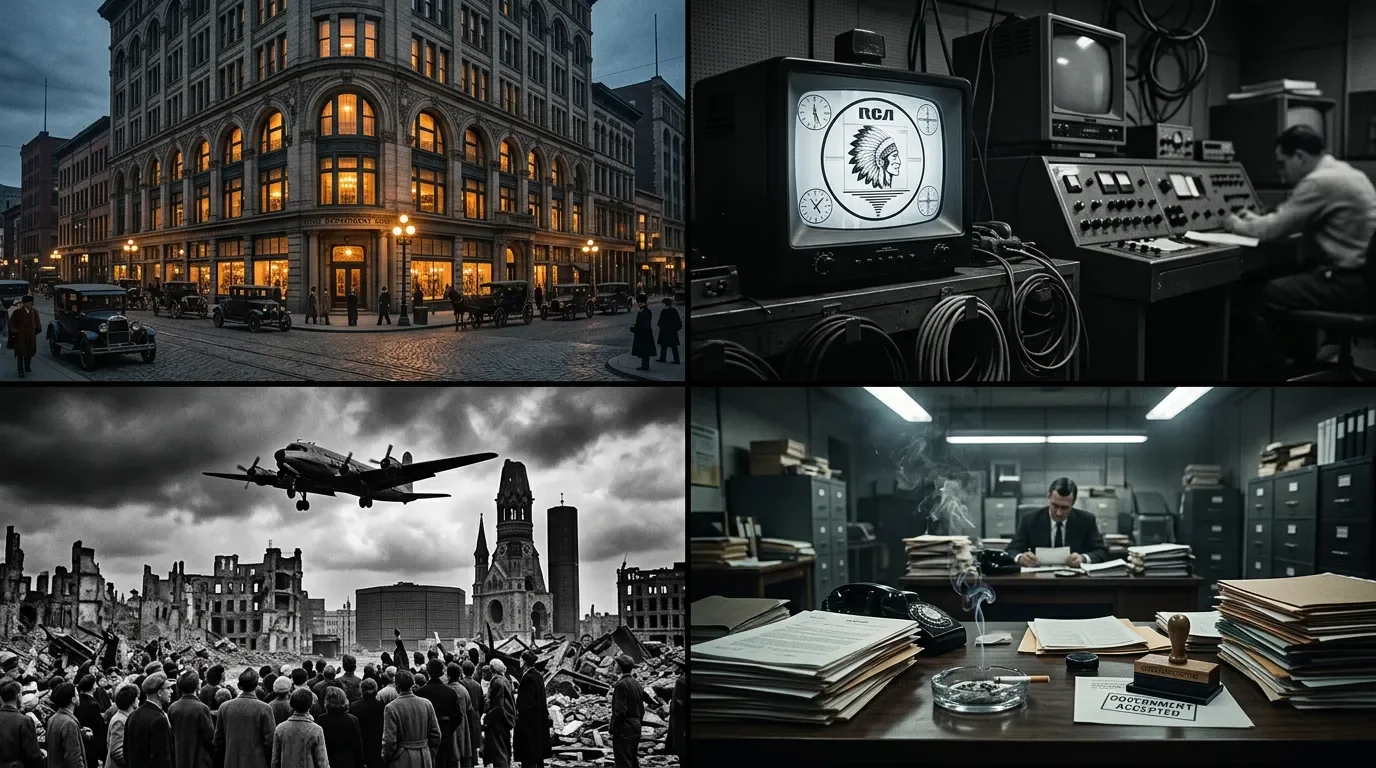
June 24 in business history: Target, commercial TV, the Berlin Blockade, and the warning that took 34 years to stick
On June 24, 1902, an accidental banker opened the Minneapolis dry-goods store that became Target. On June 24, 1941, the FCC issued licenses that turned a nine-dollar clock-face ad into the foundation of a $60 billion TV advertising industry. On June 24, 1948, the Soviet Union blockaded West Berlin — and triggered a logistics operation that moved 2.3 million tons by air in 15 months. On June 24, 1964, the FTC issued the first mandatory negative product label in US history, which the tobacco industry immediately weakened in Congress, and ultimately settled for $206 billion.
出典:...

On June 24, four decisions spread across six decades drew lines that business still follows. A banker who never meant to become a retailer opened a Minneapolis dry-goods store that would eventually swallow Kmart. A federal agency issued nine licenses that turned a modified test pattern and nine dollars into a $60 billion advertising industry. The Soviet Union blocked every road, rail line, and canal into West Berlin and triggered a logistics operation that modern airlift doctrine still traces back to. And the Federal Trade Commission put the first mandatory negative warning on a legal consumer product, starting a regulatory war the tobacco industry won the first round of — and lost the final one.
1902 — Target's accidental founder
George Draper Dayton was a banker, not a merchant. He moved from upstate New York to Minnesota in 1881 to rescue a failing bank, built his wealth in farm loans and commercial property, and by the early 1900s owned a choice corner at Seventh Street and Nicollet Avenue in Minneapolis. 1 He had put the land under a Presbyterian church. The church burned. He used the insurance payout to build a six-story commercial block — and, to fill it, took a one-third stake in a dry-goods operation called R.S. Goodfellow Company. 2
On June 24, 1902, the renamed Goodfellow Dry Goods opened its doors. The Minneapolis Journal reported that "thousands of men and women were present" and called it "one of the handsomest and best-appointed emporiums in the country." 1 Dayton's recollection, years later, was less triumphant: "Prior to 1902, I had no idea of becoming a merchant." 1 He lost money for the first several years, stopped counting the losses when they passed $100,000, and decided he would simply make it work. 1 The first annual profit arrived in 1906. 2
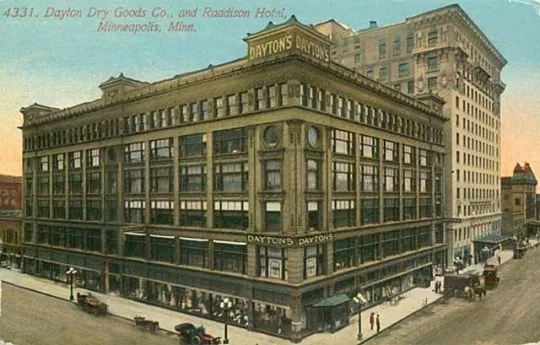
The name changed to Dayton's Dry Goods Company in 1903, then simply Dayton Company in 1910. 3 The business was profitable every year after 1906, and in 1918 Dayton created a philanthropic foundation with a $1 million endowment — later formalized as a 5% annual pretax income pledge that seeded what became the Minnesota Keystone Program for corporate giving. 2
The discount pivot came sixty years after the original opening. On May 1, 1962, Dayton's opened the first Target store in Roseville, Minnesota — 68,800 square feet, more than 75 departments, designed to combine department-store quality with discount-store prices. 4 The name came from Dayton's advertising director Stewart K. Widdess, who worked through more than 200 candidates before settling on one that implied hitting the center bullseye on price-value. 4 The "Tarzhay" mock-French pronunciation appeared almost immediately. 5
When Walmart adopted everyday-low-price in 1987, Target faced a three-way fork: specialize, cut costs aggressively, or differentiate. 6 The first two paths were blocked — Walmart owned the cost position. Target chose design. In 1999, it launched the Michael Graves partnership (water kettles, toasters, birdhouses retailing for $7 to $160) and built a roster of more than 20 designer collaborations over the following two decades. 7 By 2002 Target had passed Kmart as the second-largest US discount retailer. 8
Today the company operates roughly 1,950–1,995 stores, employs approximately 415,000 people, and reported annual revenue of about $104.8 billion in fiscal 2025. 8 It also carries the institutional memory of a $7 billion Canadian expansion that failed completely: 133 stores opened in 2013, all closed by 2015. 3
Decision mirror. Dayton's founding arc is a case study in staying in a bad bet long enough to redesign it. He stopped tracking the losses — not because the losses didn't matter, but because counting them was the wrong frame once the decision to continue had been made. The company's strategic survival in 1987 followed the same logic: Walmart made the price competition unwinnable, so Target stopped competing on price and built a defensible position in design. The question for any leader in a structurally commoditizing market isn't "can we be cheaper?" — it's "what does the customer want that the low-cost player cannot credibly offer?"
1941 — The nine-dollar commercial that launched a $60 billion industry
The FCC did not invent television on June 24, 1941. RCA had been broadcasting experimentally from New York since 1928, David Sarnoff had unveiled a working 441-line system at the 1939 World's Fair after the company spent $50 million across two decades of development, 9 and NBC's experimental station W2XBS had already televised FDR, a Yankees game, and a Republican National Convention. What the FCC did on June 24 was issue FCC Order No. 82 — the formal commercial broadcast license for W2XBS (relicensed as WNBT, channel 1, license No. 1) and W2XAB (relicensed as WCBW, channel 2, license No. 2). 10 11 Ten stations total received commercial licenses effective July 1; only New York's stations went live on that date.
WNBT signed on at 1:30 PM on July 1, 1941, with the national anthem. WCBW was supposed to go live simultaneously — the FCC had told both networks to sign on at the same moment so neither could claim to be first — but a camera failure and lighting problem delayed CBS until 2:30 PM. 12 WNBT, now WNBC, has held the distinction of oldest continuously operating commercial television station in the US ever since.
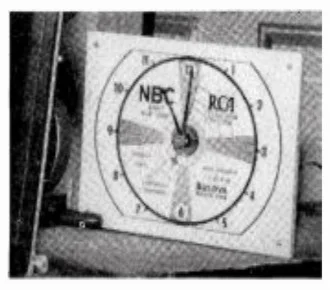
At 2:30 PM, before a Brooklyn Dodgers–Philadelphia Phillies game at Ebbets Field, WNBT aired the first paid television commercial: a 10-second Bulova Watch Company time signal. The format was not a filmed ad. It was WNBT's standard test pattern fitted with clock hands, the Bulova logo, and the text "Bulova Watch Time" in the lower-right quadrant. A second hand swept for one minute while announcer Ray Forrest delivered the line: "America runs on Bulova time." 12 Total cost: $9 — $4 for air fees and $5 for station fees. 13 Bulova ran a second time signal at 11:00 PM the same day. Three other sponsors — Sun Oil, Lever Brothers, and Procter & Gamble — also advertised on WNBT that first day; WCBW and DuMont carried no commercials. 13 No recording of the first commercial survives; the only visual record is a photograph in the July 14, 1941 issue of Broadcasting magazine. 13
There were approximately 4,000 TV sets in the New York area to receive it. 9 World War II froze the consumer market — by 1945, only about 7,000 sets were in use nationally, and the FCC capped New York stations at four broadcast hours per week. 9 Then the market broke open: roughly 9% of US households had a television by 1950, and more than 50 million households — over 85% penetration — by 1960. 9 RCA earned its first profit on television in 1949, 20 years and $50 million after it started. 9 The NTSC 525-line standard set in April 1941 remained the US analog television standard for 68 years, until the digital transition completed in 2009. 14 The US television advertising market the FCC licensed into existence on June 24, 1941 now generates over $60 billion per year. 11
Decision mirror. The nine-dollar Bulova ad is almost always told as a curiosity. The more instructive frame is the return curve: RCA invested $50 million over 20 years before its first profit on television; the Bulova ad's commercial successors now generate $60 billion annually. The FCC's June 24 order was the regulatory gate that let the market open — it didn't create the demand, the technology, or the business model. It removed the legal uncertainty that had kept commercial money on the sidelines. For any investor or executive calibrating patience on an emerging-medium bet, the arc from 4,000 sets in 1941 to 50 million households in 1960 is a useful data point: the gap between a working technology and mass-market economics can be a decade or more, and the gap closes faster than the slow years suggest it will.
1948 — When Stalin miscalculated a logistics problem
The proximate cause of the Berlin Blockade was a currency. On June 18, 1948, the Western Allies announced the Deutsche Mark (DM) — printed secretly in the US and shipped to Frankfurt under Operation Bird Dog — as the new currency for the three western occupation zones. 15 The Soviet Union, which had been inflating the old Reichsmark to fund its occupation costs, viewed the unilateral monetary reform as a violation of the Potsdam agreements and demanded the DM be excluded from Berlin. 16 Within six days, Soviet forces had closed every road, rail line, and canal into West Berlin. On June 24, 1948, the full blockade began — cutting off 2.2 million people from ground supply. 17
The city had roughly 18 to 36 days of food reserves and electricity rationed to two to four hours per day. 15 The Soviets had 40 divisions in the surrounding zone; the Western Allies had eight. 15 Three pre-negotiated air corridors — 20 miles wide, running from Hamburg, Bückeburg, and Frankfurt — remained open under existing written agreements the Soviets could not unilaterally void without a direct act of war.
Gen. Lucius D. Clay, the US military governor, had told Washington weeks earlier: "There is no practicability in maintaining our position in Berlin... we are convinced that our remaining in Berlin is essential to our prestige in Germany and in Europe. Whether for good or bad, it has become a symbol of the American intent." 17 Clay ordered the airlift on June 25. When he asked the Air Force whether it could haul coal, Lt. Gen. Curtis LeMay replied: "We can deliver anything." 18 Operation Vittles launched the following day, June 26, with 32 C-47s hauling 80 tons of milk, flour, and medicine into Tempelhof Airport. 19
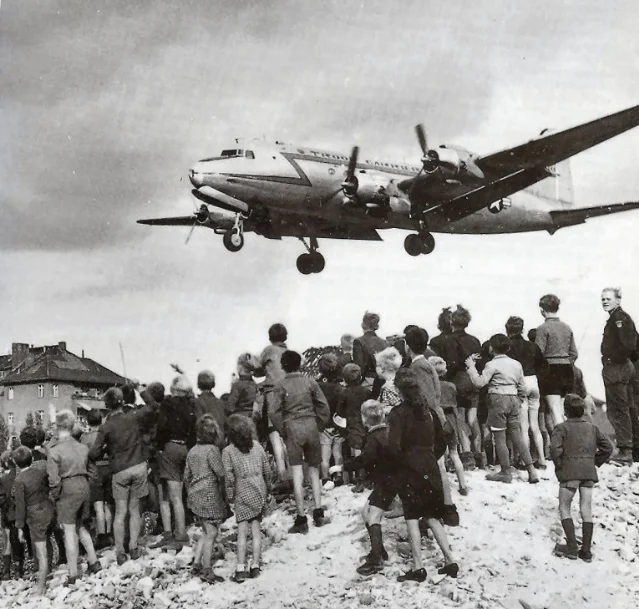
The minimum daily requirement was 4,500 tons — 1,435 tons of food plus 3,084 tons of coal. 15 Maj. Gen. William H. Tunner, who had run the World War II Hump airlift over the Himalayas, took command in late July and systematized the operation. He standardized on the Douglas C-54 Skymaster (10-ton capacity, replacing the older C-47's 3.5-ton capacity), compressed departure intervals to three minutes, banned pilots from leaving their aircraft at Tempelhof, and dispatched mobile snack trucks to the hardstands. 18 Average ground turnaround: 49 minutes. One crew unloaded 10 tons of coal in 5 minutes and 45 seconds.
The operation's high-water mark was Easter Sunday, April 16, 1949: 1,383 flights delivering 12,941 tons of coal in 24 hours — nearly triple the minimum daily requirement, executed without a single accident. 15 By spring 1949 the daily average had reached 8,893 tons. 18 The final tally: 278,228 flights, 2,334,374 tons of supplies over 15 months — roughly 76% flown by the US Air Force, 23% by the Royal Air Force. Total American cost: approximately $224 million; British cost approximately £17 million. 15
The counter-blockade was equally consequential: the Western Allies cut coal and steel shipments to the Soviet zone, squeezing East German industry at the same time the airlift was making the Soviet position look incompetent. 20 The USSR lifted the blockade on May 12, 1949 — having achieved none of its objectives. Within two weeks, West Germany formally constituted itself as the Federal Republic. North Atlantic Treaty Organization membership, which the blockade had accelerated, was already in place. In the December 1948 West Berlin city elections — held during the blockade — nearly 85% of Berliners voted against the communist party. 15
Maj. Gen. Laurence Kuter told the Institute of Aeronautical Sciences in January 1949: "For the first time in peacetime history, strategic air transport has become a conspicuous expression of American air power, peace power, and an effective weapon of diplomacy." 15 The airlift doctrine Tunner established — standardized aircraft, precise scheduling intervals, no deviation for individual heroics — became the foundation for every large-scale humanitarian and military airlift since.
Decision mirror. Stalin's blockade failed because he assumed the Western Allies would face an unsolvable logistics problem and accept defeat. The problem was solvable; it just required choosing a different mode. The decision mirror for today's practitioner is not geopolitical but operational: when a competitor or counterparty blocks your primary supply route, the strategic response is rarely to contest the blocked route. It's to identify which alternative channel is still open and build enough scale in that channel to make the original blockade irrelevant. The Allies had three air corridors guaranteed by written agreement. They used them. By the time the blockade ended, the air corridors had become the dominant supply line — not a workaround.
1964 — The warning nobody wanted to write
On January 11, 1964, Surgeon General Luther Terry released a 387-page report — the product of a committee reviewing more than 7,000 scientific articles — concluding that cigarette smoking caused lung cancer and laryngeal cancer in men, was a probable cause of lung cancer in women, and was the most important single cause of chronic bronchitis. Average smokers faced a 9-to-10 times greater risk of developing lung cancer than non-smokers; heavy smokers, at least 20 times. 21 At the time, approximately 42.6% of American adults smoked. 22
Five months later, on June 24, 1964, the Federal Trade Commission announced a Trade Regulation Rule requiring health warnings on all cigarette packages and advertising — the first time in US history that a government agency had mandated a legally sold product carry a negative statement about itself. 23 The FTC's proposed language was direct: "Cigarette Smoking Is Dangerous to Health and May Cause Death from Cancer and Other Diseases." Packages were to carry warnings starting January 1, 1965; advertising, starting July 1, 1965. 23
The tobacco industry's response was to go around the FTC entirely. Its lobbying arm, the Tobacco Institute, concentrated pressure on Congress, arguing the agency lacked authority to mandate such labeling. 24 The result: President Johnson signed the Federal Cigarette Labeling and Advertising Act on July 27, 1965 — without ceremony, without public comment — which substituted the much weaker language "Caution: Cigarette Smoking May Be Hazardous to Your Health" and imposed a four-year moratorium blocking the FTC from regulating cigarette labeling or advertising at all. 23 Representative Donald Rumsfeld (R-IL) attempted to recommit the House version; the motion failed, and the House passed the industry-friendly bill by voice vote. 23
The escalation continued. The Public Health Cigarette Smoking Act of 1969 — signed by President Nixon on April 1, 1970 — banned all cigarette advertising on American radio and television effective January 2, 1971. 25 In a piece of legislative irony, the tobacco industry effectively lobbied for this provision: a broadcast ban allowed all companies to exit television simultaneously without antitrust risk, cutting their largest advertising cost without competitive disadvantage. 25 The last cigarette commercial in US television history ran on NBC's The Tonight Show Starring Johnny Carson at 11:59 PM on January 1, 1971 — a Virginia Slims ad timed to slip through before the January 2 effective date. 25 The broadcast networks lost approximately $220 million in annual advertising revenue. 25
Philip Morris' post-regulation pivot illustrated how the industry absorbed the new constraints. The company acquired Miller Brewing around 1969–70, General Foods for $5.6 billion in 1985, and Kraft in a $13.1 billion hostile takeover in 1988. 26 Despite this — cigarettes still accounted for 70.9% of Philip Morris revenue but 93.8% of its profit at the height of diversification. 26 The company renamed itself Altria in 2003. R.J. Reynolds spent the same period as NASCAR's title sponsor: the NASCAR Winston Cup Series (1971–2003) was built specifically to replace the broadcast advertising the 1971 ban had eliminated, reaching millions of viewers through televised races without violating the letter of the law. 27
The final accounting arrived in November 1998. The four largest tobacco companies — Philip Morris, R.J. Reynolds, Brown & Williamson, and Lorillard — signed the Master Settlement Agreement with 46 state attorneys general, agreeing to pay at least $206 billion over 25 years (with annual payments continuing in perpetuity), ban outdoor billboards and cartoon characters, and disband the Tobacco Institute. 24 Mississippi Attorney General Mike Moore, who filed the first state case in 1994, put the logic plainly: "The lawsuit is premised on a simple notion: you caused the health crisis; you pay for it." 24
The smoking rate has fallen from 42.6% of US adults in 1965 to 9.9% in 2024 — the first time it has dipped below 10%. 22 Youth smoking dropped from 36.4% in 1997 to 3.8% in 2021. 22 Smoking-related illness still costs the US more than $300 billion annually — nearly $170 billion in direct medical care and $156 billion in lost productivity. 22
Decision mirror. The FTC's June 24 order is a clean case of a regulatory first strike that the regulated industry immediately converted into a weaker outcome — and then spent the next three decades paying for the delay. The tobacco industry won the short game: it replaced the FTC's strong language with a vague caution, bought four years of moratorium, and exited broadcast advertising on its own terms. It lost the long game decisively: $206 billion in settlement payments, a brand value that required a corporate name change to escape, and a 73% decline in its core customer base over 60 years. For any industry negotiating its first mandatory disclosure or safety requirement, the tactical win of weakening initial language is often the strategic loss that shapes the eventual settlement.
June 24 runs a thread through all four events: a decision that looked manageable at the moment — an accidental retailer, a nine-dollar ad, a logistical chokepoint, a weakened warning label — that compounded for decades in ways the original decision-makers could not fully see. Dayton's $100,000-plus in retail losses became a $104.8 billion revenue business. Bulova's nine-dollar test pattern became the regulatory foundation for $60 billion in annual TV advertising. Stalin's blockade accelerated NATO, West Germany, and the political legitimacy of Western Europe. The FTC's overridden warning became the most litigated product-liability arc in American consumer history — and a 73% decline in the behavior it was trying to constrain. None of these outcomes fit neatly in the frame available on June 24 of their respective years.
参考ソース
- 1MinnPost: With retail coming to a close in the old Dayton's building
- 2Minnesota Historical Society / MNopedia: Dayton's
- 3Wikipedia: History of Target Corporation
- 4Target Corporate: Cheers to 60 Years!
- 5Time: Happy Birthday, Target
- 6Forbes: Target Hits The Mark By Going Beyond Cheap And Chic
- 7Target Corporate: 20 Years of Designer Partnership
- 8Encyclopaedia Britannica: Target Corporation
- 9Early Television Museum: RCA TV Development 1929–1949
- 10Fandom TV Stations Wikia: WNBC
- 11Wikiwand / Wikipedia: WCBS-TV
- 12Television Academy: July 1, 1941 — The Day Commercial Television Was Born
- 13Television Obscurities: Tales of Lost TV — The 1st Authorized Commercial
- 14Eyes of a Generation: May 2, 1941 — Commercial Television Becomes a Reality
- 15Wikipedia: Berlin Blockade
- 16Encyclopaedia Britannica: Berlin blockade
- 17U.S. Department of State — Office of the Historian: The Berlin Airlift, 1948–1949
- 18Smithsonian National Air and Space Museum: Supplying a City by Air
- 19Air Mobility Command Museum: Operation Vittles
- 20BBC Bitesize: Events during The Berlin Blockade
- 21CDC: A History of the Surgeon General's Reports on Smoking and Health
- 22American Lung Association: Overall Smoking Trends
- 23University of Delaware ACSC: Federal Cigarette Labeling and Advertising Act — The Legislation
- 24Wikipedia: Tobacco Master Settlement Agreement
- 25Wikipedia: Public Health Cigarette Smoking Act
- 26Center for the Study of Tobacco and Society, University of Alabama: Diversification
- 27Center for the Study of Tobacco and Society, University of Alabama: Racing
このコンテンツについて、さらに観点や背景を補足しましょう。