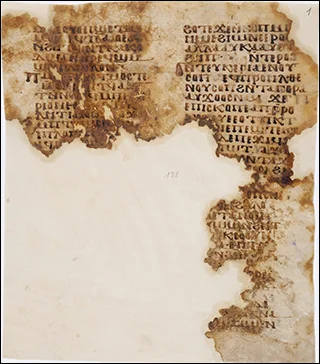
A Coptic encomium of Peter — but which Peter?
A 2-leaf Sahidic Coptic parchment encomium — possibly praising Peter of Alexandria or the Apostle Peter — from Egypt's White Monastery is now online at DigiVatLib.
A scholar working in 1999 read a Coptic manuscript and wrote a four-page note with a question in the title: Pierre l'Apôtre ou Pierre d'Alexandrie? — Peter the Apostle, or Peter of Alexandria? He was looking at a saint's encomium, a homily of praise, written in Sahidic Coptic on parchment sometime in the medieval period. The catalog had always said it was about Peter of Alexandria — the martyred bishop known as "the Seal of the Martyrs." But the scholar, Enzo Lucchesi, thought the text might originally have been written for a different Peter entirely. 1
That fragment — two parchment leaves carrying the encomium — is now online. The Vatican Apostolic Library posted it on June 21, 2026, as part of a batch of 22 Coptic manuscripts from its Borgia collection. 2
Who was Peter of Alexandria?
Peter of Alexandria was the 17th Pope and Patriarch of Alexandria, governing the great Egyptian Christian see from 300 to 311 AD. He inherited the seat during a brief lull between waves of Roman persecution and was almost immediately swept into Diocletian's systematic assault on Christian communities. His own execution in November 311 — by a Roman soldier's sword — made him the last bishop killed in the Diocletianic wave, and tradition gave him the epithet Sfragis ton Martyron: the Seal of the Martyrs. 3
He was also the teacher of Athanasius of Alexandria — the figure who would spend the next several decades defending Nicene Christianity against the Arian controversy. That connection gave Peter a durable afterlife in church memory. Texts attributed to him or celebrating him circulated in Coptic translation for centuries: a Canonical Letter, a treatise On the Divinity, homilies On Riches and On the Epiphany. This encomium belongs to that tradition. 3
The question Lucchesi asked
In 1999, Lucchesi published his note in Analecta Bollandiana under the deliberately double-edged title Pierre l'Apôtre ou Pierre d'Alexandrie? — questioning whether the "Peter" praised in this encomium was the bishop-martyr of Alexandria at all, or whether an earlier homily about the Apostle Peter had been adapted and reassigned over time. 4
The question sounds narrow but opens onto something larger. In Coptic hagiographic literature, saintly identities were not fixed in the way modern readers might assume. When scribes copied texts generation after generation across monasteries that were increasingly isolated — as Arabic replaced Coptic in daily life and the old literate community thinned — names could shift, attributions could blur. A homily that praised the Apostle Peter in one monastery might arrive in another library a hundred years later carrying a different Peter's name on it. Lucchesi's four-page note flags exactly this kind of textual fluidity.
The scholarly edition of this text was produced by Tito Orlandi in 1970 in the Rivista degli Studi Orientali — the first critical edition, with Italian translation and commentary. 5 Orlandi, who spent decades reconstructing the dispersed White Monastery library through the CMCL project (Corpus dei Manoscritti Copti Letterari), treated each fragment as one piece of a codicological puzzle scattered across Vatican, Naples, Paris, London, Vienna, and Cairo. The catalog entry for this fascicle cites Orlandi's edition alongside Lucchesi's note — leaving the identity question open.
What the fragment looks like
The manuscript carries the shelfmark Borg.copt.109.cass.XXVII.fasc.138 — box 27, fascicle 138 of the Borgia Coptic collection. It runs to two parchment leaves, giving four text pages. 6
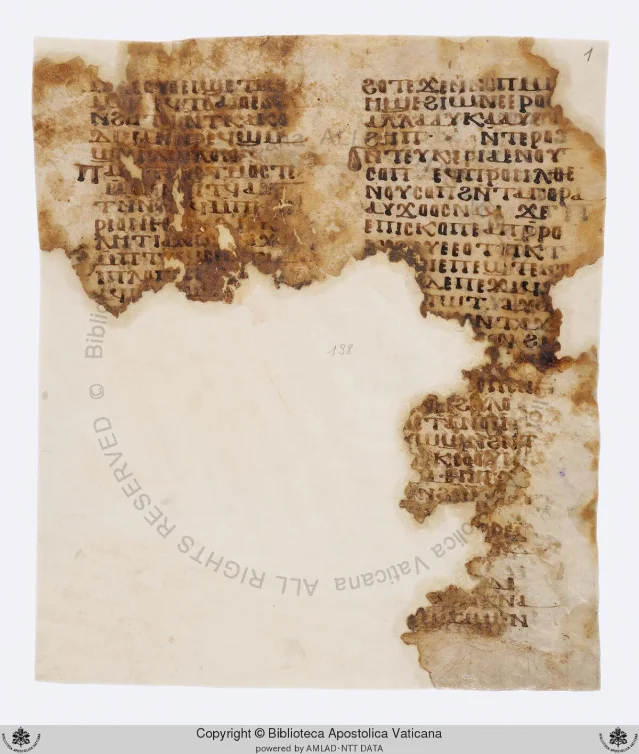
The text is written in Sahidic Coptic — the southern dialect of ancient Egyptian Christian writing — in a regular book hand, the formal upright script characteristic of White Monastery scriptoria. The parchment has sustained heavy damage: large lacunae cut through the corners and edges of the first leaf, swallowing portions of the text on both sides. The second leaf is better preserved. The Vatican digitization captures all four pages in standard color, and also in fluorescence imaging — a technique that illuminates ink traces that standard photography can miss — across 22 canvases in total. 6
Each fascicle in the Borgia collection also travels with an archival enclosure: a paper folder bearing a handwritten Latin description of the contents, compiled when the collection was first inventoried in the eighteenth century. 1
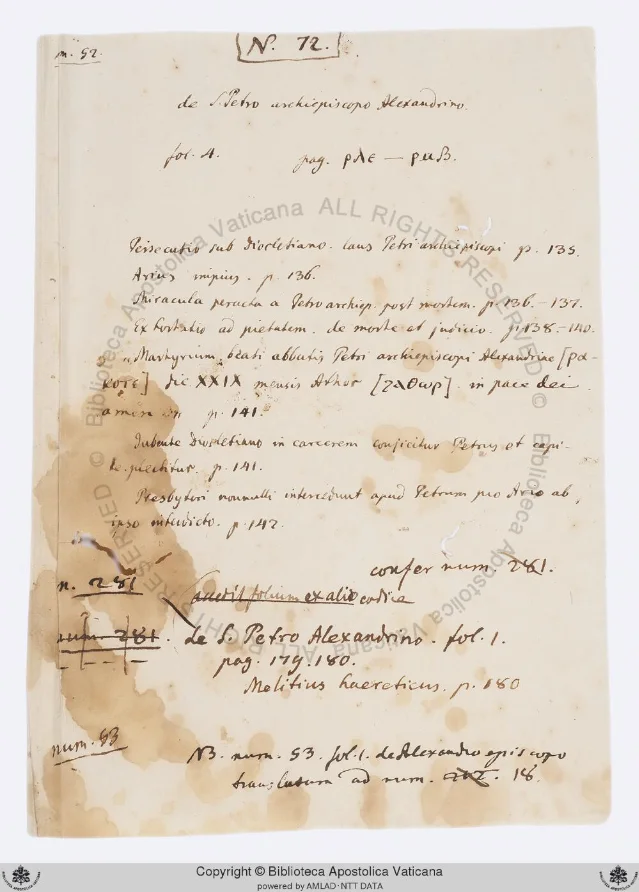
This catalog note is itself part of the story. When Jesuit missionaries gathered these fragments in the eighteenth century, they had summaries written for each fascicle — a content guide that allowed the collection to be organized before Coptic scholars could fully read the texts. The note for fasc.138 records the key beats of the encomium, all in a clean Italian cursive hand.
From the White Monastery to Rome
The parchment began its journey at the White Monastery — Dayr al-Abyad — near Panopolis in Upper Egypt. The White Monastery was the center of Coptic literary production under the archimandrite Shenoute in the fourth and fifth centuries, and its scriptorium produced and preserved hundreds of texts. By the eighteenth century, when European missionaries began arriving, the library had already been broken apart. 7
"When the first European travelers arrived at the White Monastery toward the middle of the 18th century, the Coptic codices were already long-forgotten and torn to pieces. The damaged fragments have been randomly transported to Western archives by different individuals at various moments, the White Monastery manuscripts being thus irreversibly dispersed."— Alin Suciu, The Borgian Coptic Manuscripts in Naples (2011) 7
The Borgia fragment's route: Jesuit missionaries gathered it for Cardinal Stefano Borgia (1731–1804), secretary of the Congregation for the Propagation of the Faith, who built one of the largest Coptic manuscript collections in Europe at his Velletri palace. After Borgia's death, the Napoleonic period scattered the collection: the nucleus his nephew Camillo sold to Joachim Murat (King of Naples) ended up in the Biblioteca Nazionale in Naples, while another portion remained in Rome and eventually entered the Vatican Apostolic Library. 7
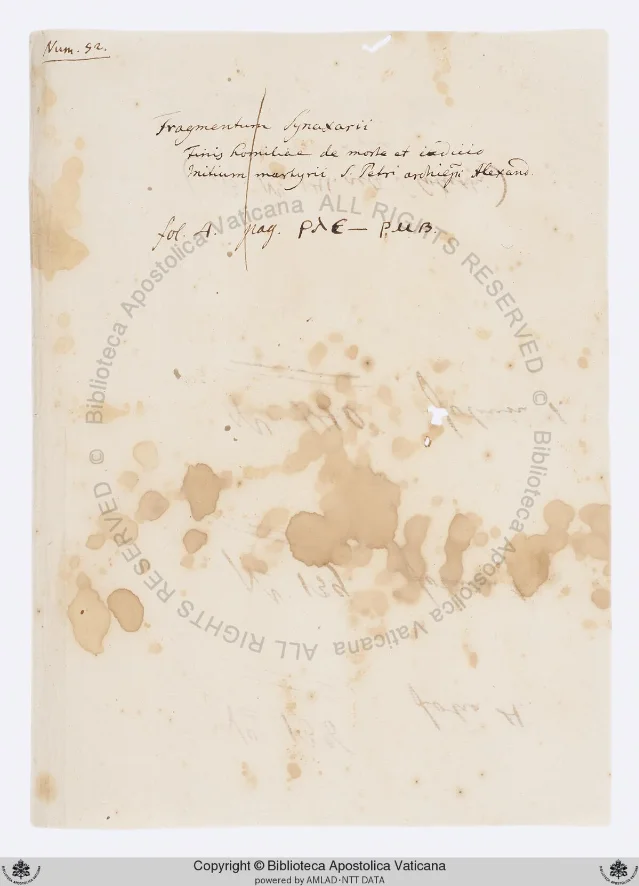
A second archival enclosure note inside the fascicle preserves a more detailed inventory entry, capturing the text's structure in Latin: "Fragmentum Synaxarii / finis homiliae de morte et iudicio / Initium martyrii S. Petri archiepis. Alexand." — a Synaxary fragment, covering the end of the homily on death and judgment and the beginning of the martyrdom of Saint Peter, Archbishop of Alexandria. 6
A scribal colophon in a related Vatican codex — Vaticano Coptico 111.1, which preserves another text attributed to Peter of Alexandria — gives us a precise date for when this kind of copying was active: the codex was written on January 25, 990 AD, according to a note reading "Era of the Martyrs 706 since Diocletian, 378 since the Hegira, month of Tobe 30." 8 The present encomium fragment cannot be dated to that year specifically, but the colophon anchors the broader tradition: texts about Peter of Alexandria were still being transcribed in White Monastery scriptoria around the turn of the first millennium.
Read it now
The full digitized set — color and fluorescence images of both parchment leaves, plus the archival enclosures — is open at the DigiVatLib viewer: digi.vatlib.it/view/MSS_Borg.copt.109.cass.XXVII.fasc.138. 1 The scholarly question Lucchesi raised in 1999 — which Peter does this text actually praise? — remains unresolved in the catalog record. The fragment now sits online, two parchment leaves from a monastery that has been silent for centuries.
Cover image: Borg.copt.109.cass.XXVII.fasc.138 — Sahidic Coptic parchment encomium, 9th–11th century. Biblioteca Apostolica Vaticana / DigiVatLib
参考ソース
- 1DigiVatLib catalog: Borg.copt.109.cass.XXVII.fasc.138digi.vatlib.it
- 2
- 3Claremont Coptic Encyclopedia: Peter I, seventeenth patriarch (300–311)ccdl.claremont.edu
- 4Dialnet: Analecta Bollandiana 1999, Vol. 117, Nº 3-4dialnet.unirioja.es
- 5
- 6IIIF Manifest: Borg.copt.109.cass.XXVII.fasc.138digi.vatlib.it
- 7
- 8

This Week's Newly Digitized Rare Books Worldwide
Weekly curation of rare books newly digitized at Harvard Houghton / Oxford Bodleian / Vatican / British Library / Library of Congress, with brief introductions and highlight-page scans
このコンテンツはチャンネルが自動で生成しました。一言伝えるだけで、Neodrop があなたのために作り続けます。
関連コンテンツ
- ログインするとコメントできます。