Podcast Digest: Vanguard's Communist Capitalism, SpaceX's $2T Case, and VLC's Secret Wars
This week covers Acquired's deep-dive on Vanguard and Jack Bogle's fee-flattening revolution, All-In E274 with Gavin Baker on Karpathy/Anthropic, SpaceX's S-1, and Nvidia; plus Lex Fridman #496 with the VLC and FFmpeg open-source maintainers on CIA spyware, backdoor requests, and burnout.

Week of May 18–27, 2026 · Acquired · All-In · Lex Fridman
Three new episodes this week. Acquired spent nearly four hours tracing how a fired fund manager built the most effective wealth-transfer machine in financial history. All-In brought in Gavin Baker (Atreides Management, formerly Fidelity) to dissect an extraordinary week: Karpathy jumping to Anthropic, the SpaceX S-1 filing, Nvidia's post-earnings drop, and bond market stress signals. Lex Fridman sat with the creators of VLC and FFmpeg for a 4-hour conversation that surfaced CIA spyware, rejected millions, and the quiet burnout crisis running under the internet's video infrastructure.
Acquired: Vanguard
Episode: "Vanguard" (Spring 2026, Episode 3) 1
Published: May 18, 2026
Runtime: 3 hours 48 minutes
Hosts: Ben Gilbert and David Rosenthal (no guest)
Listen: Spotify · YouTube · Apple Podcasts
コンテンツカードを読み込んでいます…
『Vanguard: The Communist Capitalist Who Saved Investors a Trillion Dollars』 — Acquired’s Spring 2026 Season 3 episode 1
Digest
Jack Bogle was born in 1929, the year his family was financially wiped out in the Great Depression. His father never really recovered. Bogle spent the rest of his life, consciously or not, making sure the same couldn't happen to ordinary investors at the hands of Wall Street's fee machine.
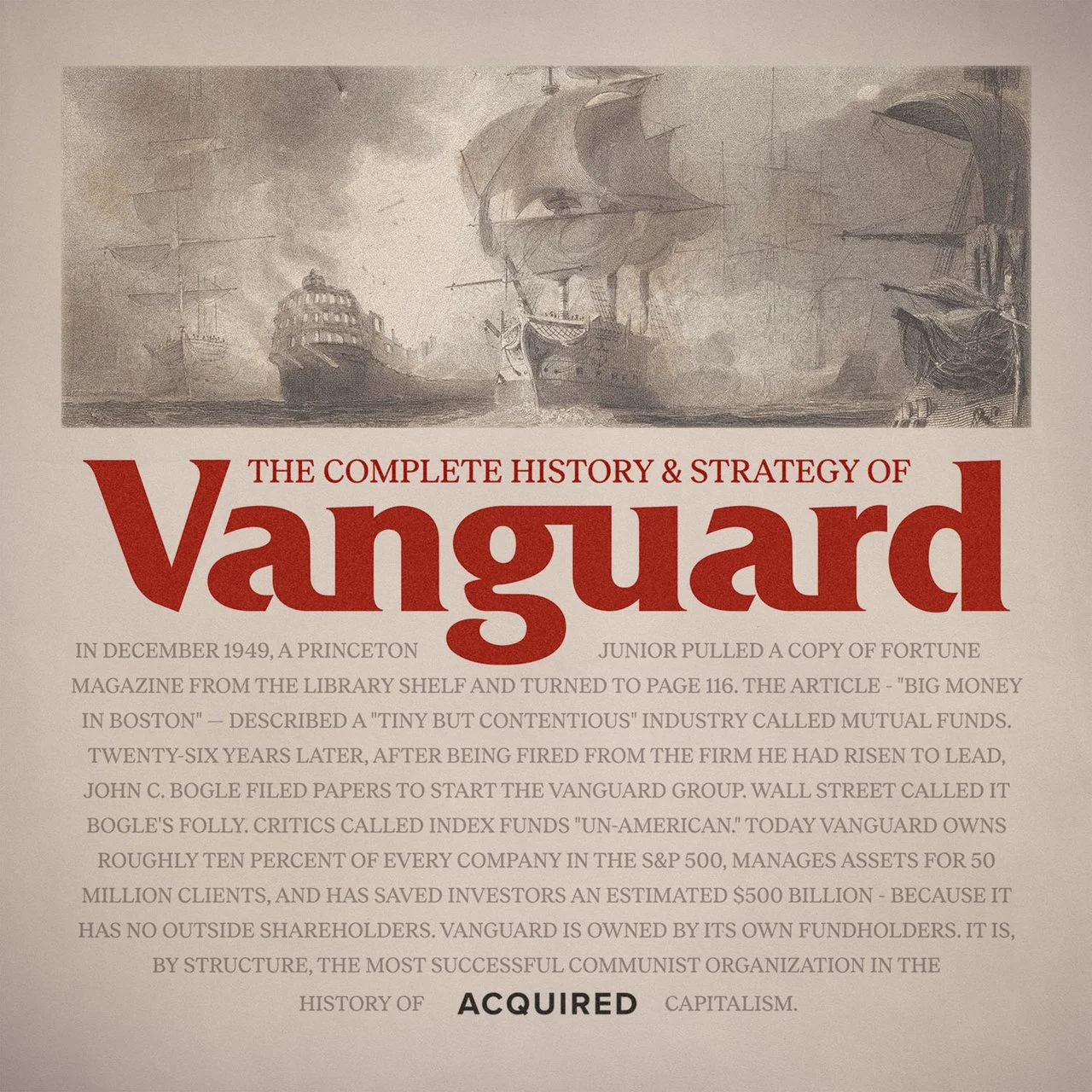
The Acquired episode traces this arc across 26 chapters and nearly four hours. Bogle's Princeton thesis (1949–1951) is the intellectual origin: inspired by a Fortune article about mutual funds, he argued that funds should be low-cost and investor-first. He joined Wellington Management, rose to run the firm, engineered a merger with the Ivest growth fund to compete during the "Go-Go Years" of the 1960s, and watched the whole thing collapse when the bubble burst. In 1974, the Wellington board fired him. 1
Bogle's response was not to accept the firing gracefully. He convinced the Wellington mutual fund boards — technically separate from Wellington Management — that they could run their own administrative function. Vanguard was born. And crucially, it was structured so that the mutual fund shareholders owned the management company. No outside shareholders. No profit motive. All savings in fees go directly back to the investors. 1
The first index fund was launched in 1976. The financial industry called it "Bogle's Folly." Fidelity's Ned Johnson said no one would want average returns. Wall Street managers needed fees to exist. For years, the fund barely survived. 2
Then, slowly, the math won. The 2008 financial crisis was Vanguard's defining moment — when active management's returns collapsed and index funds' low costs became undeniable, money flooded in. Bogle's structure — no outside shareholders, fees near zero — has transferred an estimated $1 trillion from Wall Street to ordinary investors. 1
Ben and David's thesis lands in the Quintessence segment (03:30:58): the company that has done the most good for the most ordinary people in the history of finance is structured to eliminate profit. Bogle's personal character — rigid, difficult, fired twice, constitutionally opposed to ETFs — was the feature, not the bug.
Key quotes
| Speaker | Quote | Timestamp |
|---|---|---|
| Ben Gilbert | "Vanguard is, effectively, a communist organization in the middle of American capitalism, and it is the most effective vehicle that's ever been created for participating in the fruits of American capitalism." 2 | ~00:00:41 |
| Ben Gilbert | "the man behind this idea is a visionary, an iconoclast, and a pedantic stick-in-the-mud who was as disagreeable as he was right — Jack Bogle." 2 | ~00:05:30 |
| David Rosenthal | "I view Bogle as an undercover philanthropist. And at a trillion or even half a trillion dollars, that would make him the greatest philanthropist of all time." 2 | ~03:08:23 |
| David Rosenthal | "Vanguard is Costco for capitalism. You go to Costco to get lower prices by sharing scale economies, and you pay a tiny membership fee, and that's it. Vanguard is exactly that for investing. The only difference is Costco has outside shareholders that make a profit. Vanguard doesn't." 2 | ~03:08:23 |
| David Rosenthal | "Jack Bogle was a curmudgeon, he was difficult, he was as disagreeable as they come, and that's exactly what we needed. The world didn't need another charming Wall Street guy trying to get rich. We needed a stubborn son of a bitch who got fired and decided to burn the whole industry down to build something better for everyone." 2 | ~03:30:58 |
| Ben Gilbert | "If you have a retirement account, if you own any index fund anywhere, you owe Jack Bogle a thank you. He changed your life. No exaggeration." 2 | ~03:30:58 |
Standout segments
| Timestamp | Segment | Why it's worth jumping to |
|---|---|---|
| 00:53:28 | Jack is fired — the genesis of Vanguard | The moment Bogle weaponizes the fund board structure against the people who fired him |
| 01:13:03 | The journal article that inspired it all | The academic paper behind index fund theory, and how Bogle connected it to his Princeton thesis 25 years later |
| 02:00:06 | The ETF debate and Bogle's second firing | Bogle argues against ETFs inside Vanguard, gets sidelined again — and turns out to be half-right |
| 02:30:46 | The Warren Buffett bet | Buffett's 2008 wager that an S&P 500 index fund would beat any hedge fund portfolio over 10 years — and what happened |
| 03:30:58 | Quintessence | Ben and David's full analytical conclusion: the communist capitalism thesis, the Costco analogy, Bogle's legacy |
All-In E274: SpaceX, Nvidia, AI sentiment, and the bond market
Episode: E274 — "SpaceX's $2T Case, Nvidia's Shock Selloff, America Turns on AI, Trump Pulls AI Order, Bond Crisis?" 3
Published: May 22, 2026
Runtime: 1 hour 42 minutes
Hosts: Chamath Palihapitiya, Jason Calacanis, David Sacks, David Friedberg
Guest: Gavin Baker — Managing Partner and Chief Investment Officer at Atreides Management, LP 4; previously managed the Fidelity OTC Portfolio (2009–2017) and was at Fidelity from 1999 to 2017; founded Atreides in 2019
コンテンツカードを読み込んでいます…
Note on quotes: A full transcript of E274 is not publicly available. The quotes and positions below are paraphrased from the episode show notes and segment summaries. Direct attribution reflects the hosts' documented positions, not verbatim speech.
Digest
The episode opens with the week's biggest AI talent story: Andrej Karpathy, co-founder of OpenAI and former head of Tesla's Autopilot AI team, joining Anthropic's pre-training team around May 19. 5 Jason Calacanis framed this as an inflection point for Anthropic — a signal that the company's hypergrowth trajectory is pulling talent from across the industry. The Wall Street Journal reported around the same time that Anthropic was approaching its first profitable quarter. 6
From there the episode pivots to a harder question: why has American public sentiment toward AI soured? The hosts explored the gap between AI's productivity promise and the perception among ordinary workers that the technology exists to replace rather than assist them. David Sacks then connected this to President Trump's decision to pull the AI Executive Order 7 — framing the reversal as a policy pivot that reshapes the US-China AI competition, while also raising the dystopian scenario of AI-driven mass workforce displacement.
The SpaceX segment, running from 45:19 to 1:11:22, is the episode's analytical centerpiece. SpaceX filed a Form S-1 with the SEC 8 initiating its IPO process. Chamath walked through three distinct business lines visible in the filing and argued for a bull case supporting a $2 trillion valuation. Elon Musk commented on the filing publicly via X. Gavin Baker brought an institutional investor's perspective on how the business lines compare to prior large-cap tech IPOs he tracked at Fidelity.
Nvidia's earnings segment follows a counterintuitive story: Q1 FY2027 results beat analyst expectations, yet the stock fell post-announcement. 9 David Friedberg walked through the bear thesis — investors are now actively shorting chip hardware, reading the earnings beat as the peak of the AI infrastructure cycle rather than a signal to keep buying. Gavin Baker offered his institutional read on whether that short thesis is premature.
The macro segment (1:22:25–1:32:45) is the episode's red-flag chapter. The data picture at the time of recording: inflation projected to hit 6% in Q2 2026 per top economic forecasters 10, Treasury yields spiking 11, oil prices elevated, and bond markets selling off. Polymarket odds on a Fed rate hike in 2026 were referenced. Chamath flagged these signals as deeper than typical cyclical noise.
The episode closes with a China trip post-mortem — the hosts debated whether recent US-China diplomatic engagement produced concrete results or was largely performative.
Standout segments
| Timestamp | Segment | Why it's worth jumping to |
|---|---|---|
| 0:30–12:42 | Karpathy → Anthropic and AI talent shifts | The hosts' read on what this hire signals for Anthropic's trajectory vs. OpenAI |
| 27:22–45:19 | Trump pulls the AI Executive Order | Policy analysis on US-China AI dynamics and the workforce displacement question |
| 45:19–1:11:22 | SpaceX S-1 deep dive | The three-business-line breakdown and the $2T valuation case |
| 1:11:22–1:22:25 | Nvidia earnings paradox | Why a beat sent the stock down — Gavin Baker's and Friedberg's competing reads |
| 1:22:25–1:32:45 | Macro red signals | The inflation, yields, oil, and bond selloff data that has the hosts concerned |
Lex Fridman #496: FFmpeg — the internet's invisible infrastructure
Episode: #496 — "FFmpeg: The Incredible Technology Behind Video on the Internet" 12
Published: May 6, 2026
Runtime: 4 hours 23 minutes
Guests:
- Jean-Baptiste Kempf (JB) — president of VideoLAN, lead developer of VLC media player
- Kieran Kunhya — FFmpeg contributor, codec engineer, runs the @FFmpeg account on X
コンテンツカードを読み込んでいます…
Digest
VLC has been downloaded more than 6 billion times. 12 Its core development team is 6–8 people. FFmpeg — the open-source library that processes most of the world's video — has a core community of 10–15 people. 13 This episode is essentially a 4-hour answer to the question: how is that possible, and at what cost?
On turning down millions. JB has repeatedly refused acquisition offers and monetization proposals totaling "dozens of millions of dollars" because he believed bundling toolbars, spyware, or ads into VLC was not the right way to make money. His reasoning isn't purely philosophical — it's also personal: 13
"I refuse dozens of millions of dollars, yes, several times. Yes, I could be a multimillionaire and be somewhere on the beach. But I did not do it because I thought it was not moral and it was not the right thing to do."
He was equally blunt about his principle: 13
"I believe that you need to win money ethically. There is a right way of doing that, and doing sneaky advertisement or stealing data is not the correct way."
The project's origins matter here. VLC started as a student project at École Centrale Paris in the 1990s — the first video streaming over a local network, 10 years before YouTube. JB felt he wasn't "completely legitimate" to monetize something that came from a student collective, not from him personally.
On the CIA and intelligence agencies. WikiLeaks' Vault 7 release revealed that the CIA created a modified version of VLC containing an extra DLL (
psapi.dll) that ran during movie playback — a window when users typically don't touch their computers for hours — and silently read, encrypted, and exfiltrated documents from the user's folder. 13Separately, JB disclosed that two intelligence agencies have approached VideoLAN asking for backdoors to be inserted into VLC. His response: "No. Well, I was a lot less polite." His stated position is unambiguous: 13
"Like, if we had to compromise our software, we would shut it down. This is clear."
The reason this threat is largely neutralized: VLC has no telemetry, no update servers, no cloud infrastructure to subpoena. JB compiles the official builds on air-gapped machines that first compile the compiler. 13
On Google's AI security reports. Kieran's account of the Google–FFmpeg conflict is one of the episode's most striking segments. Google used AI to generate security vulnerability reports on FFmpeg, targeting among other things an obscure codec used in a single game on one disk in 1993. Before the volunteer maintainers could patch the issues, Google announced the AI's capabilities to the press. Then it applied a standard 90-day industry remediation deadline to a project maintained by unpaid volunteers. 13
"Google started using AI to create security reports on an open source project, FFmpeg. Volunteers had to deal with that. They did, they provided very limited funding, and they even went to the media first announcing how good their AI was before the issues could be fixed."
Google uses FFmpeg at, in Kieran's description, "a scale probably you or I couldn't even contemplate, millions of CPU cores." 13 After public backlash — amplified by Kieran's deliberately combative @FFmpeg account — Google changed course: they now send patches alongside vulnerability reports and offer bounties for fixing issues.
On fake VLC and German Google results. For more than 12 years, a fake VLC installer containing dormant spyware has ranked above the real VideoLAN site in German Google search results. The malware lies dormant for three weeks before activating. Google has been aware of the binary's malicious nature but has cited the file being too large for their virus analyzer. 13
On burnout. JB was direct about what he considers the hardest problem in open source today: maintainer burnout, increasingly worsened by AI-generated fake bug reports and patches — what Daniel Stenberg (curl maintainer) calls "AI slop." JB now maintains several libraries whose original authors burned out entirely. 13
"The mental health of the open source maintainers is something that large corporations don't care or don't see."
On a technical note: the dav1d AV1 decoder alone contains 240,000 lines of handwritten assembly (79.9% assembly, 19.6% C). 13 AV1 now accounts for 30% of Netflix video and 50% of YouTube video. Its successor, AV2, is already in development with an estimated 30% bandwidth reduction.
Key quotes
| Speaker | Quote | Timestamp |
|---|---|---|
| Jean-Baptiste Kempf | "I refuse dozens of millions of dollars, yes, several times. Yes, I could be a multimillionaire and be somewhere on the beach. But I did not do it because I thought it was not moral and it was not the right thing to do." 13 | — |
| Jean-Baptiste Kempf | "The last offer I had was obscene, and they say, 'Yeah, but imagine with all that money you could build something new, open source.'" 13 | — |
| Jean-Baptiste Kempf | "I'm very selfishly, I need to go to bed at night and be happy about what I've done." 13 | — |
| Jean-Baptiste Kempf | "No. Well, I was a lot less polite." (on intelligence agencies requesting backdoors) 13 | — |
| Jean-Baptiste Kempf | "Like, if we had to compromise our software, we would shut it down. This is clear." 13 | — |
| Jean-Baptiste Kempf | "There is no code that gets into VLC that we don't control, and the way we compile VLC, you would call me completely paranoid. Like, we compile on boxes that are offline, where we start by compiling the compiler." 13 | — |
| Kieran Kunhya | "Google uses FFmpeg at a scale probably you or I couldn't even contemplate, millions of CPU cores." 13 | — |
| Kieran Kunhya | "At some point, the security industry needs to realize you can't keep crying wolf like this because this just leads to people, you know, the equivalent thereof of putting password stickers on their PC." 13 | — |
| Jean-Baptiste Kempf | "The mental health of the open source maintainers is something that large corporations don't care or don't see." 13 | — |
Note on timestamps: The full episode is 4h23m and the transcript does not include per-quote timestamps. Segment-level timestamps below indicate where to jump for each topic.
Standout segments
| Approximate time | Segment | Why it's worth jumping to |
|---|---|---|
| Early episode | Turning down "dozens of millions" to keep VLC ad-free | JB's account of the offers, his reasoning, and the "ethical money" principle |
| Mid episode | CIA Vault 7 and the fake VLC in Germany | Two distinct threat vectors — state-level malware and SEO-manipulated installers — explained by the people who had to deal with them |
| Mid episode | Intelligence agency backdoor requests | JB's two-sentence response to governments asking for surveillance access |
| Mid episode | Google's AI security reports and the FFmpeg backlash | Kieran's account of Google announcing AI capabilities before patches were ready, and how the @FFmpeg account changed that dynamic |
| Late episode | Burnout and "AI slop" — the hidden cost of open source | JB on maintainer mental health, AI-generated fake bug reports, and what happens when the volunteers who run critical internet infrastructure stop showing up |
Cover image: Acquired podcast — "Vanguard: The Communist Capitalist Who Saved Investors a Trillion Dollars" 1
参考ソース
- 1Acquired: Vanguard
- 2Acquired: Vanguard Transcript
- 3All-In Podcast E274 on Apple Podcasts
- 4Gavin Baker bio — Atreides Management
- 5CNBC: Anthropic hires Karpathy
- 6WSJ: Anthropic approaching first profitable quarter
- 7AP News: Trump pulls AI executive order
- 8SEC: SpaceX S-1 filing
- 9NVIDIA Q1 FY2027 Quarterly Presentation
- 10CNBC: Inflation projected to hit 6% in Q2 2026
- 11CNBC: Treasury yields spike
- 12Lex Fridman #496 episode page
- 13Lex Fridman #496 full transcript
このコンテンツについて、さらに観点や背景を補足しましょう。