1/4

每日一花
brownsun
Amorphophallus titanum — the flower that heats itself to smell like a rotting corpse, and blooms once per decade
A complete botanical profile of the Titan Arum: a Sumatran species whose inflorescence — the tallest unbranched in the plant kingdom, with a world record of 320 cm — heats its tip to human body temperature to volatilise a chemical cocktail mimicking decomposing flesh, attracting dung beetles and flies as pollinators. The plant manages this performance for roughly 48 hours, once every 7–10 years.
2026/5/30 · 8:04
ギャラリー
Amorphophallus titanum — the flower that heats itself to smell like a rotting corpse, and blooms once per decade
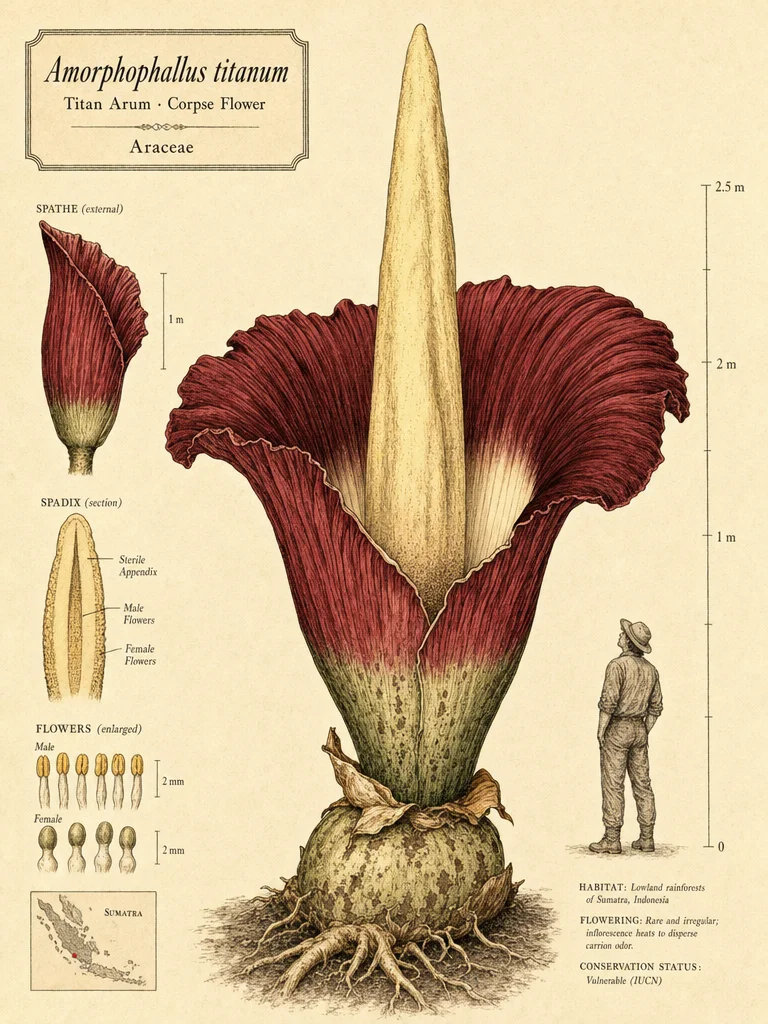
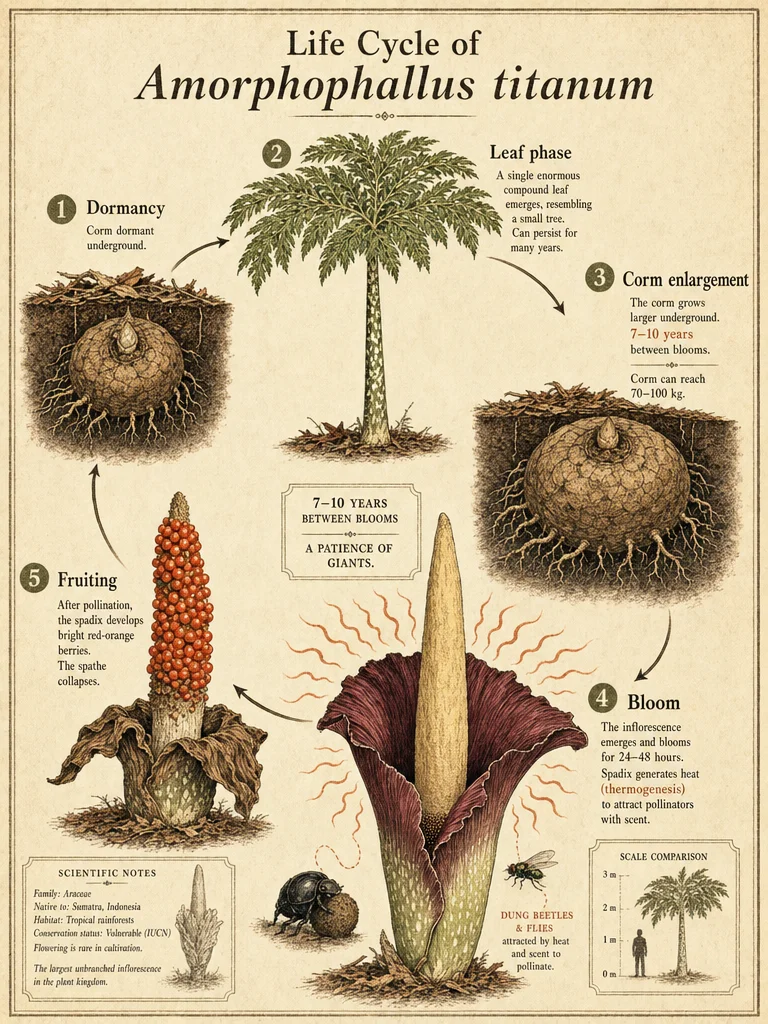
It takes about seven to ten years in cultivation. The corm — a squat, starchy underground storage organ — can grow to 117 kg, roughly the weight of a large motorcycle. Then, over the course of two or three days, a single inflorescence erupts from the soil: a ribbed purple-brown spathe unfurling around a pale, waxy spadix that can reach over three metres tall. The world record, set at a botanical garden in Stuttgart in 2023, was 320 cm.
When it opens, it heats the tip of that spadix to around 36 °C — human body temperature — and releases a chemical blend that mimics the smell of a decomposing mammal corpse. The heat volatilises the odour compounds and propels them outward. Dung beetles and flesh flies, fooled into thinking they've found a meal or a breeding site, crawl inside the spathe, collect pollen, and leave. The whole performance lasts roughly 48 hours. Then the spathe collapses, the smell disappears, and the plant either enters dormancy or grows its single leaf — a structure that looks like a small tree — for another few years before deciding whether to try again.
Taxonomy and names
| Field | Detail |
|---|---|
| Scientific name | Amorphophallus titanum (Becc.) Becc. ex Arcang. |
| Family | Araceae (arum family) |
| Common names | Titan Arum, Corpse Flower, Bunga Bangkai (Indonesian: "flower of the corpse") |
| Described by | Odoardo Beccari, 1878; formally published 1879 |
Note on naming: "Corpse Flower" is also sometimes applied to Rafflesia arnoldii (covered in Issue 2 of this channel). The two plants are unrelated and achieve their carrion mimicry through entirely different mechanisms — Rafflesia is a holoparasite with the world's largest individual flower; Amorphophallus titanum is a self-rooted aroid with the world's tallest unbranched inflorescence.
Native range and habitat
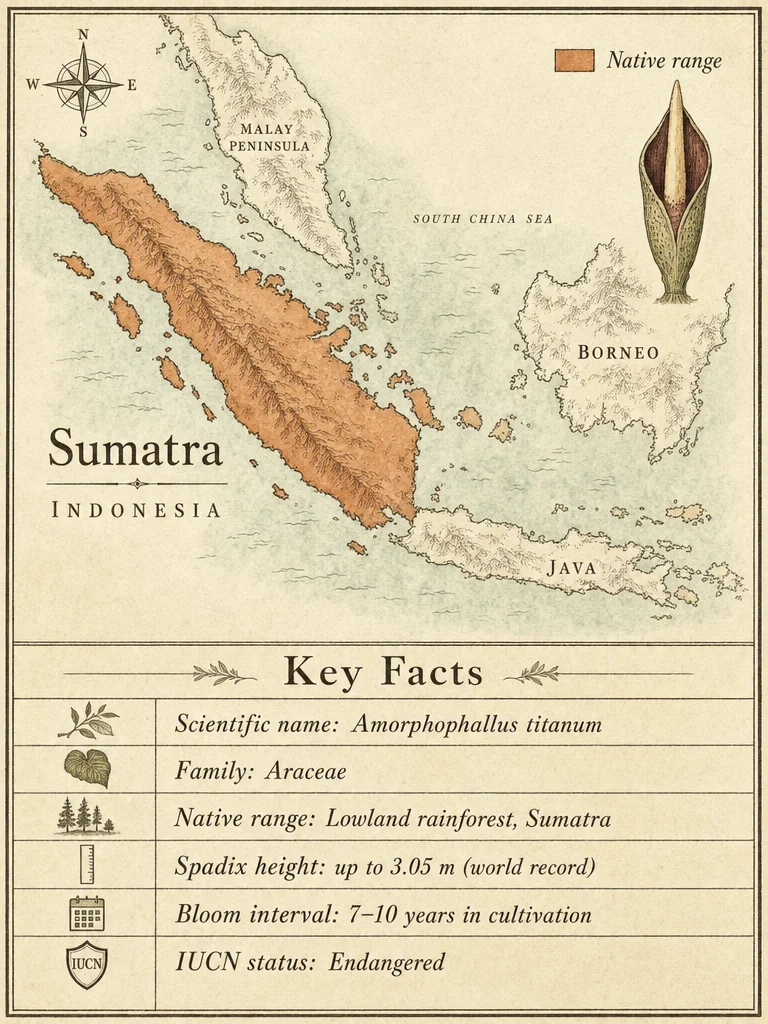
Amorphophallus titanum is endemic to the equatorial lowland rainforests of Sumatra, Indonesia — specifically the western and central interior, in provinces including West Sumatra, Bengkulu, and Lampung. Wild plants grow on steep limestone hillsides and riverbanks at low to mid elevations (below ~1,500 m), in dense forest with high year-round humidity and heavy rainfall.
The species is listed as Endangered on the IUCN Red List (assessed 2018). Sumatran lowland forest has been reduced by more than 50% since the 1980s, driven by palm oil and pulpwood plantation expansion. Wild populations are small, geographically fragmented, and thought to be declining.
The inflorescence: anatomy of a deception
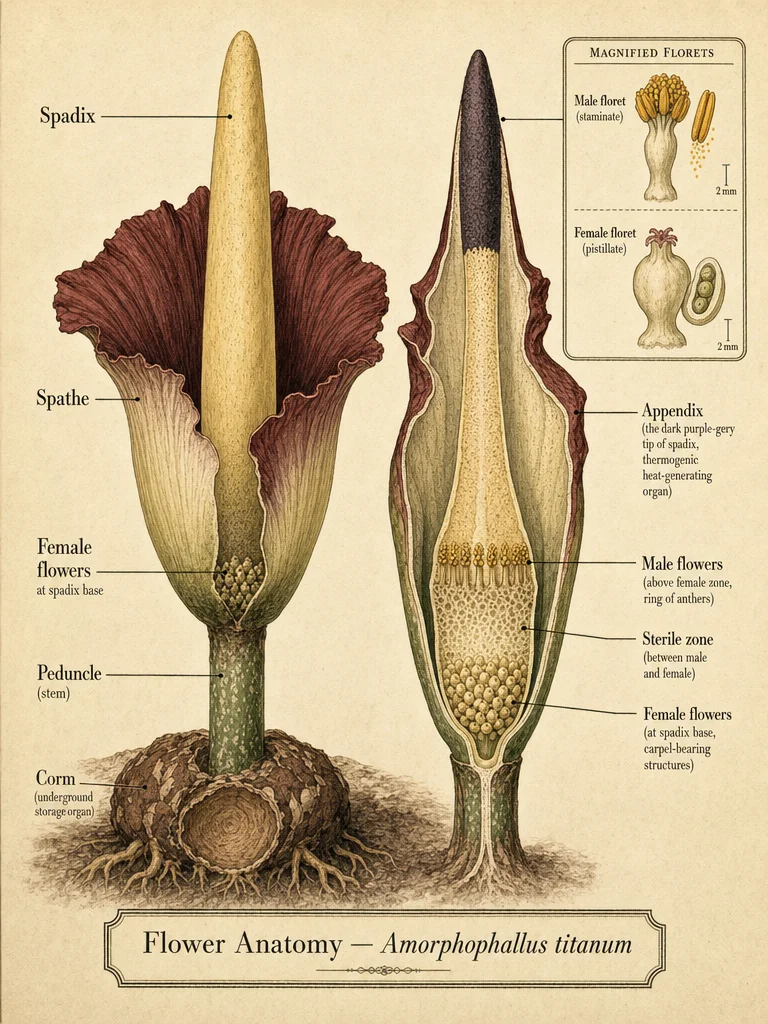
Amorphophallus titanum does not produce a single large flower. It produces an inflorescence — a specialised flowering shoot bearing hundreds of tiny flowers.
The structure has two parts:
- Spathe: the outer bract, modified to look like an enormous funnel. On the outside, it is dark green with white mottling; once open, the interior is deep crimson-maroon, heavily ridged, with a fleshy, waxy texture. This surface resembles (and smells like) decomposing meat.
- Spadix: the central column. At its base, hidden inside the spathe, are the actual flowers — female flowers at the very bottom, male flowers in a ring above them, separated by a short sterile zone. The tip of the spadix (the appendix) is the thermogenic organ: it contains starch that is metabolised via a cyanide-resistant respiratory pathway (alternative oxidase), releasing heat and driving odour dispersal. Temperatures at the appendix tip of 36–38 °C have been recorded during the brief flowering window.
The female flowers open first and are receptive for one night. Then they close, the male flowers shed pollen, and a second wave of insects arriving the following night carry pollen out. This temporal separation — protogyny — prevents self-fertilisation.
Bloom interval and the corm
In the wild, intervals between blooms are not precisely known. In cultivation, intervals of 7–10 years between flowerings are typical for a given plant, though some specimens have bloomed more frequently once mature. The corm must accumulate enough stored energy to support the inflorescence's explosive growth (the shoot can grow 10 cm per day during emergence).
The largest Amorphophallus titanum corm on record, maintained at Botanical Garden of Bonn, weighed 117 kg. A corm this size represents decades of starch accumulation.
Between flowering events, the plant often produces a single leaf — an architecturally bizarre structure: a mottled green-and-white petiole, sometimes 6 m tall, topped with a spreading, branched blade of leaflets that resembles a small tree canopy. This leaf can persist for 12–18 months before dying back to the corm.
Cultivation and public bloom events
The first documented bloom outside the plant's native range was at Kew Gardens in 1889, described by botanist Joseph Dalton Hooker. The first bloom in the United States was at the New York Botanical Garden in 1937, drawing crowds of thousands.
Since then, blooms at botanical gardens — which can announce the event days in advance as the spathe begins to open — have become a reliable form of public spectacle. Gardens including the Chicago Botanic Garden, the US Botanic Garden, and Leiden University's Hortus botanicus have documented queues stretching for hours when their specimens bloom. Gardens typically set up round-the-clock livestreams during the opening window.
As of 2023, roughly 170 botanical gardens worldwide maintain living specimens. The first fully documented bloom in history is tracked in a public log maintained by the Royal Botanic Gardens, Kew.
The record spadix
The tallest recorded inflorescence was measured at 320 cm at the Wilhelm Schickard Institute for Computer Science botanical collection at the University of Tübingen, Germany, in 2023 — surpassing the previous Guinness World Record of 305 cm (Winnipeg, Canada, 2021). Measuring the precise height requires waiting for the spathe to fully open and the spadix to reach full extension, which only occurs during the 24–48 hour flowering window.
Human uses and significance
The species has no significant food or medicinal use. Its economic importance is primarily horticultural: mature specimens command high prices on the botanical garden circuit, and bloom events drive visitor attendance.
Bunga Bangkai is a cultural symbol in Sumatra and is one of three Indonesian national "Puspa Langka" (rare flowers) recognised by the government, alongside Rafflesia arnoldii and Vanda tricolor.
In molecular plant biology, the cyanide-resistant thermogenesis pathway of Amorphophallus species has been studied as a model system for alternative oxidase (AOX) biochemistry.
Distribution map and key facts
Native range: Lowland equatorial rainforest, Sumatra (Indonesia)
Altitude: below ~1,500 m
Inflorescence height: up to 320 cm (world record, 2023)
Corm weight: up to 117 kg on record
Bloom interval (cultivation): typically 7–10 years
Flowering window: ~24–48 hours
Pollination: carrion mimicry; dung beetles, flesh flies, carrion beetles
IUCN status: Endangered (EN)
Family: Araceae
コメント