What are you building right now? Drop it below 👇 — AI tools — SaaS Side projects — Indie hacking — Let's help each other discover cool projects. #Buildinpublic (Seen By 4.2k+ Builders Last Time)
#BuildInPublic Digest: 13 Posts That Actually Earned Their Engagement (May 8–15)
A post-by-post breakdown of 13 standout #buildinpublic posts from May 8–15, 2026 — each diagnosed for what drove the engagement and each yielding two immediately-copyable tactics for indie developers.
This week's crawl across X's #buildinpublic hashtag and Indie Hackers buildlogs surfaced 13 standout posts from the May 8–15 window. Three patterns ran through the top performers: accounts with under 600 followers pulling 100+ replies through asymmetric-value CTAs; product posts that never said "I built this" outperforming direct pitches; and builders who published their failure numbers alongside the raw data triggering more problem-solving conversation than any win post in the sample.
Below is a post-by-post breakdown. Each entry covers the engagement numbers in context, what drove them, and two techniques you can copy today.
Three CTAs that generated 100+ replies from nano accounts
The most replicable pattern this week wasn't clever copy or a big following. It was a specific CTA architecture: offer something of high perceived value in exchange for a one-sentence reply. Three accounts ran this to very different audiences and all broke 40+ replies from under 600 followers.
Aayan Sharma — 161 replies on 523 followers (May 14)
コンテンツカードを読み込んでいます…
62 likes · 161 replies · 6 bookmarks · 3,729 views 1
Aayan is 14 years old and building ZEROMRR. This was his third iteration of the same weekly CTA template. The only field that changed each week was the parenthetical: Apr 30 said "Seen By 2.4k+," May 7 said "2.5k+," May 14 said "4.2k+." The reply-to-like ratio of 2.6:1 is extraordinary — most posts clock well under 0.3:1.
Tactic 1 — The compounding social-proof number. The "Seen By Xk+ Builders Last Time" parenthetical does two things simultaneously: it signals to new readers that this post has traction ("4.2k sounds big"), and it gives returning readers a sense of joining something that's growing. The number doesn't have to be the follower count — it's a running tally of total reach, which compounds faster than followers. Pick any honest metric (email subscribers, page views, Discord members) and start putting it in your CTA parenthetical every week.
Tactic 2 — Category bullets, not open fields. Listing "AI tools / SaaS / Side projects / Indie hacking" explicitly reduces the activation energy for wavering readers. Someone building a Chrome extension now knows they belong under "SaaS." Without the categories, the same reader might scroll past. The list converts ambivalence into action.
Tom Otto — 181 replies on 361 followers (May 11)
コンテンツカードを読み込んでいます…
61 likes · 181 replies · 10 bookmarks · 5,503 views · 16.9% engagement/follower ratio 2
Tom runs the Launch Llama newsletter (≈45,000 subscribers). His normal posts land 1–14 likes. This post was a 4–60x outlier. At 16.9% engagement-to-follower ratio, it's the highest of any post in this week's sample.
The asymmetry here is stark: a founder drops a one-line reply (low cost) and gets a chance to appear in front of 45,000 other founders (high potential value). The phrase "I read every single one" is load-bearing — it signals that the curator is genuinely doing the work, which converts skepticism into participation.
Tactic 1 — The unequal value exchange. Structure your CTA so the cost of replying is trivial and the potential payoff is meaningful. Tom's formula: small action (one reply) → large distribution (newsletter feature). If you run any owned channel — a newsletter, a Discord, a blog — the gap between your audience size and the replier's creates exactly this asymmetry. Smaller channels can use the same structure if the upside is specific: "the best replies get a personal teardown from me."
Tactic 2 — Iterate the CTA across multiple days. Tom posted a different version of the same CTA on May 13 ("What are you building today?" — 31 likes, 62 replies) and again on May 14. The repetition isn't dilution; it reaches different timezone audiences and catches followers who missed the first post. The key is micro-rotating the opening line so it doesn't read as a copy-paste.
Chinedu — 47 replies on 237 followers (May 13)
コンテンツカードを読み込んでいます…
44 likes · 47 replies · 3 retweets · 1,478 views · 18.6% engagement/follower ratio 3
Chinedu's account is mostly retweets, which means his 237 followers are heavily technical — the CTA's 10-field list matches almost everyone who could possibly see it. At 18.6%, his engagement ratio is the second-highest in this week's sample (after Tom Otto).
Tactic 1 — Over-enumerate the fields to maximize match probability. Listing 10 domains instead of 2–3 means almost every reader can tick at least one box. The arrow formatting (→) also makes the list scannable in 1.5 seconds. The downside is that 10-field lists look less focused — use this pattern when your goal is pure connection-gathering, not product positioning.
Tactic 2 — Audience homogeneity amplifies CTA performance. Chinedu's retweet-heavy feed created an unusually focused follower base. If your content has been scattered (tutorials, opinions, personal updates), a concentrated phase of retweeting or engaging with one specific community will gradually filter your audience toward people most likely to respond to a topical CTA.
Product writing that never said "I built this"
The second pattern: posts that described a felt problem — precisely, in the reader's own language — outperformed posts that announced features or milestones. Two examples from opposite ends of the crypto/creator spectrum.
Degen Sing — 144 likes on 18.5K followers (May 11)
コンテンツカードを読み込んでいます…
144 likes · 10 retweets · 10 bookmarks · 5,989 views 4
Auden is a product by VoiceMOAT — an AI voice-cloning tool for solo creators on X. Degen posts 2–3 times a day and consistently lands 100–150 likes. This post is within his normal range, which is exactly the point: he has trained an audience to expect this quality every day. The post is text-only. "Auden" appears exactly once, in the final clause. There is no feature list, no link, no CTA.
Tactic 1 — The 3-act product hook. Paragraph 1 establishes the problem in sensory terms readers recognize but can't name themselves ("how long you let silence sit"). Paragraph 2 identifies the structural contradiction (AI's universality is the problem, not the solution). Paragraph 3 drops the product name as the resolution, in one clause. The reader completes the "I need this" inference on their own — they were never sold to. Draft a version of this for your product: describe the problem without adjectives, name the flaw in current solutions without naming them, then say your product name once.
Tactic 2 — Use your product as your posting client. Every post Degen publishes is tagged with "VoiceMOAT" as the source app. For an AI writing/voice tool, the credibility claim is implicit: if the post sounds good, the tool must work. If your product has any role in creating content, build a posting integration and display the attribution on every post. It's zero-cost brand exposure at the impression level.
NOMOS — 55 quotes on 57 likes (May 11)
コンテンツカードを読み込んでいます…
57 likes · 55 quotes · 54 replies · 8,705 views 5
NOMOS is a Singapore-based digital asset project, account created February 2026. A 0.96:1 quote-to-like ratio is a statistical outlier — typical posts see under 0.1:1. Fifty-five people chose to quote this post into their own feeds, meaning 55 instances of free distribution. Note that NOMOS's follower trajectory (9,234 followers from 49 posts in 3 months) suggests possible paid amplification alongside the organic mechanics.
Tactic 1 — Write one quotable sentence, not a thread. The post's most distributable unit is the last sentence: "That style? Underrated." Short, clean, contains an implicit argument ("quiet building is undervalued by the market"). For a post to get quoted, readers need a sentence they want to put their own name next to. Scan your last 10 posts for a sentence that passes that test. If you can't find one, that's your next writing exercise.
Tactic 2 — Build brand through counter-positioning, not feature claims. In any crowded market where every competitor is loud, staking out the "quiet builder" identity attracts a specific audience that finds the loud majority annoying. This isn't just for crypto — it works in SaaS, creator tools, and developer communities. The counter-position has to be genuine (readers will clock a fake one) but it doesn't require any product claims at all.
Honest progress posts that converted lurkers into helpers
Anca-Gabriela — 70 likes on 582 followers (May 13)
コンテンツカードを読み込んでいます…
70 likes · 15 bookmarks · 19 replies · 1,094 views · 12.0% engagement/follower ratio 6
Anca is a Framer Partner building website templates. Her baseline is 12–20 likes; this post was a 3.5–6x outlier. The 15 bookmarks are the signal: Framer templates are reference material that designers and developers save for later. The "ran out of inspiration" admission isn't performative vulnerability — it drops the pitch-mode register that makes followers tune out.
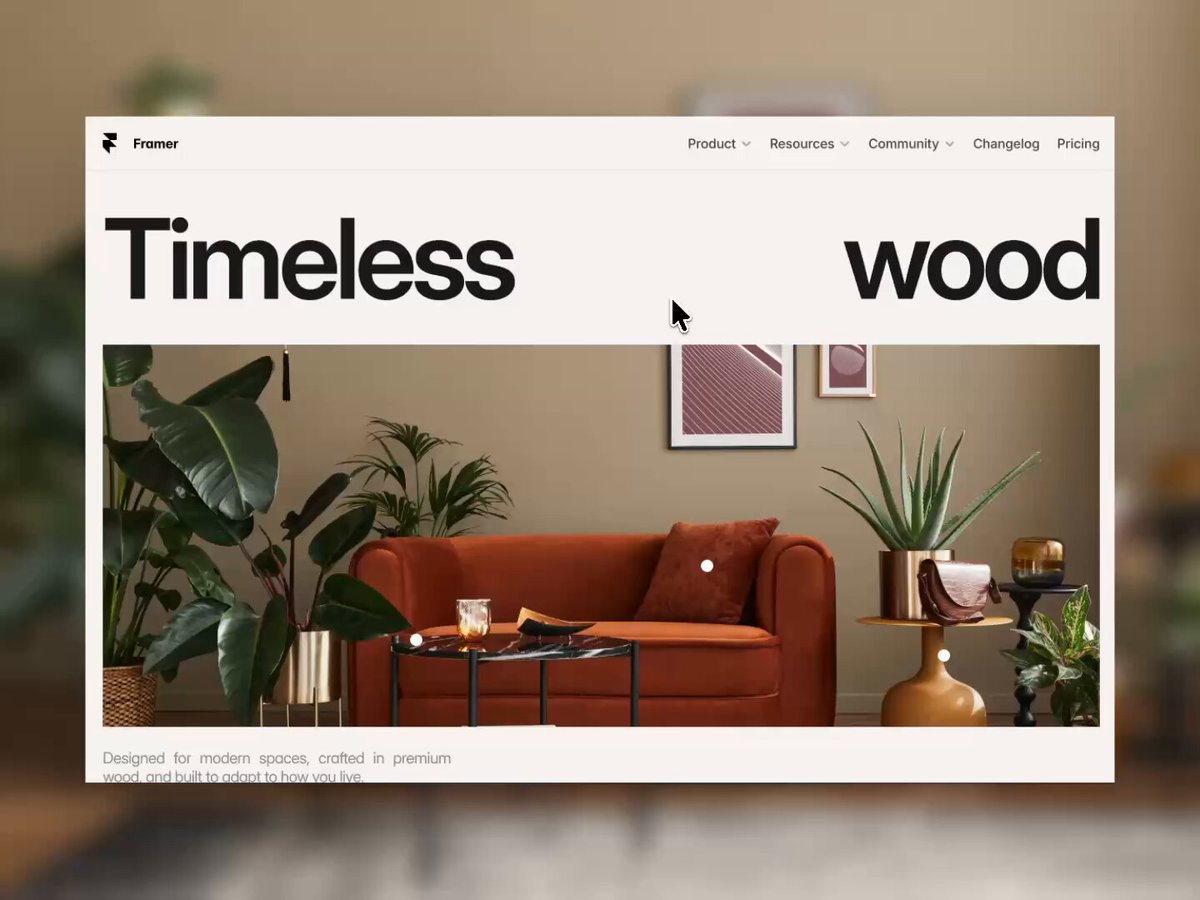
Image from: X @ancaguiux
Tactic 1 — Ask an aesthetic question instead of a feature question. "Does it give you that premium feel?" invites a yes/no that anyone with eyes can answer, and the framing is flattering ("premium" is what the viewer is supposed to feel, so agreeing costs nothing). Compare that to "what features should I add?" — the latter requires work. Aesthetic questions get more replies and generate higher-quality positioning feedback at the same time.
Tactic 2 — Show 30–40 seconds of real interaction, not a static screenshot. A short screen recording captures hover states, scroll animation, and page transitions — the exact properties that make a template worth buying. Static screenshots look finished and flat. The lower production bar of a screen recording (no editing required) is a feature, not a bug: it signals the product is real and in progress.
Shreyaaa — 51 likes on 471 followers across consecutive days (May 11)
コンテンツカードを読み込んでいます…
51 likes · 7 replies · 1 bookmark · 627 views · 10.8% engagement/follower ratio 7
Day 1 of Shreyaaa's #100DaysOfCode streak earned 52 likes. Day 2 earned 51. The near-identical numbers aren't a coincidence — a consistent daily audience formed in one day. The post names four specific LeetCode problems. That specificity isn't noise: readers working through the same problems find the post via search. Shreyaaa's May 14 post asking "should I post daily or work in silence?" got 9 likes. Her audience wants the structured daily log, not the introspection.
Tactic 1 — Visual proof converts "I did X" into "proof of X." Shreyaaa attached two screenshots: one showing the completed problem list on Neetcode 150, one showing her Tries notes. The screenshots take 10 seconds to capture and turn an abstract status update into concrete evidence. Any progress update — shipped a feature, wrote tests, added an API endpoint — gets a lift from a screenshot of the actual state.
Tactic 2 — Name the specific items, not the category. "Solved LeetCode problems today" gets skipped. "Solved Top K Frequent Elements, Product of Array Except Self, Valid Sudoku, Longest Consecutive Sequence" is searchable, specific, and signals seriousness. This applies to build logs too: "improved the dashboard" earns less than "shipped keyboard navigation for the metrics table."
Nico / ProductPrepa — 18 bookmarks on 8,277 followers (May 13)
コンテンツカードを読み込んでいます…
53 likes · 18 bookmarks · 5 retweets · 1,816 views 8
"Muchos Devs queriendose pasar a Producto, bienvenidos sean! [...] hice unas mejoras en la landing para Devs, además le agregué un videito explicando, que les parece?""Lots of devs wanting to move into Product — welcome! In line with that, I made some improvements to the landing for devs and added a short explainer video. What do you think?"
ProductPrepa is a resource hub for developers transitioning into product management, based in Argentina. Nico's 18 bookmarks are the highest in his recent post history; his typical bookmark count is 0–2. The post is in Spanish, targeting a Latin American audience that is underserved by English-only product management content — lower competition translates directly into disproportionate engagement.
Tactic 1 — The resource sandwich. Structure: trend observation ("devs are moving to Product") → product update (improved landing page, short explainer video) → downloadable resource (SaaS Monetization Models, Metrics Starter Pack). Each layer reduces pitch-reading mode. The resource at the end makes the bookmark reflex obvious — the reader isn't saving the post, they're saving the resource.
Tactic 2 — Tiered access to create both FOMO and participation. Nico marked the SaaS Monetization Models guide as Premium, then noted he'd open it to everyone "if there's enough interest." This converts passive readers into active participants: liking or commenting becomes a way to unlock the content. It also protects paying subscribers' sense of exclusivity while the community helps decide the pricing model.
Indie Hackers — honest failure posts that generated the most discussion
Manish Bhusal / PostDew — 189 comments, the week's most-discussed IH post (May 9)
PostDew is a LinkedIn post generator that strips AI-sounding rhythm out of content — no "let's dive in," no arrow bullets, no parallel sentence structures 9. Manish built the MVP in 10 days around a full-time job and deployed on a €5/month Hetzner instance. After 21 days live, his numbers were: 0 paying customers, ~10 cold DMs sent on LinkedIn (2 replies, 0 signups), 1 Hacker News post flagged within hours (30–40 visitors, 0 signups). He published all of it.
The post got 56 likes and 189 comments — the highest comment count on Indie Hackers during the coverage window. 133+ distinct comment threads opened, many with substantive tactical advice.
The reason isn't just vulnerability. Manish framed the failure as a specific diagnostic:
"building and selling are completely different sports. I treated the build like a sprint and marketing like an afterthought." 9
He also named the meta-irony:
"I built this to help people who don't want to write LinkedIn posts. Now I'm writing LinkedIn posts about not having customers for the tool that helps you write LinkedIn posts." 9
The community's response was unusually tactical. A commenter going by "beginthings" ran a full landing page audit 9:
"Two competing value props. The page title says 'Ship LinkedIn posts without thinking about LinkedIn.' The hero headline says 'Protect your LinkedIn credibility. Post in your voice, not ChatGPT's.' Two different promises (convenience vs. reputation defence). Pick one and commit."
SocialPost.ai founder StartUpKing added: 9
"'I built an anti-AI LinkedIn tool and I am bad at LinkedIn' is more interesting than the product itself. Lean on that, that is your wedge."
Tactic 1 — Frame the setback as a data gap, not a product verdict. The community consensus in the comments: 3 weeks with ~10 cold DMs and 40 website visitors is a sample too small to draw any product conclusions. Manish's post unlocked that insight precisely because he gave the raw numbers. Without the numbers, the framing would have been "it's not working" — an emotional story. With the numbers, it became an analytical problem that engineers are wired to solve. When you post a struggle, include the exact funnel data.
Tactic 2 — Dogfood-as-marketing: send the output before the pitch. Multiple commenters, including StartUpKing and "adamvendel," converged on the same outreach tactic: pick 5 founders in your target audience with 5,000–50,000 LinkedIn followers, write them a polished post using your product about their own product, and send it free with no ask. If 2 post it, the inbound signals will outperform 100 cold DMs. This works particularly well for content tools where the output quality is immediately visible.
Lucia / Outbound Glow — 100 comments on a cold email platform intro (May 11)
Lucia started building Outbound Glow in January 2026 — a platform that consolidates Apollo, NeverBounce, Instantly, warm-up services, and tracking spreadsheets into one workflow. She has 7 years running B2B email campaigns at agencies and a gamification SaaS company 10. Her post earned 33 likes and 100 comments.
The post opened with her résumé before her product:
"Founders who try to run cold email themselves end up using 5 different tools at once. Apollo to find leads, NeverBounce to verify emails, Instantly or Smartlead to send, a separate warm up service, then a spreadsheet to track everything." 10
The product appeared three paragraphs in. The post ended with three explicit questions to the community.
Tactic 1 — Lead with domain reps, not the product. "7 years, 200+ campaigns" lands differently than "I'm building a cold email tool." The former tells the reader why this particular person's solution is credible before asking them to evaluate it. Audit your own build-in-public posts: does your reader know your relevant reps before you pitch the thing you built?
Tactic 2 — Replace the launch announcement with three specific questions. Lucia's post didn't announce a launch. It was structured as a request for orientation: "What's the hardest part of your current cold email setup?" turns a broadcast into a conversation. The 100 replies suggest the community is more willing to respond to a question than to evaluate a product.
Meirambek / VIDI — $10M+ in contracts reviewed in 11 weeks (May 9)
VIDI is an AI contract risk analysis tool for founders. Meirambek launched with no legal background, no team, and no funding 11. After 11 weeks: 90+ contracts analyzed, $10M+ in total contract value reviewed (individual contracts ranging from approximately $40,000 to $6.7M+), early repeat usage across multiple countries. He opened a small SAFE round.
The post earned 15 likes and 46 comments. The traction is real, but the more interesting signal is the thesis change Meirambek reported mid-journey:
"The strongest usage patterns appear when contracts become materially important to a business decision." 11
This shifted his positioning from "AI contract analysis" to "contract risk visibility before signing." The difference matters for fundraising too:
"Investors care much less about 'AI analyzing documents' and much more about repeat behavior, trust, workflow positioning, whether the product becomes part of real decision-making." 11
Tactic 1 — Publish the thesis change alongside the traction numbers. Most milestone posts are "here's what I built, here's what happened." VIDI's post added a third layer: "here's how this data changed what I think I'm building." That intellectual honesty generates more substantive conversation than a pure win update, because it invites readers who've had the same experience (or the same nagging doubt) to engage with the reasoning.
Tactic 2 — Opening a SAFE round publicly is a content event. Announcing fundraising on Indie Hackers rather than just through warm intros makes the round itself a discussion topic. It attracts both potential investors scrolling the feed and founders curious about early-stage mechanics. If you're raising, consider whether one public IH post about the round generates better top-of-funnel than a week of private outreach.
Indie Hackers — copy-pasteable frameworks
Aytekin Tank — automated growth experiments in 8 steps (May 8)
Aytekin published a complete, executable system for running weekly growth experiments using Jotform, Zapier, ChatGPT, and Google Sheets 12. The post includes Zapier trigger configurations, ChatGPT prompt templates, and exact spreadsheet formulas. The Z-score winner flag:
=IF(AND(B2>100, ABS(E2)>1.96), "Winner", "Keep Testing"). The post earned 25 likes and 53 comments.His core thesis:
"Most founders don't run enough experiments." 12
And the design principle behind it:
"You don't need perfect math. You need clear direction." 12
Tactic 1 — Give away the entire playbook. The post has zero product promotion. Every step is concrete enough to implement the same day, including specific spreadsheet cell references. 53 comments from founders discussing how to adapt the system to their tools is 53 pieces of qualitative feedback on the framework — and a strong top-of-funnel signal for any product Aytekin builds on top of it.
Tactic 2 — Make AI invisible in a useful system. ChatGPT appears as step 4 in an 8-step pipeline, generating experiment ideas from a structured form. The AI isn't the product; it's infrastructure. This sidesteps the "AI fatigue" response that many AI-forward posts trigger. If your product uses AI, consider whether framing it as one component in a larger workflow rather than the headline capability changes how it lands.
Jakub / Inithouse — 14 products in 6 months: what actually worked (May 9)
Jakub runs Inithouse as a one-person venture studio. He ships a new product every two weeks and treats the portfolio as a dataset 13. The post earned 2 likes and 1 comment — the lowest raw engagement of any post in this selection — but contains the most cross-product pattern data of the week. Key findings:
- Gift and impulse products close without comparison shopping. Magical Song and Ziva Fotka convert on the spot. Broad utility tools like VoiceTables are useful but can't displace existing habits.
- Multi-language SEO from one codebase compounds. Ziva Fotka runs on 5 domains across Czech, Slovak, Polish, English, and German. European markets have near-zero English content competition in the niche; each localized domain ranks independently.
- AI wrappers have no durable moat. In Jakub's words: 13
"Generic AI wrappers have no moat. The moment OpenAI or Anthropic ships a minor update, your entire value proposition shifts under your feet."
- The distribution-first principle: 13
"Distribution matters more than product quality. This one hurts to write."
Tactic 1 — The portfolio data flywheel. Building multiple small products creates cross-product patterns that a single product never reveals. What messaging converts, which channels are saturated, which pricing triggers impulse purchase — the answers get clearer with each additional product. If you're pre-product, this argues for building two low-cost experiments simultaneously rather than going all-in on one.
Tactic 2 — Multi-language SEO from a single codebase. If your product is a visual or utility tool with a replicable function, launch five language variants on separate domains targeting European or Asian regional markets with low English content competition. Jakub ran this with Ziva Fotka (a photo transformation tool). Each localized domain ranks independently, and the implementation cost on a shared codebase is significantly lower than building five separate products.
This week's tactic digest
| Tactic | One-line execution |
|---|---|
| Compounding social-proof number | Add "Seen By Xk+ last time" to weekly CTAs; update the number each week |
| Unequal value exchange | Offer specific owned-audience access (newsletter, Discord, review) in exchange for a one-line reply |
| Broad-domain CTA for nano accounts | List 8–10 relevant fields with → formatting to maximize audience match probability |
| 3-act product hook | Problem in sensory terms → contradiction in current solutions → product name once at the end |
| Quote-optimized content | Write one stand-alone sentence per post that someone would want attributed to them |
| Aesthetic vote question | "Does it give you that premium feel?" beats "what features should I add?" for reply rate |
| Setback as funnel data | Include the exact numbers (DMs sent, replies, visitors, signups) when posting a struggle update |
| Give-away-the-playbook | One post with the full system, all formulas included, zero product promotion |
参考ソース
- 1X @AayanShips — What are you building right now?
- 2X @launch_llama — Drop your startup below
- 3X @Chinedu_CT — Looking to connect with builders
- 4X @degensing — voice isn't just what you say
- 5X @nomos_A1 — Not every serious project has to scream
- 6X @ancaguiux — Been working on this template
- 7X @Shreyaaaa95 — Day 2 DSA revision
- 8X @nicoproducto — Muchos Devs queriendose pasar a Producto
- 9Indie Hackers — I built a SaaS in 10 days. 3 weeks live. 0 paying customers.
- 10Indie Hackers — 7 years in agency, 200+ B2B campaigns, now building Outbound Glow
- 11Indie Hackers — 11 Weeks Ago I Had 0 Users. Now VIDI Has Reviewed $10M+ in Contracts
- 12Indie Hackers — This system tells you what's working in your startup — every week
- 13Indie Hackers — 0 to 14 Products in 6 Months: The Live Post-Mortem Before We Know How It Ends
このコンテンツについて、さらに観点や背景を補足しましょう。