
The $25 billion vote: how HP's proxy battle for Compaq became a masterclass in institutional investor arithmetic

The $25 billion vote: how HP's proxy battle for Compaq became a masterclass in institutional investor arithmetic

On September 4, 2001, Carly Fiorina announced a $25 billion all-stock acquisition of Compaq — the largest merger in computer industry history — and watched HP's stock fall 14% in a single day. Over the next six months, the deal became the most consequential proxy battle in corporate history: founding-family heirs controlling 18% of shares tried to block it, ISS's March 5, 2002 recommendation to 23% of the shareholder base effectively decided the vote, and a last-minute Deutsche Bank proxy reversal on vote day — later fined $750,000 by the SEC — produced the final 51.4%–48.6% margin. The case shows that in contested M&A votes with blocking minorities, institutional investor arithmetic and proxy advisory recommendations matter far more than boardroom persuasion; and that post-merger integration requires maintaining a strategic feedback loop well beyond the cost-synergy victory lap.

Business Negotiation Classics: One Case a Day
2026/5/26 · 21:40
購読 1 件 · コンテンツ 9 件
On the morning of September 4, 2001 — one week before the attacks that would paralyze the country — Carly Fiorina stood before cameras in New York and announced that Hewlett-Packard would acquire Compaq Computer in an all-stock deal worth approximately $25 billion 1. HP's stock dropped more than 14% before the markets closed. Michael Dell, CEO of the company eating both firms' lunch on PC market share, called it "the dumbest deal of the decade" 2.
Fiorina's closing line at the press conference: "It makes us a more effective competitor, and an even more effective partner. If you don't believe it, watch." 1
She was right about the strategy. She nearly lost the vote anyway — by fewer than three percentage points, with the outcome swinging on a last-minute proxy reversal at Deutsche Bank that later triggered an SEC enforcement action. This case is about how mergers are won in the institutional investor registry, not the boardroom, and what happens when the pressure tactics required to get there cross the line the regulators draw after the fact.

Parties and stakes

HP / FiorinaWalter HewlettPackard FoundationISS / Deutsche Bank
Stated objectiveBuild scale to compete with IBM (services) and Dell (low-cost PCs) through a $87.4B combined entityBlock the merger; protect HP's profitable printing unit from PC-business dilutionOppose merger; preserve the "HP Way" — dignity-of-labor founding philosophyISS: advise clients on shareholder value; Deutsche Bank: serve investment banking client HP
Leverage9-meeting board process; $2.5B synergy projection; Goldman Sachs advisory mandate; regulatory clearancesBoard seat (director veto signalling power); 3.7% personal stake; moral authority as founders' son10.4% shareholding — HP's largest single holder; Lew Platt (former CEO) on foundation boardISS: ~23% of HP shares under advisory influence; Deutsche Bank: 17M client shares + $1M investment banking mandate with HP
BATNA (best alternative to a negotiated agreement)Continued decline competing against IBM and Dell as a mid-tier hardware company; spinning out the printer unit was considered and rejected 1No credible alternative plan — HP board's public letter called him "a man without a plan" 3Standalone HP without Compaq — the "focus and execute" strategy Hewlett floated in mid-February 2002ISS: no recommendation = reduced advisory relevance; Deutsche Bank: vote against HP = risk to $1M contingent fee and broader banking relationship
Hidden preferenceFiorina believed Packard Foundation interests were "focused on wealth preservation" rather than value creation 3Hewlett privately sought a replacement CEO without board consultation as late as March 2, 2002 — signalling he wanted both a "no" vote and a leadership change 4Opposed large-scale layoffs on principle — David Woodley Packard said the 15,000+ job cuts violated the founders' philosophyISS was praised by Hewlett camp as having "a clear predisposition to support management"; Deutsche Bank CIO explicitly invoked the banking relationship before asking his committee to reconsider 5

Two ailing giants

By 2001, both companies were being squeezed from the same direction. Dell had surpassed Compaq as the #1 PC supplier that year on the back of its build-to-order model; HP had fallen behind both in PCs and servers 1.
HP entered the deal year with $45.2 billion in revenue but only $408 million in net profit — its stock had fallen from ~$30 to under $20 over the preceding twelve months 6. The company still ran 83 autonomous product divisions, some competing directly against each other (inkjet vs. LaserJet printers). Its most profitable unit — imaging and printing — generated $19.4 billion in revenue, 43% of the total 1. Everything else — PCs, servers, storage, consulting — was underperforming.
Compaq was in worse shape: $33.5 billion in revenue, a $785 million loss, and a workforce of 63,700 still digesting the troubled 1998 acquisition of Digital Equipment Corporation 6. The company that had been the youngest ever to reach the Fortune 500, founded in 1983, had been unable to build a defensible position against Dell's cost structure in the PC tier or IBM's services premium at the enterprise tier.
The merger logic was straightforward: the combined company would have $87.4 billion in sales and operations in over 160 countries, making it second only to IBM in global computer hardware 2. Compaq's strength in industry-standard servers, storage, and PCs would complement HP's printing dominance. A $2.5 billion annual cost synergy target would come primarily from eliminating 15,000 jobs and rationalizing redundant product lines 1.
The deal structure: Compaq shareholders would receive 0.6325 HP shares per Compaq share, valuing the transaction at approximately $25 billion — a ~19% premium to prior-Friday closing prices — with HP shareholders holding ~64% and Compaq holders ~36% of the combined entity 1.

The opposition forms

Walter Hewlett, 57, was the eldest son of HP co-founder Bill Hewlett, a cellist, an HP board member, and trustee of the William R. Hewlett Revocable Trust, which held 3.7% of HP's outstanding shares 4.
He had missed the first day of the critical two-day July 2001 board meeting where merger details were first discussed — to perform as a cellist at the Bohemian Grove encampment in Monte Rio, California 3. When the merger was formally put to the board, Hewlett voted for it as a director. Then, on November 6, 2001, he publicly announced he would vote against it as a shareholder — a dual stance he attributed to legal advice from HP counsel Larry Sonsini, who he said told him the deal would pass regardless of his board vote and that voting against as a shareholder was legally permissible 4. HP's board disputed that any such advice was given.
Seven days after Hewlett's public announcement, the David and Lucile Packard Foundation — HP's largest single shareholder, controlling 10.4% of shares — announced it would also vote against 7. David Woodley Packard, son of co-founder David Packard, cited the mass layoffs as a violation of the HP Way. Combined, the two family blocs controlled approximately 18% of HP shares — nearly the floor needed to block the deal 7.
On January 7, 2002, all eight other HP board directors signed a public SEC-filed letter accusing Hewlett of missing key meetings and mischaracterizing board discussions 4. Hewlett's published response: "The board's letter is a careful construct of fine lines and half truths." 4
By mid-February 2002, Hewlett had floated an alternative "focus and execute" plan that would spin off the imaging and printing unit. HP's board attacked it as "manipulation of earnings projections and invention of stock multiples" 3.

ISS as kingmaker

With the founding families locked against the deal at ~18%, the vote hinged on institutional investors — who held approximately 57% of HP shares — and specifically on how the proxy advisory firms would guide the index funds that outsourced their voting decisions.
On March 5, 2002, Institutional Shareholder Services (ISS), a proxy advisory firm whose clients controlled approximately 23% of HP's outstanding shares, issued a 25-page report recommending shareholders vote FOR the merger 8. ISS VP Pat McGurn said management's integration plans were "achievable." The firm's full rationale: "We believe that the Compaq merger provides a better means of maximizing long-term value by exploiting the potential of all of HP's assets rather than just for a single 'crown jewel.'" 8 ISS also rejected Hewlett's printer-spinoff alternative, noting there was "no obvious buyer" — meaning shareholders "would reap very little from the remainder of their HP investment" 8.
Roughly 12% of HP's shares were held by index funds expected to follow ISS exactly; another 7% were strongly influenced by the recommendation 9. Bear Stearns analyst Andy Neff put it plainly: the ISS support "clearly removes what could have been an insurmountable hurdle — but the battle will go down to the wire." 9
Hewlett's response to the ISS recommendation: "We believe ISS has missed the point — we believe that the HP/Compaq merger will destroy stockholder value." 8
One day later, on March 6, the FTC voted 5-0 to close its investigation with no divestitures required, concluding that the merger would not impair competition in any relevant market 10. The European Commission had already cleared the deal unconditionally on January 31, 2002 (Case COMP/M.2609) 11. The regulatory path was clear. The shareholder vote was not.
リンクプレビューを読み込んでいます…

The Deutsche Bank switch

In January 2002, HP retained Deutsche Bank's investment banking division (DB Securities) to advise on the merger. The arrangement paid DB $1 million guaranteed and another $1 million contingent on merger approval and completion. Under a confidentiality agreement, the engagement was not publicly disclosed — neither HP's shareholders nor Deutsche Bank's own asset management clients knew about it 12.
On Friday, March 15, 2002 — four days before the shareholder vote — Deutsche Bank's asset management division (DeAM) voted all 17 million client proxy shares AGAINST the merger, 3-to-1 5.
On the morning of Monday, March 17, HP management learned of the vote. HP's CFO Robert Wayman called senior DB investment bankers and asked them to arrange a last-minute presentation to DeAM's proxy committee 5. The investment bankers called DeAM's chief investment officer, who agreed to allow presentations from both HP and Hewlett's team the next day.
Two nights before the vote, Fiorina left Wayman a voicemail suggesting they do something "extraordinary" for Deutsche Bank 13.
On the morning of March 19, 2002 — vote day — Fiorina participated in a conference call with DeAM's proxy committee. At the close of her presentation, she told the committee their decision was "of great importance to our ongoing relationship." 5 After Fiorina and Hewlett's team both presented, DeAM's CIO addressed his committee: "We have an enormous banking relationship with Hewlett-Packard," he said, urging members to "reconsider their vote based on the information they hear today." 5
The committee voted 4-to-1 to switch in favour. Shortly before shareholder voting closed, DeAM's 17 million client shares were recast as FOR.
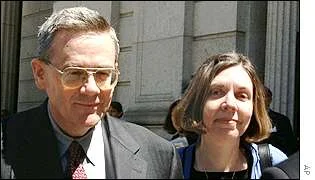
Walter Hewlett walks outside the Delaware Chancery Court after losing his lawsuit to block the merger, May 2002
Walter Hewlett leaves the Delaware Chancery Court after Chancellor Chandler's April 30, 2002 ruling rejected both his vote-manipulation and misrepresentation claims 14

Vote day, the Delaware trial, and the SEC fine

The shareholder meeting was held at the Flint Center in Cupertino on March 19, 2002, before approximately 2,000 shareholders — most of them current or former HP employees. Many wore green, the color of the opposition ballot paper; others waved green fluorescent glow sticks.
Walter Hewlett addressed the crowd from handwritten index cards. "This is a debate about the soul of HP," he said, drawing a standing ovation 6. HP's 401(k) plan — the only channel through which employees could vote confidentially — showed them voting 2-to-1 against 6.
The preliminary count: 837.9 million shares FOR, 792.6 million AGAINST — a margin of 45 million shares, or 51.4% to 48.6% 15. Without the Deutsche Bank switch of 17 million votes, the margin could have fallen below 28 million shares — potentially flipping the outcome entirely. Fiorina called it "slim but sufficient." 6
Hewlett filed suit in Delaware Chancery Court on March 28, alleging vote coercion and material misrepresentation. The three-day trial in April exposed Compaq CFO Jeff Clarke's internal memos calling integration projections "ugly" and "a disaster," and a diary entry from CEO Michael Capellas: "At our course and speed we will fail." 13 HP's defense — that these were deliberately pessimistic "sandbagging" targets managers set low to beat them — was corroborated by Boeing CEO Phil Condit, who testified that sandbagging was "all too common." 13
On April 30, 2002, Chancellor William B. Chandler III ruled for HP on all counts: "The evidence demonstrates that HP's statements concerning the merger were true, complete and made in good faith." 13 On the Deutsche Bank claim, he found no "smoking gun" — no evidence that Fiorina or Wayman had explicitly threatened to withdraw future banking business. He did, however, flag "troubling questions about the integrity of the internal ethical wall that purportedly separates Deutsche Bank's asset management division from its commercial division." 13
Hewlett did not appeal. On May 3, 2002, he conceded: "I will now do everything possible to support the successful implementation of HP's acquisition of Compaq." 14 HP's board announced he would not be re-nominated — leaving the company without a Hewlett or Packard family member on its board for the first time in its 63-year history 13.
On August 19, 2003, the SEC fined Deutsche Asset Management $750,000 and issued a cease-and-desist order for violating Section 206(2) of the Investment Advisers Act of 1940 by voting client proxies without disclosing the material conflict of interest created by its banking affiliate's paid engagement with HP 12. The SEC explicitly stated the order did not find that the vote outcome was affected — only that "the proxy voting process was tainted by the failure to disclose the conflict. The message is that the process matters." 12

Post-merger: right deal, wrong execution window

The new HP launched on May 7, 2002. More than 1,500 people had staffed the pre-close integration planning team, working in a "clean room" before regulatory approval. The operational results were swift: by the first nine months post-merger, HP had achieved $3.1 billion in annual cost savings — exceeding the $2.5 billion target by over $1 billion, with more than $1 billion from supply chain rationalization alone 16. The company laid off approximately 18,000 workers (slightly above the original 15,000 estimate) and cut the number of operating units from 83 to 4 16.
The financial trajectory under Fiorina told a different story. By the time the board forced her resignation in February 2005, HP's stock had fallen from approximately $52 (July 1999, when she joined) to approximately $21 — a roughly 50% decline against IBM's 27.5% fall and Dell's 3% fall over the same period 17. HP's PC division, which the merger proxy had projected at a 3.0% operating margin for 2003, came in at 0.1% 17.
HP stock jumped 6.9% on the day Fiorina's firing was announced 18.
Mark Hurd, former NCR head, succeeded her in March 2005. Under Hurd, HP's revenues grew from $87 billion (FY2005) to $92 billion (FY2007), profit from $2.4 billion to $6.2 billion (10.5% margin), and HP overtook Dell in global PC shipments by Q3 2006 2.
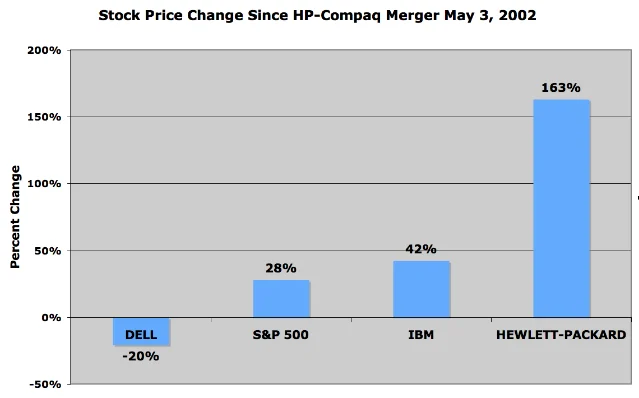
Line chart showing stock performance since May 3, 2002 merger close: HP +163%, IBM +42%, S&P 500 +28%, Dell -20%
From the merger close date (May 3, 2002) through 2008: HP +163%, IBM +42%, S&P 500 +28%, Dell -20% — the deal's strategic logic was ultimately vindicated 19
Stanford GSB professor Robert Burgelman, who studied the integration for California Management Review, identified the gap between operational and strategic success: "Ultimately, it turned out to be a good move. But although the logic of the merger was correct, executing it was difficult." 2 His diagnosis: Fiorina disbanded the integration team too early after hitting the cost synergy milestones, breaking the feedback loop between operational results and long-term customer strategy. Hurd rebuilt that loop — and the merger's architecture held.

Frameworks you can use

The proxy advisory firm as swing-vote kingmaker

In any contested M&A vote where founding families or concentrated activist shareholders control a blocking minority — roughly 18% or more — the contest for institutional swing votes becomes the entire game. ISS and Glass Lewis, between them, advise on a substantial fraction of U.S. institutional proxy votes. Index funds (Vanguard, BlackRock, State Street collectively hold 20–25% of most large-cap companies) increasingly outsource voting decisions to these firms.
The actionable implication: if your company is pursuing a contested all-company vote — merger, poison pill, board slate — map the institutional shareholder register into three buckets before the campaign begins: (1) reliable supporters, (2) reliable opponents (founding families, activist hedge funds), and (3) ISS-following index funds. The third bucket is your real target. ISS evaluates management integration credibility, standalone alternatives, and pro-rata premium — and its recommendation has historically been sufficient to move 12–19% of total shares in large contested votes. Campaign resources, roadshows, and third-party validation should be directed at the assumptions ISS will test, not at narrative persuasion of individual managers.
Hewlett's "focus and execute" alternative plan failed the ISS test at its most basic premise: there was "no obvious buyer" for the printing unit, so shareholders would be left with a stub they could not monetize. Identify and answer that question before ISS does.

Founder-family veto risk in transformative M&A

When a company's founding family retains both board representation and significant shareholding, a transformative acquisition creates a distinct governance crisis — not just a voting problem. The family carries moral authority that no institutional shareholder can replicate. Walter Hewlett's opponent-framing ("a debate about the soul of HP") was not merely rhetoric: it resonated with HP employees who voted 2-to-1 against in the confidential 401(k) plan.
The family's structural power, however, is bounded by their share count. At 18%, the Hewlett-Packard founding families could not block the deal without converting neutral institutional shareholders — and that required a credible, specific alternative plan, not just the moral argument. Without one, their opposition was, as the HP board correctly identified, "a man without a plan."
For dealmakers in founder-influenced companies (Ford, Walmart, News Corp, Dell Technologies, Berkshire Hathaway): map founding-family shareholding, board seats, and the specific interests that drive their opposition (asset protection, employment philosophy, brand stewardship) before the deal is announced. If the family's BATNA is weak — their standalone alternative requires a buyer, requires regulatory approval, or requires assumptions the market won't underwrite — their blocking power is largely rhetorical. If their BATNA is strong, engage them privately before the public announcement rather than fighting in the proxy campaign, where the reputational cost of open board conflict typically harms both sides.

The ethical wall between asset management and investment banking

The Deutsche Bank episode is the most frequently cited example in SEC enforcement history of what happens when an investment bank's asset management arm votes client proxies in a contest where the investment bank is receiving fees from one side.
The legal line the SEC drew is precise: DeAM violated the Investment Advisers Act not because the vote outcome was influenced (the SEC explicitly declined to find that), but because it voted without disclosing the conflict to its advisory clients first. The $750,000 fine was calibrated to the disclosure failure, not the vote-switching itself 12.
The practical consequence for dealmakers on the solicitation side: any investment bank you retain for a contested transaction holds proxy votes for your counterparty's shares through its asset management affiliate. You cannot legally threaten to withdraw future business, but the existence of the banking relationship — if disclosed — is itself a conflict that requires the asset manager to notify clients. HP's proxy solicitor's notation of a "carrot of future business" on a planning chart, and Fiorina's "ongoing relationship" language in the conference call, did not cross the legal threshold the Delaware court required. But they produced a paper trail the SEC used to impose reputational and financial consequences eighteen months later. Run the implied-conflict analysis on your banking advisors' asset management affiliates before the proxy campaign begins, not after.

The four-process integration framework: don't declare victory after the synergies

Burgelman and McKinney's post-mortem in California Management Review (Spring 2006) decomposed the HP-Compaq integration into four co-evolving processes: (1) formulating the integration logic and performance goals; (2) establishing the integration planning approach; (3) executing operational integration; (4) executing strategic integration — maintaining a feedback loop between operational gains and long-term customer strategy 20.
HP executed Processes 1–3 at a genuinely high level. The pre-close 1,500-person clean-room integration team produced a day-one readiness plan that analysts called "one of the best planned mergers we've ever seen" 13. The $3.1 billion operational synergy in nine months confirmed the plan worked.
The failure was Process 4. Fiorina declared operational victory and disbanded the large-scale integration team. The feedback mechanism between "we are cutting costs" and "what are our key customers experiencing as we integrate" went silent. Burgelman's prescription: keep a smaller, focused integration office in place for the strategic phase — not to run operations, but to test whether the strategic assumptions that justified the deal are still valid as the merged company engages the market. Hurd essentially rebuilt this discipline from scratch in 2005–2006, which is why the same merger that had appeared to be failing under Fiorina produced +163% stock returns from the merger date through 2008 19.
リンクプレビューを読み込んでいます…

What to remember

  • In contested votes where founding families hold a blocking minority, ISS is the actual decision-maker. The Hewlett-Packard families' 18% bloc was enough to force an institutional campaign but not enough to win alone. ISS moved an estimated 12–19% of shares, and the deal passed by 2.8 percentage points. Map the proxy advisory firm's evaluation criteria before your campaign starts, and build your integration credibility case around those criteria — not around narrative.
  • The ethical wall between an investment bank's asset management and banking arms is thin and conditional. The SEC's $750,000 fine against DeAM was based on non-disclosure, not on proven outcome-manipulation. The implication for deal-makers: any bank retained as a financial advisor holds conflicts in its asset management affiliate that must be disclosed to clients before a proxy vote. Those conflicts create pressure — even when no explicit threat is uttered — and the paper trail of that pressure survives into post-deal enforcement proceedings.
  • Founder-family opposition without a credible standalone alternative is morally powerful but structurally weak. Walter Hewlett's "soul of HP" framing resonated with employees and drew standing ovations. It did not move ISS, and ISS moved the vote. A family blocking minority's leverage depends on either having a viable alternative plan (Hewlett's printer-spinoff alternative had "no obvious buyer") or being large enough to win alone. Neither condition held.
  • Declaring synergy victory too early is the most common way to vindicate a deal's critics retrospectively. HP hit $3.1 billion in cost savings in nine months — and then lost track of what its customers thought of the merged company. Mark Hurd didn't change the deal's architecture; he rebuilt the feedback loop between operational results and market positioning that Fiorina had dismantled. The merger was right. The execution hand-off from cost integration to strategic integration was not. Keep a dedicated — if smaller — integration office in place until you can prove the strategic logic has been tested with real customer behaviour, not just internal financial targets.

Cover image: AI-generated editorial illustration

このコンテンツについて、さらに観点や背景を補足しましょう。

  • ログインするとコメントできます。