The $9.5 Million Question: How a Marble Youth Fooled — or Didn't Fool — Everyone
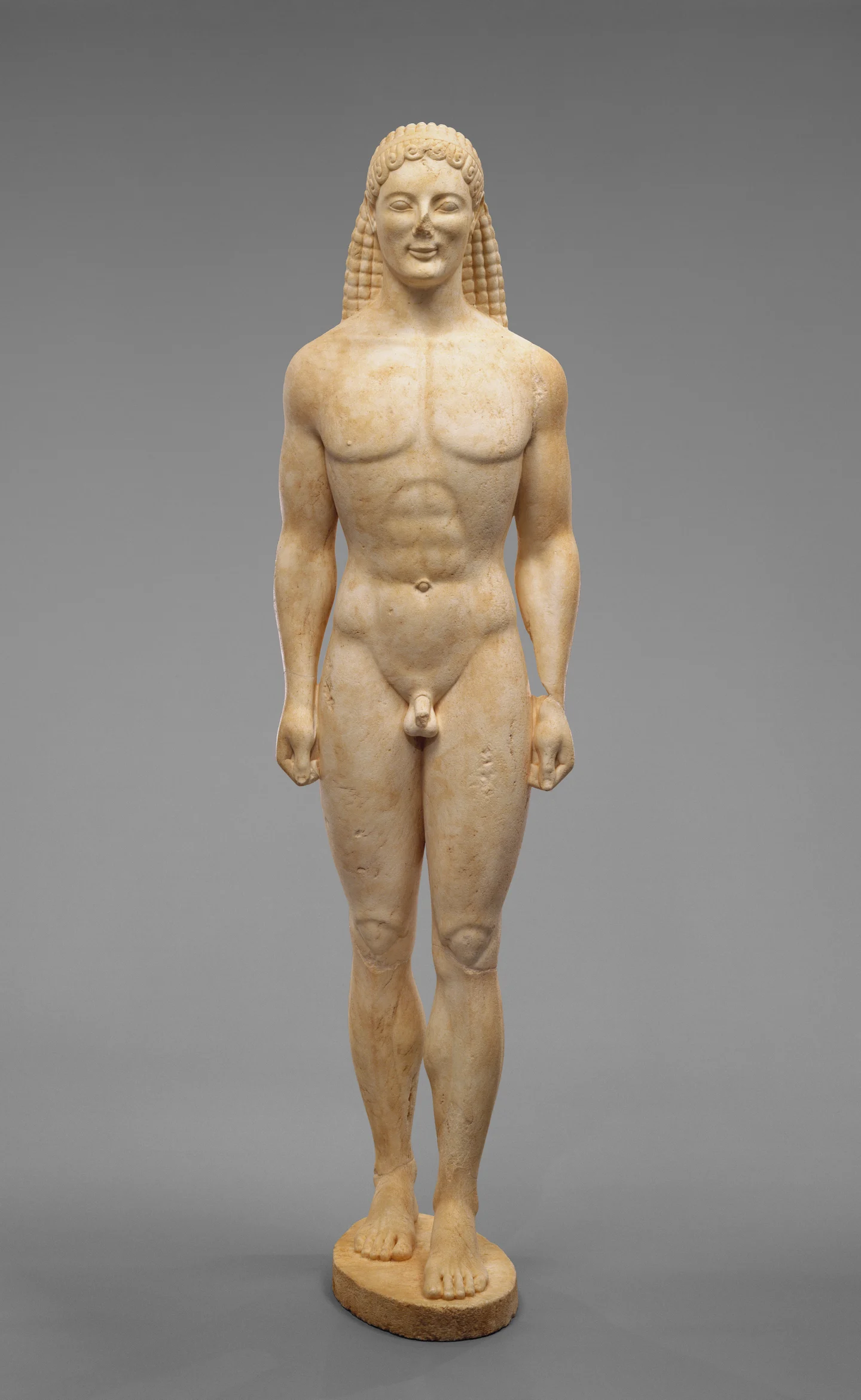
In 1983, a Basel dealer arrived at the Getty with seven marble fragments and a convincing paper trail. The letters were forged, the science that reassured the museum was later replicated in a laboratory, and the 1992 Athens colloquium — 130 experts, three days, nineteen papers — produced no verdict. The Getty Kouros (acc. 85.AA.40) still carries the most unusual museum label in America: "Greek, about 530 B.C., or modern forgery." It has been in storage since 2018.
In September 1983, a Basel antiquities dealer named Gianfranco Becchina arrived at the Getty Museum with a problem carved in marble. The problem was seven fragments of a life-sized figure that he wanted the museum to buy. 1 He left the pieces on approval with the Getty's antiquities curator, Jiří Frel, and the package included a tidy paper trail: letters from a Swiss doctor named Jean Lauffenberger, attesting that the figure had been in his Geneva collection since 1930, and — most impressively — a letter dated 1952 from Ernst Langlotz, then the world's leading authority on archaic Greek sculpture, noting the kouros's resemblance to the Anavyssos youth in the Athens museum. 2
The provenance, on paper, was respectable. The price, when the Getty board finally voted to approve the purchase in January 1985, was $9.5 million — making it the most expensive antiquity the museum had ever acquired. 1 3 One Getty board member, the Italian art historian Federico Zeri, resigned in protest before the vote was taken. He thought it was a forgery. 2
Nobody listened. The kouros went on display at the Getty Villa in October 1986. The Getty Journal called it "the only such complete figure to reach America since 1932." 4 The museum that had paid nine and a half million dollars for it was proud.
The problem — the real problem, far deeper than the forged letters — turned out to be the statue itself.
What a kouros is, and why one matters
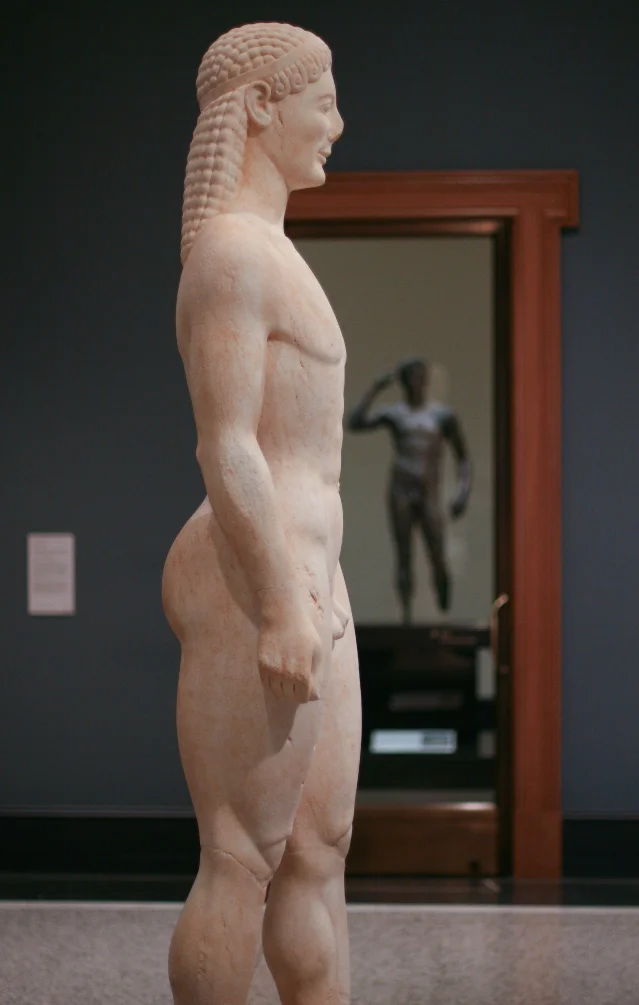
A kouros (plural: kouroi) is an archaic Greek standing male nude: left leg forward, arms at the sides, hands in loose fists with thumbs pressed against the thighs, hair falling in long braided ropes down the back. 5 The type appears in Greece from roughly 660 to 480 BCE, the period art historians call the archaic age, when Greek sculptors were absorbing Egyptian monumental stone-carving traditions and adapting them, decade by decade, into something unmistakably Hellenic. About a dozen complete or near-complete examples survive worldwide. 2
They served as grave markers, votive offerings at sanctuaries, or cult images — representations of divine youth, beauty, and physical perfection. The most famous is the Kroisos kouros from Anavyssos (now in the National Archaeological Museum in Athens, acc. no. NAMA 3851), found in Attica in 1936 with an inscription that identified it as a grave marker for a young man named Kroisos who "died fighting in the front ranks." 6 That sculpture is carved in Parian marble, with a confirmed excavation context, and its style is precisely datable to around 530 BCE. It is what scholars have in mind when they say "archaic kouros."
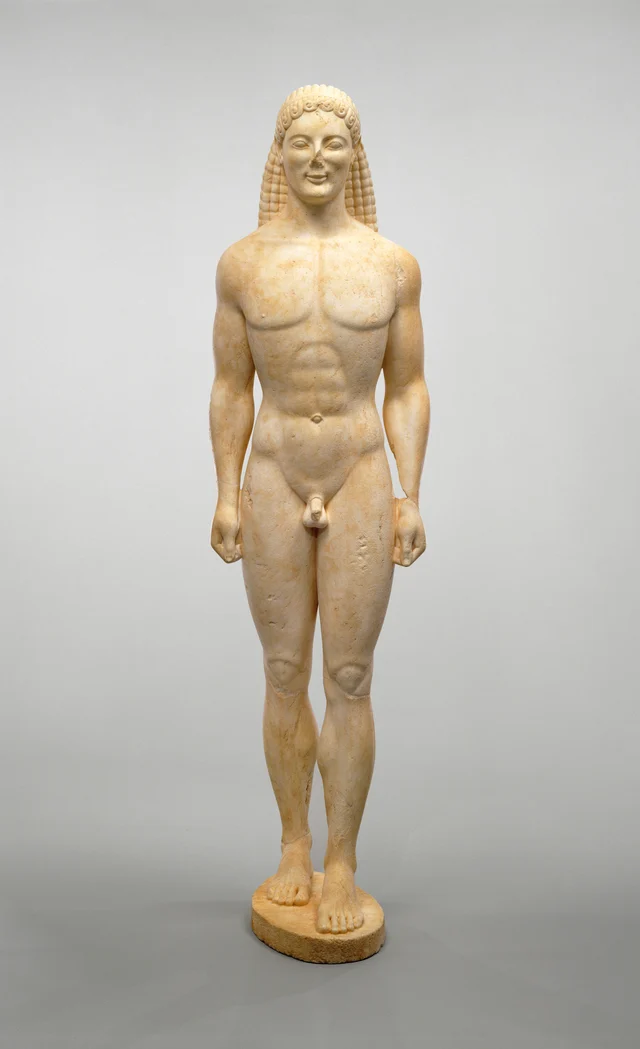
The Getty kouros, acc. no. 85.AA.40, stands 206.1 centimeters tall — six feet nine inches — and is made from dolomitic marble from the Greek island of Thasos. 7 Its left leg steps forward. Its arms hang at its sides, fists clenched with thumbs forward. Fourteen braided rope-like locks fall to its shoulders, bound at the top by a flat, wavy headband. If this figure is genuine, it dates to around 530 BCE and is one of the finest kouroi ever recovered. If it is a forgery, it is the most elaborate and technically sophisticated art fraud ever attempted.
The paper that lied
When the Getty's investigators looked more closely at the provenance documents Becchina had provided, they found something odd about the Langlotz letter. The 1952 letter — from a scholar of unimpeachable authority, commenting on the young man's resemblance to the Anavyssos youth — bore a German postal code. German postal codes in their modern four-digit format were introduced in 1972. 2 1
A second letter, dated 1955 and addressed to one A.E. Bigenwald concerning restoration work on the statue, referenced a bank account. That account did not exist until 1963. 2
The provenance chain disintegrated. Before 1983 — before the moment Becchina walked into Frel's office with seven marble fragments — the history of this statue is a blank. No excavation records, no photographs from the early twentieth century, no museum loan history, no period photograph that might corroborate a pre-1970 existence. According to the Trafficking Culture project at the University of Glasgow, the accused forger was a man named Fernando Onore, who allegedly sold the statue for $100,000 to a Calabrian middleman, who then sold it on to Becchina. 1 None of this was proven in court. Becchina himself was later convicted of illegal antiquities trafficking in Italy — on other matters — and Getty never did business with him again. 1
The Getty, confronted with forged documents, did not give up on the kouros. It reached for science.
The chemistry that seemed to prove everything
Marble is mostly calcium carbonate. Dolomitic marble — the kind from the Cape Vathy quarry on Thasos, which geologist Norman Herz identified as the source of this stone with 90% probability through carbon and oxygen isotope ratios (δ18O = −2.37, δ13C = +2.88) — also contains magnesium carbonate. 2 Over centuries of exposure, the dolomite at the surface undergoes a process called de-dolomitization: the magnesium leaches out, leaving a surface crust of calcite. In 1987, UC Davis geologist Stanley Margolis examined the Getty kouros under an electron microscope and found exactly this de-dolomitization layer. 3 Margolis concluded that the process could only happen naturally, over hundreds of years, and could not be reproduced artificially. The Getty board had already bought the statue; the science was now confirming, retroactively, that they had been right to do so.
The problem was that Margolis turned out to be wrong.
In 1990, the scholar and antiquities dealer Jeffrey Spier published a paper announcing the discovery of a confirmed forged kouros torso that used the same Thasian dolomitic marble and showed uncannily similar anatomical rendering to the Getty kouros. 2 1 Getty pulled the kouros from the gallery and sent it to the laboratory. The museum purchased Spier's fake torso for direct comparison — the two pieces were clearly not from the same stone block, and the forged torso bore visible traces of power tools, which the Getty kouros did not — but the uncomfortable implication was that whoever made one probably knew about the other.
Then, in 1991, Miriam Kastner, a marine chemist at the Scripps Institution of Oceanography, did something that unravelled Margolis's conclusion entirely: she replicated de-dolomitization in a laboratory. 3 The process that Margolis had declared impossible to fake could, under the right acidic conditions, be induced artificially. Margolis himself confirmed Kastner's results. Further analysis by Getty scientists revealed that what was coating the surface was not even the calcite crust of de-dolomitization — it was calcium oxalate, a compound that forms naturally from lichen and biological processes but can also be produced by washing stone in oxalic acid. 8
Marion True, who had become the Getty's antiquities curator in 1986 and had publicly championed the kouros's authenticity in The Burlington Magazine in January 1987, found herself reversing course in print in 1991. 2 "Everything about the kouros is problematic," she told the New York Times. "I always considered scientific opinion more objective than aesthetic judgments. Now I realize I was wrong." 3
Athens, May 1992: the trial that produced no verdict
True organized a symposium at the Goulandris Museum of Cycladic Art in Athens from May 25 to 27, 1992 — the first time a disputed antiquity had been physically transported to Greece for international scholarly review. 9 One hundred and thirty experts from thirteen countries attended. Nineteen papers were presented. The Getty shipped the kouros to Athens, so that European and Greek scholars could stand it next to the genuine kouroi in the National Archaeological Museum and compare them directly. Marion True called it "the hottest ticket in Athens." 8
The symposium produced no consensus. What it produced instead was a fascinating record of expert disagreement that the colloquium proceedings — published in 1993 — preserved in detail. 10
The case against
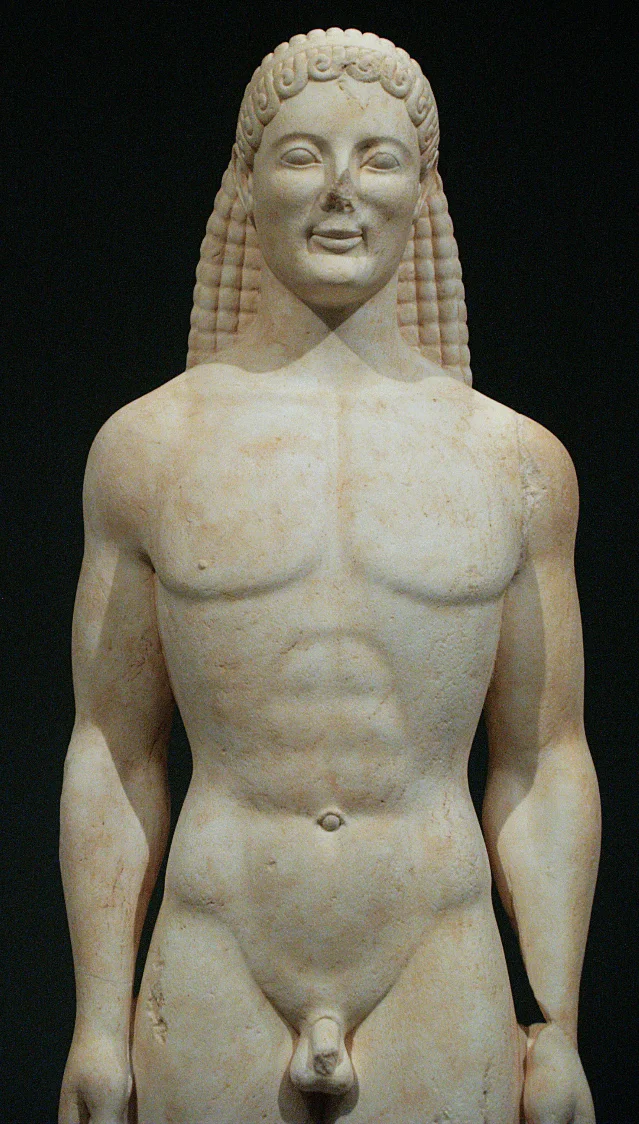
Evelyn Harrison (New York University) stood before the assembled scholars and said that when she first saw the statue, something was wrong. She identified four compounding problems: the Thasian marble source was anomalous for a kouros in Attic/Boeotian style — no genuine kouros in those styles had been found in Thasian marble; the hair at the brow was "thick and doughy," lacking the precise formal articulation of genuine archaic sculpture; the collarbone and pectoral muscles were "flat, inorganic, insufficiently modeled"; the knees were rigid rather than organic. Taken individually, each could be explained away. Taken together, Harrison argued, they pointed to a modern hand that had studied the models too carefully and in doing so had assembled something that looked like a kouros without being one. 9
"It looked strangely like some well-known Boeotian and Attic kouroi, none of which has yet been found to be made of Thasian marble. At the same time, the kouros did not give the impression of being something old; somehow it looked new."— Evelyn Harrison, The Getty Kouros Colloquium (1993) 9
Ismini Trianti, a curator at the Greek Ministry of Culture, delivered perhaps the most damaging technical paper, titled "Four Kouroi in One?" Her argument was that the Getty statue had been assembled from close study of four specific genuine kouroi: the hair came from the Kea kouros and Ptoon 12, the face from Ptoon 12 and the Anavyssos youth, the shoulders and hands from the Tenea kouros, the base and feet from Ptoon 12. Her clinching evidence was the claw-chisel tooling on the oval base: on the genuine Ptoon 12, claw marks appear only at the attachment zones; on the Getty kouros, they cover the entire underside — betraying either a forger who over-applied a tool mark they had seen in scholarly photographs, or, at best, a genuinely ancient carver with no known parallel. 9
"Perhaps the Getty kouros is, after all, an eclectic work, though not ancient but modern."— Ismini Trianti, The Getty Kouros Colloquium (1993) 9
Georgios Dontas stated flatly that the work made him "emotionally cold," and described the absence of "the central organic 'meaning' and the vital 'breath' that are so characteristic of genuine Greek artistic creations." 9 Angelos Delivorrias argued that the statue fit no known regional school of archaic carving — it was neither Attic nor Corinthian nor Boeotian nor island Greek — and that accepting it as genuine required positing an entirely unknown archaic workshop, which was methodologically indefensible without other evidence. 9
The Art Newspaper summarized the Greek contingent's position this way: "None of the Greek scholars present considered the Kouros to be a genuine piece, while most of the rest were uneasy and expressed reservations about the criteria employed." 11
The case for
Brunilde Sismondo-Ridgway (Bryn Mawr College) presented a paper titled "In Defense of Authenticity" — not a claim of certainty, but a demand for methodological rigor. Her central argument was that the same stylistic inconsistency test, applied to any genuine archaic kouros, would fail most of them. The Kroisos kouros — the Anavyssos youth, the very sculpture Langlotz had supposedly compared it to in 1952 — had itself been suspected of being a forgery when it was first published. If the art-historical community was prepared to convict on eclecticism and anomaly, it risked convicting the genuine artifacts too. 9
"Some authentic pieces can still be doubted today: the New York kouros, the Berlin kore. Let us not forget that even Kroisos was initially thought to be a fake. Perhaps 50 years from now we shall see the Getty kouros in its true light."— Brunilde Sismondo-Ridgway, The Getty Kouros Colloquium (1993) 9
Ilse Kleemann used systematic formal analysis of archaic sculptural conventions and concluded that the Getty kouros's stance — feet positioned at a slight angle suggesting the figure was turning toward the right, toward a naos (inner temple chamber) — was a precise and documented convention for votive kouroi in religious sanctuaries. She called this "one of the strongest pieces of evidence of its authenticity." 2
The methodological impasse
John Boardman (Oxford) cut through the argument at its root. All three categories of evidence, he pointed out, were fundamentally unreliable: the provenance was forged; the scientific analysis was equivocal and reversible; the stylistic judgments were subjective and inconsistent. If you took any genuine archaic kouros off the wall of a Greek museum, stripped its excavation tag, and sent it to Basel in 1983, it would fail the same consistency tests the Getty kouros was failing. 9 His remark to The Art Newspaper — "Most kouroi are eclectic works" 11 — was either a defense of the Getty kouros or a confession about the limits of connoisseurship.
Helmut Kyrieleis (German Archaeological Institute) made the sharpest institutional argument of the colloquium: "It will be difficult to remove the stigma of the counterfeit from a work such as this as long as its exact provenance remains unconfirmed. In my opinion this case indicates that museums, as public foundations, misinterpret their mission when they acquire objects of dubious provenance." 9
The Getty's own conservator, Jerry Podany, described six years of scientific testing as opening a series of nested boxes: "Every time we open one box and answer a question, we find a smaller box with more questions inside." 8 Frank Preusser, deputy director of the Getty Conservation Institute, distilled the entire epistemological problem into one sentence: "You can't prove authenticity; you can only prove a forgery." 8
The style problem that won't resolve
Beyond Athens, there is a second-order problem that nobody could resolve in 1992 and no one has resolved since: the kouros's stylistic range covers roughly a century of archaic Greek sculpture in a single body.
The hairstyle — fourteen braided locks bound by a flat, wavy headband, falling in a bell-shaped curtain to the shoulders — echoes the Sounion kouros, one of the earliest large-scale kouroi, typically dated to around 600 BCE. 2 The hands, with thumbs pressed flat against the thighs in a specific convention, resemble the Tenea kouros, a mid-sixth-century Corinthian figure. The feet and oval base closely mirror Ptoon 12, a Boeotian kouros of the third quarter of the sixth century. If the Getty kouros is genuine and dates to around 530 BCE, it somehow combines formal features from kouroi spanning some seventy years of regional variation. 2
Genuine kouroi are eclectic — Boardman was right about that. Sculptors in the archaic period borrowed across regional traditions, and the surviving corpus is small enough that any individual piece may be a genuine outlier. But the Getty kouros's eclecticism is, as Trianti argued, of a peculiar order: it seems to draw from the best-known, most-reproduced, most-studied pieces in the corpus, precisely the ones that would appear in a twentieth-century textbook. A sixth-century carver in Boeotia had not read Georg Lippold. A twentieth-century forger might have.
The ears are also inconsistent: the left ear is oval, the right is round, and the two are different heights. 2 Stelios Triantis, who analyzed the tooling marks, noted that "no sculptor of kouroi would hollow out with a fine point, nor incise outlines with this tool" — the marks suggested modern drill usage in areas where ancient sculptors would have used a different approach. 2
A label nobody else uses
Since at least 2012, the Getty Museum has given the kouros the most unusual label in the American museum system: "Greek, about 530 B.C., or modern forgery." 2 No other object in a major American museum carries a label that admits it might be a fake it paid nine million dollars for. The label is simultaneously an act of institutional honesty and an act of institutional paralysis — it acknowledges the problem without resolving it, because the problem cannot be resolved.
In April 2018, after a 15-month reinstallation of the Getty Villa, the kouros was not returned to the galleries. It went into storage. Museum director Timothy Potts confirmed the decision without a formal announcement: "The consensus of art historical study, once divided, now leans against its authenticity." 12 He specified that the statue had not been reclassified as a forgery — its label remained unchanged — and that further scientific testing, begun in the preceding year, was not yet complete. 12
The Los Angeles Times critic Christopher Knight, who had watched the reinstallation, noted the absence with frustration. The villa could have posted a placard in the empty alcove explaining the situation. It did not. A museum that had displayed the kouros for thirty years with an admitted disclaimer had now silently removed it with no public explanation. "There's ample room in the Villa's temporary gallery for a small exhibition," Knight wrote. "Getty could even have fun with it." 12
As of 2024–2025, no new scientific testing results have been published, no new provenance documents have surfaced, and no institutional update on the kouros's status has appeared in Getty's public communications. 2 12 The "further testing" Potts mentioned in 2018 has not, publicly, produced a conclusion.
What the statue means, regardless
The Getty kouros is, on some level, an epistemological thought experiment that turned into $9.5 million worth of marble. The case exposed three supposed safeguards of authenticity — provenance documentation, scientific analysis, and connoisseurship — and showed that each could fail independently, and that all three could fail together.
Provenance can be forged, as the Langlotz letter demonstrated. Science cannot prove genuineness, as Preusser bluntly stated — it can only disprove forgery, and even that requires reproducible evidence that no one has found here. And stylistic judgment, as Boardman noted with characteristic dryness, is subjective enough that the same arguments used to condemn the Getty kouros could condemn pieces that everyone accepts as genuine.
If the kouros is real, it represents a regional archaic workshop of previously unknown character, carving in Thasian dolomitic marble in a style that synthesized conventions from across the Greek world — an art-historical lacuna that would require rewriting several chapters of the archaic period. If it is fake, it was made by someone who had access to rare Thasian dolomite, could work marble at a level indistinguishable from sixth-century technique for most aspects of the carving, understood the archaic formal conventions well enough to replicate them across a body that convincingly fools a subset of trained specialists — and was either clever enough to mimic ancient weathering chemistry or lucky enough that the natural weathering of the stone gave the right reading under a scanning electron microscope.
The New York Times's Michael Kimmelman, writing in 1991, reached a conclusion that holds as well today: "Objectivity is a chimera, even in this age of electron microscopy, thermoluminescence and carbon-14 dating. Science may be no more certain than the connoisseur's eye in judging a work's authenticity." 3
The kouros stands somewhere in the Getty's storage — 206.1 centimeters of Thasian dolomite, archaic smile or modern imitation of one, $9.5 million of permanent ambiguity — and the label on it, wherever it is now, still reads "Greek, about 530 B.C., or modern forgery." 7
Nobody knows which.
Cover image: Getty Kouros (85.AA.40), dolomitic marble, Getty Villa, Malibu. Getty Open Content Program / CC0.
参考ソース
- 1Trafficking Culture: Getty Kouros case study
- 2Getty kouros — Wikipedia
- 3ART; Absolutely Real? Absolutely Fake? — NYT
- 4J. Paul Getty Museum Journal, Vol. 14, 1986
- 5Kouros — Wikipedia
- 6An Introduction to the Case of the Getty Kouros — Digital Art History
- 7Getty Research Institute: CONA Full Record (700006605)
- 8Los Angeles Times: The Anatomy of a Controversy
- 9The Getty Kouros Colloquium: Athens, 25-27 May 1992
- 10Internet Archive: The Getty Kouros Colloquium
- 11The Art Newspaper: The Getty Kouros masterpiece vs. fake debate
- 12LA Times: Something's missing from the Getty Villa reinstalled antiquities
このコンテンツについて、さらに観点や背景を補足しましょう。