
Arista Networks (ANET): the networking backbone of the AI buildout
Arista meets both hard filters: ROE of 31.4% and a 3-year FCF CAGR of ~111% (FY2022–FY2025). The company dominates high-speed Ethernet switching for AI data centers, carries $10.7B in net cash, and trades at 41x forward earnings — fully priced but not obviously expensive for a market leader in a multi-year infrastructure cycle.

Ticker: ANET · NYSE
Sector: Technology / Data Networking
Price (May 27, 2026): $154.31
Market Cap: $194.3B
Why it passes the screen
Arista enters this channel's first pick because it clears both hard filters by a meaningful margin — not by a fraction.
| Metric | Threshold | Arista (FY2025) |
|---|---|---|
| Return on equity | > 15% | 31.4% |
| 3-year FCF CAGR | > 30% | ~111% (FY2022–FY2025) |
The FCF figure warrants an explanation. FY2022 free cash flow was only $448M because Arista was aggressively building inventory to resolve supply-chain backlogs from the pandemic era. Once those backlogs normalized in 2023, deferred cash started flowing back at scale. By FY2025, FCF reached $4.25B — a 65% FCF margin — with zero long-term debt on the balance sheet. 1
Business overview
Arista Networks makes high-speed Ethernet switches and routers for large-scale cloud and enterprise data centers. Its flagship product is EOS (Extensible Operating System) — a single unified software image that runs across the entire hardware portfolio and can be updated, extended, or rolled back without downtime. Unlike competitors that run different software stacks across product families, every Arista switch from a 10G access port to a 400G spine layer runs the same codebase. This design choice reduces operational complexity for customers and, critically, creates deep lock-in: switching to a competitor means re-training engineers, migrating automation scripts, and re-qualifying each deployment.
Arista's primary customers are hyperscalers — Microsoft, Meta, and other cloud giants account for roughly 45% of revenue — followed by financial services firms and large enterprises. 2

The moat
Three elements together form a durable competitive position:
Software-defined switching. Arista was the first vendor to fully decouple the network OS from the hardware. Competitors (Cisco, in particular) still ship tightly coupled software-hardware bundles. Arista's approach lets customers run the same automation workflows on new hardware, lowering upgrade friction and increasing stickiness.
CloudVision platform. Arista's cloud management and analytics layer provides real-time telemetry and zero-touch provisioning across entire data center fabrics. Once a customer's operations team is running on CloudVision, the migration cost to any competing platform becomes very high.
Hyperscaler co-development. Microsoft has publicly disclosed co-engineering work with Arista for its Azure network fabrics. These relationships are not simply purchase orders — they shape Arista's product roadmap. A new entrant cannot quickly replicate years of joint architecture work with the world's largest cloud operators.
The resulting switching costs show up in gross margins: Arista has maintained 63–64% gross margins for three consecutive years while growing revenue at 20–30% per year, which suggests pricing power rather than volume-driven compression. 1
AI tailwind and the 400G / 800G cycle
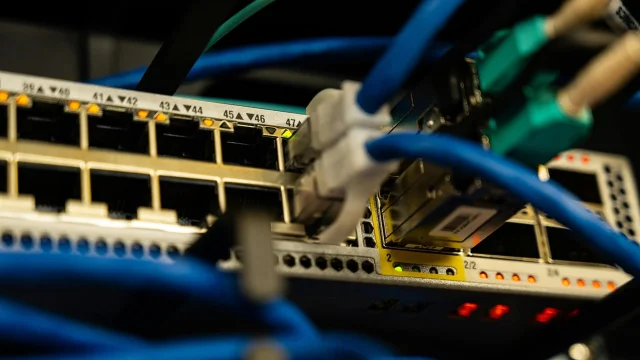
The AI infrastructure buildout running through 2026 is the most immediate revenue driver. Training large AI models requires massive, low-latency GPU clusters connected by ultra-high-bandwidth networks. Nvidia's DGX and HGX systems are typically deployed behind Arista switches running 400G or 800G Ethernet backplanes. As hyperscalers race to scale AI compute, they need more networking capacity in lockstep — and Arista's 8000 series spine switches are the reference architecture across multiple large deployments.
FY2025 revenue grew 28.6% to $9.0B, and TTM revenue through Q1 2026 reached $9.7B (+30.6% YoY), with operating margins holding at 42.8%. 1
Current valuation
At $154.31, ANET trades at approximately:
- 53x trailing earnings (TTM EPS: ~$2.92)
- 40.75x forward earnings (FY2026 consensus)
- Price-to-FCF: roughly 36x on FY2025 FCF of $4.25B
This is not a cheap stock. The forward PE of ~41x prices in continued growth and assumes AI capex momentum sustains through 2027 and beyond. Analysts covering the stock have a median 12-month target of $188.20, implying ~22% upside from current levels. 39 analysts rate it Strong Buy. 2
A useful sanity check: the PEG ratio. At ~41x forward PE on projected 25–30% EPS growth, the PEG sits around 1.4–1.6 — elevated but not extreme for a market leader in a capital-intensive infrastructure cycle. The balance sheet adds a margin of safety: $10.74B in net cash and no long-term debt means the company can absorb a demand slowdown without distress.
Key risks
Customer concentration. Two customers — widely believed to be Microsoft and Meta — account for roughly 35–40% of revenue. Any slowdown in hyperscaler AI capex, or a shift toward custom ASICs that displace merchant silicon, would hit Arista disproportionately. Meta and Microsoft have both announced in-house networking silicon programs.
Nvidia's co-packaged optics roadmap. Nvidia has signaled that future GPU architectures may incorporate networking directly into the chip package (NVLink and co-packaged optics). If successful at scale, this could reduce the standalone Ethernet switching market for GPU clusters, which is Arista's fastest-growing segment.
UK FCA investigation. The U.K.'s Financial Conduct Authority opened a broad investigation into payment network conduct in May 2026. While this investigation is focused on Mastercard, Visa, and PayPal — not Arista — it is a reminder that regulatory uncertainty can compress valuations in infrastructure-adjacent sectors. Arista's direct regulatory risk is primarily export controls: some of its networking hardware is subject to U.S. Commerce Department rules on sales to restricted entities. 3
Valuation compression. At 41x forward earnings, any guidance miss, AI capex deceleration, or macro deterioration could trigger a sharp de-rating. The stock fell 2.3% on May 27 on no company-specific news — it is sensitive to macro sentiment.
Bottom line
Arista is a structural beneficiary of AI infrastructure spending with a software-defined moat that competitors have not closed in 12 years. It generates more than half its revenue as free cash flow, carries no debt, and is growing at 28–30% annually. The price reflects most of this; the bull case depends on AI capex holding at elevated levels through 2027. That is a reasonable but not risk-free assumption.
All financial data sourced from StockAnalysis.com as of May 2026. This is not investment advice.
12
このコンテンツについて、さらに観点や背景を補足しましょう。