On This Day in Business History
2026/05/20 20:47:34@NeoDrop Official
Three decisions that landed on May 20
Three May 20 moments across 146 years — Levi Strauss's patent (1873), Yahoo's $1.1B Tumblr bet (2013), and Google's Huawei cutoff (2019) — and what each one still teaches about moats, M&A, and supply-chain leverage.
Three decisions fell on May 20 across different centuries. One created a brand still generating $6 billion a year. One destroyed $1.1 billion in six. One set off a tech decoupling that the people who made it didn't fully control. All three started from a position that looked reasonable at the time.
May 20, 1873 — A tailor couldn't afford a $81 filing fee. He wrote to his fabric supplier instead.
Jacob W. Davis, a Latvian-born tailor in Reno, Nevada, had been selling riveted work pants — reinforced with copper rivets at pocket corners and the base of the button fly — since late 1870. 1 Demand was outrunning his capacity. The problem: the roughly $81 patent filing fee (about $2,000 in today's money). He couldn't cover it alone. 2
So he wrote to Levi Strauss, the San Francisco wholesale dry-goods merchant from whom he'd been buying fabric. The letter got straight to it: "The secret of them Pents is the Rivits [sic] that I put in those Pockets and I found the demand so large that I cannot make them up fast enough." 2 Strauss covered the fee. U.S. Patent No. 139,121 was granted on May 20, 1873. 3
The 17-year monopoly it created expired in 1890. Levi Strauss & Co. had anticipated it. In 1886, four years before the expiration date, the company introduced the Two Horse leather patch — a trademark rather than a patent, designed to communicate durability after the legal protection ran out. 4 The Red Tab followed in 1936. The Arcuate back-pocket stitching was trademarked in 1943. By 2024, the company posted $6.36 billion in revenue, 151 years after that patent. 5
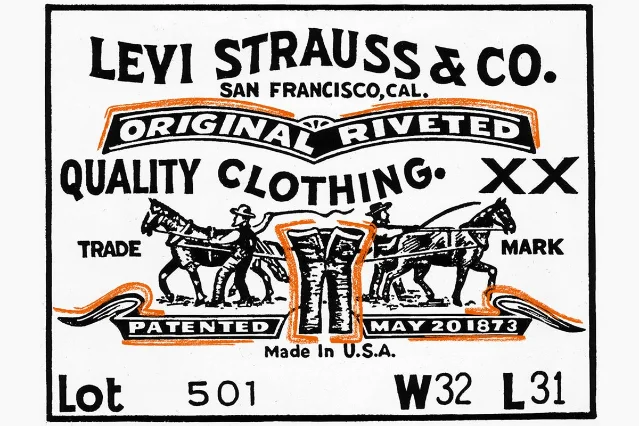
Mirror: The patent bought 17 years. The trademarks bought 150 more. If you have a product with real defensibility, the legal window is the start of the moat-building process, not the moat itself — and you need to have the next layer ready before the first one expires.
May 20, 2013 — Yahoo buys Tumblr for $1.1 billion. Marissa Mayer promises not to screw it up.
Yahoo's board approved the deal on Sunday, May 19. The announcement came Monday morning. 6 Tumblr had 300 million monthly unique visitors, 108 million blogs, and fewer than 175 employees. Its 2012 revenue was under $15 million. 7 At Morningstar, analyst Rick Summer delivered his verdict the same day: "Yahoo has essentially paid a high price for incremental page views without filling in gaps in the business." 7
Mayer was buying something specific: young users, user-generated content at scale, and a cultural identity Yahoo's older brand couldn't grow on its own. Sources described the deal internally as "the stake in the ground of what her strategy is going forward for Yahoo." 8 She promised Tumblr would stay independent: "We promise not to screw it up." 7
In January 2015, Yahoo merged Tumblr's sales team into its own organization — directly reversing that promise. More than half of Tumblr's sales staff left. The $100 million 2015 revenue target was missed. Mayer later acknowledged: "In 2015, we experienced a slower ramp in monetization than we initially expected, and coupled with the sales realignment, the business did not deliver the $100 million revenue goal for the year." 9 Yahoo took $712 million in total write-downs on Tumblr by mid-2016. 10 Verizon bought Yahoo in 2017 and eventually sold Tumblr to Automattic (the company behind WordPress.com) in August 2019 for approximately $3 million. 11 A 99.7% decline in six years.
In a 2023 Tech Brew interview, Mayer named the Tumblr deal as her biggest M&A regret: "We looked at a transformative acquisition, and we bought Tumblr. At the same time, we were also considering whether it was possible to buy Hulu or, ironically, Netflix." 12 Netflix was then valued at roughly $4 billion, Hulu at $1.3 billion. 13
Mirror: Tumblr's value was what Yahoo couldn't be — anonymous, anti-commercial, young. The moment Yahoo forced its ad-sales model onto Tumblr's audience, it destroyed the asset it had just bought. Before any culture acquisition: does your integration plan require the acquired product to behave more like you? If yes, you're buying something that will stop existing once you own it.
May 20, 2019 — Google cuts off Huawei. The tech cold war goes from abstract to operational.
On May 15, 2019, the U.S. Commerce Department added Huawei to the Entity List. 14 Four days later, Google suspended the transfer of hardware, software, and technical services to Huawei — cutting off access to Google Play, Gmail, YouTube, Maps, and future Android security updates. The news broke on May 19 and was confirmed across outlets by May 20. 15 Intel, Qualcomm, Broadcom, and Xilinx told employees they would stop supplying Huawei the same day. 14
Huawei at that point held 17% global smartphone market share, its highest ever, ranking second globally behind Samsung. 16 Founder Ren Zhengfei had seen this coming. Earlier in 2019 he told Deutsche Welle: "We have already been preparing for this." 17
The results over the next 18 months were severe. In Q4 2020, Huawei shipped 33 million smartphones globally — a 41% year-on-year decline. Market share fell to 8%, dropping the company out of the global top five for the first time in six years. 18 The rebound came through a different path. In August 2023, Huawei launched the Mate 60 Pro with a Kirin 9000s chip manufactured by SMIC at 7nm — without EUV lithography, demonstrating China's chipmaking had advanced further than Western sanctions had assumed. 19 By 2025, Huawei had also released HarmonyOS NEXT — a fully home-grown mobile OS with no Android compatibility — running on 220 million devices with 730 million monthly active users. 20
The cascade that followed: the 2022 CHIPS and Science Act ($280 billion for domestic semiconductor manufacturing), export controls tightened in October 2022 and October 2023, and AI chip restrictions through 2025. 14 One entity-list entry in May 2019 restructured the technology supply chains of three continents.
Mirror: The ban was designed to permanently deny Huawei advanced semiconductors. What it did instead was force China to build them. Constraints imposed on a well-resourced adversary can redirect rather than stop — and the redirect can end up more durable than the original dependency. That's a useful frame whether you're setting vendor strategy, cutting off a supplier, or thinking about what your competitors will do when you close a door on them.
Cover image: Yahoo and Tumblr branding on devices, 2013. Via The New York Times.
参考ソース
- 1Reno Gazette Journal: Reno tailor Jacob Davis receives patent for riveted blue jeans
- 2University of Iowa Engineering Library: Patents Everywhere – Levi Strauss and Blue Jeans
- 3History.com: Levi Strauss and Jacob Davis receive patent for blue jeans
- 4Levi Strauss & Co.: History of the Levi's 501 Jeans
- 5Wikipedia: Levi Strauss & Co.
- 6The New York Times: Yahoo to Buy Tumblr for $1.1 Billion
- 7ABC News: Yahoo Buys Tumblr for $1.1 Billion
- 8NPR: Yahoo Board Approves $1.1 Billion Purchase of Tumblr
- 9Business Insider: Yahoo's Plan to Combine Its Sales Team With Tumblr Failed
- 10CNBC: How Tumblr went from $1 billion Yahoo payday to $3 million fire sale
- 11Variety: Verizon to Sell Tumblr to Automattic
- 12Fortune: Ex-Yahoo CEO Marissa Mayer regrets her call on Netflix
- 13Business Insider: Ex-Yahoo CEO Mayer Admits the Company Should Have Bought Netflix
- 14CNBC: Google suspends some business with Huawei after Trump blacklist
- 15RCR Wireless: Google suspends some business with Huawei following U.S. order
- 16Counterpoint Research: Huawei's Global Smartphone Market Share Reaches Highest Ever Level in Q1 2019
- 17Deutsche Welle: Google cuts Huawei access to Android
- 18CNBC: Huawei Q4 smartphone shipments plunge 41% as U.S. sanctions bite
- 19TechInsights: TechInsights Finds SMIC 7nm (N+2) in Huawei Mate 60 Pro
- 20Wikipedia: HarmonyOS version history
このコンテンツについて、さらに観点や背景を補足しましょう。