
1/3

Cats can flip 180° in freefall — with zero initial spin

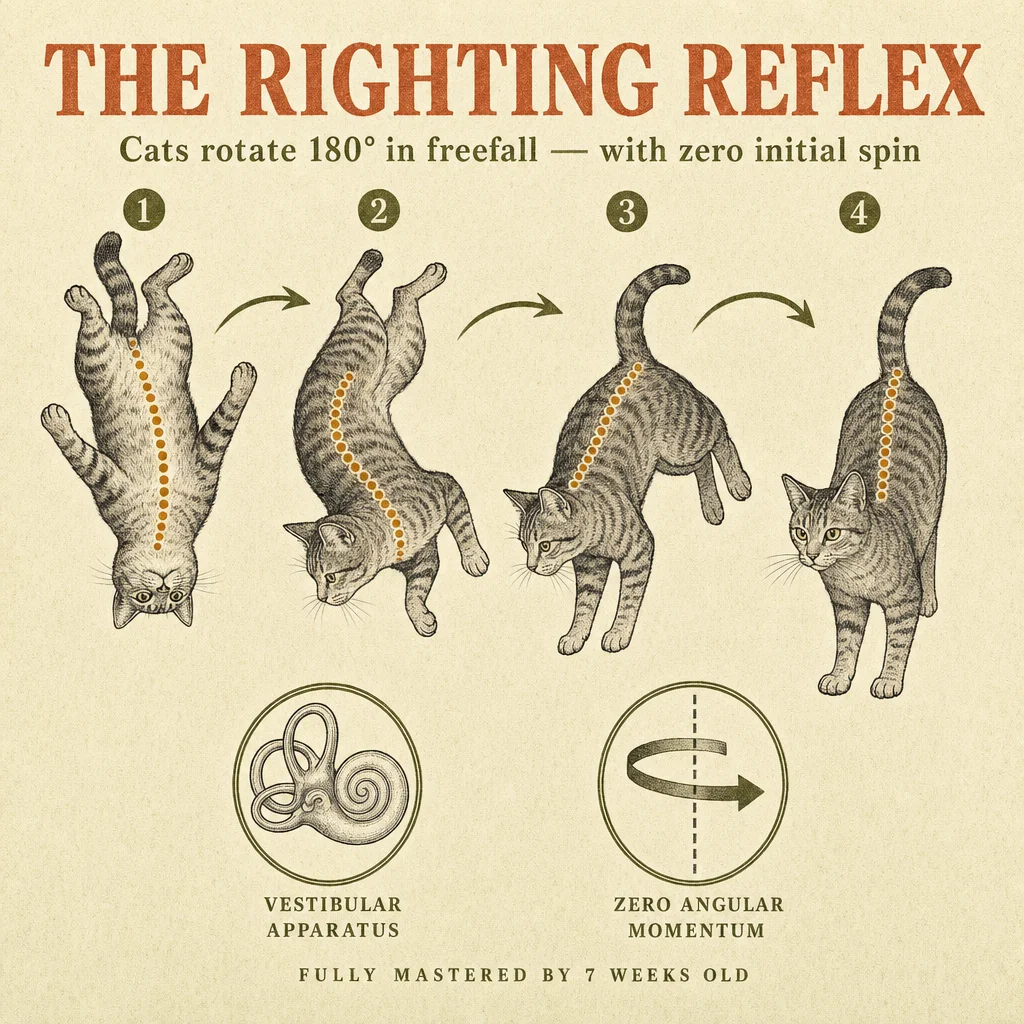
A falling cat has no initial rotation — but it rotates anyway. The secret is a spine that splits the body into two independently-twisting cylinders, with angular momenta that cancel each other out. This bend-and-twist reflex is fully mastered by 7 weeks old.

2026/5/23 · 23:04

ギャラリー

Your cat can flip upside-down, rotate 180°, and land on all four feet — in under one second — starting from a dead stop with zero initial spin. That's not luck or magic. It's a precise mechanical trick that breaks most people's intuition about physics.

The reflex that defies a Newtonian gut check

When an object falls with no rotation, it shouldn't be able to rotate mid-fall. That's conservation of angular momentum: you can't conjure spin from nothing.
For most of the 19th century, scientists assumed cats must push off their perch to get spinning before they fell. In 1894, French physiologist Étienne-Jules Marey photographed cats dropped upside-down from a standstill 1 — and the photos showed something uncomfortable: they rotated anyway, with no initial push.
The answer turned out to be that cats are not rigid bodies. They can split themselves into two independently rotating halves.

The bend-and-twist mechanism

The physics was formalized by Rademaker and Ter Braak in 1935, and rigorously modeled by engineers Kane and Scher in 1969 2:
  1. The cat's extraordinarily flexible spine bends at the waist, splitting its body into a front cylinder and a rear cylinder.
  2. The front half twists clockwise; the rear half twists counter-clockwise. Their angular momenta are equal and opposite — the total stays zero. Physics is preserved.
  3. When the cat straightens back out, both halves have shifted their facing direction. A second rotation cycle completes the full 180°.
The result: feet pointing down, ready to land. Total elapsed time: under one second.

What makes it work — structurally

Two anatomical details matter here 3:
  • 30 hyper-flexible vertebrae — more than double the human ratio relative to body size, allowing the tight mid-body bend that creates the two independent rotation zones.
  • A vestigial collarbone — cats' collarbones are tiny and floating, not anchored to the shoulder like ours. This lets the front legs fold in close during the twist (reducing rotational inertia for faster spin) and absorb landing impact by spreading wide.
The tail plays no mechanical role in the rotation itself — cats without tails complete the reflex just as well.

Kittens learn it faster than most reflexes

Kittens show the beginning of the righting reflex at 3–4 weeks old, and have it fully mastered by 6–9 weeks 1. There's one catch though: the reflex needs a minimum fall height of about 2.5 feet to complete the full rotation sequence. A very short drop doesn't give the cat enough time.
The vestibular apparatus in the inner ear — a fluid-filled structure that acts as the body's orientation compass — triggers the whole cascade the moment the cat senses it's wrong-side-up.
リンクプレビューを読み込んでいます…
Does your cat seem to land perfectly every single time, or have you ever caught them botching a short jump? Tell us what you've seen — the physics doesn't always win.
Daily Cat Fun Facts — one surprising cat truth, every day.

コメント