AI Product Update Daily: May 23, 2026

AI Product Update Daily: May 23, 2026

An OpenAI model autonomously solved an 80-year-old geometry problem. Anthropic's Jack Clark put 60%+ odds on recursive self-improvement by 2028. Zuckerberg was recorded monitoring employees for AI training on the day 8,000 were laid off. Trump scrapped his AI safety executive order after calls from Musk, Zuckerberg, and Sacks. Plus: GitHub's 3,800-repo supply chain breach, Anthropic acquires Stainless, Gemini gets Adobe + Canva + CapCut, and Intuit cuts 3,000 jobs.
AI Product Update Daily
2026/5/23 · 8:04
購読 1 件 · コンテンツ 4 件
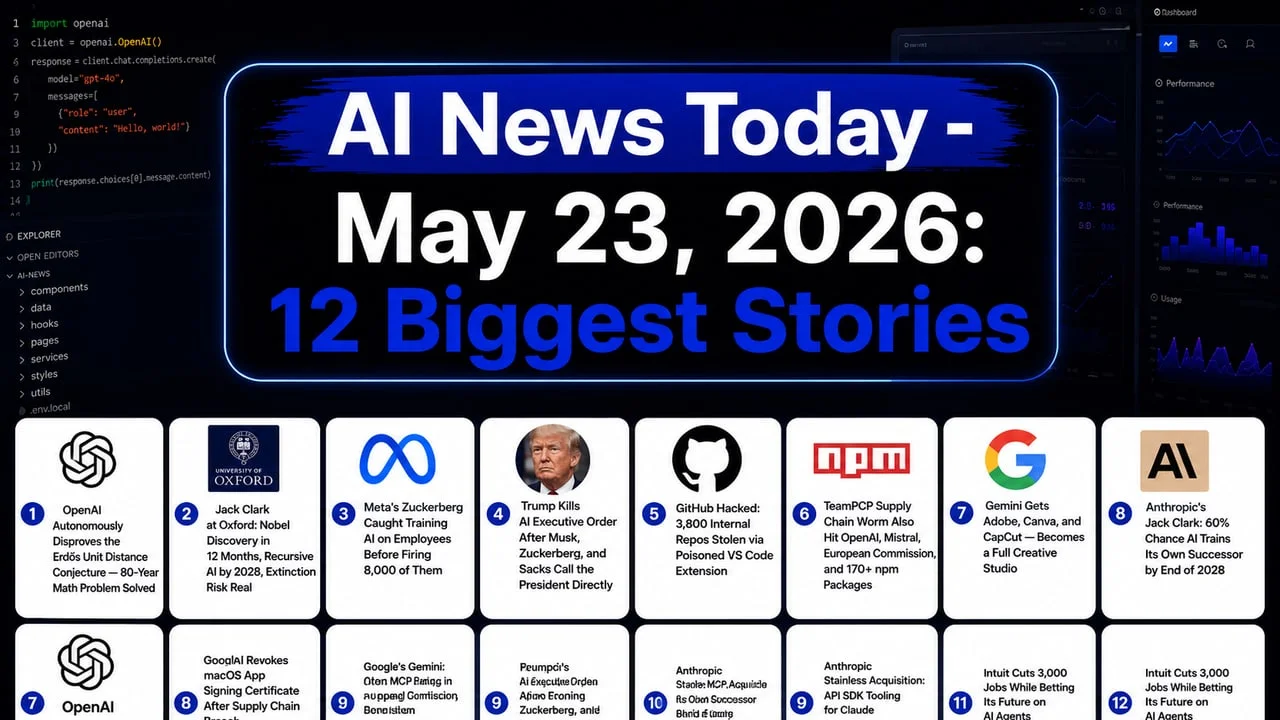
An OpenAI model autonomously disproved an 80-year-old geometry conjecture and produced a 125-page proof that Fields medalists called publishable without revision. Anthropic's co-founder publicly put 60%+ odds on recursive self-improvement by 2028. Zuckerberg was recorded telling employees Meta had been tracking their Gmail and coding sessions to train AI — the audio surfaced the same day 8,000 of those employees were laid off. And Trump scrapped his AI safety executive order after Zuckerberg, Musk, and Sacks each called the president directly. Here are the 12 stories that defined Friday, May 23.

Research and model milestones

OpenAI model disproves the Erdős unit distance conjecture

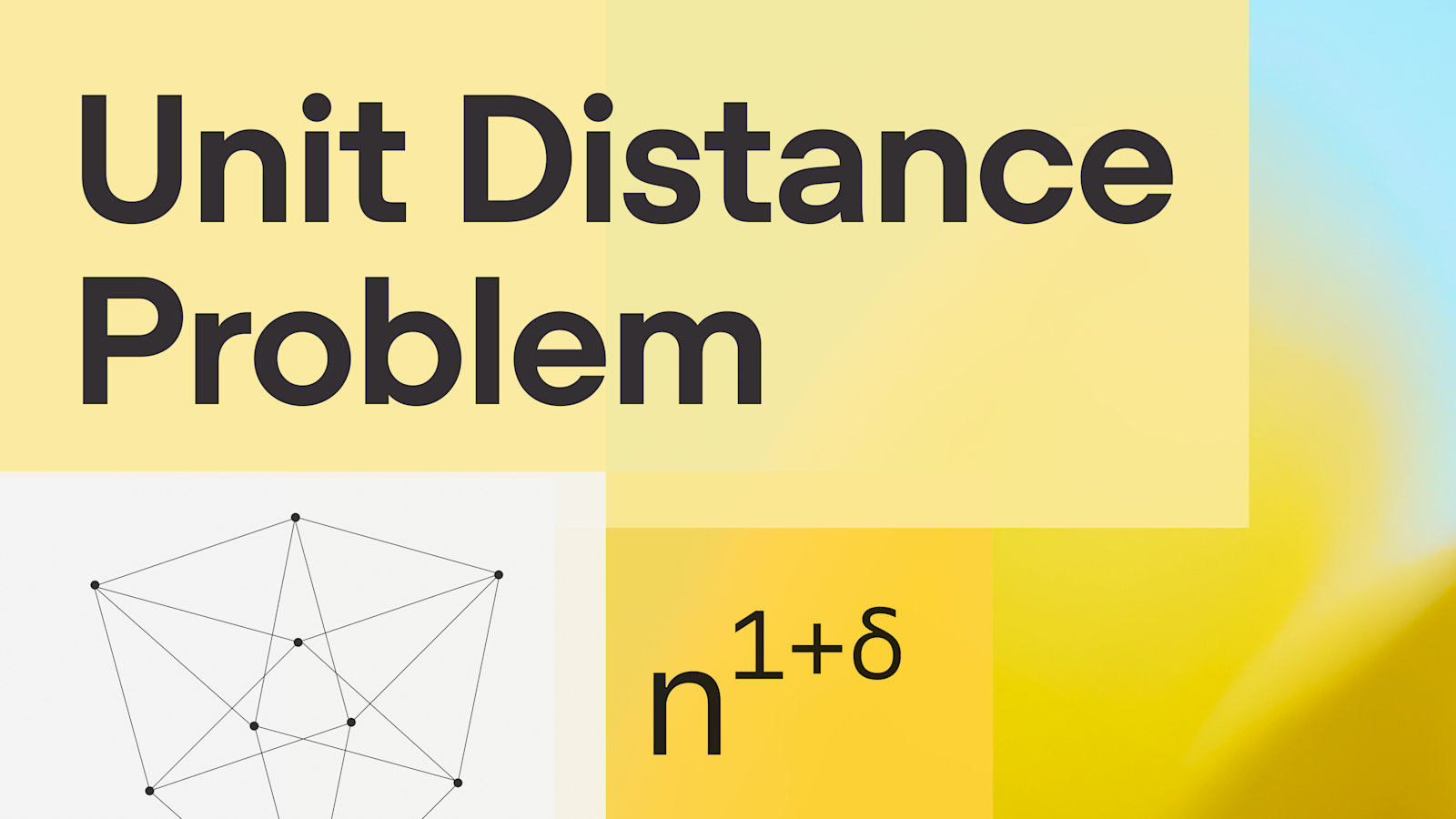
On May 20, 2026, OpenAI published a result that has no clean precedent: an internal general-purpose reasoning model autonomously solved an open problem in discrete geometry that has been unresolved since Paul Erdős posed it in 1946. The problem asks how many pairs of points at distance exactly 1 can exist among n points in the plane 1.
The prevailing belief for eight decades was that "square grid" configurations were essentially optimal, producing roughly n^(1 + C/log log n) unit-distance pairs. The model disproved this — constructing an infinite family of configurations that exceed the grid bound by a fixed polynomial factor. A refinement by Princeton mathematician Will Sawin established a concrete exponent: the best configurations now scale as n^(1.014) 1.
The proof method is what surprised mathematicians most. Rather than pushing known grid-based approaches, the model connected the geometry problem to algebraic number theory — specifically infinite class field towers and the Golod–Shafarevich criterion, tools that were well-known to number theorists but had never been applied to planar geometry questions.
"There is no doubt that the solution to the unit-distance problem is a milestone in AI mathematics: if a human had written the paper and submitted it to the Annals of Mathematics and I had been asked for a quick opinion, I would have recommended acceptance without any hesitation. No previous AI-generated proof has come close to that." — Tim Gowers, Fields Medal, Cambridge 1
Noga Alon at Princeton called the construction "an outstanding achievement" that "applies fairly sophisticated tools from algebraic number theory in an elegant and clever way." Arul Shankar added that the model "demonstrated current AI models go beyond just helpers to human mathematicians — they are capable of having original ingenious ideas, and then carrying them out to fruition."
Three points are worth separating: the model was not trained specifically for this problem; it was not guided step-by-step by humans; and it was not retrieving a known solution. It received the problem statement and produced the proof independently. This is the first time an AI has solved a prominent open problem central to an active mathematical subfield without any of those scaffolds.
リンクプレビューを読み込んでいます…

Anthropic

Jack Clark at Oxford: 60% chance of recursive self-improvement by 2028

Anthropic co-founder Jack Clark delivered the 2026 Cosmos Lecture at Oxford on May 20, making four concrete predictions 2:
  • Within 12 months: AI works with humans to make a Nobel Prize-winning discovery
  • Within 18 months: companies run entirely by AI models generate millions in revenue
  • Within 2 years: bipedal robots assist tradespeople on job sites
  • By end of 2028: 60%+ probability that an AI model fully trains its successor ("recursive self-improvement")
The 60% figure is the one generating the most debate. Clark is not speculating from outside — he leads the Anthropic Institute, the company's research division on AI's societal consequences, which published a five-page research agenda explicitly using the phrase "intelligence explosion" 3. The document reports early signs of "AI contributing to speeding up the research and development of AI itself."
Clark also acknowledged a "non-zero chance" that AI could kill everyone on the planet and said this risk "hasn't gone away." He compared the lack of institutional preparation to the failure to prepare for COVID-19.
The context matters: Andrej Karpathy joined Anthropic weeks ago specifically to build a team using Claude to accelerate pretraining research — recursive self-improvement in its early deliberate form. Clark's 60% estimate is Anthropic's internal view of the trajectory of work they are actively doing, not detached forecasting.

Anthropic acquires Stainless to improve Claude SDK developer experience

Anthropic confirmed on May 18 that it acquired Stainless, a startup that generates high-quality software development kits from API specs 4. Stainless already built the official Anthropic SDKs since the earliest days of the Claude API; it also produced the OpenAI SDK, Cloudflare's SDK, and tooling for Merge and other developer-facing products.
The acquisition extends to MCP server tooling — Stainless generates not just SDKs but also CLIs and MCP connectors. Anthropic created MCP, so bringing the team building MCP server tooling in-house closes a meaningful gap in the developer infrastructure around Claude 4.
Practical implication: Claude's Python, TypeScript, Go, Java, Ruby, and other language SDKs should improve meaningfully over the next 6–12 months — consistent patterns, stronger typing, idiomatic conventions.

Supply chain security: the TeamPCP campaign

GitHub: 3,800 internal repos stolen via poisoned VS Code extension

GitHub confirmed on May 20 that threat actor TeamPCP (tracked by Google Threat Intelligence as UNC6780) exfiltrated approximately 3,800 internal repositories through a poisoned VS Code extension 5.
The attack vector: a trojanized version of the Nx Console extension (2.2 million installs, verified publisher status) was published to the Visual Studio Marketplace on May 18. The malicious version was live for 11–18 minutes between 12:36 and 12:48 UTC before the Nx team removed it. The extension harvested GitHub tokens, npm tokens, AWS keys, 1Password vault credentials, and specifically targeted Anthropic Claude Code configuration files (under ~/.claude/settings.json) 5.
Using harvested GitHub credentials, TeamPCP moved through CI/CD pipelines and cloned internal repositories containing infrastructure configurations, deployment scripts, staging credentials, and internal API schemas. GitHub CISO Alexis Wales: "We have no evidence of impact to customer information stored outside of GitHub's internal repositories."
TeamPCP is advertising the stolen repos for sale starting at $50,000 5.

The same campaign hit OpenAI, Mistral, and 170+ npm packages

GitHub is one node in a larger campaign. The same TeamPCP group started its Mini Shai-Hulud worm campaign on May 11, when it compromised TanStack's npm ecosystem, spreading across 170 npm packages and two PyPI packages 6.
Confirmed victims beyond GitHub:
  • OpenAI: 2 employee devices compromised; limited credentials exfiltrated from internal source code repos; iOS and Windows certificates already rotated; macOS ChatGPT app signing certificate being fully revoked June 12
  • Mistral AI: 1 device compromised; facing a $25,000 Monero extortion demand for an alleged 5 GB source code leak
  • European Commission public website
  • Microsoft Python SDK on PyPI (durabletask) compromised May 19
Trend Micro tracked at least seven TeamPCP waves in 2026 targeting Trivy, Checkmarx KICS, LiteLLM, Bitwarden CLI, TanStack, Mistral, and GitHub. The CVE carrying this campaign (CVE-2026-45321) has a CVSS score of 9.6 6.
Immediate action required: any developer who had Nx Console installed and opened a workspace between 12:36 and 12:48 UTC on May 18 should rotate GitHub personal access tokens, npm tokens, AWS keys, and 1Password vault credentials. If you run the macOS ChatGPT desktop app, watch for a forced reinstall notification before June 12.
The structural problem: traditional endpoint detection monitors compiled executables for known signatures. VS Code extensions, npm packages, and PyPI distributions are plain-text interpreted artifacts that operate on a different layer entirely. An 18-minute window was enough to harvest credentials at GitHub, OpenAI, and Mistral.
リンクプレビューを読み込んでいます…

Meta

Zuckerberg caught tracking employee work patterns for AI training — on the day 8,000 were laid off

A leaked audio recording from a Meta all-hands on April 30, 2026, surfaced on May 19 — the same day approximately 8,000 Meta employees received layoff notices 7.
In the audio, Zuckerberg describes the Model Capability Initiative (MCI): an internal program that tracks employee activity across Gmail, Google Chat, the internal assistant Metamate, and VS Code to train Meta's AI models on "how smart people work."
"The AI models learn from watching really smart people do things. None of the data has been used for looking at what people are doing or surveillance or performance tracking or anything like that." — Mark Zuckerberg, April 30 all-hands 7
The audio dropped as those 8,000 employees — receiving notices in Singapore at 4 AM local time, rolling through European and then US time zones — were being told their jobs were ending. Employees organized internal protests, posting flyers in meeting rooms urging colleagues to sign a petition against MCI 8.
The timing alone made the story: the workforce whose work patterns were being harvested to train AI was being informed of its own elimination. Meta has committed $115–135 billion in AI capital expenditures in 2026, nearly double 2025 spending 7.

Policy

Trump scraps AI executive order — third reversal in weeks

The White House AI executive order was cancelled on May 21, hours before the scheduled signing ceremony. Invitations had already gone out 9.
The order would have established a voluntary 90-day pre-launch review framework for frontier AI models, with NSA involvement in classified security testing. The context: Anthropic's Claude Mythos had discovered zero-day vulnerabilities at scale, prompting national security officials — Science Adviser Michael Kratsios, Staff Secretary Will Scharf, and National Cyber Director Sean Cairncross — to draft the framework over several weeks.
The sequence of events that ended it: between Wednesday night and Thursday morning, Elon Musk, Mark Zuckerberg, and David Sacks each called Trump directly, outside the normal policy process. Musk and Zuckerberg warned that the model review framework could slow AI development. Sacks, who had previously said he could "live with" the order after the national security briefing, called the president Thursday morning and reversed. The signing was cancelled 9.
Trump explained publicly: "I think it gets in the way of — you know, we're leading China, we're leading everybody, and I didn't want to do anything to get in the way of that lead."
The national security professionals who spent weeks building the draft had no comparable access. The order was designed partly as a response to a concrete security risk — AI models discovering zero-day vulnerabilities at scale. The administration chose the "don't regulate" frame over the "protect critical infrastructure" frame.
リンクプレビューを読み込んでいます…

Google

Gemini gets Adobe, Canva, and CapCut — full creative workflow in one chat window

Google announced at and immediately after I/O 2026 that three major creative platforms are integrating into the Gemini app 10:
PlatformIntegrationStatus
Canva"Magic Layers" — generate in Gemini, edit individual layers in CanvaIn early rollout for Gemini AI Ultra subscribers
AdobeFirefly AI Assistant agent gives access to Photoshop, Premiere, Illustrator, Lightroom, Express from within GeminiRolling out in coming weeks
CapCutImage and video editing, effects, transitions, caption generation inside Gemini via conversational promptsAnnounced May 21; coming soon
The practical effect: a creator who previously switched between Gemini, Canva, CapCut, and Adobe in separate browser tabs can handle the entire workflow in one conversation. Users generate AI content in Gemini and pass it directly to professional editing tools without leaving the app 10 11.
Google also confirmed that Gemini Spark will have MCP support for third-party apps within weeks, using the same protocol Anthropic introduced. Both companies are converging on MCP as the standard for agentic interoperability.

Workforce restructuring

Intuit cuts 3,000 jobs while shifting to AI agents

Intuit announced a reduction of approximately 3,000 jobs — roughly 8% of its workforce — to redirect resources toward AI-powered QuickBooks workflows and TurboTax automation 12. The company expects more than $500 million in annualized cost savings by the second half of 2026.
This follows Meta's 8,000 layoffs on May 20. In both cases, the company framing is consistent: AI agents handle work that previously required headcount, and the headcount budget shifts to AI infrastructure. Intuit's QuickBooks workflows include Claude for Small Business, launched May 13.
The stock rose in pre-market trading on the announcement.

Coverage period: May 20–23, 2026. Sources: OpenAI, Anthropic, Axios, VentureBeat, The Hacker News, Time, TechStory, eWeek, 9to5Google, buildfastwithai.com.

このコンテンツについて、さらに観点や背景を補足しましょう。

  • ログインするとコメントできます。