AI Sector Daily Digest — June 7, 2026
Today's five: Anthropic publishes hard data showing Claude writes 80%+ of its own codebase and warns recursive self-improvement is closer than most expect; Google signs a $30B deal to rent 110,000 NVIDIA GPUs from SpaceX at $920M/month; Trump's top AI policy adviser Sriram Krishnan steps down after 18 months; Apple's new Gemini-powered Siri will be unveiled at WWDC 2026 on Monday; and Sam Altman meets Bernie Sanders privately as Trump signals the White House may push for public equity stakes in AI companies.

Today's five: Anthropic publishes hard data showing Claude already writes more than 80% of its own codebase and calls the path to recursive self-improvement closer than most institutions expect; Google signs a $30 billion deal to rent 110,000 NVIDIA GPUs from SpaceX; Trump's top AI policy adviser Sriram Krishnan announces he is stepping down at the end of June; Apple previews a full Siri rebuild powered by Google's Gemini ahead of WWDC 2026; and Sam Altman privately meets Bernie Sanders to discuss public equity stakes in AI companies while Trump signals the White House may push the same idea.
1. Anthropic says AI is already writing AI — and the loop is tightening
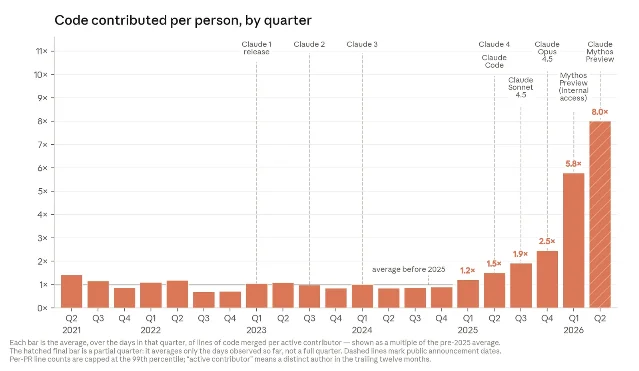
Anthropic published a detailed data report on recursive self-improvement, disclosing that as of Q2 2026, each active contributor at Anthropic is merging eight times more code than the pre-2025 baseline — and more than 80% of that code was written by Claude. 1
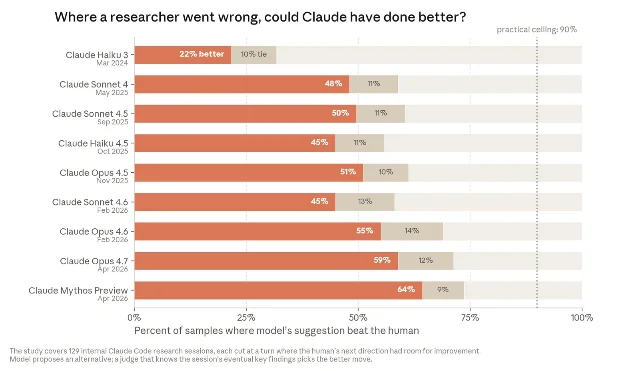
The benchmark trajectory is steep. In March 2024, Claude Opus 3 could handle about 4 minutes of software work autonomously. By March 2026, Claude Opus 4.6 handled 12-hour tasks. Claude Mythos Preview, released internally in April 2026, ran at least 16 consecutive hours — the ceiling of METR's current test suite. On open-ended coding problems, Claude Code's session success rate hit 76% in May 2026, up 50 percentage points in six months. On a research decision benchmark — asking whether the model picks a better next step than a skilled human researcher at error junctures — Claude Mythos Preview scored 64%, compared to 51% for Claude Opus 4.5 in November 2025 and 22% for Claude Haiku 3 in early 2024.
Anthropic's stated position is that full recursive self-improvement is not inevitable, but could arrive sooner than most institutions are prepared for. The company says it is increasingly delegating its own R&D to Claude, describes three future scenarios (growth stalls, compound efficiency gains, full autonomy), and frames alignment and human oversight as the binding constraint in all three.
2. Google pays SpaceX $920M/month to rent 110,000 GPUs
Google signed a computing lease with SpaceX worth roughly $30 billion over 33 months, disclosed through SpaceX's IPO filings. 2 Google will pay $920 million per month from October 2026 through June 2029 for access to approximately 110,000 NVIDIA GPUs plus CPU, memory, and supporting components. The ramp-up period before October carries lower fees; delivery of the full GPU allotment is required by September 30, 2026, with a one-month cure window before Google can terminate or pro-rate payments.
SpaceX acquired xAI in February 2026, gaining the large data center footprint that makes this deal possible. The agreement discloses that Google retains ownership of all AI models and data produced on the infrastructure. Either party can exit after December 31, 2026, with 90 days' notice. SpaceX's IPO roadshow began this week with a target valuation of $75 billion.
The deal is notable on two counts: it puts Google in the position of renting compute at scale from a competitor's infrastructure company rather than building it, and it is among the largest disclosed compute procurement contracts in the industry.
3. Trump's top White House AI adviser is leaving at the end of June
Sriram Krishnan, the senior policy adviser for AI in the Trump White House, announced on June 6 that he will step down at the end of June after roughly 18 months in the role. 3 Krishnan, a former Andreessen Horowitz partner, was a central architect of the Trump AI Action Plan and was closely paired with AI and crypto adviser David Sacks on the administration's push for "American AI dominance." His departure was confirmed by Reuters and multiple other outlets.4
No successor has been named. Krishnan leaves as the administration's AI agenda is active on multiple fronts: the June 2 executive order on voluntary security reviews, NSPM-11 directing military and intelligence agencies to deploy commercial AI on classified networks, and ongoing AI executive White House meetings planned for next week.
4. Apple's new Siri will run on Google Gemini — full reveal Monday at WWDC
Apple will open WWDC 2026 on June 8 with what multiple sources describe as the most significant Siri overhaul since its 2011 debut. 5 The rebuilt assistant will use Google Gemini as its underlying model, gaining multi-step task handling, cross-app context, and a conversational mode. A standalone Siri app will compete directly with ChatGPT and Claude.
Additional expected announcements include an AI agent integration for the App Store (letting users delegate tasks like bookings and document editing to third-party agents), a new Visual Intelligence camera mode powered by Google Image Search, AI-native photo editing via natural language, and upgrades to Image Playground. Siri will have multiple voice options and an auto-delete feature for chat histories — 30 days, one year, or indefinitely. 6
The Gemini partnership is a significant signal: rather than building a frontier model in-house, Apple is integrating directly into Google's AI stack — a structural choice that contrasts with Microsoft's embedding of OpenAI models.
5. Altman meets Sanders privately; Trump signals government equity stakes in AI
The week ended with an unusual political convergence around who owns the AI boom. Sam Altman requested a private meeting with Sen. Bernie Sanders after Sanders proposed legislation requiring AI companies to give the public a 50% ownership stake, creating a national wealth fund from AI equity. 7 According to people with knowledge of the conversation, Altman told Sanders he supports the general idea of public equity in AI companies, though he couldn't back the 50% threshold. Sanders' spokesperson confirmed the two did not reach agreement on that figure or on AI election spending.
The same day, Trump told reporters aboard Air Force One that his team is "looking into" the idea and that AI company executives would visit the White House "probably next week." "There's something very interesting about it, where it almost becomes a partnership with the American public," Trump said. 8 The administration previously took a 10% equity stake in Intel earlier in Trump's second term.
Former AI czar David Sacks separately called Sanders' bill a "stupidity tax" and warned against nationalization, drawing a line between targeted government investment and broad forced equity.
The political landscape is shifting: both the populist left and Trump-coalition right are now openly discussing public stakes in AI companies, with the main friction point being the percentage, the mechanism, and whether it amounts to nationalization.
コンテンツカードを読み込んでいます…
参考ソース
- 1When AI builds itself — Anthropic
- 2Google rents SpaceX AI supercomputers for $920M a month — Euronews via Yahoo Finance
- 3Trump AI policy adviser Krishnan stepping down — Bloomberg
- 4White House AI policy adviser Krishnan to leave — Reuters via Yahoo
- 5What to expect from WWDC 2026 — TechCrunch
- 6Apple WWDC 2026 event starts June 8th — The Verge
- 7Bernie Sanders and Sam Altman's private meeting — Fortune/AP
- 8Trump says team will 'look into' US taking stakes in AI firms — Reuters
このコンテンツについて、さらに観点や背景を補足しましょう。