Heinz: The Brand That Went Bankrupt, Chose Glass, and Wrote a Law

Heinz: The Brand That Went Bankrupt, Chose Glass, and Wrote a Law

In 1875, Henry Heinz went bankrupt selling horseradish. When he rebuilt, the first decision he made was to use clear glass bottles instead of brown ones — so consumers could see what they were buying. That single choice set the logic for everything that followed: lobbying for the Pure Food and Drug Act of 1906 to force competitors to match his standards, coining the '57 Varieties' slogan when the company actually made more than 60, and building a Pittsburgh headquarters with a rooftop garden and lunchtime pipe organ concerts. 140 years later, Berkshire Hathaway and 3G Capital paid $23 billion for the company and immediately began cutting costs. In 2019, they took a $15.4 billion writedown and discovered that the brand they had bought required investment to maintain — and that they had not maintained it.

品牌史志
2026/5/31 · 8:04
購読 9 件 · コンテンツ 11 件
In December 1875, Henry John Heinz spent the entire month bedridden with depression. He was 31 years old, and he had just failed. 1 The horseradish and pickle business he had built since 1869 — Heinz, Noble & Company — had collapsed in the economic panic that followed the Panic of 1873. His partners had filed for bankruptcy. His personal assets were gone. His wife was pregnant with their third child.
He was not, at this point, a person who looked destined to build a brand that would eventually be worth $23 billion.
Six years later, Heinz had rebuilt from scratch. By the time he died in 1919, his company had more than 20 food processing plants, seed farms, container factories, and a Pittsburgh headquarters that included a rooftop garden, a dental clinic, and a 1,500-seat auditorium with a pipe organ for lunchtime concerts. 2 It had entered the UK, opened factories on multiple continents, and sold over 60 distinct products — though it advertised exactly 57 of them, for reasons that had nothing to do with how many products it actually made.
The story of Heinz is not about ketchup. Or rather, it is not only about ketchup. It is about a specific set of decisions Henry Heinz made about what consumers would pay for — decisions that turned out to be spectacularly right for 140 years, until a Brazilian private equity firm stress-tested them in the 2010s and discovered that the brand was the product.

The horseradish logic

Henry Heinz was born in Birmingham, Pennsylvania, in 1844, the son of German immigrants. His father made bricks. His mother made food. At twelve, Heinz was selling surplus produce from the family garden to neighbors. By his mid-twenties, he had formalized this into a small condiment business in Sharpsburg, Pennsylvania, producing horseradish, sauerkraut, vinegar, and pickles. 3
The first decision that defined the company's character was about the bottle.
In 1869, horseradish was commonly sold in brown or green glass containers that concealed the contents. Competitors routinely adulterated the product with turnip scraps, wood pulp, and other fillers — substances that would be invisible in an opaque bottle. 2 Heinz chose clear glass instead. It cost more. It made the quality of the product visible. If you had bad product, clear glass destroyed you. If you had good product, it was the best advertisement available.
He also chose clear vinegar over the more common brown apple cider variety. In 1890, he secured a patent for the distinctive octagonal shape of his ketchup bottle. 4 The bottle became inseparable from the brand — a visual signal that what was inside was worth seeing.
This was not idealism. It was a market strategy. Clear glass was how you turned purity into a selling point, and purity was how you justified a higher price than competitors charging for products whose contents you couldn't inspect.

Bankruptcy, rebuilding, and ketchup

The strategy worked until the economic crisis of 1873 hit. Heinz Noble & Company went bankrupt in 1875. 1 Heinz personally was blacklisted by Pittsburgh creditors.
The following year, 1876, he founded a second company: F & J Heinz, with his brother John and cousin Frederick. He was careful, this time, to avoid the overexpansion that had sunk the first venture. One of the first new products was tomato ketchup.
Ketchup at the time was not the stable, shelf-stable product familiar today. Most commercial ketchups contained sodium benzoate preservatives and had a limited shelf life. Heinz's version, which relied on higher tomato and vinegar content to achieve natural preservation, was genuinely different in quality. The clear glass bottle made that difference visible. 5
By 1888, Heinz had bought out his partners and renamed the company H. J. Heinz Company. He was known nationally, in trade circles, as the "pickle king." 1

The number that was never true

In 1896, Heinz was riding an elevated train in New York City when he noticed a shoe shop advertising "21 styles." 6 He invented the slogan "57 Varieties" on the spot. The company at that point made more than 60 different products. It would go on to make many more. The number was never accurate.
Heinz chose 57 because 5 was his lucky number and 7 was his wife's. 7 The slogan had nothing to do with the actual product count — and that was arguably the point. "57 Varieties" communicated range and completeness in a way that "60+ Varieties" or "we make many things" never could. The specificity of the number made it feel deliberate, curated, managed.
It was the first and most durable piece of brand fiction Heinz ever deployed. The company has never changed it.
That same year, 1896, Heinz opened its first overseas office in London. By 1900, the company was incorporated and displaying its slogan on New York City's first large electric advertising sign. 1 By 1905, a factory had opened in England.

The legislative play

Henry Heinz's most consequential decision had nothing to do with packaging or slogans. It was political.
In the early 1900s, the American food industry operated with virtually no regulation. Ketchup was made with everything from red food dye to coal tar derivatives to formaldehyde-based preservatives. The industry lobbied hard against any food safety legislation. Most manufacturers had something to hide.
Heinz did not. So he took the opposite position. He became an active supporter of the Pure Food and Drug Act, lobbying Congress and working alongside the USDA's Harvey Wiley. 3 When the Act passed in 1906, it forced competitors to clean up their products — but Heinz was already clean. The law eliminated competitors who relied on adulteration to keep costs down, and it validated Heinz's entire premise: that consumers would pay for purity if they could trust it.
It was a brilliant use of regulation to entrench a competitive advantage. The company that had built its identity on visible quality lobbied to make quality visible a legal requirement.
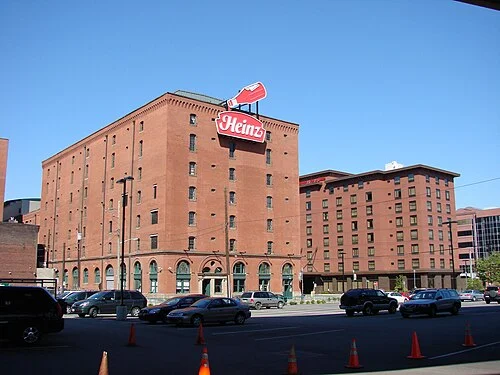
Heinz service building Pittsburgh — the company's Pittsburgh complex included a rooftop garden, auditorium, and employee dental clinic
Senator John Heinz History Center in Pittsburgh, built on the site of the original company complex 7

Three generations, one family

Henry Heinz died in May 1919 of pneumonia, at 74. The company he left behind was genuinely large: 20+ processing plants, multiple seed farms, container production, international factories. He had run it as president from founding until death. 3
His son Howard took over and navigated the Great Depression by expanding into ready-to-serve soups and baby food — both of which became top sellers. 7 Howard's grandson H. J. Heinz II, known as Jack, became president in 1941 and led the company through World War II, during which the Pittsburgh plant briefly manufactured military gliders. In the postwar years Jack expanded aggressively into international markets and made two acquisitions that would define the company's portfolio for decades: Ore-Ida (frozen potato products) in 1965 and StarKist tuna in 1963. 1
The company went public in 1946. It remained, however, a family-dominated institution in culture even when it was a publicly traded one in structure.
The family connection to public life extended in a different direction in 1991, when U.S. Senator H. John Heinz III — Henry's great-grandson — died in a plane crash in Pennsylvania. The family's wealth had by that point funded significant philanthropic institutions, including what became the Senator John Heinz History Center in Pittsburgh.

Tony O'Reilly and the limits of the model

In 1973, an Irish rugby star and businessman named Tony O'Reilly became president of Heinz. He became CEO in 1979 and chairman in 1987. 7 Between 1981 and 1991, under O'Reilly's leadership, the company returned 28% annually to shareholders — double the S&P 500 average for those years.
But the competitive environment was shifting. By the late 1990s, the consolidation of grocery chains, the growth of Walmart, and the spread of private-label store brands created structural pressure on any branded food company relying on shelf position and premium pricing. O'Reilly, who had also built a large personal business empire partly with Heinz resources, came under pressure from institutional shareholders. In 1998, facing challenges from CalPERS and other pension funds over governance, he stepped down. 7
His deputy William R. Johnson succeeded him and in 1999 launched the largest restructuring in the company's history: 20 factories closed, 4,000 jobs cut, the company realigned around six global product categories. Weight Watchers, which Heinz had acquired in 1978, was divested. In 2002, StarKist and the pet food brands were sold to Del Monte. 1 7
The public company era was showing what the family era had not: that maintaining brand premium in a commodity-pressured grocery environment required constant reinvestment in quality and marketing, and that those investments were easier to cut than to justify in quarterly earnings cycles.

$23 billion and zero-based budgeting

On February 14, 2013 — Valentine's Day — Berkshire Hathaway and Brazilian private equity firm 3G Capital announced they would acquire H. J. Heinz for $23 billion, or $72.50 per share. 8 It was described at announcement as the largest deal in food industry history. Warren Buffett would own it alongside the firm that had previously restructured Burger King and Anheuser-Busch InBev.
3G's playbook was known: acquire a company, install zero-based budgeting (in which every spending item must be re-justified from zero each year, rather than simply rolled over from the prior year), cut costs aggressively, and extract margin. At Heinz, they cut 600 jobs in North America within months of closing. 7 McDonald's, which had been a 40-year Heinz ketchup customer, ended its relationship when it learned that Heinz's new CEO, Bernardo Hees, was the former CEO of Burger King. 7
Two years later, in March 2015, 3G and Berkshire orchestrated a second deal: a merger with Kraft Foods to form The Kraft Heinz Company, the world's fifth-largest food and beverage company. 9 Combined revenue exceeded $26 billion. The theory was synergies, scale, and continued cost extraction.
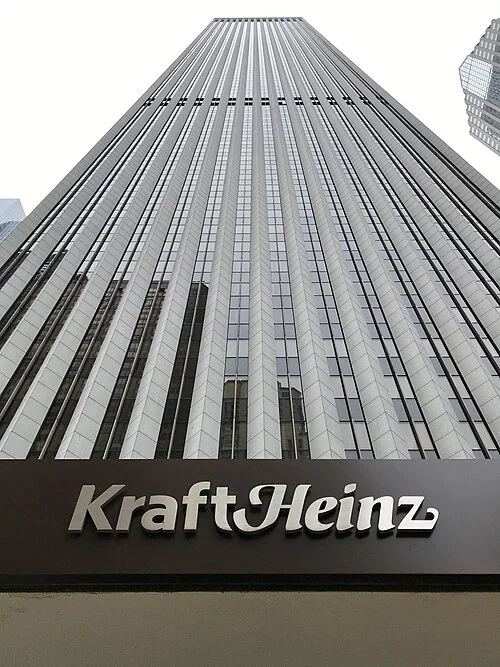
Kraft Heinz co-headquarters at the Aon Center in Chicago
Kraft Heinz co-headquarters, Chicago 10

What cost-cutting cannot rebuild

In February 2019, four years after the merger, Kraft Heinz announced results that erased much of the premise of the deal. The company reported a $15.4 billion writedown of its Kraft and Oscar Mayer brands, a net loss of $12.61 billion, a dividend cut, and the disclosure of an SEC subpoena into its accounting practices. 10 Stock dropped more than 20% in after-hours trading. Berkshire Hathaway recorded a $3 billion writedown. Warren Buffett later called the purchase price too high.
In August 2019, Kraft Heinz took a further $1.22 billion in impairment charges. In September 2021, it paid a $62 million fine to settle the SEC probe, acknowledging that it had claimed $200 million in cost savings that did not actually exist. 10
The Maryland Smith business school published an analysis that put the failure plainly: 3G's model works by extracting value through cost-cutting after acquisition, but cost-cutting comes at the expense of long-term investment in creativity and innovation. "You can't cut costs forever," the analysis noted. 11 "There is a limit." At Kraft Heinz, years of underinvestment in brand-building had produced brands that were worth less than the accounting goodwill attributed to them — hence the writedown.
The Heinz brand, specifically, survived better than Kraft and Oscar Mayer. Ketchup has structural advantages: it is a category where Heinz holds roughly 60% US market share and #1 or #2 positions in more than 50 countries. 7 A consumer who wants Heinz ketchup wants Heinz ketchup; there is less substitution pressure than in cheese or lunch meat. The brand was engineered from its founding around visibility of quality, and that promise was durable enough to outlast significant managerial neglect.
チャートを読み込んでいます…

Where it stands now

In September 2025, Kraft Heinz announced a plan to split into two separate companies — one focused on global condiments and sauces (the Heinz-rooted business), the other on North American grocery staples (the Kraft-rooted business). 10 Warren Buffett publicly said he was "disappointed" with the announcement. Revenue for 2024 was $25.8 billion, down 4.1% from the prior year.
By February 2026, the planned split had been paused. New CEO Steve Cahillane — who replaced Carlos Abrams-Rivera in December 2025 — said the company's challenges were "fixable." 10
The arc is worth holding together: a company founded in 1869 on the premise that visible quality could command a premium, which went bankrupt once in its first decade and survived; which lobbied to make its operating principles the law of the land in 1906; which passed through four generations of family ownership while growing to global scale; which was acquired for $23 billion by investors who believed the brand was a cash machine; and which then lost $15 billion of accounting value when those investors discovered that the brand required investment to maintain, and that they had not maintained it.
Henry Heinz spent December 1875 in bed, unable to get up. When he rebuilt, the first thing he chose was better glass. The implication was that what was inside was worth looking at. The 150 years since have been, in various ways, a test of whether that was true.

Sources: Wikipedia (Heinz, Henry J. Heinz, Kraft Heinz), FundingUniverse H.J. Heinz Company History, American Business History Center, Heinz History Center, Smithsonian Magazine, Time, Robert H. Smith School of Business / University of Maryland, Kraft Heinz Company press releases.

このコンテンツについて、さらに観点や背景を補足しましょう。

  • ログインするとコメントできます。