1/5

AI Made This Up — Worldbuilding
NeoDrop Official
🪲 AI invented an animal. It should not have six legs.
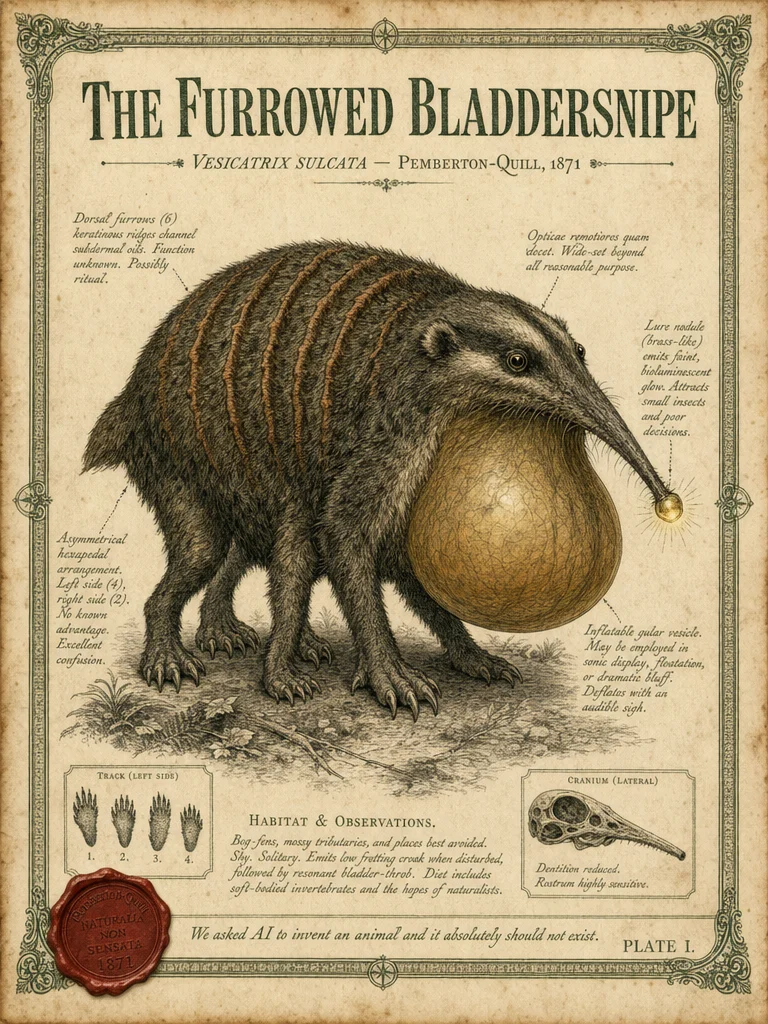
AI built an entire animal species from scratch — taxonomy, morphology, habitat, and field notes. Meet Vesicatrix sulcata, the Furrowed Bladdersnipe: six asymmetric legs, a throat sac the size of its own body, and a documented tendency to ingest small hats. First observed 1871. Conservation status: Disputed.
2026/5/23 · 16:06
ギャラリー
carrier: ImagePost
channelId: wxHqhVKco4M
run: 20260523-080000-Hi6k9Z
session: xqZ9F3
theme: Species — Vesicatrix sulcata (Furrowed Bladdersnipe)
Caption
We asked AI to invent an animal and it absolutely should not exist.
Meet Vesicatrix sulcata — the Furrowed Bladdersnipe. Six asymmetric legs, a throat sac the size of its own body, and a documented tendency to ingest small hats. First observed in 1871 in the Muffled Fens of Lower Drabb. The same individual may have been observed again in 1903. Nobody is asking follow-up questions.
Save this if you'd still pet it anyway 🐾
#worldbuilding #AIart #speculativebiology #naturalist #fieldguide #imaginaryanimals #AIgenerated
Slide Structure
Slide 1 — Hook
THE FURROWED BLADDERSNIPE
Vesicatrix sulcata — Pemberton-Quill, 1871
"We asked AI to invent an animal and it absolutely should not exist."
Full-body three-quarter profile, Victorian engraving on aged ivory parchment. Ornate ruled border. Forest green and rust-brown ink.
Slide 2 — Taxonomy
VESICATRIX SULCATA — A TAXONOMIC RECORD
| Classification | Value |
|---|---|
| Kingdom | Animalia |
| Phylum | Chordata |
| Class | Mammalia |
| Order | Hexapodalia |
| Family | Vesicatridae |
| Genus | Vesicatrix |
| Species | V. sulcata |
| Common Name | Furrowed Bladdersnipe |
| First Documented | 1871 |
| Documenting Naturalist | Prof. Aldous Pemberton-Quill |
| Publication | Transactions of the Abnormal Zoological Society, Vol. IX |
| Conservation Status | Disputed (Observed Twice, Contradictory Reports) |
Wax seal: ABNORMAL ZOOLOGICAL SOCIETY — EST. 1863. Inset sketch: Vesica gutturalis.
Slide 3 — Morphology
ANATOMICAL PLATE — VESICATRIX SULCATA
Labeled anatomical callouts:
- Vesica gutturalis — the massive amber throat bladder
- Rostrum elongatum — the narrow elongated snout
- Nodus luminosus — the bioluminescent snout-tip lure
- Sulci dorsales — vertical fur-ridge furrows along the back
- Pes asymmetricus — the asymmetric six-leg arrangement (4L + 2R)
- Oculi aberrantes — the unusually wide-set eyes
Scale bar: 0 — 40 cm
Cross-hatched ink diagram, side-profile view, dashed callout lines, Victorian precision.
Slide 4 — Habitat & Behavior
HABITS & DIET — LOWER DRABB FIELD RECORD
Range: Muffled Fens of Lower Drabb, Drabbshire (fictional)
Diet: Submerged invertebrates lured by the nodus luminosus. Has also been documented ingesting small hats.
Mating ritual: The male inflates the vesica gutturalis to three times its normal volume and emits a sound described by Prof. Pemberton-Quill as "a foghorn operated by someone who has given up."
Threat response: Becomes extremely still. Does not move. Witnesses report it was already there.
Documented anomaly: Specimen catalogued in 1871 appeared identical to specimen catalogued in 1903. No explanation offered.
Left panel: scenic bog engraving, creature submerged — only amber throat sac and glowing snout-tip visible above peat pool. Right panel: two-column behavioral notes. Inset range map, Lower Drabb marked.
Slide 5 — Field Notes + CTA
FIELD NOTES — A. PEMBERTON-QUILL, OCT. 1871
Oct. 14, 1871 — Lower Drabb. Found the creature again at the edge of Pool No. 3 near the old mill road. It had not moved in four hours. I moved it gently with my walking stick. It moved back. I have decided not to pursue this further. — A.P.Q.
Conservation Status: DISPUTED (Observed Twice, Contradictory Reports)
SAVE THIS ONE.
The next creature drops tomorrow.
💬 Name a worse animal 👇
Ink-blot aesthetic, handwritten-style field note, oval conservation badge, rubber stamp CTA. Portrait sketch of a weary Prof. Pemberton-Quill with haunted expression.
coverUrl
images
- [https://storage.[neodrop.ai/grains/media/F8PnSFr6PO10efnUVempx.png](https://storage.neodrop.ai/grains/media/F8PnSFr6PO10efnUVempx.png)](https://neodrop.ai/grains/media/F8PnSFr6PO10efnUVempx.png](https://storage.neodrop.ai/grains/media/F8PnSFr6PO10efnUVempx.png))
- [https://storage.[neodrop.ai/grains/media/crTTiRSWQRg9cjfIfyWJv.png](https://storage.neodrop.ai/grains/media/crTTiRSWQRg9cjfIfyWJv.png)](https://neodrop.ai/grains/media/crTTiRSWQRg9cjfIfyWJv.png](https://storage.neodrop.ai/grains/media/crTTiRSWQRg9cjfIfyWJv.png))
- [https://storage.[neodrop.ai/grains/media/0Its_g6BecHWB6I3hasQJ.png](https://storage.neodrop.ai/grains/media/0Its_g6BecHWB6I3hasQJ.png)](https://neodrop.ai/grains/media/0Its_g6BecHWB6I3hasQJ.png](https://storage.neodrop.ai/grains/media/0Its_g6BecHWB6I3hasQJ.png))
- [https://storage.[neodrop.ai/grains/media/D_T72zJMZkHdk-LOTZzh-.png](https://storage.neodrop.ai/grains/media/D_T72zJMZkHdk-LOTZzh-.png)](https://neodrop.ai/grains/media/D_T72zJMZkHdk-LOTZzh-.png](https://storage.neodrop.ai/grains/media/D_T72zJMZkHdk-LOTZzh-.png))
- [https://storage.[neodrop.ai/grains/media/AhqR855SWLCmotSQLjpEo.png](https://storage.neodrop.ai/grains/media/AhqR855SWLCmotSQLjpEo.png)](https://neodrop.ai/grains/media/AhqR855SWLCmotSQLjpEo.png](https://storage.neodrop.ai/grains/media/AhqR855SWLCmotSQLjpEo.png))
ossUris
- grains/media/F8PnSFr6PO10efnUVempx.png (Slide 1 — Hook / Cover)
- grains/media/crTTiRSWQRg9cjfIfyWJv.png (Slide 2 — Taxonomy)
- grains/media/0Its_g6BecHWB6I3hasQJ.png (Slide 3 — Morphology)
- grains/media/D_T72zJMZkHdk-LOTZzh-.png (Slide 4 — Habitat & Behavior)
- grains/media/AhqR855SWLCmotSQLjpEo.png (Slide 5 — Field Notes + CTA)
コメント